Best Prosumer Espresso Machines for Serious Home Baristas
You’ll pull consistent, café-quality shots with prosumer machines like the Diletta Bello, Gaggia Classic Evo Pro, or Rancilio Silvia series. They offer 58mm portafilters, E61 group heads, and PID control for precision. Dual boilers in the Silvia Pro X or Diletta Alto let you brew and steam simultaneously. If speed matters, the Breville Barista Pro heats in seconds. Manual control means you handle grind, dose, and timing-skill matters. There’s a clear path to better espresso once you know the options.
We are supported by our audience. When you purchase through links on our site, we may earn an affiliate commission, at no extra cost for you. Learn more. Last update on 10th July 2026 / Images from Amazon Product Advertising API.
Notable Insights
- Durable stainless steel builds and commercial-grade components ensure longevity and professional performance for home use.
- E61 group heads and 58mm portafilters provide temperature stability and optimal extraction for high-quality espresso.
- Dual boiler or heat exchange systems enable simultaneous brewing and steaming, enhancing efficiency and workflow.
- PID temperature control offers precise water temperature management for consistent shot quality and flavor development.
- Commercial-style steam wands allow skilled milk texturing, supporting microfoam creation for latte art and specialty drinks.
Diletta Bello Espresso Machine (Stainless Steel)

If you’re a home barista who wants café-quality espresso without stepping into commercial territory, the Diletta Bello Espresso Machine (Stainless Steel) is built for you. I use its 3L insulated boiler daily-it handles back-to-back shots and steaming thanks to the heat exchange system. The E61 group gives pro-level temperature stability, and the stainless steel build feels solid at 50 pounds. I like the manual controls; they let me fine-tune every shot. It’s not dishwasher safe, so I clean carefully. At 120 volts, it fits standard outlets but needs dedicated space-mine sits on a dedicated counter. If you want Italian craftsmanship and real control, this machine delivers-just know it’s built for focus, not speed.
Best For: Home baristas seeking café-quality espresso with precise control and authentic Italian craftsmanship in a compact, semi-automatic machine.
Pros:
- Durable stainless steel construction with a 3L insulated boiler for consistent temperature and back-to-back brewing
- Heat exchange system and E61 group head enable simultaneous brewing and steaming with professional-level performance
- Manual controls and eco mode provide full customization and energy efficiency
Cons:
- Heavy at 50 pounds and requires dedicated counter space and a stable setup
- Not dishwasher safe, requiring careful hand cleaning for maintenance
- Only compatible with ground coffee and lacks built-in grinder or automated features for convenience
Gaggia RI9380/51 Classic Evo Pro Espresso Machine, Industrial Grey, Small

Who wouldn’t want commercial-grade build quality in a compact machine that fits on a home counter? I’ve used the Gaggia RI9380/51 Classic Evo Pro, and it delivers 9-bar espresso with a durable 58mm portafilter and three-way valve for quick cleanup. Made in Italy, its steel housing and updated boiler resist wear and scale. It’s semi-automatic, so you control the brew time, and it works with ground coffee or ESE pods. The steam wand textures milk well for lattes. At under 10 inches wide, it saves space but isn’t dishwasher safe. I replace the water filter regularly to keep performance consistent.
Best For: Home baristas seeking commercial-grade build quality and authentic espresso performance in a compact, semi-automatic machine.
Pros:
- Durable stainless steel construction with a 58mm portafilter and three-way solenoid valve for professional results and quick cleanup
- Compact design fits easily on small countertops while delivering 9-bar pressure espresso and excellent milk frothing with a commercial steam wand
- Versatile brewing options with support for ground coffee, pressurized baskets, and ESE pods, plus an updated scale-resistant boiler for longevity
Cons:
- Not dishwasher safe, requiring careful hand cleaning to maintain performance and appearance
- Requires regular water filter changes to prevent scale buildup and ensure consistent operation
- Semi-automatic operation may be less convenient for users who prefer fully automated espresso machines
Rancilio Silvia Espresso Machine w/ PID Installed,67 ounce, Black

The Rancilio Silvia with PID is built for home baristas who want consistent, café-quality espresso without stepping into commercial territory. I rely on its digital PID controller for precise temperature control, which improves shot consistency and reduces brew-time fluctuations. The 58mm commercial-grade group head and brass boiler hold heat well, and the 3-way solenoid valve releases pressure cleanly, giving me dry pucks and easier maintenance. Its programmable pre-infusion and built-in shot timer let me fine-tune extractions with real feedback. While it’s heavy and not dishwasher-safe, the included tools and steam wand make it a complete package for serious espresso at home.
Best For: Home baristas seeking precise temperature control and professional-grade components for consistent, high-quality espresso.
Pros:
- Digital PID controller ensures accurate temperature stability and improved shot consistency
- Commercial-grade 58mm group head and solid brass boiler provide excellent heat retention and durability
- Programmable pre-infusion and built-in shot timer allow for precise extraction customization
Cons:
- Heavy at 50 pounds, making it difficult to move or reposition
- Not dishwasher safe, requiring manual cleaning of components
- Higher price point may be a barrier for casual users or beginners
Rancilio Silvia Pro X Espresso Machine, Pink

You’ll want the Rancilio Silvia Pro X in pink if you’re serious about pulling consistent, café-quality shots at home without stepping into commercial territory. I use its dual PID controllers to fine-tune brew and steam temps with precision. The dual boiler setup means I can pull shots while steaming milk-no waiting. Its digital display shows real-time temperature and acts as a shot timer, and I’ve found the soft preinfusion improves extraction. I program the Auto On to warm up before I wake. At 55 pounds, it’s heavy but solid, and the included water filter helps maintain performance. It’s ideal for daily use, especially if you value control and reliability.
Best For: Home baristas who want professional-grade espresso control and consistency with the convenience of dual boilers and programmable features.
Pros:
- Dual PID controllers and dual boilers enable precise temperature control and simultaneous brewing and steaming
- Programmable Auto On and shot timing enhance convenience and consistency for daily use
- Includes a water filter, backflushing tools, and a comprehensive accessory kit for easy maintenance
Cons:
- Heavy at 55 pounds, making it difficult to move or reposition
- 15-minute warm-up time is longer than some competing models
- Higher price point may be prohibitive for casual espresso drinkers
Diletta Bello+ Espresso Machine (Black)
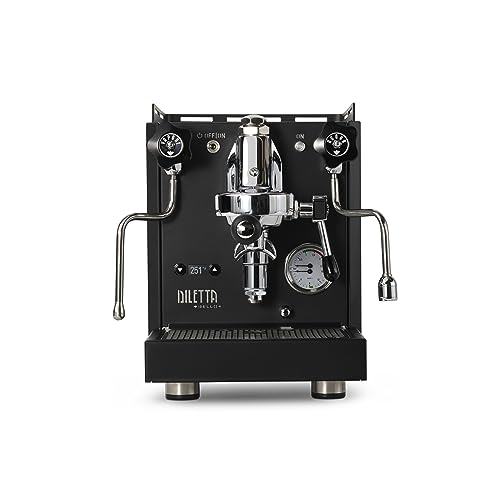
A prosumer espresso machine like the Diletta Bello+ (Black) fits best for home baristas who want professional-grade control without commercial complexity. I use its E61 group head and heat exchanger to brew and steam at the same time, just like in cafes. The PID lets me adjust and see boiler temps, and preinfusion up to 10 seconds improves shot consistency. I appreciate the manual controls-they help me refine my timing and technique. Its stainless steel build feels solid, and the deeper drip tray cuts down mess. At 51.9 pounds, it’s heavy but stable. It’s built for home use, not high-volume pulling, but for daily espresso, lattes, or cappuccinos, it delivers.
Best For: Home baristas seeking professional-grade espresso control with cafe-style features in a durable, compact machine.
Pros:
- E61 group head and heat exchanger enable simultaneous brewing and steaming for efficient espresso service
- PID temperature control and programmable preinfusion enhance shot consistency and customization
- Solid stainless steel construction and deeper drip tray offer durability and improved cleanliness
Cons:
- Heavy at 51.9 pounds, making placement and movement difficult
- Manual controls may challenge beginners seeking fully automated operation
- Not designed for high-volume use, limiting suitability for busy households or commercial settings
Rocket Espresso Appartamento Nera E61

When you’re serious about pulling consistent espresso shots and steaming milk at home without the complexity of a dual boiler, the Rocket Espresso Appartamento Nera E61 stands out with its true E61 group head and heat exchange system, making it ideal for home baristas who want commercial-style performance in a compact design. I use its 1.8L boiler daily-it heats up fast and holds temperature well. The vibration pump delivers solid pressure, and the manual controls give me full command over brew and steam. It’s not dishwasher safe, but cleaning’s quick with the included tools. At 58 pounds, it’s heavy, but the small footprint fits my tight kitchen.
Best For: Home baristas seeking commercial-style espresso performance with simultaneous brew and steam in a compact, heat exchange machine.
Pros:
- True E61 group head and heat exchange boiler enable professional-quality espresso and reliable milk steaming
- Compact design fits well in small kitchens while offering a powerful 1.8L boiler and 1200-watt heating system
- Includes essential accessories like dual portafilters, baskets, tamper, and cleaning cloth for immediate use
Cons:
- Heavy at 58 pounds, making placement and movement difficult
- Manual controls require learning curve for beginners
- Not dishwasher safe, demanding hand cleaning for maintenance
Breville Barista Express Espresso Machine BES870XL, Brushed Stainless Steel

The Breville Barista Express BES870XL stands out for home baristas who want full control over their espresso without stepping up to commercial gear. I use it to grind beans directly into the portafilter with its built-in conical burr grinder, saving time and reducing mess. The PID system keeps water temperature stable, and low-pressure pre-infusion helps me pull balanced shots. It’s manual, so I control the grind, dose, and tamp, which helps me fine-tune for any bean. The included tamper and dose-trimming tool make prep easier. At under one minute from bean to espresso, it’s efficient. Plus, registering the machine gets you two free bags of specialty coffee-useful for experimenting.
Best For: Home baristas who want full control over their espresso-making process and desire an all-in-one machine with a built-in grinder for crafting café-quality coffee.
Pros:
- Integrated conical burr grinder delivers fresh grounds directly into the portafilter, streamlining the brewing process
- PID temperature control and low-pressure pre-infusion ensure consistent, balanced espresso extraction
- Comes with useful accessories like a built-in tamper and dose-trimming tool, plus two free bags of specialty coffee upon registration
Cons:
- Manual operation requires a learning curve to master grinding, tamping, and extraction techniques
- At 22.1 pounds, it’s relatively heavy and less portable than simpler machines
- Higher price point compared to basic espresso machines without integrated grinders
Diletta Alto Espresso Machine (Dual Boiler, PID)

You’ll get the most from the Diletta Alto Espresso Machine if you want precise, repeatable espresso pulls without diving into commercial-tier complexity. I rely on its dual boiler and PID control for stable temps-critical for consistent shots. The front-panel PID lets me fine-tune brew and steam temps to the degree, while the built-in shot timer helps track extraction. I appreciate the manual solenoid and pre-infusion for flavor control. Its 40-pound Italian-built frame feels solid, and the 58mm group handles standard baskets. It heats in 22 minutes, and the steam wand powers through milk fast. I’ve found it balances pro performance with home practicality better than most under $3,000.
Best For: Home baristas seeking precise, repeatable espresso with professional-grade features in a compact, Italian-built machine under $3,000.
Pros:
- Dual boiler and PID control ensure precise, stable temperature management for both brewing and steaming
- Manual solenoid valve and pre-infusion enhance flavor control and extraction quality
- Durable 40-pound build with 58mm commercial-standard grouphead and included accessories for full customization
Cons:
- 22-minute warm-up time is longer than some competing models
- No flow control for advanced water profiling, limiting fine-tuning for specialty coffee enthusiasts
- Front PID interface, while functional, may feel less intuitive compared to rotary dial or touchscreen systems
Gaggia RI9380/49 Classic Evo Pro Espresso Machine, Thunder Black, Small

A solid step up from entry-level machines, the Gaggia RI9380/49 Classic Evo Pro Espresso Machine, Thunder Black, Small-also known as the Gaggia Classic E24-fits best for home baristas ready to treat coffee making like a craft without diving into full commercial gear. I’ve used it, and its 9-bar pressure and uncoated aluminum boiler deliver consistent shots quickly, heating up in under 10 minutes. The commercial 58mm portafilter and three-way valve improve shot quality and reduce mess. It’s made in Italy, built tough with steel housing, and handles ground coffee, pods, or ESE. You’ll need to hand-clean it, but the design is self-serviceable, and it’s quiet thanks to a better-mounted pump. Comes with single, double, and pressurized baskets, plus a tamper and scoop-everything you need to start pulling real espresso at home.
Best For: Home baristas seeking a durable, prosumer-grade espresso machine that delivers consistent, café-quality espresso with manual control and authentic Italian craftsmanship.
Pros:
- Delivers 9-bar pressure and rapid heat-up time for reliable espresso extraction
- Features a commercial 58mm portafilter and three-way solenoid valve for improved crema and easier cleanup
- Made in Italy with a robust steel housing and self-serviceable design for long-term reliability
Cons:
- Requires hand cleaning as it is not dishwasher safe
- Uncoated aluminum boiler may require diligent maintenance to prevent corrosion
- No automatic milk frothing or built-in grinder, limiting convenience for beginners
Breville Barista Pro Espresso Machine BES878BSS, Brushed Stainless Steel
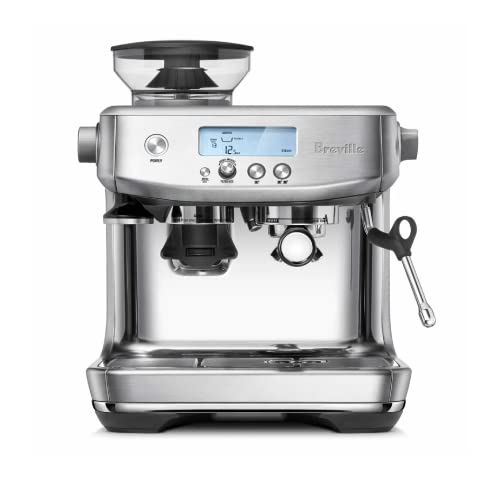
Built for home baristas who want café-quality espresso without the steep learning curve, the Breville Barista Pro BES878BSS hits the sweet spot between automated convenience and hands-on control. I use its integrated grinder to go from beans to espresso in under a minute, and the PID system keeps water temp steady within ±2°C for consistent shots. The ThermoJet heats up in 3 seconds, so I’m never waiting long. I pull precise shots using the LCD guides and dial in grind size manually. The steam wand textures milk well, though it takes practice. At 19.5 pounds, it’s solid but not too heavy. It comes with a milk jug, tamper, and dose-trimming tool-everything I need to start.
Best For: Home baristas seeking café-quality espresso with intuitive guidance and minimal wait time between brewing and steaming.
Pros:
- Integrated grinder with dose control delivers fresh grounds quickly, enabling bean-to-espresso in under a minute
- PID temperature control and ThermoJet heating system ensure precise, consistent extraction and rapid heat-up
- LCD interface and manual steam wand provide balance between automation and hands-on customization for milk texturing
Cons:
- Steam wand performance requires practice to achieve barista-level microfoam consistently
- Limited 1/2 lb bean hopper capacity necessitates frequent refilling for heavy use
- Higher price point may be a barrier for casual coffee drinkers or beginners
Factors to Consider When Choosing a Prosumer Espresso Machine
You’ll want to balance your budget and the value you’re getting, since prosumer machines range from $500 to over $2,000 with varying features. Look at build quality, boiler type, and temperature control-these affect how consistently you can pull shots, with dual boilers and PID controllers giving you more precision. And don’t overlook ease of use, especially if you’re upgrading from a basic machine, because things like intuitive controls and quick heat-up times make a real difference in daily routine.
Budget And Value
When weighing your options, price alone won’t tell you the full story-what matters is how the machine’s features match your brewing habits and long-term goals. Entry-level prosumer models start around $500, but dual boilers and PID controllers can push prices past $2,000, offering better temperature control and the ability to brew and steam at the same time. If you pull multiple shots daily, that extra power pays off. Integrated grinders add convenience and freshness but tack on several hundred dollars. Skipping one saves money but means buying a grinder separately. Look for eco-modes or auto-on functions-they cut energy use over time, adding long-term value. Machines with 58mm portafilters and three-way valves cost more, but they deliver consistent performance and are easier to maintain. Choose based on how much you’ll use it, not just the sticker price.
Build Quality
A prosumer espresso machine’s longevity and performance hinge on its build quality, and smart choices start with materials that handle heat, pressure, and daily use. You’ll want stainless steel boilers and casings-they resist corrosion and hold up over time. Look for a commercial-grade 58mm portafilter made from stainless steel or brass; it locks in heat and delivers even extractions. Machines built with solid steel or brass internal frames reduce vibration and keep everything stable during brewing. Insulated boilers aren’t just a bonus-they cut heat loss and maintain steady temperatures for consistent shots, especially during back-to-back pulls. A three-way solenoid valve helps too by releasing pressure automatically, so your puck doesn’t explode when you remove the portafilter. That makes cleanup easier and improves shot repeatability. Skip flimsy plastic parts-stick with metal components throughout. Your machine should feel heavy, solid, and built like a real tool, not a countertop decoration.
Boiler Type
While you might be tempted to prioritize外观 or size, the type of boiler in a prosumer espresso machine directly shapes how you’ll use it day to day. Single boiler models are affordable and heat up quickly, but you can’t steam and brew at the same time-you’ll need to wait between tasks. Heat exchange (HX) boilers use one boiler with a tube to separate brewing and steaming water, letting you do both one after another with a 20-minute warm-up. Dual boiler machines have separate tanks for each function, so you can brew and steam simultaneously with no delays. Stainless steel or brass boilers hold heat better than aluminum, improving stability. While PID controllers boost precision in any setup, your boiler type决定了 workflow efficiency. Choose single boiler for simplicity, HX for continuous use, or dual boiler for full control and speed.
Temperature Control
What if your espresso’s flavor hinged on a single degree? You’ll want precise temperature control. Machines with PID controllers keep brew water within ±1°C of your target, ensuring shot consistency. Dual boiler systems give you independent control over brew and steam temperatures, so you’re not choosing between a good extraction and hot milk. Heat exchange boilers let you brew and steam at once, but rely on a thermosiphon loop that can limit fine-tuning. Pre-infusion, especially with gradual pressure ramp-up, helps stabilize temperature and improves puck saturation before full pressure kicks in. Digital temperature displays let you monitor real-time boiler conditions, so you adjust based on actual data, not guesses. If you’re chasing repeatable shots, prioritize PID, pre-infusion, and clear feedback. Skip models without temperature visibility-guessing leads to inconsistency. You’ve got better things to do than chase variables you can’t control.
Ease Of Use
How much time do you really want to spend learning your machine before pulling a decent shot? You want controls that make sense right away-look for clearly labeled buttons or dials so you can manage brew and steam without confusion. If you’re using an integrated grinder, dose control and adjustable settings help you get consistent grind size fast, which means better shots with less trial and error. A digital PID system gives you real-time temp feedback and stabilizes heat automatically, so you’re not tweaking settings mid-brew. Programmable features-like pre-infusion, shot volume, and auto start-up-boost consistency and save time. Machines with rapid heat-up tech get brewing-ready in under 30 seconds, cutting wait time and streamlining your morning routine. Pick a model that works as hard as you do.
Steam Performance
If you’re pulling lattes or cappuccinos regularly, steam performance becomes just as important as brew quality. Look for heat exchange or dual boiler systems-they let you brew and steam at the same time, cutting wait times and improving your workflow. Machines with at least 9 bars of steam pressure and strong heating elements deliver fast, steady steam for smooth microfoam. A commercial-style stainless steel wand with multiple holes gives you better control and lasts longer. Bigger boilers, 2 liters or more, hold temperature during back-to-back drinks, so you’re not waiting for recovery. Wand placement matters too-position it right to create a solid vortex, which helps make milk silky and evenly textured. Skip weak wands or underpowered boilers if you’re serious about milk drinks. Models like the Profitec Pro 600 or Rocket R58 deliver the steam power and stability you need. Choose smart, and you’ll steam like a pro.
Size And Design
A prosumer espresso machine needs to fit both your space and your workflow, so check the dimensions before you commit. Most models range from 8 to 20 inches deep, 9 to 13 inches wide, and 14 to 16 inches tall-measure your counter to avoid surprises. Weighing 20 to 60 pounds, these machines aren’t easy to move, so pick a spot with solid support. Cup clearance under the group head is usually 3 to 5 inches; make sure your favorite mugs fit. Look at the drip tray depth, too-deeper trays catch more spills and reduce how often you empty them, a plus in tight spaces. Design-wise, you’ll find compact, modern, or mid-century styles in stainless steel, painted, or powder-coated finishes. Choose one that matches your kitchen’s look without sacrificing function.
Maintenance Requirements
While built to handle daily use, prosumer espresso machines demand consistent upkeep to perform reliably, so you’ll need to factor in the time and effort each model requires. If your machine has a three-way solenoid valve, you’ll backflush regularly to clear oils and maintain pressure stability. Heat exchanger and dual boiler systems need descaling every few months-more often with hard water-to protect temperature accuracy and boiler life. Always wipe and purge the steam wand after use; skipping this leads to clogs and bacteria. Clean the portafilter and group head daily, and do a detergent backflush weekly for best results. Replace or clean the water filter every 1–3 months and keep the tank fresh to reduce scale and preserve taste. Machines like the Lelit Anna or Rocket Appartamento are great, but their maintenance needs vary-choose one that fits your discipline.
Frequently Asked Questions
Can I Use Soft Water With These Machines?
You can use soft water, but you shouldn’t-it’s risky. Soft water lacks minerals, so it corrodes boiler components over time. Machines like the Lelit Anna or Rancilio Silvia need balanced mineral content to run safely. Use filtered tap water or re-mineralized water instead. Hard water causes scale, but soft water causes pitting and metal wear. Aim for medium hardness-around 50–100 ppm. It’s safer and prolongs machine life.
Do Any Models Come With a Warranty?
Yes, most prosumer espresso machines come with a warranty-typically 1 to 2 years, sometimes longer. You’ll often get 2 years on parts and labor from brands like Breville, Rocket, or Lelit. Some require product registration to activate it. Commercial-grade models may offer extended coverage. Always check the manufacturer’s policy, since water hardness, improper use, or non-approved accessories can void it. Keep your receipt and follow maintenance guidelines to stay covered.
Are Replacement Parts Easy to Find?
Yes, you’ll find replacement parts easily for most prosumer espresso machines. Brands like Breville, Rancilio, and Rocket offer strong aftermarket support. You can order gaskets, filters, or portafilters online fast. Third-party suppliers also stock common parts. Some models, like the Lelit Anna or Giotto, have widely available components. Just keep your model number handy. Less common brands might take longer. Always check parts availability before buying-saves hassle later.
Is Professional Installation Required for Dual Boilers?
You don’t need professional installation for most dual boiler machines-they’re designed for home use and plug into standard outlets. Just unbox, fill the water tank, and power up. Models like the Lelit Anna PL41TEM or Rocket Appartamento run on 120V and need no special wiring. Skip the pro install unless you’re hard-plumbing or adding a dedicated circuit, which is rare. Setup’s meant to be simple.
Can I Steam Milk While Pulling a Shot?
Yes, you can steam milk while pulling a shot if the machine has a dual boiler or a heat exchanger system. Dual boilers let you do both at once without temperature drops. Heat exchangers can manage it, but with less precision. Single-boiler models don’t allow simultaneous steaming and brewing-you’ll have to wait. For true multitasking, pick a dual boiler like the Lelit Anna or Rocket Appartamento. Always check steam recovery times and boiler sizes for best results.