Best Refractometer for Coffee That Pros and Enthusiasts Trust
You trust precision when dialing in the perfect shot, and the R2 Extract delivers with 0.01% TDS resolution, IP67 rating, and app integration for real-time brew tracking. Pros prefer it over budget models like the GOYOJO, which lacks fine resolution. While the Atago PAL-COFFEE offers lab-grade optics, it doesn’t connect to apps. For accuracy, durability, and smart features, the R2 stands out-especially in busy cafes or competitions where consistency matters most. There’s more to evaluate if you’re comparing build, range, and workflow fit.
We are supported by our audience. When you purchase through links on our site, we may earn an affiliate commission, at no extra cost for you. Learn more. Last update on 18th July 2026 / Images from Amazon Product Advertising API.
Notable Insights
- High-end models like VST LAB II and R2 Extract offer ±0.02% TDS accuracy for precise coffee extraction analysis.
- Devices with 0–32% Brix/TDS range, such as VST LAB Coffee IV, are optimized specifically for espresso and brew methods.
- Automatic Temperature Compensation (ATC) ensures reliable readings in variable environments like cafes or competitions.
- IP67-rated refractometers like R2 Extract provide durability and water resistance ideal for professional, high-moisture settings.
- Minimal sample size (0.2 ml) and app integration in models like Coffee Brewing Control System enhance usability and data tracking.
Flagfront Digital Brix Refractometer 0-55

If you’re a coffee professional or serious home brewer who values speed and precision, the Flagfront Digital Brix Refractometer 0–55 is built for people like me-those who need consistent, lab-grade sugar measurements without the fuss. I get accurate readings in about 3 seconds, and the automatic temperature compensation means I don’t have to worry about skewed results in changing environments. The stainless steel sample tank resists corrosion and wipes clean fast. It’s compact, waterproof (IP58), and works in direct sunlight thanks to anti-glare tech. I’ve used cheaper models, but this one delivers repeatable 0–55% Brix accuracy, essential for espresso and cold brew consistency. Includes test tubes, cloth, manual, and comes with solid support-1-year warranty, 24-hour help, and lifetime technical backup. It’s a reliable tool, not overpriced like some lab units, and built for daily use.
Best For: Coffee professionals and serious home brewers who need fast, accurate, and portable sugar content measurements for consistent brewing.
Pros:
- Delivers precise 0–55% Brix readings in just 3 seconds with ±0.1% accuracy
- Features automatic temperature compensation and anti-glare technology for reliable use in varying environments
- Durable, IP58 waterproof design with stainless steel sample tank and comprehensive support including lifetime technical assistance
Cons:
- Limited to a maximum 55% Brix range, which may not cover high-sugar specialty applications
- Requires a 12V battery, which is uncommon and may be inconvenient to replace
- Bulkier than some competing models, with package dimensions exceeding 12 inches in length
R2 Extract Coffee TDS Refractometer

The R2 Extract Coffee TDS Refractometer is built for baristas and serious home brewers who demand lab-grade accuracy without the lab setup. I use it daily, and it delivers precise readings from 0–30% TDS with ±0.02% precision and 0.01% resolution. It’s optimized for espresso, pour over, and cold brew, so you get consistent, reliable extraction analysis. The unit’s compact, weighs just 9.9 ounces, and has an IP67 rating-I rinse it clean without worry. It runs on a rechargeable battery, connects to an app for tracking brews, and supports multi-test modes. Compared to basic refractometers, the R2 gives pro-level data in a durable, portable form.
Best For: Baristas, coffee shop professionals, and serious home brewers seeking lab-grade TDS measurement accuracy in a portable, durable design.
Pros:
- Delivers high-precision TDS readings (±0.02% precision, 0.01% resolution) for accurate coffee extraction analysis
- Compact, IP67-rated waterproof design allows for easy cleaning and reliable use in busy environments
- App integration and multi-mode operation enable data tracking, recipe sharing, and advanced brewing insights
Cons:
- Higher price point compared to basic refractometers, potentially limiting accessibility for casual users
- Requires calibration and proper maintenance to sustain lab-grade accuracy over time
- App dependency may be a drawback for users preferring standalone device operation
3-in-1 Digital Refractometer with ATC
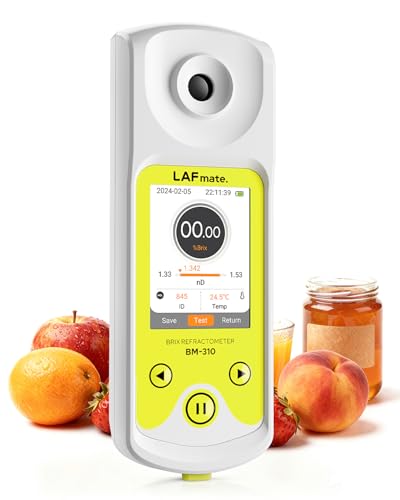
I rely on the 3-in-1 Digital Refractometer with ATC when I need fast, accurate Brix readings for coffee, especially during brewing or quality checks. It delivers readings from 0–95% Brix with ±0.2% precision and 0.05% resolution, plus refractive index data. The ATC works between 5°C–40°C, so I get reliable results without waiting. Calibration is simple-just use distilled water. The TFT backlight display stays readable in bright or dim light, and it stores up to 100 readings. It charges fast via Type-C, lasts 12 hours, and resists splashes with IP65 rating. I appreciate the included case, dropper, and 12-month support.
Best For: Coffee brewers, home winemakers, and hobbyists needing quick, precise Brix and refractive index measurements with reliable temperature compensation.
Pros:
- Delivers accurate 0–95% Brix readings with ±0.2% precision and 0.05% resolution, ideal for coffee, syrup, and brewing applications
- Built-in ATC and simple water-based calibration ensure consistent results across temperatures from 5°C–40°C
- Features a TFT backlight display, IP65 splash resistance, Type-C charging, and stores up to 100 readings for field-friendly use
Cons:
- Not waterproof-IP65 rating only protects against splashes, not submersion
- Limited to 12 hours of continuous use, which may require recharging during extended sessions
- No stated measurement range or accuracy for refractive index, limiting clarity for advanced scientific applications
Coffee Brewing Control System with TDS Refractometer & Scale
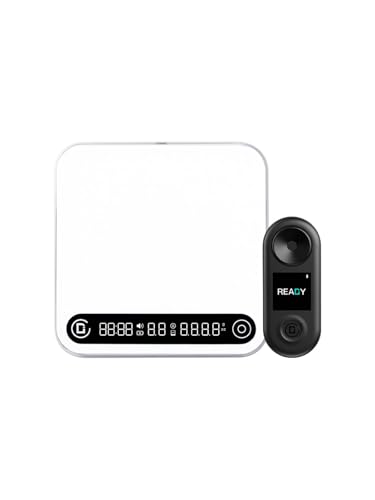
When dialing in espresso or perfecting a pour over, you need tools that deliver consistent, repeatable results-this is where the Coffee Brewing Control System with TDS refractometer and scale stands out, especially for home baristas and café technicians who prioritize precision. I use its 0.02% TDS accuracy and 0.1g scale resolution to hit the Golden Cup standard every time. The smart app tracks brewing in real time, auto-times pours, and guides flow rate. With Standard, Multi-Test, and Auto-Test modes, it handles pour over and espresso effortlessly. It’s IP67-rated, so spills aren’t a problem, and the rechargeable battery lasts through busy sessions.
Best For: Home baristas and café technicians who demand precision and consistency in espresso and pour over brewing.
Pros:
- Combines a 0.02% precision TDS refractometer and 0.1g resolution scale for accurate, Golden Cup-compliant brewing
- Smart app connectivity offers real-time tracking, automatic timing, flow rate monitoring, and guided brewing
- IP67 waterproof rating and durable design ensure reliability and easy cleanup in demanding environments
Cons:
- Higher price point may be prohibitive for casual coffee enthusiasts
- Requires calibration and maintenance for long-term accuracy
- App dependency may limit functionality without a connected smartphone
GOYOJO Digital Brix Refractometer for Liquids

You’ll want the GOYOJO Digital Brix Refractometer if you’re a coffee producer, roaster, or quality tester who needs fast, reliable sugar measurements without guesswork. I use it for coffee, but it works just as well for juices, beer, or fruits. It reads Brix from 0–55% in 3 seconds with ±0.5 accuracy. The ATC feature adjusts for temperature between 10°C and 80°C, so I don’t sweat small changes in my workspace. It needs just 3–5 drops of sample, which is perfect for limited brews. Built tough, it slips in my pocket, runs on two included AAA batteries, and shuts off automatically. I’ve had mine since it launched in 2024-still going strong.
Best For: Coffee producers, roasters, and quality testers needing fast, accurate sugar content measurements in liquids with minimal sample volume.
Pros:
- Delivers quick 3-second readings with ±0.5 Brix accuracy and automatic temperature compensation (ATC) for reliable results
- Compact, pocket-sized design with auto shut-off and included AAA batteries makes it highly portable and field-friendly
- Measures across a 0–55% Brix range using only 3–5 drops, ideal for testing small batches like coffee, juice, and beer
Cons:
- Limited to liquid samples, so not suitable for solid or viscous substances without preparation
- Battery life may be short under heavy use due to lack of rechargeable power option
- Potential for measurement drift if not regularly calibrated, especially after frequent field use
3-in-1 Digital Brix Refractometer for Honey, Juice, Coffee

The 3-in-1 Digital Brix Refractometer from LOHAND is best suited for coffee producers, brewers, and quality control enthusiasts who need fast, reliable sugar content measurements across multiple applications. I use it for coffee, honey, and juice with consistent accuracy. It measures 0–95% Brix, has a 0.1% resolution, and gives results in under 3 seconds. The ATC and IP65 rating mean it handles field and lab use well. Its touchscreen is clear and intuitive. I appreciate the included tools and lifetime support. It’s compact, durable, and battery-powered, though the prism only should be rinsed-don’t submerge it.
Best For: Coffee producers, brewers, and quality control enthusiasts who need fast, accurate sugar content measurements across honey, juice, coffee, and other liquids in both field and lab settings.
Pros:
- Measures Brix (0–95%), refractive index, and features automatic temperature compensation with 0.1% resolution and results in under 3 seconds
- Durable, IP65 waterproof rated design with a large color touchscreen and user-friendly interface suitable for beginners and professionals
- Includes essential tools like pipettes, cleaning cloth, sample bottle, and offers lifetime technical support with a 1-year warranty
Cons:
- Prism can only be rinsed with water-main body is not submersible, limiting cleaning options
- Battery life may be strained by continuous use due to auto-shutoff and lack of rechargeable power option
- Limited to sugar content and refractive index measurements, not suitable for more advanced chemical analysis
Coffee Brewing Kit with Scale & Refractometer

If you’re serious about dialing in your brew and want lab-grade accuracy in real-world conditions, the COFFMETER Brew Control System 2 is built for you. I use its TDS refractometer with 0.02% accuracy and 0.1g scale daily to track extraction precisely. Real-time flow rate, drip-activated timer, and weight tracking help me optimize pour over, espresso, and cold brew. It connects to a mobile app so I can save recipes, analyze results, and compare techniques with others. The refractometer’s IP67-rated and rechargeable, at just 1 pound and compact enough to take anywhere. I rely on it at home, in cafés, or on the road. Model B0F5QB1ZWC, launching July 2025.
Best For: Coffee enthusiasts, professional baristas, and traveling brewers seeking lab-grade precision and smart tracking for consistent, high-quality brews across pour over, espresso, and cold brew methods.
Pros:
- Includes a high-accuracy TDS refractometer (0.02%) and 0.1g digital scale for precise extraction measurement and brewing consistency.
- Features smart technology with mobile app integration for recipe storage, data analysis, and community engagement.
- Portable, durable design with IP67 waterproof rating, rechargeable battery, and compact size ideal for home, café, or travel use.
Cons:
- High level of technical precision may overwhelm casual coffee drinkers or beginners.
- Requires a mobile app for full functionality, limiting standalone usability.
- Availability starting July 2025 may delay immediate access for interested buyers.
Digital Brix Refractometer 0-35% ±0.2

Coffee professionals and detail-driven home baristas who prioritize speed, accuracy, and rugged reliability will find the Digital Brix Refractometer 0-35% ±0.2 a solid match for daily brewing demands. I use it for quick, consistent readings with coffee, juices, and other beverages. It gives results in 5 seconds, has a backlit LCD, and adjusts automatically for temperature between 10–40°C. The ±0.2% accuracy and 0.1% resolution deliver dependable data. Built to IP65 standards, it resists dust, water, and drops. My unit, the Aicevoos Q6, came with batteries and a manual-ready to go out of the box.
Best For: Coffee professionals and detail-driven home baristas who need fast, accurate, and durable Brix measurements for beverages and juices.
Pros:
- Delivers quick readings in 5 seconds with a clear backlit LCD for easy viewing
- Features automatic temperature compensation (10–40°C) and ±0.2% accuracy for reliable results
- Rugged, IP65-rated design resists dust, water, and drops, making it ideal for field or daily use
Cons:
- Limited to a 0–35% Brix range, which may not suit high-sugar applications
- Uses AAA batteries, which may need frequent replacement in heavy-use settings
- Brand (Aicevoos) may be less familiar compared to established industry names
Brix Refractometer with ATC – Dual Scale
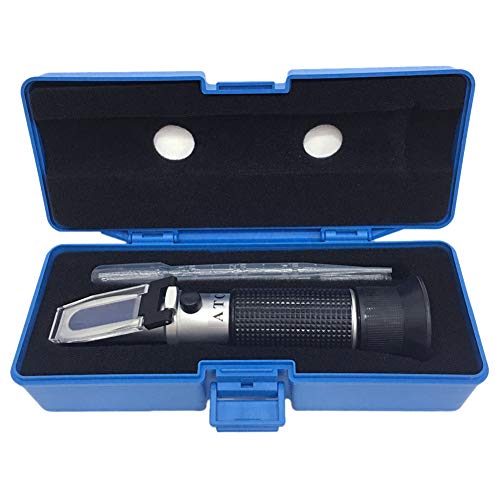
You’ll want a Brix refractometer with ATC and a dual scale if you’re serious about dialing in your brew with consistency, especially when measuring espresso shots or tracking extraction in real time. I rely on mine for quick, accurate readings between 0–32% Brix and 1.000–1.120 specific gravity. The automatic temperature compensation (ATC) means I get stable results even if my kitchen’s warm. It’s lightweight, built with chromium, and fits easily in my kit. At 3.7 ounces and just 7 inches long, it’s durable and portable. Made by Xindacheng (model COMINHKPR124469), it’s still available and ideal for coffee, brewing, or garden use.
Best For: Homebrewers, coffee enthusiasts, and gardeners seeking a portable, accurate tool for measuring sugar content and specific gravity with automatic temperature compensation.
Pros:
- Delivers quick, reliable readings with dual scale (0–32% Brix and 1.000–1.120 Specific Gravity) for versatile use
- Features Automatic Temperature Compensation (ATC) for consistent results across varying temperatures
- Compact, lightweight (3.7 oz), and durable chromium construction makes it ideal for field or lab use
Cons:
- Limited Brix range may not suit applications requiring measurements beyond 32%
- No protective case included, increasing risk of damage during transport
- May require periodic calibration for long-term accuracy, especially with heavy use
LOHAND Brix Refractometer with ATC (0-32%)

For home brewers and small-scale producers who need reliable sugar measurements without the hassle of digital upkeep, the LOHAND Brix Refractometer with ATC (0–32%) stands out as a solid, no-frills tool built for real-world use. I rely on its automatic temperature compensation to deliver consistent readings, even when my kitchen fluctuates in temperature. It only takes a few drops of liquid, making it efficient for testing coffee, juice, or syrup. Built with pure copper and chromium, it resists corrosion and wears well over time. The included case, pipette, and lifetime support make it practical. While it lacks digital precision, its durability and simplicity suit my workflow perfectly.
Best For: Home brewers, small-scale food producers, and gardening enthusiasts who need a durable, easy-to-use tool for quick and reliable sugar concentration measurements without digital complexity.
Pros:
- Durable construction with pure copper and chromium resists corrosion and ensures long-term use
- Automatic Temperature Compensation (ATC) provides accurate readings despite temperature fluctuations
- Compact, portable design with included accessories and lifetime technical support enhances usability
Cons:
- Limited to a 0–32% Brix range, making it unsuitable for high-sugar applications
- Manual readings may lack the precision of digital refractometers
- 0.2% resolution may not meet requirements for highly sensitive laboratory use
Factors to Consider When Choosing a Refractometer for Coffee
You’ll want to check the measurement range first-models like the VEE GEE Slim and the LOHAND Brix both cover 0–32%, which is ideal for most coffee extracts. Accuracy and precision matter just as much, especially if you’re comparing brews or tweaking recipes, and an auto-temperature compensation (ATC) feature keeps readings consistent even if your sample’s a bit hot or cold. Since you only need a few drops, small sample sizes make testing easy, but don’t overlook the display-backlit LCDs, like on the Escali Digital, beat dim analog scales when you’re working in low light.
Measurement Range
A refractometer’s measurement range determines how well it handles the variety of coffee brews you’ll test. You’ll want at least 0–30% Brix or TDS to cover most coffee types, from drip to cold brew concentrate. While some models go as high as 95% Brix-great for syrups-it’s overkill if you’re only measuring coffee. For espresso and pour-over, 0–12% TDS is usually enough, especially with 0.01% resolution for fine control. A too-narrow range, though, can’t track strong brews accurately, which limits flexibility. If you pull both light filter coffee and dense concentrates, a broader range gives you room to grow. Stick to tools that match your actual workflow. The VST LAB Coffee IV, for example, covers 0–32% TDS, making it a pro favorite for its balance of range and coffee-specific design. Choose smart, not just wide.
Accuracy And Precision
When tracking extraction in coffee, accuracy and precision matter most-top models deliver readings within ±0.02% TDS, while budget units may drift up to ±0.5%. You need that tight accuracy to make real adjustments in your brew. Look for a refractometer with at least 0.01% resolution so you can detect small shifts in total dissolved solids. High-end models like the VST Lab II or Atago PAL-COFFEE use precision optics and sealed, light-blocking designs to cut user error and deliver repeatable results. They read in under 3 seconds, minimizing evaporation effects during testing. Cheaper models may save money upfront but lack the consistency for serious analysis. Even with automatic temperature compensation (covered next), poor optics or slow response times hurt reliability. If you’re adjusting grind, water, or time to fine-tune flavor, your tool must reflect real changes-not instrument noise. Trust matters, but so does proof. Pick a device built for the task, not just the price.
Temperature Compensation
Since coffee extraction testing often happens in environments where temperature isn’t perfectly controlled, having a refractometer with Automatic Temperature Compensation (ATC) makes a real difference in measurement reliability. You’ll get accurate readings between 5°C and 80°C because ATC adjusts for sample temp on the fly. Without it, your results can drift as much as 0.2% Brix per 1°C away from 20°C, skewing your data. ATC eliminates constant recalibration when temps shift, which matters in busy cafes or outdoor setups. High-end models maintain ±0.1% Brix accuracy thanks to built-in ATC systems. That consistency is key when dialing in espresso or comparing brews. For reliable, real-world use-especially outside lab conditions-choosing a refractometer with ATC isn’t optional. It’s essential for trustworthy, repeatable measurements you can actually act on.
Sample Size Required
You’ll only need about 0.2 ml-roughly 3 to 5 drops-of coffee to get a reading on most quality refractometers, which is especially useful when testing espresso shots with limited yield. Models like the Atago PAL-COFFEE and VST Lab II are designed with small prism surfaces that require minimal sample volume while still delivering accurate results. A smaller sample size means you can test more shots without wasting coffee, a real benefit in busy cafes or during recipe development. Some refractometers achieve this efficiency through optimized optical systems that focus light precisely, even with tiny amounts of liquid. While most units perform well at this volume, results can vary slightly depending on how evenly you spread the sample. Make sure to follow the manufacturer’s instructions for loading to avoid errors. If you’re mostly pulling espresso, prioritize models proven to work reliably with low-volume samples.
Display Type
How easily can you read your refractometer’s display in a busy café environment? If you’re working under dim or uneven lighting, a backlit LCD display guarantees you still get clear readings. Bright TFT screens with high resolution make values easy to distinguish, reducing mistakes during fast service. For outdoor use or sunlit spaces, anti-glare technology cuts reflections so you’re not squinting at the screen. Touchscreens with color displays simplify navigation-just tap to switch modes or pull up settings. But they need careful handling, as they can be more sensitive. For quick, repeated checks, go for a large, high-contrast digital screen. It cuts eye strain and speeds up workflow. You don’t need fancy graphics-just dependable clarity. Prioritize readability under your real-world conditions.
Durability And Build
A refractometer built to last stands up to the daily grind of a busy café, not just in theory but in practice. You need one with an IP67 waterproof rating so it resists water submersion and dust-crucial near espresso machines and sinks. Look for stainless steel or industrial-grade polymer bodies; they won’t corrode from coffee oils and clean easily. A fully sealed, rugged design handles drops and rough transport without damaging internal parts. Models with reinforced prism covers and high-refractive-index lenses keep delivering accurate readings, even after months of heavy use in wet or abrasive conditions. While you want durability, don’t sacrifice portability-many top units weigh under 14 ounces, giving you long-term toughness without bulk. You’re not just buying a tool-you’re investing in consistent, reliable performance that holds up year after year.
Power Source
Where do you need your refractometer to work-behind a crowded café counter, in a remote roastery, or on the go? If you’re in a fixed location, a model with a rechargeable 750mAh lithium-ion battery, like the VST LAB pro, gives you up to 12 hours of runtime and charges quickly via USB-C. That means less downtime and more consistent readings during busy service. But if you’re mobile or lack reliable power, a device running on AAA or 12V disposable batteries might be smarter-you just swap them out. Many units include auto-off or sleep modes to save power during breaks. Consider how often you’ll use it: rechargeables are cost-efficient and eco-friendly over time, while disposables offer reliability when charging isn’t an option. Choose based on your workflow, not convenience.
App Connectivity
Once you’ve settled how your refractometer gets power, the next step is deciding whether it should connect to your phone. If you want to track TDS and Brix data over time, app connectivity makes it easy. It lets you instantly send readings to your device, log them automatically, and view trends across brews. Models like the VST Lab III sync with apps that record time, temp, and concentration without extra work. You’ll also get guided brewing modes that adjust feedback in real time. Plus, regular software updates and shared recipes from other users help refine your technique. While not essential, apps add smart tracking and analysis that manual logging just can’t match. For serious home baristas or cafés chasing consistency, that edge pays off. But if you only test occasionally, a standalone unit might suit you better. Weigh how much data you use-then choose accordingly.
Frequently Asked Questions
How Often Should I Calibrate My Coffee Refractometer?
You should calibrate your coffee refractometer before each use to guarantee accurate readings. Temperature changes, residue, and handling affect accuracy. Use distilled water or your calibration solution, and clean the prism thoroughly. Skipping calibration skews TDS and extraction results. While some skip it daily, pros don’t risk it-consistent brewing demands consistent tools. Auto-temperature models help, but they still need regular checks. Make it routine-calibrate every time.
Can I Use a Refractometer for Cold Brew Coffee?
You can use a refractometer for cold brew coffee, but you’ll need one that compensates for high sugar and oil content. Standard models may give inaccurate readings due to viscosity. Digital refractometers like the VST Lab II or Atago PAL-COFFEE handle these better. Always calibrate before use, especially with cold samples, since temperature affects accuracy. For reliable TDS (total dissolved solids) results, filter the cold brew first to reduce residue that skews readings.
Is a Refractometer Necessary for Home Coffee Brewing?
You don’t need a refractometer for home brewing-it’s not essential. Most home brewers do fine with taste, grind size, and brew time. Refractometers give precise TDS readings, which helps if you’re tweaking recipes or chasing consistency. But they’re pricey and need calibration. Unless you’re deeply into data or dialing in a specific setup, your palate’s enough. Try one if you’re curious, but don’t feel pressured-it won’t make your coffee taste better by itself.
Do Refractometers Work With Espresso and Filter Coffee?
Yes, refractometers work with both espresso and filter coffee. You measure TDS (total dissolved solids) to calculate extraction yield. For espresso, you need a low-range model like the VST LAB II or Atago PAL-COFFEE, which handle higher concentrations. Pour-overs need precision in lower ranges. Calibration matters-use distilled water and follow rinse steps. It’s not essential at home, but if you’re dialing in beans or troubleshooting, it gives concrete data most brewers can’t see otherwise.
Can Temperature Affect My Refractometer’s Readings?
Yes, temperature affects your readings. You need to let your coffee cool to the refractometer’s recommended range-usually around 20–25°C-before testing. If it’s too hot or cold, the Brix or TDS measurement shifts, giving false results. Most entry-level models, like the Atago PAL-COFFEE, don’t auto-correct for temp, so you’ve got to stabilize the sample. Pro units handle it better, but you still need consistency.