Top Coffee Roasting Airflow Controllers for Precision Roasts
You get precise control over your roasts with airflow controllers like the Aillio Bullet R1 or Nano7, both offering adjustable fan speeds, real-time temp tracking, and programmable profiles. The Bullet uses induction heating and Artisan-compatible software, while the Nano7 pairs with Kaffelogic Studio for custom tuning. Smaller units like the LUEUR or APOXCON models give manual control but lack advanced automation. Choose based on batch size, software needs, and build quality-your setup determines how repeatable your results will be. More details on top models and key features follow.
We are supported by our audience. When you purchase through links on our site, we may earn an affiliate commission, at no extra cost for you. Learn more. Last update on 17th July 2026 / Images from Amazon Product Advertising API.
Notable Insights
- Aillio Bullet R1 offers precise airflow control via touchscreen and supports programmable profiles for repeatable, precision roasts.
- Nano7 Home Roaster features adaptive PID tuning and fully programmable airflow for exact roast profile replication.
- SR800 Roaster provides nine power levels and manual fan adjustment to customize airflow for flavor precision.
- LUEUR Electric Roaster allows independent control of fan speed, heat, and timer for tailored light-to-dark roasting.
- Controllers with Artisan software compatibility enable advanced airflow automation based on real-time bean temperature tracking.
Coffee Roaster Controller

If you’re running a 500g coffee roaster and need precise control over temperature, power, and airflow, this Coffee Roaster Controller is built for your setup. I use it to fine-tune roasts with direct access to heat (via percentage), fan speed, and temp adjustments. A single press switches between Celsius and Fahrenheit, and I can start preheating or roasting with intuitive button combos. The touchscreen’s compact-just 3.9 inches long-and light at 7 ounces. Model number controller001 (ASIN: B0DLGZHSR1) supports manual or auto modes, and I adjust fan filtering by pressing both buttons together. It’s not for larger roasters, but for my 500g batch, it’s effective and straightforward.
Best For: Home coffee roasters using 500g capacity roasters who want precise, touchscreen-controlled adjustments for temperature, power, and fan settings.
Pros:
- Offers granular control over temperature, heater power (percentage-based), and fan speed for customized roast profiles
- Intuitive touchscreen interface with easy mode switching (auto/manual), preheating, and cooling via simple button combinations
- Compact and lightweight design (3.9 x 2.7 x 0.7 in, 7 oz) ideal for small-scale roasting setups
Cons:
- Limited to 500g roasters, making it unsuitable for larger batch sizes or commercial use
- Advanced features like filter settings require multi-button presses that may not be intuitive for beginners
- No included information on warranty length or direct support access in the product details
LUEUR Electric Coffee Bean Roaster (100g)
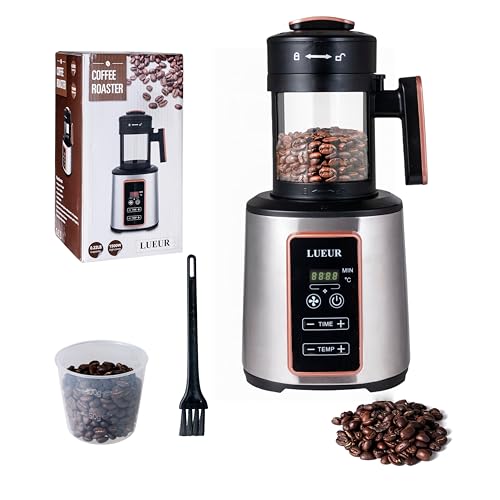
The LUEUR Electric Coffee Bean Roaster (100g) works best for home roasters who want precise control without stepping into commercial-grade complexity. I use its 1500W hot air system to roast up to 100g per batch evenly, thanks to consistent airflow and heat. The adjustable timer, variable heat, and fan speed let me tweak roast profiles-light or dark-without burning beans. A detachable chaff basket catches husks, making cleanup fast, though it’s not dishwasher safe. Its compact black design fits small spaces, and the simple interface suits beginners and enthusiasts. I plug it in via AC adapter-no special setup needed. It’s reliable, straightforward, and ready for daily use.
Best For: Home roasters seeking precise control over small-batch coffee roasting without commercial equipment complexity.
Pros:
- 1500W hot air system ensures even, efficient roasting with consistent temperature distribution
- Fully adjustable timer, heat settings, and fan speed allow customizable roast profiles from light to dark
- Detachable chaff basket simplifies cleanup and maintains a tidy workspace
Cons:
- Chaff collection basket is not dishwasher safe, requiring manual cleaning
- Limited capacity of 100g per batch may not suit larger households or frequent use
- Requires AC adapter power source, limiting portability without outlet access
Electric Coffee Bean Roaster 100g Capacity

You’ll get the most out of this electric coffee bean roaster if you’re someone who values consistency and control without needing a bulky setup. I use the 1500W heating system daily-it delivers fast, even roasting with airflow that prevents scorching. The adjustable temperature and timer let me nail light to dark roasts, bean after bean. I watch the process through the transparent lid, no guesswork needed. The 100g capacity suits my small batches, and the chaff collector snaps out clean in seconds. At just over 4 pounds, it’s light but steady on my counter. Model YOK111MIL018LS30 (ASIN: B0FLJ5DHGV) launched August 7, 2025, and comes with online warranty support.
Best For: Home coffee enthusiasts who want precise, consistent roasting with minimal cleanup and counter space.
Pros:
- 1500W heating system with hot air circulation ensures fast, even roasting without scorching
- Adjustable temperature and timer allow full control over light to dark roast profiles
- Removable chaff collector and compact design make it easy to use and clean
Cons:
- 100g capacity may be too small for larger households or frequent roasting
- Transparent lid, while useful, may retain heat and require caution during use
- Limited availability since it was first released August 7, 2025, potentially affecting stock
SR800 Coffee Roaster – Roast at Home

Though compact, the SR800 Coffee Roaster handles 6–8 oz batches, making it ideal for home users who want fresh, custom-roasted coffee without investing in large-scale equipment. I use its nine power levels and adjustable fan to tweak roasts based on bean type and desired flavor. It roasts evenly in under 10 minutes thanks to the convection fan and fluid motion system. The digital display shows real-time temperature, which helps me stay precise. I roast wet-processed, decaf, or organic beans on demand, ensuring peak freshness. Built with heat-resistant plastic and stainless steel, it’s lightweight yet durable. At 1750 watts, it’s powerful but efficient for daily use.
Best For: Home coffee enthusiasts who want full control over roasting small batches of green coffee beans with precise heat and fan settings for maximum freshness and custom flavor profiles.
Pros:
- Roasts 6–8 oz batches quickly and evenly in under 10 minutes with real-time temperature monitoring
- Offers nine power levels and adjustable convection fan for detailed roast customization
- Compact, durable design using heat-resistant plastic and stainless steel for reliable home use
Cons:
- Limited to 8 oz maximum batch size, which may not suit larger households or entertaining
- Requires separate purchase of green coffee beans, which may be less accessible to some users
- Digital display and manual controls may present a slight learning curve for absolute beginners
Exhaust Adapter for Aillio Bullet R1 R2

Anyone using an Aillio Bullet R1 or R2 who wants cleaner, more efficient exhaust management will find this exhaust adapter a practical upgrade. I’ve used it to direct smoke straight into my vent hose, and it cuts down on fumes in my roasting space. It fits snugly on the exhaust port without gaps, so there’s less leakage and better airflow control. The design is simple, but it works well-durable metal, easy to attach with basic tools, and low-profile so it doesn’t clutter my setup. It’s made by Generic (ASIN: B0FXGSCG1B, Model: DSGFD6VFD2), available starting October 23, 2025, under grill connectors.
Best For: Home roasters using the Aillio Bullet R1 or R2 who want a reliable, low-profile exhaust solution to reduce smoke dispersion and improve air quality during roasting.
Pros:
- Ensures a snug, gap-free fit on the Aillio Bullet R1/R2 exhaust port for minimal leakage
- Simple, tool-friendly installation with durable metal construction built for repeated use
- Compact design efficiently directs smoke into vent hose without cluttering workspace
Cons:
- Made by Generic brand, which may raise concerns about long-term reliability or support
- Limited availability details ahead of its October 23, 2025 release date
- May require separate purchase of vent hose or additional components for full setup
CAFEMASY Coffee Bean Roaster Machine
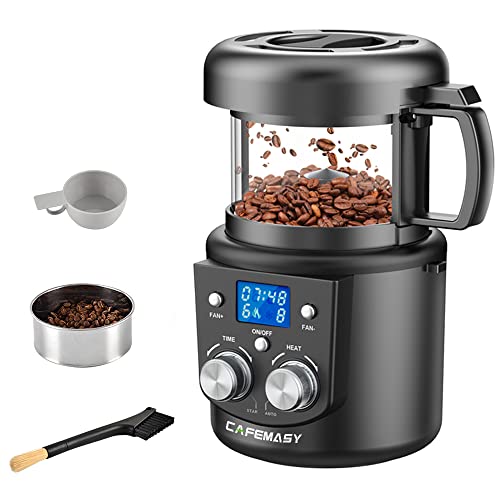
The CAFEMASY Coffee Bean Roaster Machine suits home roasters who want precise control without complex machinery. I use its manual mode to adjust heat, time, and fan power-great for dialing in batches between 80g and 100g. The LED display keeps settings clear, and the borosilicate glass chamber lets me watch color changes in real time. Its automatic cooling cycle kicks in after roasting, which I appreciate for consistency. While the plastic build feels light, the heat-resistant ABS and bakelite handle stay safe during operation. It’s compact, fits on my countertop, and the chaff basket makes cleanup easy. Not for large batches, but it’s reliable for small, repeatable roasts.
Best For: Home coffee enthusiasts who want precise, small-batch roasting with real-time visual monitoring and easy cleanup.
Pros:
- Allows full manual control over heat, time, and fan settings for customized roasting
- Transparent borosilicate glass chamber enables real-time bean color monitoring
- Compact design with chaff collection basket and automatic cooling for convenience
Cons:
- Limited capacity of 80–100g per batch, unsuitable for large-scale roasting
- Plastic construction may feel lightweight or less durable over time
- Learning curve for beginners to master manual roasting parameters
Coffee Bean Roaster Machine – Electric Air Roaster

If you’re looking for a compact, no-fuss option to roast small batches of coffee at home, the Roustory Coffee Bean Roaster Machine – Electric Air Roaster is built with your needs in mind. I use its 1500W power and 3-speed fan to roast 100g of beans evenly, enough for one cup. The LED controls let me adjust time (up to 20 minutes) and temperature (up to 464°F), with auto or manual modes. After roasting, it cools beans automatically. Its plastic and glass build is lightweight (4.63 lbs) and fits small spaces. A non-slip base and swivel lock keep it stable and safe. I appreciate the included measuring cup and brush for cleanup. It’s 110V, fits U.S. outlets, and stores easily.
Best For: Home coffee enthusiasts who want a compact, easy-to-use electric roaster for small, fresh batches of custom-roasted beans.
Pros:
- Compact and lightweight design with a small footprint, ideal for home use and easy storage
- Intuitive LED controls with adjustable time, temperature, and fan speed for precise roasting
- Includes useful accessories like a measuring cup and cleaning brush for convenience
Cons:
- Limited capacity of 100g per batch, not suitable for larger quantities or frequent use
- Made partially of plastic, which may raise concerns about durability under high heat
- Only compatible with 110V outlets, limiting use outside the U.S. without adapters
Nano7 Home Coffee Roaster (Nano110vBoost)
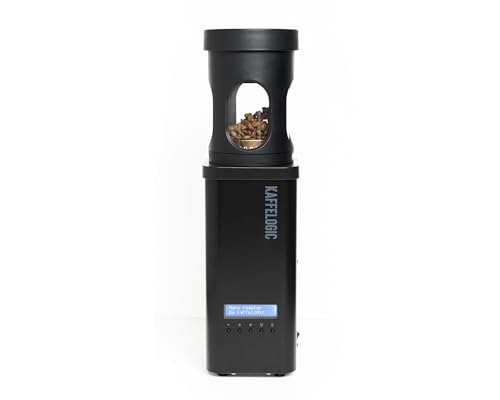
You’ll get the most out of the Nano7 Home Coffee Roaster (Nano110vBoost) if you want precise control over airflow and temperature without needing manual oversight, since it uses a built-in PID system with adaptive tuning to maintain consistent roast profiles. I rely on its look-ahead algorithms to adjust in real time, and I’ve found it handles 100–120g batches best. With the Boost Kit, I can roast as little as 50g. It’s fully programmable, and I create custom profiles in Kaffelogic Studio. I plug in via USB, not dishwasher-safe, and I roast any bean type confidently.
Best For: Home coffee enthusiasts and professionals seeking precise, hands-off control over small-batch roasting with customizable profiles and advanced temperature management.
Pros:
- Fully programmable with PID control and adaptive algorithms for consistent, repeatable roast profiles
- Compact design with support for 50–200g batches, ideal for sample roasting and small-batch experimentation
- USB connectivity and Kaffelogic Studio software enable custom profile creation, saving, and sharing
Cons:
- Not dishwasher safe, requiring manual cleaning after each use
- Limited batch size max of 200g, which may not suit larger household or commercial needs
- Higher initial cost compared to non-automated or manual roasters with fewer features
Electric Coffee Bean Roaster 1500W

When I need reliable control over roast profiles without the complexity of larger systems, the APOXCON Electric Coffee Bean Roaster 1500W stands out-especially for home users roasting small, 100g batches. Its digital controls let me adjust heat, fan speed, and timer with accuracy, giving consistent results. The borosilicate glass chamber offers clear visibility, and the chaff basket reduces mess. At under 5 pounds, it’s compact but requires post-roast cleaning to prevent airflow blockage. I always let it finish its cooling cycle before shutting down. While it’s less powerful than pro models, it’s a solid, beginner-friendly choice for fresh, customized roasts.
Best For: Home coffee enthusiasts seeking precise, small-batch roasting with ease of use and consistent results.
Pros:
- Digital controls allow accurate adjustment of heat, fan speed, and timer for customized roast profiles
- Borosilicate glass chamber provides clear visibility during roasting, enhancing control and monitoring
- Compact design and integrated chaff collection basket make it convenient and mess-minimizing for home use
Cons:
- Limited to 100g batch size, which may not suit those needing larger quantities
- Requires strict post-roast cleaning and cooling cycle to prevent chaff blockage and machine damage
- Less powerful than professional-grade roasters, potentially limiting roast depth and speed
Factors to Consider When Choosing Coffee Roasting Airflow Controllers
You need precise airflow control to manage roast development evenly, especially when working with beans that demand consistent heat and oxygen flow. Look for controllers with fine-tuned fan speed settings and solid temperature integration-they’ll give you better adjustability and flexibility during critical roast phases. Don’t overlook build quality and durability, since units like the TC4 and Aillio Bullet use robust components to handle repeated high-heat cycles.
Airflow Control Precision
While airflow might seem like a background factor in roasting, precise control directly shapes heat transfer and bean development from start to finish. You need consistent airflow to avoid scorching and guarantee even roasts, especially during the drying and Maillard phases-small changes can speed up or slow down reactions. Adjustable fan speeds let you fine-tune profiles: lower speeds extend development, while higher ones cool beans fast after roasting. Look for controllers with high-resolution settings, like 1% or 10 RPM increments, so you can repeat results batch after batch. Systems with closed-loop feedback, such as PID-controlled fans, keep airflow steady even when chaff builds up or temps shift. That stability matters if you’re roasting in a changing environment or running back-to-back batches. Basic fan controls work for simple setups, but if you want control and consistency, digital precision isn’t optional-it’s essential.
Temperature Integration
If you’re aiming for repeatable roasts, pairing airflow control with temperature integration makes a clear difference. Controllers with real-time temperature feedback adjust airflow automatically, keeping bean temp steady during key stages. When heat spikes, the system tweaks airflow to prevent scorching-especially useful during aggressive ramps. Closed-loop models use probes to sync adjustments, smoothing out inconsistencies from ambient shifts or bean batch differences. Look for adjustable setpoint hysteresis; it reduces rapid fan cycling, boosting stability. Some advanced units even predict first crack, using algorithms to pre-modulate airflow and ease into development. That kind of precision helps maintain roast integrity without constant oversight. If you’re using a Probat or even a mid-tier Giesen, integrated controls like those in Artisan or Cropster-compatible setups offer reliable, data-driven results. It’s not just about automation-it’s about consistency you can replicate bag after bag.
Fan Speed Settings
When selecting a coffee roasting airflow controller, one of the most practical features to evaluate is the fan speed range and how it’s adjusted. Most systems offer 3 to 9 preset levels, giving you clear control over airflow for consistent roasts. Higher speeds improve heat dissipation, cutting scorching risks by evenly moving hot air through the beans. You’ll want lower speeds early on to trap heat and support steady bean development. Ramping up the fan mid-roast boosts uniformity and helps with cooling later. If you’re chasing repeatable profiles, adjustable speeds are a must-models with percentage-based settings (like 1–100%) let you fine-tune airflow in real time, syncing closely with temperature changes. That kind of precision helps match or refine past roasts with confidence.
Adjustability And Flexibility
You already know fan speed settings give you control over airflow during roasting, but how much you can adjust and customize that airflow determines how much control you really have. You can typically fine-tune fan speeds across 3 to 11 settings, letting you manage heat distribution and reduce scorching in early or dark roast phases. Variable ranges-from 30–50% on low to 100% on high-help you control bean agitation and roast intensity. Models like the Artisan or IKAWA Air offer programmable profiles that auto-adjust fan speed by time or bean temperature, boosting batch consistency. You’ll also use max airflow post-roast to clear chaff and cool beans fast. Digital interfaces with independent controls let you tweak ventilation on the fly, whether you’re following a set profile or making manual adjustments. Look for controllers that let you switch between automation and hands-on control depending on your roast style.
Build Quality Durability
A well-built airflow controller stands up to the harsh conditions inside a roaster, where heat, moisture, and constant use can quickly degrade lesser components. You need parts made from high-temperature plastics or metals that handle over 400°F without warping. Look for tight-sealing connections and precision-engineered parts to stop air leaks and keep airflow steady through every roast. Reinforced housings and corrosion-resistant finishes help the unit last in hot, humid environments. Industrial-grade fans with sealed bearings hold up over thousands of cycles, reducing wear. Impact-resistant enclosures and stress-tested joints resist damage from regular handling and repeated expansion from heat shifts. Cheaper models might cut corners on materials or assembly, leading to early failure. When you choose a durable controller, you’re investing in consistency and long-term reliability. Brands like Artisan and 7th Sense build with these standards in mind.
Compatibility With Roasters
How well does your airflow controller actually match your roaster? You need to check that it supports your roaster’s batch capacity-mismatched units cause uneven roasts and poor heat transfer. Make sure the voltage and power specs line up to avoid safety risks or malfunctions. Confirm the controller works within your roaster fan’s CFM range so you can make precise airflow tweaks during roast cycles. Don’t overlook physical fit-measure the dimensions and mounting setup to guarantee it installs cleanly without blocking airflow or access to key parts. Also, verify it supports your roaster’s exhaust design, whether you’re using recirculating or vented airflow. Controllers like the Artisan or Cropster-compatible models often list compatible roaster types-use those guides. Skipping these checks could cost you in performance, safety, or repair time. Match specs carefully-it’s worth it.
User Interface Design
What makes one airflow controller easier to use than another? You’ll find touchscreen interfaces simplify navigation, offering responsive digital controls for precise airflow adjustments. LED displays give you real-time feedback on fan speed, usually with clear low-to-high stages. If you prefer physical feedback, dedicated “+” and “−” buttons let you fine-tune airflow smoothly and maintain consistency between roasts. Some models even support filter setup modes-press two buttons at once to calibrate airflow response curves for better accuracy. Look for layouts that separate airflow controls from temperature and power settings; that way, you won’t accidentally change critical parameters mid-roast. A well-organized interface reduces mistakes and speeds up adjustments, especially during fast-paced sessions. Controllers like the TC4 or Artisan PID prove that smart design improves precision without complicating your workflow.
Cooling Cycle Management
Once the roast concludes, your airflow controller should immediately shift to cooling mode, using strong bursts of cold air to drop bean temperatures from over 400°F to under 200°F within 2–3 minutes. You need this rapid cooldown to stop residual cooking and avoid baked flavors. If cooling drags on, beans keep developing, harming clarity and sweetness. Look for controllers that automatically trigger max fan speed post-roast-models like the Artisan PID or 7i75D Roastmaster do this reliably. Proper airflow here also clears leftover chaff and volatiles, boosting bean cleanliness and roaster hygiene. Not all systems handle cooling equally; some manual setups require you to engage fans yourself, risking delays. Go for automation where possible. Strong, consistent airflow during this phase isn’t just about temperature-it’s about preserving roast integrity and ensuring batch-to-batch consistency. Don’t overlook it.
Frequently Asked Questions
Can I Use These Controllers With Gas Roasters?
You can use airflow controllers with gas roasters, but compatibility depends on the model. Most aftermarket controllers work with roasters that have variable-speed blowers, like the Loring or some modified Probat machines. They won’t retrofit easily onto basic drum roasters without electronic controls. If your gas roaster has an adjustable fan motor, you can integrate a PID-based airflow controller for better roast precision. Check voltage, motor type, and control inputs before buying.
Do Airflow Controllers Affect Roast Flavor Significantly?
Yes, airflow controllers affect roast flavor markedly. You’re adjusting heat transfer and development by speeding up or slowing down gas flow. Higher airflow cools beans slightly and promotes even roasting, while lower airflow increases heat exposure, risking scorching. Devices like the Artisan PID or TC4 Shield give you precise control. You’ll notice cleaner, brighter profiles with proper adjustments. It’s not just automation-it’s about repeatable, intentional flavor shaping.
Are Replacement Parts Readily Available for These Models?
Yes, you can usually get replacement parts for most mid-to-high-end airflow controllers, like those from Artisan or PID systems used with Probat or Loring roasters. Common components such as fans, sensors, and control boards are often available directly from manufacturers or third-party suppliers. Cheaper or obsolete models may have limited support. Always check the manufacturer’s service policy and part lifespan before buying. Keeping spares for critical parts saves downtime.
How Often Should I Clean the Airflow System?
You should clean the airflow system every 5 to 10 roasting sessions, depending on bean volume and roast level. Dark roasts and frequent use build more chaff and oil faster, requiring more frequent cleaning. Neglecting it causes uneven airflow and inconsistent roasts. Use compressed air or a soft brush weekly, and do a full teardown monthly. Models like the Aillio Bullet or Gene Café respond well to this routine, while simpler roasters need less effort.
Can Beginners Easily Operate These Controllers?
Yes, you can easily operate these controllers even as a beginner. Models like the TC4 and Artisan PID come with intuitive interfaces and clear instructions. You’ll adjust airflow with simple knobs or software sliders, and real-time feedback helps you learn fast. Some trial and error is normal, but most systems are stable and predictable. Just follow the manual, start with small roasts, and you’ll get consistent results without confusion.