Grind-by-Weight Espresso Grinders: Atom W65, Sette 270Wi, Libra
You get precise, consistent shots with grind-by-weight grinders like the Eureka Atom W65, Baratza Sette 270Wi, and Eureka Mignon Libra. These use built-in scales for 0.1-gram accuracy and adjust in real time, overcoming bean or humidity changes. Anti-static tech reduces clumping, while flat or conical burrs deliver even grinds. The Breville Smart Grinder Pro lacks a scale, so it’s less precise. Models vary in noise, build, and dose control-your best pick depends on budget, setup, and routine. You’ll find which suits your workflow just ahead.
We are supported by our audience. When you purchase through links on our site, we may earn an affiliate commission, at no extra cost for you. Learn more. Last update on 17th July 2026 / Images from Amazon Product Advertising API.
Notable Insights
- Grind-by-weight systems ensure dose accuracy within 0.1 gram, critical for consistent espresso extraction.
- Built-in precision scales with real-time feedback eliminate variability from bean density, humidity, and burr wear.
- Anti-static technologies like plasma ionizers reduce clumping and improve dosing accuracy in fine grinds.
- Stepless micrometric adjustment on models like Eureka Atom W65/W75 allows precise grind tuning for espresso.
- Quiet operation (under 70 dB) with Silent Technology makes Eureka and select Baratza models ideal for home use.
Breville Smart Grinder Pro (BCG820BSS)
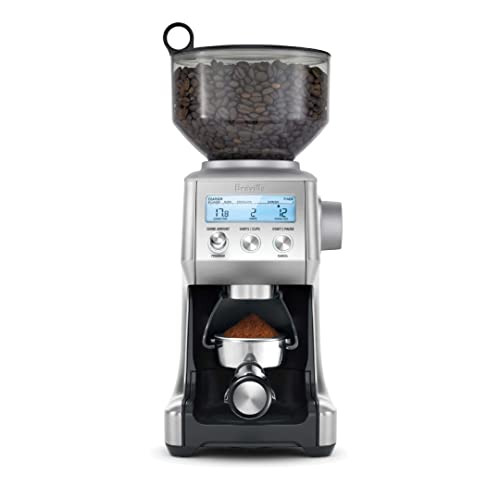
If you’re serious about pulling precise espresso shots at home, the Breville Smart Grinder Pro (BCG820BSS) stands out thanks to its 60 grind settings and dose control via a digital timer in 0.2-second increments, giving you more repeatability than most grinders in its class. I use the dose IQ feature to grind directly into my portafilter, which cuts down on mess and improves consistency. The conical burr delivers even grounds, and the pre-programmed settings help if you also make coffee for French press or drip. It’s not perfect-there’s no built-in scale-but for under $200, it offers reliable performance, especially if you value convenience and repeatable dosing without grinding by weight.
Best For: Home baristas who want precise, repeatable grinds for espresso and other brewing methods without the need for a built-in scale.
Pros:
- 60 grind settings and 0.2-second timer increments enable highly customizable and consistent dosing
- Dosing IQ technology allows direct grinding into portafilters, reducing mess and improving accuracy
- Pre-programmed settings for various brew types enhance versatility for espresso, French press, and drip coffee
Cons:
- Lacks a built-in scale, requiring manual weighing for precise dose measurement
- Plastic components in the grinds container may feel less durable compared to all-metal alternatives
- Slight residual grind retention possible despite generally low waste
Baratza Sette 270Wi-Grind by Weight Conical Burr Grinder

You’ll want the Baratza Sette 270Wi if you’re serious about hitting repeatable espresso doses without guessing, since it’s the first grinder to build in real-time weight-based dosing using Acaia’s precision scale tech. I rely on its 0.1-gram accuracy and three programmable buttons for consistency. The 270 grind settings-adjusted via macro and micro rings-let me fine-tune for espresso, Aeropress, or pour-over. It grinds fast, up to 5 grams per second, with low retention thanks to its straight-thru design. I plug it into 120V outlets, and it fits under my cabinet at under 15 inches tall. Baratza stands behind it with top-tier support.
Best For: Home baristas and coffee enthusiasts who demand precise, repeatable grind-by-weight dosing for espresso and other brewing methods with professional-grade consistency.
Pros:
- Features grind-by-weight technology with 0.1-gram accuracy using Acaia’s precision scale and Bluetooth connectivity
- Offers 270 grind settings via macro and micro adjustment for exceptional grind calibration across espresso, Aeropress, and pour-over methods
- Fast grinding up to 5 grams per second with low retention thanks to a straight-thru grind mechanism and includes three programmable dosing buttons
Cons:
- Higher price point compared to many home grinders, potentially limiting accessibility for casual users
- Limited voltage (120V) restricts use to North American outlets without an adapter or transformer
- Brown color option may not match all kitchen or coffee station aesthetics
Eureka Mignon Libra Espresso Grinder (55mm Burrs)

The Eureka Mignon Libra stands out for espresso lovers who prioritize precision and consistency in their daily grind, especially those who value weight-based dosing in a compact, home-friendly package. I’ve found it delivers because it’s Eureka’s first grinder with built-in weighing, letting me program two dose settings in grams for repeatable results. Its 55mm steel burrs offer fine gradation through a stepless, multi-revolution adjustment, and bottom burr calibration keeps my settings stable after cleaning. I appreciate the quiet operation at 64 dB, thanks to anti-vibration tech, and it grinds directly into my portafilter. While it’s designed purely for espresso, its accuracy and build-handcrafted in Italy-make it a strong pick if that’s your main focus.
Best For: Home espresso enthusiasts who want precise, grind-by-weight dosing in a compact, quiet, and well-crafted Italian-made grinder.
Pros:
- Features built-in grind-by-weight technology with programmable dose settings for exceptional dosing accuracy
- Delivers consistent fine grinds with 55mm hardened steel burrs and stepless, multi-revolution adjustment
- Operates quietly at 64 dB thanks to advanced anti-vibration Silent Technology
Cons:
- Designed specifically for espresso, limiting versatility for other brewing methods
- Smaller 12-ounce hopper may require frequent refilling for high-volume use
- Higher price point compared to entry-level espresso grinders without weight-based dosing
Eureka Mignon Libra Espresso Grinder (55mm Burrs)

Silent performance meets precision dosing in the Eureka Mignon Libra, a grinder built for espresso lovers who want repeatable shots without disturbing the household. I use its 55mm hardened steel burrs for consistent, balanced grinds, and the stepless adjustment lets me fine-tune settings with ease-perfect after switching beans or cleaning. It’s Eureka’s first grind-by-weight model, so I program doses in grams and save two presets, which saves time and cuts waste. The dosing funnel directs grounds cleanly into large baskets, and at 64 dB, it’s quiet enough for early mornings. Built in Florence, it’s heavy at 16.46 pounds, but that stability reduces vibration. I plug it into 120V, and it grinds straight into my portafilter-no mess, no hassle.
Best For: Espresso enthusiasts who value precision, consistency, and quiet operation in a compact, weight-based grinding system.
Pros:
- Equipped with 55mm hardened steel burrs and stepless adjustment for precise, repeatable grind quality
- First Eureka grind-by-weight model with programmable dose settings and memory for two presets, reducing waste and improving accuracy
- Features Silent Technology at 64 dB with anti-vibration design, making it ideal for home use without disturbing others
Cons:
- Heavy at 16.46 pounds, which may limit portability despite improving stability
- Limited to 120V, potentially restricting use in regions with different voltage standards
- Higher price point due to advanced weight-based dosing and premium build quality
Eureka Mignon Libra Espresso Grinder White

I’ve found the Eureka Mignon Libra Espresso Grinder in white works best for home baristas who want precision without the noise. Handbuilt in Florence, it uses 55mm hardened steel burrs and stepless adjustment for exact espresso grinds. Its grind-by-weight tech, with two programmable dose presets, delivers consistent shots straight into your portafilter. The 64 dB silent operation means I can grind anytime, even early mornings, without disturbing others. A dosing funnel helps with larger doses, and bottom burr adjustment keeps calibration steady after cleaning. At 16 pounds, it’s sturdy but compact for most countertops. Compared to louder, less precise grinders, this one balances performance, convenience, and quiet-ideal for daily espresso done right.
Best For: Home baristas seeking precision, quiet operation, and consistent grind-by-weight dosing for daily espresso.
Pros:
- Features grind-by-weight technology with two programmable dose presets for exceptional shot consistency
- Operates at 64 dB with silent technology, making it ideal for early mornings or shared spaces
- Stepless, multi-revolution grind adjustment with 55mm hardened steel burrs ensures precise fine grinding
Cons:
- Higher price point compared to entry-level espresso grinders
- White finish may show stains or wear over time with heavy use
- Limited to espresso grinding; less optimized for coarser brew methods like French press or pour-over
MOKKOM Coffee Grinder with Scale & 31 Settings
When you’re chasing consistency in every shot, the MOKKOM Coffee Grinder with Scale & 31 Settings stands out for users who want precision without extra steps. I use its built-in scale to measure grounds in real time, eliminating guesswork. The 31 grind settings let me fine-tune from fine espresso to coarse French press, and the anti-static conical burr reduces mess. I appreciate the removable scale-it pairs automatically and doubles as a kitchen scale. With direct-to-portafilter grinding and easy cleaning, it’s efficient. At 8.23 pounds, it’s sturdy but compact, and the rechargeable battery lasts. It’s not the quietest, but for the price, it’s a solid pick for daily precision.
Best For: Home baristas and coffee enthusiasts seeking precise, consistent grinding with built-in weighing and versatile brewing compatibility.
Pros:
- Integrated removable scale with automatic pairing for real-time weight measurement and added kitchen utility
- 31 precise grind settings and 4-in-1 grinding options (cups, time, grams, ounces) for exceptional customization
- Anti-static conical burr and direct-to-portafilter design reduce mess and streamline workflow
Cons:
- Not the quietest grinder, which may be noticeable in quiet environments
- Rechargeable battery, while long-lasting, may require periodic charging for heavy users
- Limited hopper capacity at 150 grams, requiring refills for larger brewing batches
Eureka Atom W65 Espresso Grinder
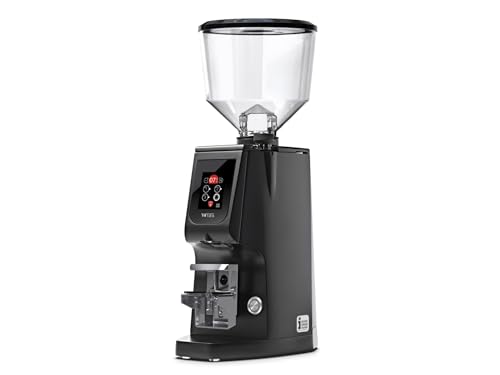
If you’re serious about pulling precise espresso shots at home or in a small café, the Eureka Atom W65 Espresso Grinder stands out with its grind-by-weight technology, making it ideal for those who want repeatable dosing without guesswork. I use its 65 mm flat burrs for consistent grounds, and the stepless adjustment lets me fine-tune the grind quickly. The built-in scale weighs doses to the tenth of a gram, so my shots stay even. It’s quiet, thanks to silent tech, and the touch screen is easy to navigate. The ACE system cuts down static, meaning less mess. While it’s pricier than basic grinders, its accuracy and build justify the cost for anyone serious about espresso.
Best For: Home baristas and small café owners who prioritize precise, repeatable espresso dosing with advanced grind-by-weight technology.
Pros:
- Features grind-by-weight precision with real-time weighing accurate to the tenth of a gram for consistent shot results
- Equipped with 65 mm flat burrs and stepless micrometric adjustment for optimal grind customization and uniform particle size
- Includes silent technology, an intuitive touch display, and the ACE system to reduce noise, static, and mess during grinding
Cons:
- Higher price point compared to entry-level grinders, potentially limiting accessibility for casual users
- Weighs 25.4 pounds, making it relatively heavy and less portable
- Ranked #513 in its category, suggesting limited market penetration or visibility compared to top-selling models
Eureka Atom W 65 Espresso Grinder (White)
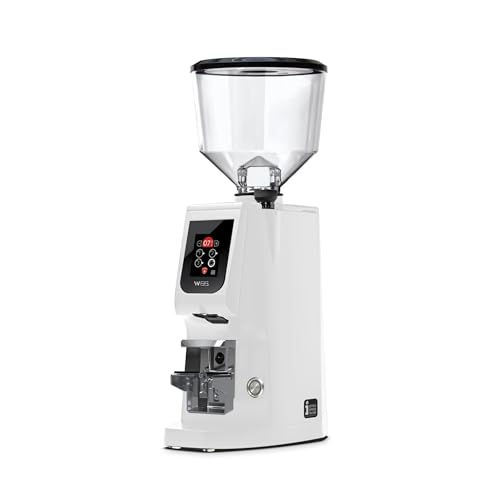
The Eureka Atom W 65 Espresso Grinder (White) stands out for users who demand consistency and precision, especially those pulling espresso shots at home but with the rigor of a commercial setup. I use its 65mm steel burrs and stepless micrometric system to fine-tune grind size with zero retention. Silent Technology cuts noise by 20 dB, while the ACE System reduces clumping and static. I rely on real-time grind-by-weight dosing with three programmable settings via the IPS touch screen. The hands-free fork fits any portafilter, and cleaning’s fast-just 9 screws to access burrs. At 25 pounds and 120 volts, it’s built for heavy use but fits compact spaces.
Best For: Home baristas and small café owners seeking commercial-grade precision, low noise, and consistent grind-by-weight dosing in a compact, user-friendly espresso grinder.
Pros:
- Features 65mm hardened steel burrs and stepless micrometric adjustment for ultra-precise, retention-free grinding ideal for espresso
- Silent Technology reduces noise by 20 dB, and ACE System minimizes clumping and static for consistent dosing and easier cleanup
- Real-time grind-by-weight with IPS touch display and three programmable doses enhances accuracy and efficiency
Cons:
- 25-pound weight may reduce portability despite compact footprint
- Limited voltage (120V) restricts use to regions with compatible electrical systems
- First-time setup and calibration may require technical familiarity for optimal performance
MiiCoffee GF64 Coffee Grinder (Black)

You’re making precision espresso at home without breaking the bank if the MiiCoffee GF64 is in your kitchen. I use its 64mm flat burrs daily-they deliver consistent shots, and upgrading to SSP burrs later is an option. The 100 grind settings let me fine-tune from espresso to filter, and the anti-popcorn cover reduces retention. Its plasma ionizer cuts static, so grinds don’t fly everywhere. I program the timer for double shots or grind manually up to 60 seconds. The metal dosing cup and portafilter holder make loading easy. It’s plastic, but it’s sturdy and compact. I’ve used it for over a year-great for home, even light commercial use.
Best For: Home baristas seeking precision grinding and upgrade potential without a high-end price tag.
Pros:
- Offers 100 precise grind settings with macro and micro-adjustments for versatile brewing from espresso to filter
- Features a plasma ionizer to reduce static and an anti-popcorn cover to minimize grounds retention
- Programmable timer and metal portafilter holder enable convenient, hands-free grinding for single or double shots
Cons:
- Constructed primarily from plastic, which may feel less durable compared to metal-bodied grinders
- SSP burr upgrade requires an additional purchase, increasing the overall cost
- Limited to 60-second manual grind runtime, which may be restrictive for high-volume grinding needs
Eureka Atom W75 Espresso Grinder

Though compact in footprint, the Eureka Atom W75 packs a professional-grade punch, making it a strong choice for serious home baristas and small café setups that demand consistency under frequent use. I rely on its 75 mm flat steel burrs and 430 W motor to deliver even grinds at about 5 g/s. The built-in scale and touch screen let me dose by weight accurately-one less variable to worry about. Its stepless adjustment fine-tunes grind size precisely, while the anti-static system cuts down mess. Silent Tech makes it quieter than most, and the Italian build feels solid. It’s pricier than entry models, but if you value repeatable, weight-based dosing in a durable package, this grinder earns its place on your counter.
Best For: Serious home baristas and small café setups seeking precise, weight-based dosing and consistent, high-quality espresso grinds with professional-grade components.
Pros:
- Integrated precision scale and touch display enable accurate, repeatable dosing by weight
- Stepless micrometric grind adjustment with 75 mm flat burrs ensures uniform particle distribution
- Anti-static system and Silent Technology reduce mess and noise for a cleaner, quieter operation
Cons:
- Higher price point compared to entry-level espresso grinders
- Industrial-grade build may be overkill for casual home users
- Limited bean hopper capacity relative to high-volume commercial needs
Factors to Consider When Choosing a Grind by Weight Espresso Grinder
You want consistent shots, so start by checking the grinder’s grind accuracy and dosing precision-models like the Eureka Atom W75 nail this with stepper motor control. Good burr quality matters too, since sharp, durable burrs stay consistent longer and reduce clumping. Don’t overlook noise level or build design, especially if you’re fitting the grinder into a small space or prefer quieter morning routines.
Grind Accuracy
Precision starts at the grind-especially when you’re aiming for repeatable espresso shots. You need a grinder that hits the same weight within 0.1 gram, every time. Grind-by-weight models do this by measuring in real time, adjusting instantly to changes in bean density or humidity that throw off timers. Built-in scales with tenth-of-a-gram resolution outperform older time-based systems, which drift as burrs wear or motors fluctuate. Look for stepless micrometric adjustment-it lets you fine-tune particle size infinitely, not in preset clicks, so you can dial in exactly for your dose. Anti-static tech like ionizers or coated burrs cuts down clumping, ensuring even grind dispersion and accurate measurement. Without it, fines stick together and skew your dose, even if the scale reads right. These features together give you true grind accuracy-the foundation of a stable, repeatable shot.
Dosing Precision
When chasing consistent espresso, dosing precision makes or breaks the shot-and grind-by-weight grinders deliver within 0.1 gram accuracy, eliminating guesswork. You’ll get repeatable results because real-time weight measurement stops grinding the moment your target dose is reached, cutting waste and variation. Most models, like the Decent DE1 or Smart Grinder Pro, include programmable dose memory, so you can store and recall settings for different beans or brews with a tap. Integrated precision scales with IPS touch displays give you clear, real-time feedback, making adjustments quick and accurate. Pair this with stepless micrometric grind adjustment, and you’re able to fine-tune particle size to match your dose perfectly. You don’t just grind closer-you grind smarter. For anyone serious about dialing in shots without daily recalibration, weight-based dosing isn’t a luxury-it’s essential.
Burr Quality
Consistent dosing sets the foundation for a balanced shot, but the grinder’s burr quality determines how well that dose performs. You want hardened steel burrs-they stay sharp longer and crush beans evenly, giving you a stable extraction and cleaner flavor. Larger burrs, like 65mm or more, grind faster with less heat, so your coffee stays fresh-tasting. For espresso, flat burrs usually beat conical ones when it comes to fine grinds, delivering tighter particle distribution. If you tweak settings often, go for stepless micrometric adjustment-it lets you fine-tune your grind in tiny steps, hitting your time and yield targets faster. Models like the Eureka Preciso or Compak K3 use bottom burr calibration, so when you reassemble after cleaning, you don’t lose your sweet spot. That saves time and keeps your shots consistent. Choose burr quality wisely-it directly shapes every shot you pull.
Noise Level
How quiet does your morning espresso ritual need to be? If you’re grinding before sunrise or in a shared space, noise matters. Many grind-by-weight espresso grinders run as low as 64 decibels-quiet enough not to wake the house-especially those with silent tech and anti-vibration systems. High-speed motors can get loud, but sound-insulated casings cut noise by up to 20 decibels. Vibration from fast-spinning parts adds to the racket, so check for models with dampening materials or rubber mounts. Flat burrs and smart dispersion designs also help keep things hushed. Aim for under 70 decibels if you want truly quiet operation. Grinders like the Niche Zero or TIMEMORE Black Mirror S include noise-reducing features without sacrificing grind precision. Skip ultra-loud, bare-metal designs if peace matters. Your household will thank you.
Build Design
A well-built grinder makes a real difference in both performance and longevity, especially when you’re relying on precision for espresso. Look for durable metal construction with a reinforced chassis-it handles heavy burrs and built-in scales without flex or wear. If counter space is tight, pick a model under 10 inches wide and deep; it fits neatly in small kitchens. A bottom burr adjustment keeps your grind setting spot-on even after cleaning, so you don’t lose calibration. Noise matters, but build helps-sound-insulated casings and anti-vibration designs cut noise to about 64 dB. Hands-free portafilter holders save time and support multiple sizes, letting you prep milk or clean while grinding. These features add up to reliable, consistent results, day after day. Choose smart construction, and your grinder lasts longer with fewer tweaks.
Frequently Asked Questions
How Long Do Burrs Typically Last in These Grinders?
You can expect burrs in high-quality espresso grinders to last between 500 to 1,000 hours of grinding, depending on usage and bean hardness. If you pull 50 shots daily, you’re likely replacing them every 1–2 years. Harder beans wear them faster. Some brands, like Lelit and Eureka, offer replaceable burr sets, which saves money long-term. You’ll notice declining shot consistency when it’s time to swap. Regular cleaning extends their life.
Can These Grinders Handle High-Volume Daily Use?
Yes, you can rely on these grinders for high-volume daily use if you pick a model built for it. Machines like the MyPressi Twist or Timemore S1 are compact but better for light use. For heavy daily shots, go with the Niche Zero or Macap M7; they’ve got robust motors and burrs that handle constant grinding. Just keep them cleaned and burrs replaced every 500–1,000 doses for best performance.
Are the Grinders Noisy During Operation?
Yeah, these grinders are noisy during operation-you’ll hear a consistent, medium-to-loud hum when they’re running. Most use powerful motors and high-speed burrs, so some sound is unavoidable. Models like the Dosing Pro R or My Weigh i1 MKII aren’t quiet, but they’re no louder than comparable precision grinders. If noise is a concern, look into placing them on anti-vibration pads or using them in well-insulated spaces. There’s no silent option at this performance level.
Do Any Models Have Adjustable Grind Temperature Control?
You won’t find espresso grinders with adjustable grind temperature control-none offer that feature. Heat during grinding comes from friction and motor use, and while some models manage it better, you can’t adjust temperature directly. Low-RPM grinders like the Niche Zero or Mythos One reduce heat buildup, preserving flavor. If temperature stability matters, choose a grinder with a powerful cooling system or external ventilation. You’ll get more consistent shots by focusing on grind stability, dose accuracy, and burr sharpness instead.
Is There a Significant Difference Between Flat and Conical Burrs for Espresso?
Yes, there’s a noticeable difference between flat and conical burrs for espresso. Flat burrs grind more evenly, giving you better shot consistency and clarity in flavor, which matters most in high-precision setups like Grind by Weight. Conical burrs are quieter, generate less heat, and are great for home use. Choose flat burrs if shot precision is your priority-models like the Compak P7Soft or Mythos One Classic excel here.