How to Optimize Bloom Time for Decaf or Aged Coffee Beans
Use a 30–45 second bloom with decaf or aged beans, even if you don’t see much bubbling. They lose CO2 faster, so pour twice the coffee’s weight in 200°F water to fully degas. Grind slightly finer than table salt for better extraction, and stick to 195–205°F water to avoid bitterness. A gooseneck kettle helps control the pour. Pre-infusing this way improves flavor balance, especially with stale or processed beans-your next cup will show you just how much technique can revive even older coffee.
Notable Insights
- Decaf and aged beans release less CO2, so expect a weaker bloom even with optimal brewing.
- Store beans in air-tight containers with one-way valves to preserve trapped gases and improve bloom potential.
- Grind decaf or old beans slightly finer than table salt to enhance extraction and gas release.
- Use water between 195–205°F to avoid bitterness and support even degassing during bloom.
- Extend pre-infusion to 30–45 seconds with twice the coffee’s weight in water for full saturation.
Why Decaf and Old Beans Don’t Bloom?
While fresh roasted coffee beans release a burst of carbon dioxide when hot water hits them-what we call “bloom”-decaf and aged beans don’t react the same way, and that’s mostly due to time and processing. Decaf beans undergo chemical processing that increases bean porosity and accelerates CO2 depletion, leaving less gas to escape during brewing. Older beans, even if originally fresh, lose CO2 naturally over time-usually after 2–4 weeks post-roast. With less trapped gas, you won’t see a vigorous bloom. This isn’t a flaw, just chemistry. You can still brew good coffee, but expect a weaker initial reaction. Light roasts retain gas slightly longer than dark roasts, so storage and roast level matter. For best results, grind just before brewing and use scale-measured water. A gooseneck kettle helps control pour speed, but any decent electric kettle works if you pour steadily. The bloom phase still matters-just don’t expect fireworks.
Your Flat Coffee Starts With a Weak Bloom
What if the reason your coffee tastes flat isn’t your brew method-but what came before it? A weak bloom often starts with poor bean storage or an unsuitable roast profile. If you’re using decaf or aged beans, they’ve already lost much of their trapped CO2, so any further exposure to air or moisture speeds decay. That means stale aromas and a flat taste, no matter how precise your pour. Keep beans in airtight containers away from light and heat-vacuum-sealed or one-way valve bags work best. Also, consider the roast profile: darker roasts degas faster and may not bloom well if not used quickly. Even with aged beans, a proper bloom still helps extract remaining gases and primes the grounds. Skipping it, or rushing it, leaves flavor on the table. You won’t fix poor storage with technique, but good practices can help you get the most from what you’ve got.
Grind Finer to Compensate for Lost CO2
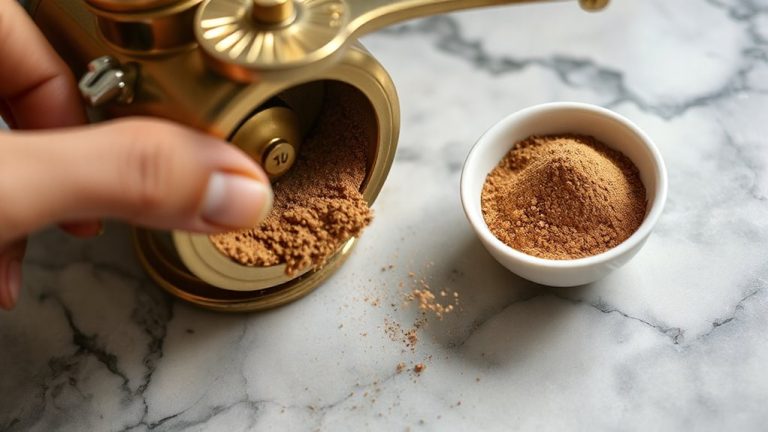
A weak bloom doesn’t just signal stale beans-it directly affects how well your coffee extracts during brewing. Since decaf and aged beans lose CO2, they struggle to release gases during bloom, leading to uneven extraction. Grinding finer increases surface area, helping water access what’s left of the trapped gases and improving extraction efficiency. Don’t overdo it-too fine and you’ll clog your filter or over-extract. Aim for a consistency just slightly tighter than table salt. Lower caffeine density in decaf means the beans behave differently, so maintaining roast integrity is key. A burr grinder gives you the control you need; blade grinders won’t cut it. For consistent results, choose a burr grinder recommended for precision grinding.
Brew Cooler to Avoid Bitter, Flat Taste
Brewing decaf or aged beans at a lower temperature helps you sidestep the sharp, flat flavors that high heat can pull out. Since these beans lack CO2 and extract easily, high water temperature can overdraw bitter compounds. Aim for 195–205°F instead of boiling. This range improves balance, especially in pour-over or drip methods. Your brew method matters-slower techniques like V60 benefit more from cooler water than immersion brewers like the French press, which stabilize temperature better. If you’re using a gooseneck kettle, adjust the setting; with a stovetop kettle, let it rest 15–20 seconds off boil. Cooler water reduces scalding, preserves delicate notes, and prevents harsh aftertastes. It’s not a fix-all, but paired with a finer grind, it creates a smoother, more accurate extraction. Test it side-by-side-chances are, you’ll taste the difference. For optimal control during pour-over, consider using a gooseneck kettle with precise temperature settings.
Pre-Infuse Longer for Stale or Decaf Beans
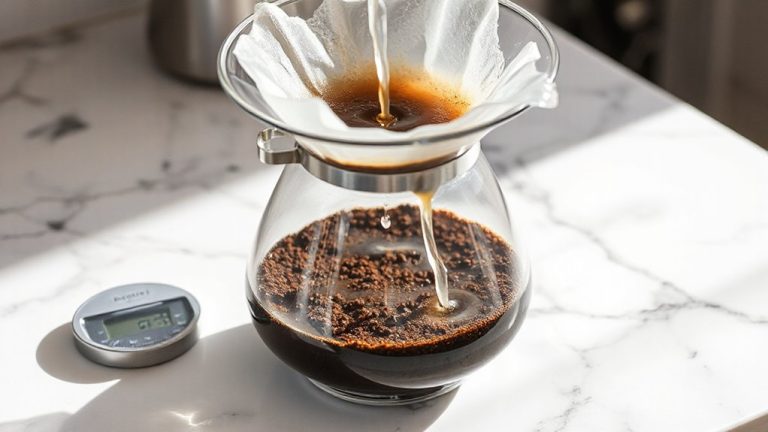
Letting stale or decaf beans pre-infuse for 30 to 45 seconds gives them time to degas fully, which improves extraction evenness. These beans often trap CO2 longer, so a longer bloom helps water penetrate evenly. Use water temperature around 200°F-it’s hot enough to extract well without scorching. If you’re using a pour-over like a V60 or Kalita Wave, pause after pouring twice the bean’s weight in water. Wait the full 30–45 seconds before continuing. This step can extend your total brew duration slightly, but it’s worth it for cleaner flavor. Skipping it risks uneven extraction, especially with aged beans that absorb water slower. Decaf beans, often processed with lower density, also benefit. Don’t rush this phase-even if your usual brew duration is short, let the bloom do its job. A full pre-infusion sets the stage for balanced taste without sour or hollow notes.
Fix Flat Brews With a Stronger Bloom
Why does your coffee sometimes taste dull or lifeless, even when you follow your usual routine? The issue might be a weak bloom, especially with decaf or aged beans. These beans release CO2 slower, so a stronger initial water charge helps. Use 2–3 times the water weight of the coffee for a more aggressive pre-wet, ensuring even saturation. Bad water quality can dull flavors, so always use filtered water to support clarity and extraction. Lighter roast color beans often retain more gas than dark roasts, needing longer, more robust blooming. For consistency, try gooseneck kettles like the Fellow Stagg or Hario V60 for control. If your brew still tastes flat, check grind size-too coarse slows blooming. A finer grind speeds gas release. Adjust based on roast age and storage. Stronger blooms fix flat cups by improving extraction and aroma. A quality burr grinder ensures consistent particle size, which is crucial for optimal bloom and extraction, especially when using best coffee grinders for espresso or pour-over.
On a final note
You won’t get a strong bloom with decaf or old beans because they’ve lost CO2. That’s normal. To improve flavor, grind finer to increase surface area and extract more during brewing. Use slightly cooler water-around 195°F-to avoid bitterness. Try a longer pre-infusion, like 45 seconds in a pour-over, to help gases escape and water penetrate evenly. While the bloom will stay weak, these tweaks help you pull a more balanced, drinkable cup from less-than-fresh beans.