How to Calibrate a Hand Grinder for Turkish Coffee Fineness
Set your hand grinder’s burrs to a powder-like fineness-slightly coarser than confectioner’s sugar but finer than espresso. Use a burr grinder with precise adjustment, like the 1Zpresso J-Max or Timemore C2. Disassemble carefully, adjust the ring in half-notch turns, then test grind. Brew at 200°F for 4–6 minutes; check for a thin sediment layer. If sludge forms, go finer. Fine-tune until crema and flavor balance-your ideal setting is just a few tweaks away.
Notable Insights
- Use a burr hand grinder with ultra-fine adjustment capability to achieve Turkish coffee’s powder-like grind.
- Disassemble the grinder carefully to access the calibration ring or adjustment nut under the top burr.
- Adjust the burrs incrementally toward the finest setting, avoiding forced turns to prevent misalignment.
- Aim for a consistency slightly coarser than confectioner’s sugar, ensuring uniform, flour-like particles.
- Test grind quality by brewing a sample and refine settings based on sediment texture and brew time.
Start With the Right Grind for Turkish Coffee
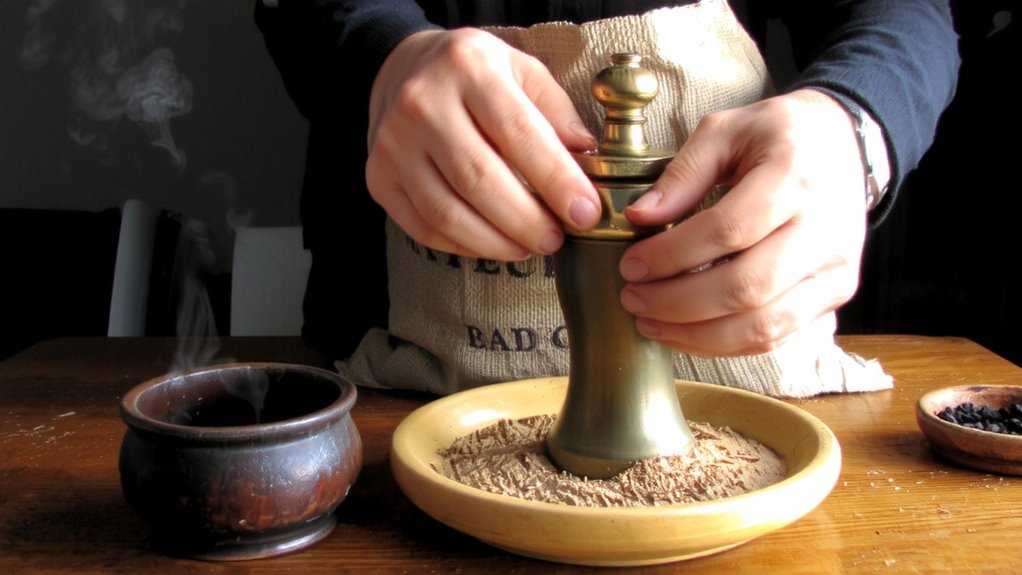
Fine powder, not sand-like grit-that’s the goal for Turkish coffee. You need particles so fine they dissolve almost like cocoa-ID powder, not coarse bits that settle heavily. This level demands extreme grind uniformمنظمةy; inconsistent sizes lead to uneven flavor extraction, leaving some notes bitter and others flat. When all particles are alike, water pulls evenly, giving you balanced, aromatic results with a rich crema on top. If your grind has chunky flecks, extraction fails-sourness and sludge follow. Aim for consistency over speed. Even the best hand grinders struggle here, so calibration matters. You’re not just grinding coffee-you’re preparing a base for proper chemistry. Skip this precision, and no brewing method fixes it. Get the texture right first, then tweak. That powder-like feel? That’s your starting line. For optimal results, consider using one of the best Turkish coffee grinders designed to achieve this ultra-fine consistency.
Choose a Grinder That Can Handle Turkish Fineness
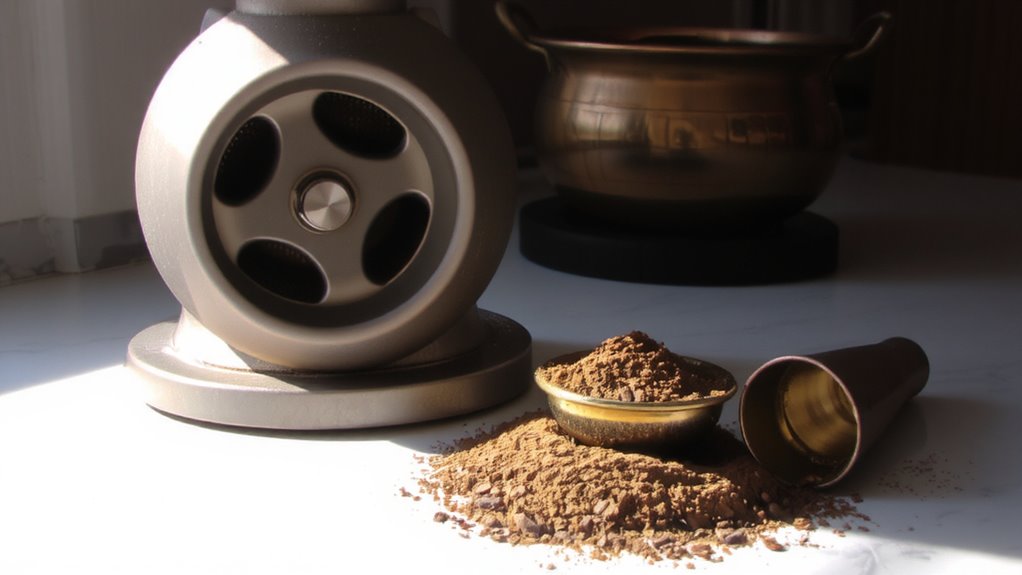
A capable grinder is non-negotiable when chasing true Turkish fineness-most can’t cut it. You need one designed for ultra-fine grounds, with precision adjustment and strong grinder durability. Cheap models wear out fast and can’t achieve the flour-like consistency Turkish coffee demands. Opt for trusted brands with solid brand reputation; they invest in quality materials and consistent performance. Manual grinders like the 1ZPresso J-Max or Handground PG offer fine control and long-term reliability. Avoid blade grinders-they’re inconsistent and generate heat, altering flavor. According to expert reviews, the Best Mill Grinders deliver the precision and durability needed for Turkish coffee.
| Feature | Why It Matters |
|---|---|
| Adjustable Burrs | Lets you reach Turkish-grade fineness |
| Steel or Ceramic Burrs | Guarantees consistency and longevity |
| Tight Calibration | Supports micro-adjustments |
| Solid Build | Improves grinder durability |
| Known Brand Reputation | Signals reliability and support |
Open Your Grinder for Fine-Tuning
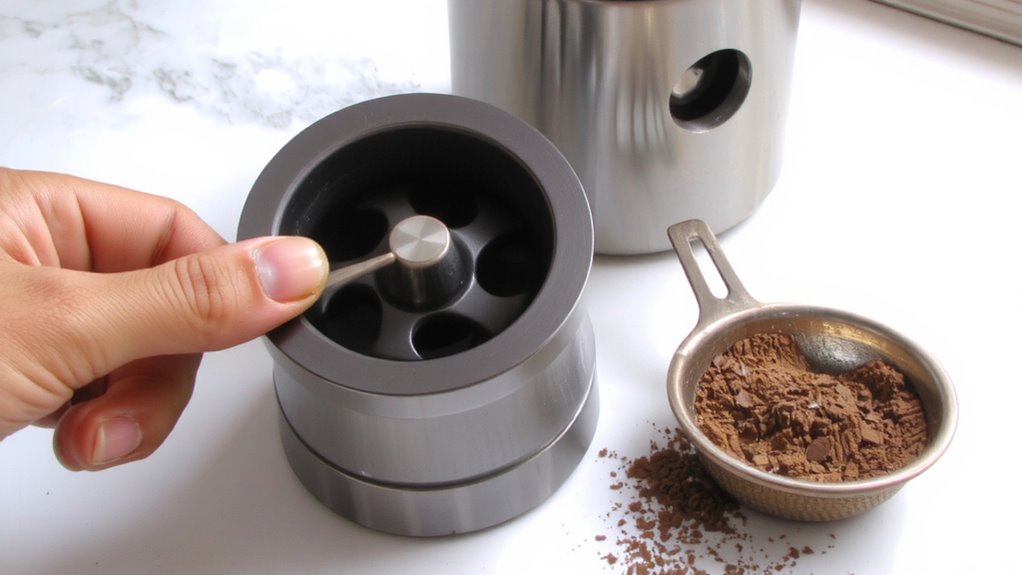
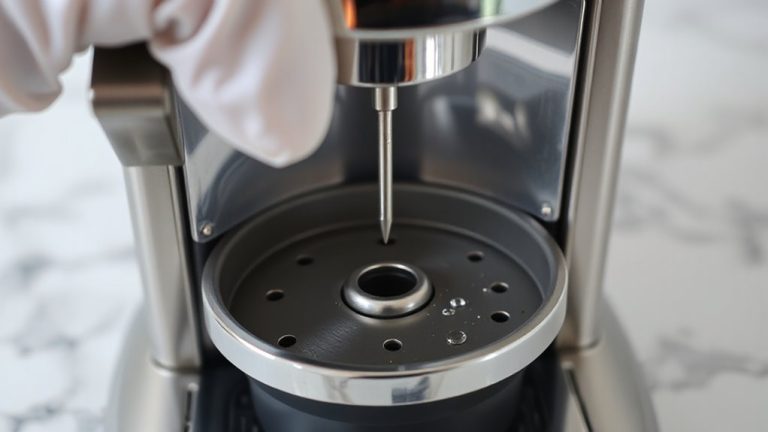
Once you’ve confirmed your grinder supports ultra-fine settings, it’s time to access the internal mechanism for calibration. Carefully begin the grinder disassembly following the manufacturer’s instructions-many models like the 1Zpresso J-Max or K-Max allow full access with just a few screws. Use a clean workspace to avoid losing small parts. Before opening, check your maintenance schedule; if it’s been months since cleaning or burr inspection, now’s the perfect time. Removing buildup improves accuracy and extends lifespan. Some grinders have calibration nuts or adjustment rings under the top burr; exposing these is key for precision tuning. Handle each part gently, and note the original positions so reassembly is seamless. Mishandling during disassembly can throw off grind consistency, so move deliberately. Once open, you’ll be ready to adjust the burrs in the next step-no need to do it yet. Keep all pieces organized. For best results, consider models known for precision, such as those featured in the best manual coffee grinders roundup.
Set the Burrs to Turkish Coffee Powder Fineness
Think of your grinder’s burrs as the heart of your Turkish coffee setup-get them right, and you’re halfway to a perfect cup. Turn the adjustment ring slowly toward the finest setting, but don’t force it. Most hand grinders, like the 1ZPresso J-Max or Timemore C2, have stepped or stepless adjustments; go past espresso fineness until you’re near powder-like consistency. Proper burr alignment guarantees even grinding and prevents inconsistent particles, which can ruin extraction. Misaligned burrs create friction, generate heat, and increase static control issues, making grounds stick or clump. To reduce static, especially in dry environments, consider using a small anti-static tool or tapping the grinder lightly. Avoid over-tightening, as this can damage the mechanism. Aim for a uniform, flour-like texture-coarser than confectioner’s sugar but not dusty. You’ll confirm the result after your next step, but for now, focus on precision and patience.
Brew a Test Shot to Check Grind Consistency
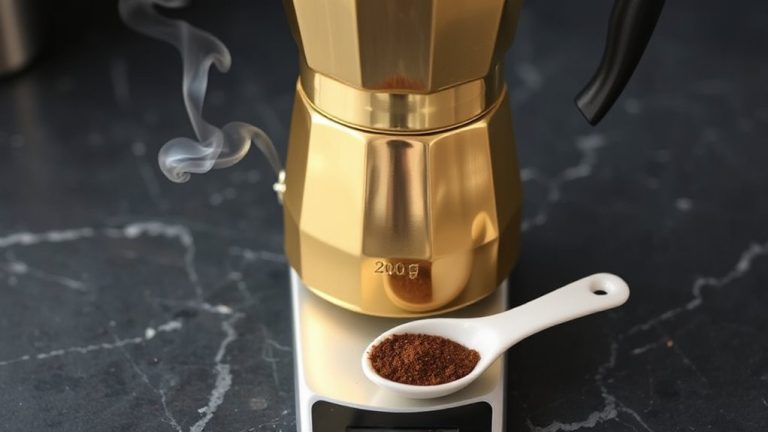
While your grinder may be dialed in to its finest setting, the real test comes when you brew a small shot to check the actual grind consistency. Use freshly ground beans and the same water temperature you’d normally apply-just off boiling, around 200°F-to guarantee accurate results. Brew a single shot in your cezve or ibrik, letting it settle naturally. Examine the sludge: it should be fine, like powdered sugar, with minimal coarse particles. The taste profile should be rich and intense, not sour or harsh. If it’s too sharp, the grind might be too coarse; if it’s overly bitter, the particles could be too fine or the water temperature too high. This test helps confirm your grinder’s performance under real brewing conditions, giving you a reliable baseline before making further tweaks.
Adjust Based on Sediment and Brew Time
How does your coffee’s sediment and brew time reflect the accuracy of your grind? If you see a thick layer of grind sediment settled at the bottom of your cup, your coffee is likely ground fine enough. Too much floating sludge, though, means the grind might be too coarse and could affect flavor clarity. On the other hand, a thin, dusty layer suggests it’s properly fine. Brew duration also tells you something. For Turkish coffee, the ideal brew duration is typically 4 to 6 minutes on low heat. If it boils too fast, the grind may be too fine; if it takes longer, it’s likely too coarse. Adjust your hand grinder in small steps-half a notch at a time-and retest. Track both sediment and brew duration to dial in precision without guesswork.
Lock In Your Turkish Coffee Setting
What if you could hit the same perfect Turkish grind every time, without second-guessing the setting? Lock in your ideal grind by noting the exact position on your hand grinder’s scale. Use a permanent marker or small sticker to mark the sweet spot. Proper burr alignment guarantees uniform particles, critical for smooth Turkish coffee without grit. Any misalignment leads to inconsistent grinds and off flavors. Retention reduction matters too-less coffee trapped in the mechanism means more of your dose ends up in the cup, improving yield and consistency. Confirm your grinder model’s retention rate; compact designs like the 1Zpresso J-Max perform well.
| Grinder Feature | Why It Matters | Example Models |
|---|---|---|
| Burr Alignment | Guarantees even grind | Kinu M47 |
| Retention Reduction | Maximizes coffee use | 1Zpresso Q8 |
| Grind Markings | Allows repeatability | Comandante C40 |
On a final note
You’ve got your grinder set, now lock it in. Turkish coffee needs the finest powder-like grind-think powdered sugar. If the brew is too slow or gritty, adjust slightly finer. Too fast or muddled? Coarsen a touch. Aim for a 2–3 minute brew with fine sediment settled at the bottom. Once it’s consistent, mark the setting. Not all grinders go fine enough; the 1ZPresso JX-Pro or Timemore C2 handle this well. Keep it calibrated-freshness and precision make the cup.