Best Manual Coffee Grinders: TIMEMORE C3S vs 1Zpresso J-Ultra
You get consistent, even grinds with manual coffee grinders like the TIMEMORE Chestnut C3S or 1Zpresso J-Ultra, thanks to their precision conical burrs and fine click adjustments. Ceramic or stainless steel burrs reduce heat and preserve flavor, while 40+ settings let you dial in espresso, pour-over, or French press with repeatable accuracy. They’re quiet, portable, and durable-ideal for home or travel-but require hand effort and regular brushing for maintenance. The right choice depends on your brew method, portability needs, and preferred grind control. Pick one that matches your routine, and you’ll uncover better-tasting coffee with every turn.
We are supported by our audience. When you purchase through links on our site, we may earn an affiliate commission, at no extra cost for you. Learn more. Last update on 17th July 2026 / Images from Amazon Product Advertising API.
Notable Insights
- Ceramic conical burrs reduce heat and static, preserving coffee oils for a cleaner, more flavorful brew.
- Precision grind settings with 0.05mm increments ensure consistent, repeatable results for any brewing method.
- Stainless steel burrs with 55–58HRC hardness offer durability and long-term grind consistency.
- Compact, lightweight designs with foldable handles make top grinders ideal for travel and portability.
- Tool-free disassembly and magnetic catch cups simplify cleaning, maintaining flavor integrity over time.
60g Manual Coffee Grinder with 40 Settings

If you need a manual grinder that handles large batches without sacrificing precision, this 60g model stands out as one of the few that lets you grind for multiple servings in a single session. I use it for French press and pour-over, and it cuts grinding time in half. The 40 click settings give exact control-each click changes the grind by 0.05mm, which even pros notice. Ceramic burrs keep heat low, so flavors stay clean and oils don’t burn. It’s lightweight (just over a pound) and fits in my travel bag, great for camping or commuting. Unlike blade grinders, it delivers even particles, and the external ring means I adjust quickly-no guessing.
Best For: Coffee enthusiasts who want a high-capacity, precise manual grinder for home, travel, or outdoor use with consistent, barista-quality results across multiple brewing methods.
Pros:
- 60g large capacity allows grinding for multiple servings or brew types in one session, ideal for French press, pour-over, and cold brew
- 40 precise external click settings with 0.05mm increments offer lab-accurate grind control without internal adjustments
- Ceramic conical burrs minimize heat and static, preserving coffee oils and delivering uniform particles for enhanced flavor
Cons:
- Manual grinding requires physical effort, which may be tiring for large quantities or frequent use
- Lightweight plastic construction may feel less durable compared to premium metal grinders
- Static can still cause grounds to cling, requiring workarounds like misting beans with water
Mini Manual Coffee Grinder with 40 Settings

The Mini Manual Coffee Grinder with 40 Settings from CEVING suits coffee lovers who want precision and portability without sacrificing grind quality. I use it for everything from espresso to French press, and the 40 settings deliver consistent results. The conical ceramic burr grinds evenly and stays cool, preserving flavor better than blade or steel burr grinders. At 325g, it’s light enough to toss in a bag for camping or travel. It holds 30g per grind-enough for two cups-so it’s best for one or two people. Cleaning’s simple: just pop apart the three main parts and brush off grounds. I avoid water to keep flavors fresh. CEVING made this reliable, practical, and travel-ready.
Best For: Coffee enthusiasts who prioritize precision, portability, and flavor preservation in manual grinding for personal or travel use.
Pros:
- Offers 40 precise grind settings with a conical ceramic burr for consistent, heat-reduced grinding across all brew methods
- Compact, lightweight design (325g) makes it ideal for travel, camping, and on-the-go use
- Easy to clean and maintain with three detachable parts and no need for electricity
Cons:
- 30g capacity limits suitability for larger batches or households with multiple coffee drinkers
- Manual operation requires more effort compared to electric grinders
- Not recommended for water cleaning, which may limit deep cleaning options
1Zpresso J-Ultra Manual Coffee Grinder

You’ll appreciate the Zpresso J-Ultra most if you demand precise, repeatable grind settings for espresso or Turkish coffee, since its external adjustment system offers 8-micron increments that make dialing in consistent. I rely on its stainless steel build and coated conical burrs for clean, even grinds without wobble. It’s compact, with a foldable handle and travel case, so I take it on trips without hassle. The magnetic catch cup holds 35–40 grams and stays put during use. Cleaning’s quick-I pop it apart with no tools and use the included brush. It’s built to last, rated for 100–200kg of beans, and backed by a one-year warranty.
Best For: Coffee enthusiasts who prioritize precise, repeatable grind settings for espresso or Turkish coffee and value portability and durability in a manual grinder.
Pros:
- External grind adjustment in 8-micron increments enables highly accurate and consistent dosing
- Compact, foldable design with included travel case makes it ideal for on-the-go use
- Tool-free disassembly and magnetic catch cup enhance ease of cleaning and workflow efficiency
Cons:
- Limited catch cup capacity of 35–40 grams may require frequent emptying for larger batches
- Stainless steel construction, while durable, adds weight compared to lighter travel grinders
- No built-in scale or timer, requiring additional tools for precise brewing setups
TIMEMORE Chestnut C2S Manual Coffee Grinder

For travelers and home brewers who prioritize durability and grind consistency in a compact package, the TIMEMORE Chestnut C2S stands out. I’ve used it daily, and its full metal body feels solid without adding bulk. The 38mm stainless steel burr delivers even grinds-no fines or boulders-and it handles everything from French press to espresso. At 700g, it’s light but balanced, and the extended handle cuts grinding effort. I can disassemble it quickly for cleaning, which matters when I’m on the move. Adjustments are precise, hidden under the top cap to prevent accidental shifts. It’s not the cheapest, but it’s reliable, consistently ranked in the top 15 manual grinders for good reason.
Best For: Travelers and home brewers seeking a durable, compact, and precise manual coffee grinder with consistent grind performance across all brewing methods.
Pros:
- Full metal body and CNC-machined 38mm stainless steel burr provide durability and excellent grind consistency
- Lightweight (700g) with an ergonomic handle for easy, efficient grinding and portability
- Internally adjustable settings ensure precision and prevent accidental changes during use
Cons:
- Higher price point compared to entry-level manual grinders
- 25g capacity may require multiple batches for larger servings
- Limited color options, currently only available in black
60g Manual Coffee Grinder with 40 Settings

A 60g capacity sets this manual grinder apart, making it the best choice for those who need more ground coffee without multiple refills-ideal for French press, cold brew, or serving a small group. I use the CEVING MCG-02 daily, and its 40 click-ring settings give precise control from espresso to French press, adjusting in tiny 0.05mm steps. Stainless steel burrs crush beans evenly, boosting flavor without heat buildup. It’s compact, lightweight at just over a pound, and fits easily in my bag for travel. Compared to smaller grinders like the TIMEMORE Chestnut C2S, this holds twice as much-fewer refills, less hassle.
Best For: Those who need a high-capacity, portable manual coffee grinder for multiple brewing methods and larger servings without frequent refills.
Pros:
- 60g capacity allows for grinding enough coffee for multiple cups or group servings without refilling, outperforming most manual grinders
- 40 precise click-ring settings in 0.05mm increments enable consistent grind size for everything from espresso to French press
- Durable stainless steel burrs deliver uniform grinding and excellent flavor extraction while remaining compact and travel-friendly
Cons:
- Larger capacity may add slight bulk compared to ultra-compact travel grinders
- Manual grinding requires time and effort, not ideal for those seeking speed or convenience
- Premium build and features come at a higher price point than entry-level grinders
TIMEMORE Chestnut C3S Manual Coffee Grinder

The TIMEMORE Chestnut C3S stands out for travelers and home baristas who demand precision without sacrificing portability. I’ve used it on hikes and at home, and its 1.54-pound aluminum body feels durable yet light. The 52 mm conical burr, made from stainless steel with 55–58HRC hardness, crushes beans evenly-fewer fines mean cleaner flavor. With 36 click settings, I can dial from espresso to French press in seconds. The folding handle clips shut, making it pack-friendly, and the built-in bearing cuts grinding effort noticeably. It disassembles quickly for cleaning, a real plus. At #2 in manual grinders, it’s earned its rank-this is reliable, no-nonsense tooling for real use.
Best For: Travelers, outdoor enthusiasts, and home baristas who value precision grinding and portability in a durable, compact manual coffee grinder.
Pros:
- Durable full-metal aluminum alloy body with excellent heat dissipation and a lightweight 1.54-pound design
- S2C660 stainless steel conical burr (55–58HRC hardness) delivers uniform grind with minimal fines for cleaner flavor
- 36 precise grind settings and folding handle make it versatile for all brew methods and ideal for travel
Cons:
- Manual grinding requires physical effort, which may be tiring for large quantities or frequent use
- Plastic components in the grounds container may feel less premium compared to full metal builds
- Limited hopper capacity best suited for one to two servings, not ideal for groups
PARACITY Manual Coffee Bean Grinder with Ceramic Burr

This grinder stands out for travelers and outdoor enthusiasts who need reliable, consistent results without electricity. I use the PARACITY manual grinder when I’m off-grid, and its ceramic burr delivers even grounds without heat buildup. The adjustable settings work for espresso to French press, and the stainless steel handle feels sturdy. I keep beans in one glass jar and grounds in the other-both fit neatly in my pack. The silicone base prevents slipping, which helps while camping. All parts wash easily, though I watch the glass carefully-it can break if dropped. It’s affordable and portable, but not as durable as metal-bodied grinders. I recommend it for occasional use, not daily heavy grinding.
Best For: Travelers, campers, and outdoor enthusiasts who want a portable, electricity-free coffee grinder for occasional use.
Pros:
- Delivers consistent, uniform grind with adjustable settings for multiple brew methods
- Compact, lightweight design with included glass jars for convenient bean and ground storage
- Easy to clean with all removable and washable parts, plus a nonslip silicone base for stability
Cons:
- Glass components are fragile and prone to breaking if dropped or mishandled
- Less durable than metal-bodied manual grinders, not ideal for heavy daily use
- Only one glass jar included despite description mentioning two
Portable Coffee Grinder with Ceramic Burr
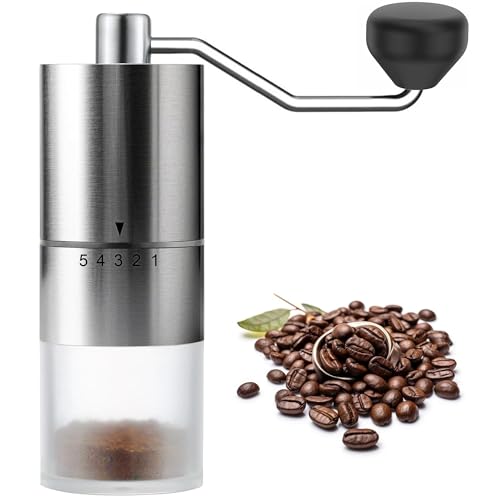
Lightweight and built for the road, the EZLucky EZ-coffee-s stands out if you need a reliable grind on the move. I use it for camping, travel, or when I just want fresh coffee at work. Its ceramic conical burr gives five grind settings, so I can dial in espresso, pour-over, or French press with real consistency. At 250g, it’s light but feels solid, thanks to the stainless steel body and durable ceramic core. The acrylic container cleans easily, and the external adjustment saves time. It’s not the fastest, but for portability and flavor clarity, it’s a smart pick. With 4.2 stars from 409 reviews, it’s clearly working for others too.
Best For: Travelers, campers, and coffee enthusiasts who want fresh, consistent grinds on the go without sacrificing flavor or portability.
Pros:
- Lightweight (250g) and portable with durable stainless steel construction and ceramic burr for precise grinding
- Five adjustable settings for versatile brewing methods including espresso, French press, and pour-over
- Easy to clean with a fully washable design and external grind adjustment for quick customization
Cons:
- Manual grinding requires effort and time, making it slower than electric grinders
- Acrylic grounds container may feel less premium and could be prone to cracking if dropped
- Inconsistent weight listing (0.705 oz vs. 250g) may cause confusion for potential buyers
CIRCLE JOY Manual Coffee Grinder
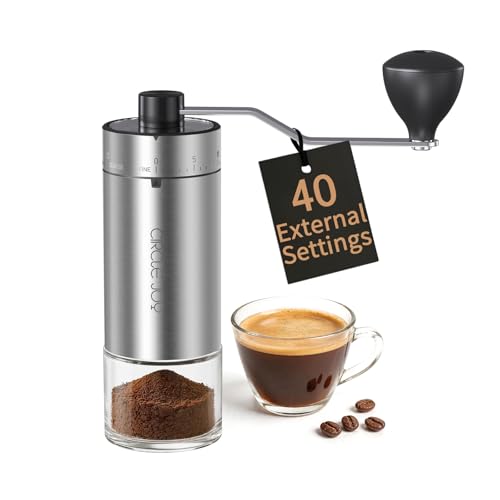
When precision across every brew method matters, the CIRCLE JOY Manual Coffee Grinder stands out with 40 external grind settings that let me switch smoothly from fine espresso to coarse French press without guesswork. Its ceramic conical burrs crush beans evenly, which means better flavor and less heat damage. I appreciate the long handle-it reduces strain and speeds up grinding. At just over a pound, it’s light enough for travel or camping. The clear glass hopper lets me monitor grounds, so I don’t overfill. Built with stainless steel and durable plastic, it feels solid but not bulky. It’s compact, easy to store, and ideal for home, office, or on-the-go use.
Best For: Coffee enthusiasts who value precision, portability, and durability in a manual grinder for home, travel, or outdoor brewing.
Pros:
- Offers 40 precise external grind settings for full versatility across all brewing methods
- Features ceramic conical burrs that ensure consistent grinding with minimal heat buildup
- Compact, lightweight design with a comfortable handle and clear glass hopper for easy monitoring
Cons:
- Glass hopper may be less durable than plastic or metal alternatives during travel
- Manual operation requires effort, which can be tiring for large quantities
- Premium build and materials come at a higher price point compared to basic grinders
TIMEMORE Chestnut C2 Manual Coffee Grinder

The TIMEMORE Chestnut C2 stands out for users who prioritize grinding precision in a compact, portable design-especially those brewing manually at home, in the office, or on the trail. I use its 420 stainless steel burrs for consistent grind size, and the double-bearing system makes cranking smooth with less hand fatigue. It’s lightweight at 1.3 pounds, holds 25g, and fits in my bag with the included cloth pouch. I adjust the grind internally with the center knob-clockwise for finer, like pour over; counterclockwise for coarse, like French press. I clean it easily with the included brush; no water needed. It’s reliable, durable, and great for travel.
Best For: Manual coffee brewers seeking a compact, precise, and portable grinder for home, office, or outdoor use.
Pros:
- High-precision 420 stainless steel burrs deliver consistent grind size for optimal flavor across brewing methods
- Smooth double-bearing mechanism reduces hand fatigue and ensures comfortable, effortless grinding
- Lightweight, tool-free design with included carrying pouch makes it ideal for travel and on-the-go brewing
Cons:
- Limited 25g capacity may require multiple batches for larger brews
- Internal grind adjustment can be less intuitive for beginners
- Not recommended for water cleaning, which may limit deep-cleaning options
Factors to Consider When Choosing a Manual Coffee Grinder
You’ll want a grinder that gives you precise grind sizes, especially if you’re using different brew methods like pour over or French press. Look for durable burrs-ceramic or stainless steel-since they last longer and keep grinding evenly over time. Consider how easy it is to adjust settings, how much coffee it holds, and whether you’ll carry it while traveling.
Grind Size Precision
Though flavor starts with the bean, it’s your grinder’s precision that determines whether those notes come through clean or muddled. You need consistent grind size-adjustments as small as 0.05mm can make or break extraction. Look for conical burrs with 55–58HRC hardness; they crush beans evenly, reducing boulders and fines. High-end models offer up to 40 external click settings, giving you repeatable control from Turkish to French press. Each click can adjust the grind by just 8 microns, which is essential when dialing in espresso or pour-over. External adjustment lets you tweak settings fast, no tools needed, so you keep calibration intact. Blade grinders? They’re out-no real precision, just uneven chunks and powder. For true control, pick a manual grinder with fine, numbered increments and a sturdy mechanism. Your daily brew will taste balanced, not bitter or weak.
Burr Material Quality
Burr material plays a key role in how your coffee tastes and how long your grinder lasts. You’ll mainly choose between ceramic and stainless steel. Ceramic burrs stay cool during grinding, protecting delicate coffee oils for smoother, more complex flavors, and they resist corrosion while running quietly-ideal for light to medium roasts. But they’re more brittle, so avoid heavy or uneven pressure. Stainless steel burrs, especially those with a 55–58HRC hardness rating, offer excellent durability and hold their sharpness longer, making them great for frequent use. Both materials work best in conical designs, which crush beans evenly and reduce fines for better extraction. Look for precision-coated or CNC-machined burrs, as they boost consistency and flavor clarity. Choose ceramic for flavor purity and quiet use, steel for toughness and longevity.
Capacity And Portability
A manual coffee grinder’s capacity and portability directly impact how and where you brew. You’ll typically find capacities between 25g and 60g-enough for one to four cups. Larger chambers let you grind multiple servings at once, ideal for families or French press use, while smaller 25–30g hoppers suit single espresso or pour-over sessions. If you travel, camp, or have limited space, size matters. Most portable grinders stand under 8 inches tall and weigh between 250g and 700g, with lighter models easier to pack. Look for compact builds under 3 inches wide and features like foldable handles or detachable shafts-they slip neatly into bags. The 1Zpresso Q2, for example, balances 48g capacity with sub-350g weight, making it travel-friendly without sacrificing grind volume. Choose based on your brewing frequency and mobility needs.
Adjustability Ease
When fine-tuning your grind size matters for consistent brews, opt for a manual grinder with an external adjustment ring that gives you at least 30 distinct settings-you won’t need to take the unit apart just to make small changes. Turn the ring and feel each click, with adjustments as precise as 0.05mm or 8 microns, letting you fine-tune for clean pours or rich espresso. These micro-adjustments deliver lab-level consistency, even noticeable to expert palates. Look for numbered markers-they make it easy to return to your go-to setting for French press or pour-over. Unlike internal dials, external rings let you tweak grind size mid-brew, no reassembly needed, so cleanup stays simple. Models like the 1ZPresso Q2 or Timemore C2 use this click-ring design for reliable, tactile control. You get repeatable results, session after session, without guesswork. It’s practical precision that suits daily use and shifting brew methods-just twist, grind, and go.
Build Durability
You want your manual grinder to last, so start by checking the build materials-stainless steel and aluminum alloy bodies handle daily use without warping or wearing down. These metals resist corrosion and maintain structural strength, even with frequent grinding. Look for grinders with fully metal construction and a double-bearing axis system; they reduce wobble, distribute stress evenly, and prevent premature wear. The burrs matter just as much: ceramic ones stay cool and resist degradation over time, while high-quality metal burrs with a hardness rating of 55–58HRC keep their shape and deliver consistent grounds. Avoid plastic housings-they flex under pressure and weaken over time. You’ll get better long-term performance from models like the 1ZPresso Q2 or Timemore C2, which use durable materials throughout. Build quality directly impacts grind consistency and lifespan, so don’t skip it when comparing options.
Ease Of Cleaning
Keeping your manual grinder clean guarantees consistent flavor and prevents old oils from spoiling future brews. You’ll want a model that disassembles quickly without tools-many let you access the burrs and chamber in seconds. Ceramic burrs help here, producing less static than steel, so grounds don’t stick as much. Look for grinders with smooth, seamless chambers and removable parts; fewer crevices mean less gunk buildup over time. Magnetic catch cups or detachable grounds containers make emptying and wiping down simple, cutting down on stale residue. Always use a dry brush for cleaning-water can cause rust, mold, or off-flavors, especially in steel components. While some grinders are easier to wipe out than others, avoiding moisture keeps your grind fresh and your machine reliable. Choose smart features that cut cleaning time without risking damage.
Weight And Dimensions
A manual grinder’s weight and size directly impact where and how you use it. Most models weigh between 300g and 750g, with ones under 400g being easier to carry in a backpack or pack. If you’re traveling or storing it in a tight kitchen, look for compact dimensions-under 8 inches tall and less than 3 inches wide fits neatly in drawers or travel bags. Lightweight grinders can wobble, so check for a low center of mass and a nonslip base to stay steady while grinding. Larger grinders often hold more beans but add bulk, making them less ideal for on-the-go use. Foldable handles cut 2–3 inches from the length, boosting portability. Think about where you’ll use it most-your kitchen counter, campsite, or office-and pick a size that fits that space without crowding it.
Hand Crank Efficiency
While grind consistency starts with the burrs, the hand crank’s design plays a decisive role in how effortless or laborious your grinding session becomes. A longer handle gives you more leverage, cutting down hand fatigue-especially when you’re doing a full 30g grind. Look for models with built-in bearings; they let the crank spin smoothly and keep momentum, so you don’t have to work as hard. Foldable handles save space but often shorten the crank, meaning more turns and slower grinding. The grip matters too-textured, ergonomic shapes improve control and comfort during long sessions. High-efficiency cranks with low resistance can finish a full dose in under a minute, like those on the 1Zpresso J-X or Comandante C40. If speed and ease are priorities, prioritize crank design just as much as burr quality.
Frequently Asked Questions
How Long Does a Manual Coffee Grinder Last?
You can expect a manual coffee grinder to last 5 to 10 years with regular use and proper care. High-quality models like the 1Zpresso J-Max or Timemore C2 use durable stainless steel burrs that resist wear. Cheaper grinders may degrade faster due to plastic parts or low-grade metal. Clean it monthly, avoid moisture, and you’ll maintain consistent grind quality. It won’t outlive an electric grinder, but it’s reliable, portable, and repairable in many cases.
Can I Use a Manual Grinder for Tea Leaves?
You can use a manual grinder for tea leaves, but it’s not ideal. You’ll risk clogging the burrs, especially with fine settings meant for espresso. If you do, choose a grinder with adjustable coarseness like the Hario Skerton Pro or 1ZPresso Q2, and clean it thoroughly after. For regular tea grinding, a dedicated herb grinder works better and preserves your coffee grinder’s performance over time.
Are Manual Grinders More Consistent Than Electric Ones?
You typically get more consistent grind size with electric burr grinders, especially mid-range to high-end models like the Baratza Encore or Fellow Opus. Manual grinders, such as the 1Zpresso JX-Pro or Timemore C2, can be consistent too, but depend heavily on your hand speed and pressure. Electric grinders save time and reduce user error. If precision and convenience matter, go electric. For travel or simplicity, a quality manual works fine.
Do Manual Grinders Work Well for Espresso?
Yes, manual grinders can work well for espresso if you use a high-quality model with precise, consistent burrs like the 1Zpresso JX-Pro or K-Mill M4. You’ll need to apply steady, even pressure and develop a consistent technique to achieve the fine, uniform grounds espresso demands. While slower than electric grinders, manual options offer control, portability, and lower cost-ideal for home or travel use when precision matters.
Is It Safe to Clean a Manual Grinder With Water?
youhttps://thecoffeemania.com/best-manual-coffee-grinders/)You shouldn’t clean your manual grinder with water. Water causes rust on metal burrs and internal parts, especially in models like the 1Zpresso J-Max or Timemore C2. Moisture also makes leftover coffee grounds stick and clump, which hurts grind quality. Instead, you should disassemble it regularly-brush out grounds with a brass brush and use a dry, stiff cloth. If needed, use rice to absorb oils and debris, then wipe dry. Keep it dry and clean properly to maintain performance and longevity.