Blending Artistry: How to Combine Coffees for Optimal Flavor Profiles
You start by choosing beans with complementary traits-like bright, floral Ethiopians and deep, earthy Sumatrans. Balance acidity and body so neither overpowers. Roast each bean separately to bring out its best: lighter for brightness, darker for richness. Then brew with the right grind and water temperature, taste black, and tweak ratios by 10% until it’s balanced. There’s more to fine-tuning your ideal mix just ahead.
Notable Insights
- Begin by evaluating individual bean profiles to understand their unique aroma, acidity, body, and aftertaste contributions.
- Combine high-brightness beans like Ethiopian with deep, earthy Sumatran for balanced flavor complexity.
- Match roast profiles to each bean’s characteristics to preserve acidity or enhance body as needed.
- Use precise brew methods with proper grind size and temperature to clearly assess blend performance.
- Adjust blend ratios in 5–10% increments, tasting black to refine brightness, depth, and mouthfeel balance.
Understand Coffee Flavor Profiles First
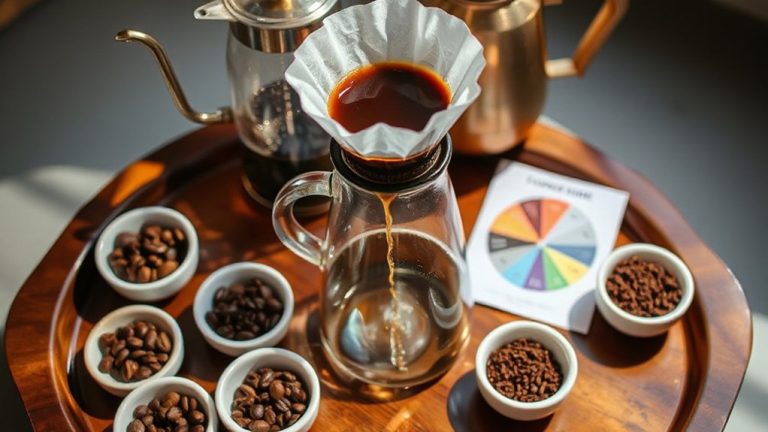
Flavor starts with knowing what’s in your cup. You can’t blend well if you don’t understand individual coffee profiles first. Each bean carries distinct flavor notes-think citrus, chocolate, or nuts-shaped by origin, roast, and processing. Sensory evaluation helps you identify these traits systematically. Train your palate by slurping black coffee slowly, noting aroma, acidity, body, and aftertaste. Use a flavor wheel or tasting form to track patterns. Light roasts often highlight floral or fruity notes; dark roasts emphasize bitterness and structure. Compare single-origin coffees side by side to sharpen your skills. Tools like pour-over cones or French presses give clearer profiles than automatic machines. This baseline knowledge makes blending purposeful, not guesswork. You’ll know which beans add sweetness, which cut harshness, and how to balance a final cup with intention and repeatable results. A great way to develop this skill is through structured tasting sessions using a coffee tasting kit.
Pick Origins That Balance Brightness and Depth
You’ve learned how to identify the individual traits in single-origin coffees, from citrusy brightness to chocolatey depth. Now, smart origin pairing helps you achieve flavor harmony in your blend. Combine a bright Ethiopian, with its lemon and floral notes, with a deep Sumatran offering earthy, chocolatey weight. This contrast balances high notes and low. A Colombian can add structure, while a Guatemalan brings complexity. Kenya AA introduces sharp fruitiness, best tamed by smoother Brazilian base notes.
| Origin | Brightness | Depth |
|---|---|---|
| Ethiopia | High | Low |
| Sumatra | Low | High |
| Colombia | Medium | Medium |
| Guatemala | Medium | Medium |
| Brazil | Low | Medium |
Choose origins to complement, not compete-flavor harmony depends on intentional contrast and proportion.
Balance Acidity and Body in Your Blend
Most successful blends strike a clear balance between acidity and body, two pillars that shape how coffee feels and tastes. You want enough acidity to bring brightness and liveliness, but not so much that it overwhelms the cup. At the same time, a strong body adds richness and weight, often from beans like Sumatran or Brazilian. Too much body, though, can make the coffee feel heavy or muddy. Your goal is mouthfeel harmony-where the smoothness and texture support, rather than clash with, the flavor. Achieving this creates flavor synergy, enhancing notes like citrus or chocolate instead of masking them. For example, pairing a bright Ethiopian with a full-bodied Guatemalan can balance crispness and depth. Adjust your ratios by 5–10% to fine-tune. Use brewing methods like a paper filter to highlight acidity or a French press to emphasize body. A well-chosen French press coffee maker can significantly influence the body and depth of your blended coffee.
Roast Each Bean for Blend Balance
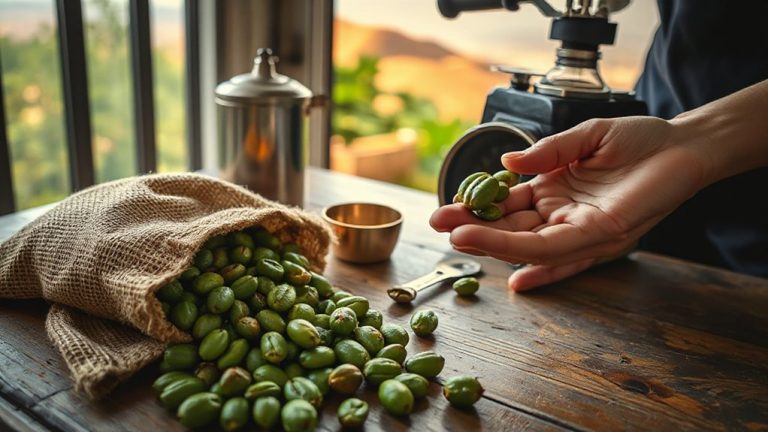
Getting the right balance between acidity and body sets the foundation for a great blend, but that balance starts long before mixing beans-it begins in the roaster. You need to roast each component separately to match its characteristics. Beans vary in bean density, which affects how they absorb heat-denser beans often need more energy and time. If you don’t account for this, underdeveloped or scorched flavors can ruin your blend. Roast curvature matters too; it’s how the bean’s temperature changes over time. A smooth, controlled curve preserves clarity, while erratic ramps create unevenness. Roast light for bright, acidic beans to lift the blend, and go darker on low-acid, heavy-bodied ones to add depth. This way, each bean contributes intentionally. Blending pre-roasted components gives you precise control, especially with profile roasters that track heat retention and airflow. You’re not guessing-you’re building. For consistent and high-quality results, consider using essential tools like a coffee roasting thermometer to monitor bean temperature throughout the process.
Brew, Taste, and Adjust Your Ratios
How do you know if your blend truly works? You brew it, taste it, and tweak it. Use a consistent water temperature-usually 195–205°F-to extract flavors evenly. Match your grind size to your brew method: fine for espresso, medium for pour-over, coarse for French press. Small changes here make big differences in flavor. Taste the coffee black, noting brightness, body, and balance. If it’s too sour, adjust the grind finer or increase brew time. If it’s bitter, go coarser or lower the temperature slightly.
| Brew Method | Grind Size |
|---|---|
| Espresso | Fine |
| Pour-over | Medium |
| AeroPress | Medium-Fine |
| French Press | Coarse |
| Cold Brew | Extra Coarse |
Adjust your bean ratios-start with 50/50, then shift by 10% increments. Record each change. Repeat until it’s balanced.
On a final note
You now know how to build a balanced blend by matching bright, acidic beans like Ethiopian Yirgacheffe with deeper, fuller-bodied ones like Sumatran. Roast each separately for ideal flavor, then brew and tweak ratios-try 60/40 or 70/30-until acidity and body align. A good burr grinder and consistent brew method, like pour-over or espresso, make all the difference. Adjust based on taste, not theory.