Coffee Refractometers Compared: VST vs R2 Extract vs Flagfront
You’ll want a refractometer with ±0.02% accuracy and 0.01% resolution for precise TDS measurements, like the R2 Extract or VST models pros use. These give consistent results for espresso and pour-over, with fast 3–5 second readings and automatic temperature compensation. Look for IP67 waterproofing, backlit displays, and app integration for logging brews. Compact, durable designs handle café use. Simpler tools like the PAL-COFFEE work well for quick checks. Your next step reveals how each model fits different brewing needs.
We are supported by our audience. When you purchase through links on our site, we may earn an affiliate commission, at no extra cost for you. Learn more. Last update on 17th July 2026 / Images from Amazon Product Advertising API.
Notable Insights
- Pros prefer refractometers with ±0.02% accuracy for precise TDS measurement in espresso extraction.
- Devices like the R2 Extract offer lab-grade precision, app integration, and IP67 waterproof durability.
- Automatic Temperature Compensation (ATC) ensures reliable readings across varying brew temperatures.
- Compact, lightweight designs such as the Pocket Coffee Densitometer enable portability and ease of use.
- Factory-calibrated, sealed optics with backlit displays enhance readability and maintain accuracy over time.
R2 Extract Coffee TDS Refractometer

If you’re serious about dialing in precise coffee extractions, the R2 Extract Coffee TDS Refractometer is the best choice for baristas and specialty coffee enthusiasts who need reliable, lab-grade measurements in real time. I use it daily for espresso, pour over, and cold brew-it delivers consistent results with ±0.02% precision. Its compact size fits in my apron pocket, and at just 9.9 ounces, it’s easy to carry. The IP67 rating means I can rinse it clean without worry. With Standard, Multi-Test, and Auto-Test modes, it adapts to any workflow. I log every brew in the app, track trends, and fine-tune recipes with real data-no guesswork.
Best For: Baristas, specialty coffee shops, and serious coffee enthusiasts who demand lab-grade precision and real-time TDS measurements for espresso, pour over, and cold brew.
Pros:
- High-accuracy TDS measurements with ±0.02% precision and 0.01% resolution for precise extraction analysis
- Compact, lightweight design with IP67 waterproof rating for durability and easy cleaning in fast-paced environments
- Integrates with a mobile app for brew logging, recipe sharing, and data-driven technique refinement
Cons:
- Requires regular calibration and proper sample handling to maintain measurement accuracy
- Higher price point compared to basic refractometers, potentially limiting access for casual users
- Mobile app dependency may be inconvenient for users preferring standalone operation
Flagfront Digital Brix Refractometer 0-55

I rely on the Flagfront Digital Brix Refractometer 0–55 when I need fast, consistent readings for coffee or beverage analysis without juggling multiple devices. It gives me accurate Brix measurements from 0–55% with ±0.1% precision in about 3 seconds. Automatic temperature compensation means I get reliable results even if my sample’s warm. The anti-glare display works great outdoors, and the IP58-rated, stainless steel design handles spills and dust without issue. It’s compact, sealed, and durable-perfect for the field or kitchen. I use it for coffee, juice, or fruit testing, and it covers most routine needs. It comes with test tubes, a cleaning cloth, and manual, plus solid support: 1-year warranty, lifetime tech help, and quick customer service. While it doesn’t measure TDS directly like an R2 Extract, it’s a versatile, budget-friendly option for broad sugar analysis across beverages and agriculture.
Best For: Coffee producers, juice manufacturers, and agricultural professionals needing a fast, accurate, and durable digital Brix refractometer for field or kitchen use.
Pros:
- Delivers quick, precise Brix measurements (0–55% with ±0.1% accuracy) in just 3 seconds
- Features automatic temperature compensation and anti-glare display for reliable outdoor and variable-condition use
- Rugged, IP58 waterproof design with stainless steel sample tank ensures durability and easy cleaning
Cons:
- Does not measure TDS or provide espresso extraction-specific data like specialized tools such as R2 Extract
- Limited to Brix measurement only, lacking multi-parameter analysis for advanced beverage testing
- Requires a 12V battery, which may be less common and more costly to replace than standard batteries
Coffee Brewing Control System – TDS Refractometer & Scale
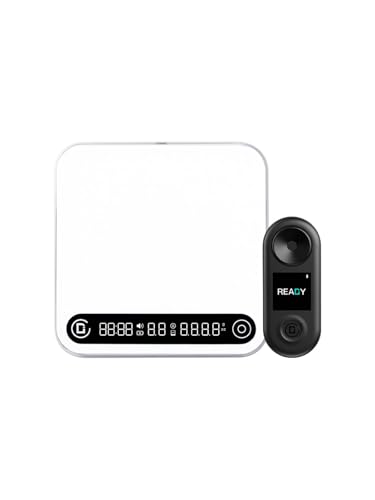
The Coffee Brewing Control System – TDS Refractometer & Scale is built for baristas and home brewers who treat coffee like a science, not guesswork. I rely on its 0.02% TDS precision and 0.1g scale resolution to hit the Golden Cup standard consistently. The smart app tracks brew time, flow rate, and extraction in real time, which helps me fine-tune pour over or espresso with confidence. It offers Standard, Multi-Test, and Auto-Test modes, works across brewing methods, and syncs data via app for analysis. The IP67-rated refractometer is durable, easy to clean, and battery-powered for convenience.
Best For: Baristas and precision-focused coffee enthusiasts who want scientific control over brewing parameters for consistent, high-quality results.
Pros:
- Delivers lab-grade accuracy with 0.02% TDS precision and 0.1g scale resolution for optimal extraction analysis
- Real-time smart app integration tracks brew time, flow rate, and concentration with intuitive data visualization
- Durable, IP67 waterproof refractometer with multiple test modes and easy cleanup suits high-volume or home use
Cons:
- High price point may be prohibitive for casual coffee drinkers or beginners
- Requires calibration and maintenance for accurate TDS readings, adding complexity
- App dependency may limit accessibility for users preferring standalone device operation
Coffee Brewing Kit with Scale & Refractometer

You’ll get the most out of this coffee brewing kit if you’re someone who values precision and consistency in every cup, especially when dialing in pour over, espresso, or cold brew. I rely on the COFFMETER Brew Control System 2’s 0.02% TDS accuracy and 0.1g scale readings to nail extractions. Its drip-activated timer and real-time flow tracking simplify brews, while the IP67 refractometer handles spills and travel. Paired with the app, I log data, tweak recipes, and compare results with other users. It’s not cheap, but for serious control at home or in a café, it’s one of the most practical setups I’ve used.
Best For: Home baristas and coffee professionals who prioritize precision, consistency, and data-driven brewing in pour over, espresso, or cold brew.
Pros:
- High-precision TDS refractometer (0.02% accuracy) and digital scale (0.1g precision) ensure consistent extraction and repeatability
- Smart app integration enables recipe storage, data tracking, and community sharing for refining brewing techniques
- Durable, portable design with IP67 waterproof rating and drip-activated features ideal for use at home, in cafés, or on the go
Cons:
- Premium price point may be prohibitive for casual coffee drinkers
- Requires calibration and maintenance for accurate refractometer readings
- App-dependent features may be less accessible without a smartphone or tablet
3-in-1 Rechargeable Brix Refractometer for Wine, Coffee, Honey
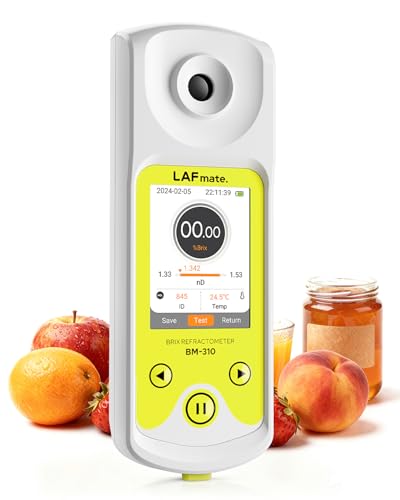
Packed with versatility, the 3-in-1 Rechargeable Brix Refractometer suits coffee makers who also dabble in wine or honey-based brewing and want accurate, consistent measurements without juggling multiple devices. I rely on its ±0.2% precision and ATC to deliver stable results, even in changing temps. The backlit TFT screen is clear in low light, and switching between Brix, specific gravity, and RI is simple. I like that it stores 100 readings and charges fast via USB-C. It’s IP65-rated, so spills won’t kill it. Calibration with water is quick-no special fluid needed. At just over 8 ounces, it’s portable, and the 12-hour battery is reliable. LAFMATE includes a case, dropper, and cloth, which I actually use. Model BM-310 (ASIN: B0FKGMMFJ1) works well for coffee, but I’ve used it confidently in mead and wine batches, too. It’s not flashy, but it’s practical, accurate, and built for real use. Released in November 2025, it’s a solid upgrade over single-use tools.
Best For: Coffee makers, home brewers, and winemakers who need a versatile, portable, and accurate refractometer for measuring sugar content in wine, coffee, honey, and more without requiring multiple devices.
Pros:
- Measures Brix, specific gravity, and refractive index with ±0.2% accuracy and automatic temperature compensation for reliable field readings
- Rechargeable via USB-C with 12-hour battery life, IP65-rated for durability, and includes essential accessories like dropper, case, and calibration cloth
- Stores up to 100 readings, features a backlit TFT display for low-light use, and allows easy water-based calibration without special fluids
Cons:
- Limited to 0.05% resolution, which may not suffice for highly precise laboratory applications
- No external software or Bluetooth connectivity for data export or advanced analysis
- Relatively short standby time of over 15 days, which may require frequent recharging during extended storage
GOYOJO Digital Brix Refractometer for Liquids

For anyone serious about precision in coffee brewing-especially at the bench level-the GOYOJO Digital Brix Refractometer delivers fast, dependable readings with minimal fuss. I get accurate results in just 3 seconds, with ±0.5 Brix precision across a 0–55% range. It works great for coffee, juice, beer, and more. Automatic temperature compensation (10°C–80°C) means I don’t tweak settings when the room shifts. It needs only 3–5 drops per test, so I save samples. The design is compact, fits in my pocket, runs on included AAA batteries, and shuts off automatically. Model GT128, from GOYOJO, is reliable, field-ready, and practical for daily use.
Best For: Coffee professionals and food/beverage artisans who need fast, accurate sugar content measurements in lab, kitchen, or field settings.
Pros:
- Delivers precise ±0.5 Brix accuracy in just 3 seconds with automatic temperature compensation (10°C–80°C)
- Requires only 3–5 drops (0.2 ml) per test, conserving valuable samples
- Compact, portable design with auto shut-off and included AAA batteries for field-ready convenience
Cons:
- Limited to a 0–55% Brix range, which may not suit highly concentrated solutions
- Battery-powered operation may require frequent replacements in high-use scenarios
- No data logging or connectivity features for digital record-keeping
Brix Refractometer with ATC for Brewing
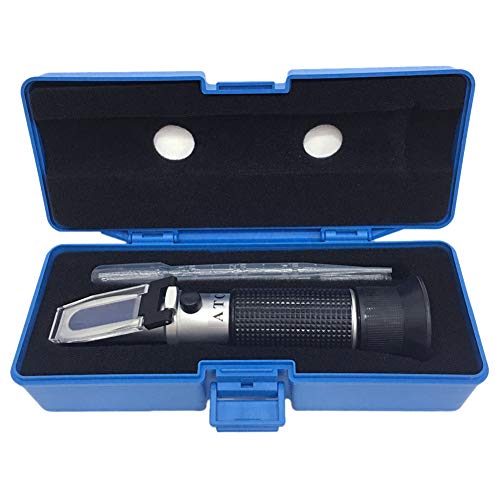
Though compact and straightforward, the Brix Refractometer with ATC for Brewing stands out if I prioritize consistent, temperature-compensated readings in fast-paced brewing environments. It measures 0–32% Brix and 1.000–1.120 specific gravity with a dual scale, so I get both values instantly. The ATC feature means I don’t sweat small temperature shifts-they won’t skew my results. Built from chrome-plated metal, it’s light at 3.7 ounces and fits in my palm, surviving repeated use. Made by Xindacheng (model COMINHKPR124469, ASIN B01LW2ZU6R), it’s not discontinued and has held top rankings since 2016.
Best For: Homebrewers, winemakers, and gardeners who need fast, accurate sugar content and specific gravity measurements with automatic temperature compensation.
Pros:
- Provides dual-scale readings (0–32% Brix and 1.000–1.120 specific gravity) for instant, simultaneous measurements
- Automatic temperature compensation (ATC) ensures reliable results despite temperature fluctuations
- Durable, lightweight chrome-plated metal construction makes it portable and built for repeated use
Cons:
- Limited to liquid samples, not suitable for viscous or opaque substances that can affect accuracy
- Requires manual calibration and regular cleaning to maintain measurement precision
- Chrome-plated finish may degrade over time with exposure to harsh substances or improper handling
Digital Brix Refractometer 0-35% ATC

If you’re a coffee professional or a detail-driven home barista who values speed and consistency, the Digital Brix Refractometer 0-35% ATC from Aicevoos fits the role. I rely on this tool daily-it reads Brix levels in just 5 seconds with 0.1% resolution and ±0.2% accuracy. Its automatic temperature compensation (10–40°C) means I get reliable results without waiting. The backlit LCD helps in low light, and the IP65 rating stands up to spills and dust. It’s light, tough, and easy to clean. While it doesn’t go beyond 35% Brix, that’s plenty for espresso and brewed coffee.
Best For: Coffee professionals and detail-driven home baristas who need fast, accurate Brix measurements for espresso and brewed coffee.
Pros:
- Delivers quick 5-second readings with 0.1% resolution and ±0.2% accuracy for consistent results
- Automatic temperature compensation (10–40°C) ensures precision across varying sample temperatures
- Rugged, IP65-rated design resists water, dust, and drops, making it ideal for busy or on-the-go environments
Cons:
- Limited to a maximum of 35% Brix, which may not suit applications requiring higher sugar concentration measurements
- Requires AAA batteries, which may need frequent replacement in high-use settings
- Backlit LCD, while helpful in low light, may degrade over time with heavy usage
Pocket coffee densitometer PAL-COFFEE (BX/TDS) From import JPN

The Pocket Coffee Densitometer PAL-COFFEE (BX/TDS) from Atago, imported from Japan, stands out for coffee enthusiasts and professionals who demand precision in measuring brew strength. I rely on its 0.01% resolution to catch small differences in concentration, even in hot coffee. It gives stable readings and converts Brix to TDS with one button hold-super convenient. I use the dual-scale model because it shows both BX and TDS, unlike the single-scale version. It’s compact, runs on included AAA batteries, and weighs just 6.3 oz. Atago backs it with a 1-year warranty. Not top-ranked in broad categories, but it’s proven accurate for real-world brewing.
Best For: Coffee professionals and enthusiasts who need precise, portable measurement of coffee concentration with dual-scale Brix and TDS readings.
Pros:
- High 0.01% resolution for detecting subtle differences in coffee strength
- Dual BX/TDS scales with easy one-button Brix to TDS conversion
- Compact, lightweight design with included AAA batteries for immediate use
Cons:
- Niche product with limited relevance outside coffee brewing applications
- Low market visibility, ranked poorly in broad retail categories
- Requires careful handling and calibration for consistent accuracy
3-in-1 Digital Brix Refractometer for Honey, Juice, Coffee

You’ll want the LOHAND LH-T95 3-in-1 Digital Brix Refractometer if you’re serious about precision across coffee, honey, and juice testing-especially when speed and multi-use functionality matter. I rely on its 0–95% Brix range, ±0.3% accuracy, and ATC for consistent results in under 3 seconds. The color touchscreen clearly shows Brix, RI, and temperature, and it’s simple enough for beginners. It’s compact, IP65-rated, and runs on included AAA batteries. I clean the prism with water, not submerging the body. The included tools and lifetime support make it practical for field or lab use.
Best For: Professionals and enthusiasts in food processing, agriculture, brewing, or beekeeping who need fast, accurate, and portable sugar concentration measurements across honey, juice, coffee, and other liquids.
Pros:
- 3-in-1 functionality measures Brix, Refractive Index, and temperature with ±0.3% accuracy and Automatic Temperature Compensation (ATC)
- Color touchscreen display with intuitive interface delivers results in under 3 seconds-ideal for beginners and experts alike
- Compact, IP65-rated design with included accessories and lifetime technical support makes it durable and user-friendly for field or lab use
Cons:
- Prism requires careful cleaning with water only; device is not fully submersible despite IP65 rating
- Uses AAA batteries, which may need frequent replacement in heavy-use scenarios
- High 0–95% Brix range may exceed needs for casual users, potentially adding unnecessary cost
Factors to Consider When Choosing Coffee Refractometers
You’ll want a refractometer that gives you accurate, repeatable readings so you can trust your brew numbers. Look for a sturdy build, clear display, and simple calibration-these keep things running smoothly whether you’re in a cafe or on the go. Size matters too, since a compact design fits better in tight workspaces or a tool bag.
Measurement Accuracy And Precision
While measuring coffee extraction, accuracy and precision in your refractometer directly impact how well you can fine-tune brews. You’ll find most models offer accuracy between ±0.02% and ±0.3%, but pros stick with devices at the tighter end-±0.02%-especially for espresso, where small errors throw off results fast. Look for 0.01% resolution so you catch tiny shifts in total dissolved solids (TDS), helping you adjust grind or time with confidence. Automatic Temperature Compensation (ATC) is a must-it corrects readings between 5°C and 40°C, so you’re not recalibrating every time the sample cools. High-resolution optics and factory-calibrated sensors boost repeatability, meaning your numbers stay consistent from shot to shot. Skip cheaper units without ATC or fine resolution-those can’t keep up with real-world brewing demands. Trust a precise tool, and your adjustments stay grounded in data, not guesses.
Device Durability And Build Quality
A durable build guarantees your coffee refractometer stands up to the daily grind of a busy café or frequent field use. Look for waterproof ratings like IP65 or higher-these keep water and dust out during cleaning or in humid conditions. Opt for models with stainless steel or rugged polymer housings; they resist impacts, scratches, and corrosion better than basic plastics. Sealed optics maintain accuracy, even when spills or temperature swings happen. A non-slip casing helps you hold it securely, reducing drop risks. Units with a protective prism cover or built-in calibration last longer by limiting contamination and wear. Avoid flimsy designs-cheap materials crack or degrade under constant use. While some refractometers skimp on durability to cut costs, investing in a well-built device means consistent performance over time. You’ll save money and hassle by choosing toughness over convenience.
Portability And Size Considerations
Size and weight matter when you’re moving between stations or brewing on the go. Compact refractometers under 3.5 inches long and weighing less than 10 ounces fit easily in a pocket or toolkit, making them ideal for baristas who switch locations. Models around 0.9 x 0.6 x 3.3 inches offer one-handed use, so you can test brews without slowing down service. Lightweight units, especially those between 5 and 8 ounces, reduce hand fatigue during back-to-back readings-perfect for busy cafes or travel setups. Look for rugged, pocket-friendly builds with non-slip grips and durable exteriors to handle daily bumps and frequent use. If you work outdoors or in steamy environments, a waterproof rating like IP65 keeps dust and moisture out, ensuring reliable performance whether you’re in a shop or at a pop-up event. These features make transport and field use hassle-free.
Ease Of Calibration And Use
When you’re in the middle of a busy service, you don’t have time for complicated setups-choose a coffee refractometer that calibrates quickly and operates intuitively. Use models that calibrate with distilled water-it’s simple, cheap, and always available. Skip those needing special fluids; they’re extra hassle and cost. Pick a unit with automatic temperature compensation (ATC); it adjusts readings on its own, so you’re not guessing corrections. One-button calibration with on-screen prompts makes life easier, especially for new users. Look for a beep or light that confirms calibration worked-no guesswork. Devices like the VST or Atago PAL-COFFEE offer clear menus and backlit displays, so you can work fast without mistakes. These features cut down errors and training time. In high-volume cafes, speed and reliability matter. A refractometer that’s simple to use gets accurate results, every time, without slowing you down.
Display Clarity And Readability
What good is an accurate reading if you can’t see it clearly? You need a refractometer with a high-resolution TFT or LCD backlit display to read results in dim or bright conditions. Look for at least 0.01% resolution so you don’t miss small shifts in TDS or Brix. If you work in direct sunlight, an anti-glare screen keeps the data visible without squinting. Dual-scale displays let you see Brix and TDS at once, speeding up your workflow. A large color touchscreen makes navigation easier, especially during busy service. Units like the VST or Atago PAL-BX/ALC help pros read fast and act fast. Skip models with dim, low-res screens-they’ll slow you down. Clarity isn’t just comfort; it’s accuracy you can trust on the spot.
Connectivity And Data Management
A clear display gets you accurate readings, but built-in connectivity turns those numbers into actionable insights. You can log brew data directly to mobile apps, track extraction over time, and spot trends that help fine-tune consistency. Models like the VST LabBox sync with apps, so you can save sessions, compare results, and refine recipes with real-world data. Real-time monitoring gives instant feedback on concentration and flow, helping you adjust on the fly. Some units offer over-the-air updates, so you gain new features without buying new gear. Sharing recipes with peers becomes easy, supporting team-based quality control in busy cafes. Units with onboard storage let you recall past brews, making it simpler to replicate success or troubleshoot issues. If you rely on data for precision, choose a refractometer that doesn’t just measure - it integrates, stores, and grows with your workflow.
Battery Life And Power Options
You’ll often rely on your refractometer throughout long service periods, so battery life matters. Some models deliver up to 12 hours of continuous use on a single charge-ideal for busy cafes or back-to-back brew sessions. Rechargeable lithium-ion batteries are common, often paired with auto-off and sleep modes to save power and extend runtime. In standby mode, certain units last over 15 days before needing a charge. Others run on standard AAA batteries, offering quick swaps but more frequent replacements during heavy use. If you prefer modern convenience, USB Type-C charging is available on select models, giving faster, universal charging without proprietary cables. While rechargeable options save money and reduce waste, AAA-powered units shine where charging access is limited. Choose based on your workflow: consistent use favors built-in batteries, while occasional checks may suit replaceable ones.
Frequently Asked Questions
How Accurate Are Coffee Refractometers for Home Use?
They’re pretty accurate if you calibrate them right, but they’re not foolproof. You’ll see clear numbers for brew strength and extraction, which helps dial in consistency. Still, home models like the VST or Atago might drift over time. You’ll need to clean the prism well and use distilled water for calibration. It’s a precise tool, but only if you stay disciplined about maintenance and technique. Don’t expect pro-lab perfection.
Can I Calibrate My Refractometer Without Solution?
No, you can’t properly calibrate your refractometer without a calibration solution. Water alone won’t work because it lacks the precise sugar concentration needed for accuracy. Using distilled water might seem logical, but it doesn’t validate the device’s readings. For reliable results, always use a control solution-like a 0 Brix or 1.3316 nD standard. Skipping this step risks false readings, leading to inconsistent brews and poor extraction analysis.
Do Refractometers Work With Dark Roast Coffee?
Yes, refractometers work with dark roast coffee, but you’ll need to adjust your expectations. Dark roasts extract more quickly and often appear to have lower TDS due to carbon dioxide and oil content interfering with light transmission. You’re better off using a refractometer calibrated for espresso or brewed coffee and comparing results against a light or medium roast baseline. Always clean the prism thoroughly between readings to avoid residue buildup that skews results.
Is a Higher TDS Always Better for Taste?
No, a higher TDS isn’t always better for taste. You risk over-extraction, leading to bitter, harsh flavors. Balance matters-most specialty coffee pros target 1.2–1.4% TDS for drip, depending on roast and preference. Too low tastes weak or sour; too high loses clarity. Dial in your grind, water, and time first. Use tools like the VST LAB II or Compass to measure accurately, then adjust based on flavor, not just numbers.
How Do I Clean My Refractometer After Use?
You clean your refractometer right after use by rinsing the prism with clean water-no soap, since residue skews readings. Wipe it gently with a soft, lint-free cloth to avoid scratches. If you’ve tested syrupy samples, follow up with a damp cloth to remove any stickiness. Avoid alcohol unless the manufacturer specifies it. Let it air dry or pat dry before storing. Do this every time to keep your readings accurate and the lens in top condition.