Best Espresso Grinders: SHARDOR CG018 vs Breville Pro
You’ll get the most consistent espresso shots with grinders like the SHARDOR CG018 or Baratza Encore ESP, both using 40mm conical burrs and fine step adjustments for even grounds. These models balance precision, low static, and heat control, while direct-to-portafilter options reduce waste. Breville’s Smart Grinder Pro offers more settings but at a higher price. Pick based on your machine and routine-each has trade-offs in build and usability worth weighing carefully.
We are supported by our audience. When you purchase through links on our site, we may earn an affiliate commission, at no extra cost for you. Learn more. Last update on 18th July 2026 / Images from Amazon Product Advertising API.
Notable Insights
- Baristas trust conical burr grinders with precise micro-adjustments for consistent espresso extraction.
- Models with 40mm+ stainless steel burrs deliver uniform particle size and minimal heat buildup.
- Grinders offering 0.1-second timer precision enhance dosing accuracy and shot-to-shot consistency.
- Low-static, low-retention designs preserve flavor and reduce waste during espresso grinding.
- Trusted brands provide durable construction, easy maintenance, and reliable customer support for daily use.
SHARDOR Conical Burr Coffee Grinder

If you’re after consistent espresso grinds without breaking the bank, the SHARDOR Conical Burr Coffee Grinder (Model CG018) stands out as a solid pick. I use its 40mm stainless steel conical burrs daily-they deliver even fine grinds essential for espresso. With 51 settings, dialing in is precise, covering everything from French press to cold brew. The touchscreen timer, adjustable in 0.1-second increments up to 60 seconds, guarantees repeatable dosing. It grinds directly into a portafilter, and anti-static tech cuts mess. At 6.15 pounds, it’s compact but sturdy. While not commercial-grade, it’s a smart choice for home baristas who want control without overspending.
Best For: Home baristas seeking precise, consistent espresso grinds with advanced features at an affordable price.
Pros:
- 51 precise grind settings and 0.1-second timer increments ensure accurate, repeatable dosing
- Direct-to-portafilter grinding with anti-static technology reduces mess and waste
- Compact design with touchscreen interface and versatile grind range for multiple brew methods
Cons:
- 40mm burrs are smaller than high-end grinders, potentially limiting throughput and longevity
- Plastic construction may feel less durable compared to premium metal-bodied grinders
- Limited wattage details provided, which may affect grinding speed for dense beans
Breville Smart Grinder Pro for Coffee
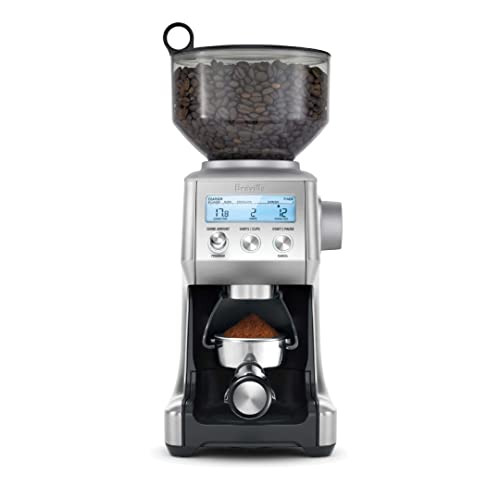
The Breville Smart Grinder Pro stands out for espresso lovers who want repeatable precision without stepping into boutique-level pricing. I rely on its 60 grind settings and conical burrs to fine-tune doses for espresso, French press, or drip. Its digital timer, adjustable in 0.2-second increments, delivers consistent grind volume, while Dosing IQ reduces mess and waste. I grind straight into my portafilter using the included 58mm cradle, and the LCD keeps settings visible. At 165 watts, it’s powerful but not overly loud. It’s heavy at nearly 6.4 pounds, so it stays put. Breville includes a sealed container, brush, and filter basket-solid extras. There’s no auto-stop, so I watch it closely. Compared to budget models like the SHARDOR, it offers more control and durability, though it costs more. The 2-year warranty gives me confidence. For daily espresso with minimal guesswork, it’s a practical, mid-tier choice that balances features and price.
Best For: Espresso enthusiasts seeking precise, repeatable grinding with professional-level control at a mid-tier price.
Pros:
- 60 grind settings and 0.2-second timer increments enable highly precise, consistent dosing
- Dosing IQ and direct-to-portafilter grinding minimize mess and improve shot accuracy
- Durable conical burr design and 2-year warranty ensure long-term reliability
Cons:
- No auto-stop function requires manual monitoring during grinding
- Heavy at 6.4 pounds, making it less portable
- Higher price point compared to entry-level grinders with fewer features
AMZCHEF Burr Coffee Grinder with 48 Settings
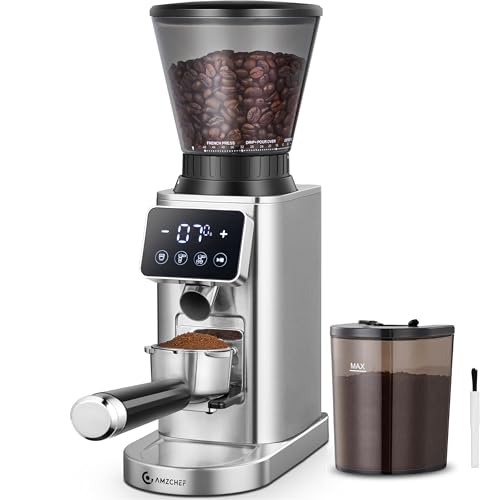
I rely on consistency and precision when pulling espresso shots, and the AMZCHEF Burr Coffee Grinder with 48 settings delivers both for home baristas who want full control without stepping into commercial territory. Its 40mm stainless steel conical burr spins at 450rpm, reducing heat and static while preserving flavor. I appreciate the 48 settings-they let me fine-tune from French press to espresso easily. The digital timer, adjustable in 0.5-second increments, guarantees repeatable doses. It fits 50mm portafilters and includes a light-blocking grounds container to maintain freshness. First use may leave residue, but it clears quickly. At under 5.5 pounds, it’s compact and practical for small setups.
Best For: Home baristas seeking precision and consistency in grinding for espresso and other brew methods without commercial equipment.
Pros:
- 48 precise grind settings enable customization for espresso, drip, and French press
- Patented 40mm stainless steel conical burr operates at 450rpm to reduce heat and static, preserving flavor
- LED digital timer adjustable in 0.5-second increments ensures accurate and repeatable dosing
Cons:
- Initial use may produce residual coffee powder that requires cleaning
- Limited to 50mm portafilters, which may not fit all machines
- Higher price point compared to blade grinders or lower-end burr models
Baratza Encore ESP Coffee Grinder ZCG495BLK, Black

You’ll want the Baratza Encore ESP if you’re serious about espresso but don’t want to juggle multiple grinders for different brew methods. I use it daily, and the dual-range adjustment-micro-steps 1–20 for espresso, macro 21–40 for filter-gives precise control without switching gear. The 40mm Liechtenstein steel burrs deliver consistent grinds, and the DC motor powers through beans quietly. I can adjust grind size with one hand and clean the burrs tool-free in seconds. It’s compact, reliable, and backed by Baratza’s warranty and support. Wirecutter and coffee pros recommend it, and I do too-if you want one grinder that does both well, this is it.
Best For: Home baristas who want a single high-performance grinder capable of both precise espresso and versatile filter brewing.
Pros:
- Dual-range grind adjustment (micro-steps 1–20 for espresso, macro 21–40 for filter) offers precision and flexibility
- 40mm hardened alloy steel burrs from Liechtenstein ensure consistent, high-quality grinds
- Tool-free burr removal and compact design make cleaning and maintenance easy
Cons:
- Higher price point compared to basic entry-level grinders
- Plastic construction may feel less durable than pricier metal alternatives
- Limited hopper capacity requires frequent bean refills for high-volume use
Neretva 2-in-1 Burr Coffee Grinder

When grinding for espresso matters but space and budget are tight, the Neretva 2-in-1 Burr Coffee Grinder stands out as a practical pick for home baristas who want consistency without complexity. I use its 30 grind settings to fine-tune for espresso or switch to French press with ease. The 3.0 stainless steel conical burrs deliver even particles, and the anti-static tech reduces clumping. It fits portafilters from 51–58mm, grinding directly into them, which saves time. At under 7 pounds, it’s compact but solid. Just don’t expect Turkish-level fineness. Timer precision helps, and cleanup’s simple with the included brush and blower.
Best For: Home baristas seeking a compact, budget-friendly grinder with consistent performance for espresso and other brewing methods.
Pros:
- 30 precise grind settings and timer control for versatile brewing from espresso to French press
- Anti-static technology and conical steel burrs reduce clumping and ensure uniform particle size
- Direct-to-portafilter grinding with 51–58mm compatibility saves time and reduces mess
Cons:
- Not suitable for Turkish coffee due to grind fineness limitations
- Portafilter not included, requiring separate purchase
- Limited warranty details available only upon request
Tuni G1 Conical Burr Coffee Grinder

The Tuni G1 Conical Burr Coffee Grinder stands out for home baristas who want precise, consistent grinds without taking up much counter space. I rely on its 48 grind settings and 0.5-second time adjustments for everything from espresso to French press. Its 40mm conical burrs spin at 450 RPM, reducing heat and static, while the anti-static tech improves consistency. The compact design fits small kitchens, and the 250g hopper holds enough beans for multiple uses. I appreciate the LED touchscreen, removable grounds bin, and portafilter holder for 54–58mm baskets. It’s solid, easy to clean, and includes useful extras like a dosing cup and built-in brush.
Best For: Home baristas seeking precise, consistent grinds across multiple brewing methods in a compact, space-saving design.
Pros:
- 48 grind settings and 0.5-second grind time adjustments enable highly customizable, precise grinding for various brew types
- 40mm conical burrs at 450 RPM reduce heat and static, preserving flavor and improving consistency
- Compact footprint, removable grounds container, and integrated brush make it practical and easy to maintain in small kitchens
Cons:
- Limited to 12 servings maximum, which may not suit large gatherings or commercial use
- Plastic components in the grounds container and dosing cup may feel less durable than all-metal builds
- No built-in timer memory for favorite settings, requiring manual input each time
Viesimple Gen 4 Coffee Grinder Black

A dedicated home barista who values precision and compact design will find the Viesimple Gen 4 Coffee Grinder Black a strong fit, especially when counter space is limited and consistency matters. I use its 48 mm conical burrs for even grounds, and the anti-static coating keeps mess under 0.2%. The sealed lid and magnetic dosing cup prevent spills and flying powder. It’s quiet at under 50 dB and handles global voltages. I appreciate the 2-year warranty and that each unit is factory-tested. While it holds only 30 grams, it’s efficient for single doses. I’ve found it reliable for espresso, pour-over, or French press-no fuss, just consistent results.
Best For: Home baristas seeking a compact, precise, and quiet grinder for single doses with consistent results across espresso, pour-over, and French press.
Pros:
- 48 mm conical burrs deliver consistent grind quality with anti-static coating reducing mess to less than 0.2%
- Compact aluminum design with magnetic dosing cup and sealed lid prevents spills and flying powder
- Quiet operation under 50 dB, global voltage compatibility, and backed by a 2-year factory-tested warranty
Cons:
- Limited 30-gram capacity, best suited for single doses rather than batch grinding
- Higher initial cost compared to entry-level grinders
- Availability restricted to online channels, currently via Amazon only
Burr Coffee Grinder with 45 Settings
You’re looking for control without complexity, and the COFIBREWS CG215B-SV delivers it through 45 precisely spaced grind settings that let you fine-tune from espresso to French press with confidence. I use the 40mm stainless steel conical burr running at 450rpm-it stays cool and keeps flavors clean. The LED touch panel lets me pick servings by cups or shot type, adjusting grind time in 0.5-second increments. It fits most portafilters, holds 300g of beans, and its anti-static design cuts mess. I clean the removable parts fast, and the build feels durable. It’s not flashy, but it’s reliable, precise, and ready for daily use.
Best For: Home baristas seeking precise, consistent grind control across multiple brewing methods with a durable, easy-to-clean electric grinder.
Pros:
- 45 precise grind settings and 0.5-second time adjustments ensure consistent results for espresso, drip, and French press
- Low-speed 40mm stainless steel conical burr preserves flavor by minimizing heat and static
- Removable parts and anti-static design make cleaning quick and mess-free
Cons:
- Portafilter not included, requiring a separate purchase for espresso use
- Limited color options with only a silver finish available
- Large footprint may be cumbersome for small kitchen spaces
SHARDOR 64mm Burr Coffee Grinder Black

When precision and consistency matter most, the SHARDOR 64mm Burr Coffee Grinder Black stands out, especially for espresso lovers who demand reliable dosing and minimal heat transfer during grinding. I’ve found its 64mm flat burrs deliver uniform particles across 100 settings, handling everything from espresso to French press smoothly. The all-metal grinding chamber feels durable, and at 260 watts, it powers through beans without overheating. I appreciate the LED timer with 0.1-second accuracy-it guarantees repeatable doses. Cleaning’s easy too, thanks to removable parts and an anti-static system. Just note: the single-dose hopper costs extra.
Best For: Coffee enthusiasts and home baristas seeking precision, consistency, and durability in grinding for various brew methods, especially espresso.
Pros:
- 64mm flat burrs with 100 adjustable settings ensure uniform grinding and precise control for multiple brewing styles
- All-metal grinding chamber and 260-watt motor provide durability and efficient, cool operation
- LED timer with 0.1-second accuracy and removable components make dosing consistent and cleaning easy
Cons:
- Single-dose hopper is sold separately, increasing overall cost for single dosing users
- At 8.82 pounds, it may be heavier than some prefer for countertop mobility
- Limited color option available (only black)
Coffee Grinder with 30 Settings

Thirty grind settings give this grinder a clear edge if you brew multiple ways and demand precision-especially when pulling espresso shots that hinge on fine adjustments. I use settings 1–9 for espresso, where even small tweaks change extraction. For filter or cold brew, 9–21 works best, giving clean, balanced results. French press? Try 22–30 for that coarser, even grind. The stainless steel conical burr guarantees uniform particles, so flavor stays consistent. I can dial in 2 to 12 cups, which cuts waste. It’s compact-fits my small kitchen. Cleaning’s easy: just remove the hopper, burr, and chamber. A brush helps. No portafilter, though.
Best For: Coffee enthusiasts who use multiple brewing methods and value precise, consistent grind settings for optimal flavor extraction.
Pros:
- Offers 30 precise grind settings, ideal for espresso, filter, cold brew, and French press
- Stainless steel conical burr ensures uniform grinding for consistent flavor
- Compact design with easy-to-clean removable parts and included cleaning brush
Cons:
- No portafilter included, which may be inconvenient for espresso users
- Adjusting grind settings may require trial and error for optimal results
- Upper burr removal for cleaning might be tricky for some users
Factors to Consider When Choosing the Best Espresso Grinder
You need precise grind size control to pull consistent espresso shots, and burr type-flat or conical-affects both that precision and how quickly your beans get ground. Look for grinders that offer reliable dosing and are built to last, like the Baratza Sette 270 or the 1ZPresso JX-Pro. Cleaning should be quick and straightforward, so models with easy-access burrs and minimal retention will save you time and hassle.
Grind Size Precision
A good espresso grinder delivers consistent grind size precision, and that starts with having enough adjustment options to fine-tune your dose. You need at least 30 settings to confidently dial in from ristretto to lungo. Stepless grinders go further, letting you make infinite micro-adjustments for exact calibration-ideal when 0.1-second differences impact extraction. Fixed increments can work, but you’ll lose flexibility. Uniform grinds matter just as much; high-quality burrs produce fewer fines and boulders, ensuring even flow through the puck. Look for models like the Compak K6 or Eureka Mignon Silent, known for stable performance. Pair precise grinding with high-resolution timers (0.1-second increments) to replicate results shot after shot. Without grind consistency and repeatability, dialing in becomes guesswork-don’t skip either when chasing balanced, reliable espresso.
Burr Type Selection
When choosing the right burr type for espresso, you’ll mainly decide between conical and flat designs, each offering distinct benefits. Conical burrs grind at lower speeds, generating less heat so you preserve more of the coffee’s delicate oils and flavor. They also produce less static, reducing chaff flyaway and mess. Flat burrs, on the other hand, deliver extremely uniform particle sizes, which helps extraction stay consistent-critical for pulling balanced espresso shots. Most high-end grinders use stainless steel burrs because they resist corrosion and stay sharp longer. Larger burrs, like 64mm models, improve dose accuracy by minimizing grounds retention and boosting throughput. If you’re using a conical burr, look for low-speed motors to maximize heat control. Flat burrs suit precision-focused users, while conical setups often appeal to those prioritizing flavor preservation and quieter operation.
Dosing Consistency
Consistent dosing plays a direct role in achieving balanced espresso shots, building on the foundation of burr quality discussed earlier. If your grind amount varies even slightly, you’ll likely pull under-extracted or over-extracted shots. To stay precise, use grinders with electronic timers that adjust in 0.1-second increments-this fine control boosts shot-to-shot reliability. Anti-static tech is another key feature; it cuts down on coffee clumping and clinging, so more grounds end up where they should: in the portafilter. Uniform particle size, thanks to quality conical or flat burrs, guarantees even extraction and steady dosing. Look for low retention designs, too-they minimize leftover grounds in the chamber, which helps keep each dose accurate and prevents old coffee from messing with flavor. Models like the Baratza Sette 270Wi or Eureka Mignon Silenzio deliver in these areas without overcomplicating things.
Build Quality Matters
Durability and precision start with what the grinder is made of, and that means paying close attention to materials and construction. You want stainless steel or hardened alloy burrs-they stay sharp longer and deliver consistent grounds, shot after shot. Plastic parts heat up and wear out fast; metal chambers and casings handle daily use better and disperse heat efficiently. Look for precision burr carriers and solid motor mounts-they reduce wobble, which means even grinding and less long-term wear. Some grinders add anti-static tech or special coatings, cutting down on wasted grounds and improving consistency. Models like the Eureka Mignon or Baratza Vario use tool-free designs with quick-release burrs, making upkeep easier and keeping performance high over time. You won’t need constant adjustments or part replacements if the build’s solid. Choose sturdy, well-aligned components, and your grinder won’t just last-it’ll keep pulling even shots for years.
Ease Of Cleaning
A clean grinder means better shots, and you’ll want one that makes maintenance simple. Look for removable parts like burrs, hoppers, and grounds trays-you can clean these easily and reduce old oil buildup. Grinders with anti-static tech cut down on cling, so you’ll deal with less mess after grinding. A quick-release burr system lets you take it apart without tools, giving you faster access to tricky spots. Sealed or magnetic grounds cups help trap fine powder, keeping your counter clean and minimizing loss. Some models even include built-in brushes or air blowers, so you’re not hunting for tools every time. These features save time and keep your grind consistent. Skipping regular cleaning leads to stale flavors and clogs. Choose a grinder that’s built to stay clean, not just built to grind.
Noise Level Impact
Keeping your grinder clean helps maintain flavor and performance, but how loud it runs can be just as important-especially if you’re pulling shots early in the morning or in a shared space. Look for models under 50 decibels if quiet operation matters to you-these won’t disrupt others nearby. Grinders with slower speeds, like 450 RPM, reduce noise by cutting down on friction and vibration. Sealed chambers and anti-static tech also help mute sound by containing it during grinding. Avoid high-wattage motors if noise is a concern-they often spin faster and louder, sometimes hitting over 70 decibels, which can be jarring in homes or small offices. Quieter grinders, like the Baratza Encore ESP or Mazzer Mini, balance performance and sound control. You’ll get consistent shots without waking the household. If low noise is a priority, check specs carefully-don’t assume all burr grinders are equally quiet. Your environment shapes what “good” really means.
Brew Method Compatibility
While your brewing method shapes the ideal grind, espresso requires the most precise control to hit that sweet spot for extraction. You need a grinder with at least 30 settings to fine-tune particle size-fewer adjustments make dialing in frustrating. Stepless or micro-adjustable grinders, like the Eureka Mignon Special Edition, give you the precision needed. A conical burr 40mm or larger guarantees even grounds and reduces heat, preserving flavor. Look for low RPMs (around 450) to avoid burning the beans and losing delicate aromas. Direct-to-portafilter grinding cuts down on waste and static, keeping your dose accurate. Blade grinders or budget models with inconsistent output won’t deliver the shot quality you want. If you’re serious about espresso, match your grinder to its demands-don’t expect a flat burr meant for drip to perform here.
Frequently Asked Questions
How Do I Clean a Burr Coffee Grinder?
You clean a burr grinder by unplugging it, then removing the burrs to brush out coffee oils and residue with a soft brush. Wipe down the chamber with a dry cloth-never use water. For deep cleaning, use grinder cleaning tablets or rice flour to absorb oils. Reassemble carefully. Regular cleaning every 1–2 weeks prevents flavor contamination and maintains grind consistency, especially with oily beans. Avoid abrasive tools that damage burrs.
Can I Use Pre-Ground Coffee in Espresso Machines?
You can use pre-ground coffee in espresso machines, but you shouldn’t. Pre-ground loses freshness fast, leading to flat, dull shots. Espresso needs precise, consistent grind size, which pre-ground rarely provides. If you do use it, pick a reputable brand labeled specifically for espresso, like Lavazza Super Crema, and use it immediately. Even then, results won’t match freshly ground beans. For real quality, grind beans just before brewing.
Do Espresso Grinders Work for Cold Brew?
Yes, espresso grinders work for cold brew, but they’re not ideal. You need a coarse, even grind, and most espresso grinders specialize in ultra-fine settings, making it hard to adjust coarsely without uneven results. Blade grinders or entry-level burr models like the Baratza Encore might serve better. If you use an espresso grinder, dial it all the way up and test small batches. For consistency and cost, a dedicated cold brew or drip grinder saves time and delivers better extraction.
Are Conical Burrs Better Than Flat Burrs?
you’ll find conical burrs often deliver more consistent grinds with less heat, ideal for espresso’s fine requirements. they’re quieter and handle frequent grinding well-think Baratza Sette 270W or Mahlkönig Vario. flat burrs offer ultra-uniform particles, preferred in high-end machines like EK43, but cost more and wear faster. your choice depends on your machine, budget, and brewing frequency-neither’s universally better, just better suited to specific needs and setups.
How Often Should I Replace Grinder Burrs?
You should replace grinder burrs every 500 to 1,000 hours of grinding, depending on usage and bean hardness. If you grind daily, that’s roughly every 1–2 years. Dull burrs reduce shot consistency and flavor clarity. You’ll notice longer grind times, increased fines, or uneven extraction. Harder beans or high-altitude use wear burrs faster. Check manufacturer specs-Mazzer, for example, suggests 800 hours for their steel burrs. Ceramic lasts longer but costs more.