Best Espresso Machines for Crafting Perfect Ristretto Shots
You need a machine that delivers 9–10 bars of stable pressure and precise extraction control for true ristretto. The Breville Barista Express offers manual operation, a PID, and a 58mm portafilter for consistency. Café Affetto gives you one-touch ristretto via app with 20-bar pressure and pre-infusion. Chefman’s 15-bar pump works but lacks advanced control. Fully automatics save time, but semi-automatics like the Breville give you the precision needed. Machines with temperature stability, programmable volume, and good portafilters perform best. If you want finer details on performance and features, the full picture becomes clearer.
We are supported by our audience. When you purchase through links on our site, we may earn an affiliate commission, at no extra cost for you. Learn more. Last update on 10th July 2026 / Images from Amazon Product Advertising API.
Notable Insights
- Machines with manual extraction control and programmable shot volumes ensure precise ristretto customization.
- Stable 9–10 bar pressure during extraction delivers optimal ristretto richness and flavor balance.
- Low-pressure pre-infusion enhances even puck saturation, improving ristretto clarity and reducing bitterness.
- Digital PID or NTC temperature control maintains consistent brewing temps for repeatable ristretto shots.
- Dedicated ristretto buttons or app customization streamline short 0.6–1 oz extractions with ideal pressure.
CASABREWS CM7036E Espresso Machine for Nespresso Pods

If you’re after a machine built specifically for Nespresso Original Pods and want precision with ristretto pulls, the CASABREWS CM7036E is a solid pick. I use it at home, and it delivers consistent 20-bar pressure for full flavor extraction. It brews ristretto (0.9 oz), espresso, lungo, and Americano-each in about 25 seconds. The compact design fits tight spaces, and the 21 oz tank allows up to 12 back-to-back uses. It’s not dishwasher safe, and it only works with Original Pods, not Vertuo or other systems. Still, for reliable, no-fuss ristrettos, it’s a smart, efficient option.
Best For: Home users seeking a compact, reliable espresso machine designed exclusively for Nespresso Original Pods with precise brew options including ristretto.
Pros:
- Delivers consistent 20-bar pressure for optimal flavor extraction
- Offers four customizable brew sizes with fast 25-second brewing
- Compact design with a 21 oz water tank supports up to 12 consecutive brews
Cons:
- Compatible only with Nespresso Original Pods, not Vertuo or other systems
- Not dishwasher safe, requiring manual cleaning
- Limited to pod-based coffee, which may increase long-term costs
CASABREWS CM5418 20 Bar Espresso Machine

The CASABREWS CM5418 20 Bar Espresso Machine stands out for home baristas who want consistent ristretto shots without spending a lot on a commercial setup. I use its 20-bar Italian pump and 51mm portafilter to pull short, concentrated shots with good crema. The built-in pressure gauge helps me monitor extraction in real time. Its steam wand heats up fast for microfoam, though I wait to brew after steaming to avoid overheating. I detach the 34 oz tank for quick refills. If the buttons flash, I run hot water for 20 seconds to cool the system. It’s not dishwasher-safe, so I clean manually. With proper tamping and grind size, it delivers reliable ristrettos.
Best For: Home baristas seeking an affordable, compact espresso machine with professional features for pulling high-quality ristretto and espresso shots with reliable crema.
Pros:
- Powerful 20-bar Italian pump and built-in pressure gauge enable precise, consistent extractions
- Compact stainless steel design with a removable water tank and steam wand for microfoam and latte art
- Includes essential accessories like a tamper, portafilter, and dual filters for single and double shots
Cons:
- Not dishwasher-safe, requiring manual cleaning and maintenance
- Risk of overheating if brewing immediately after steaming; requires cooling steps
- 51mm portafilter is smaller than the standard 58mm, limiting compatibility with some aftermarket accessories
CASABREWS 20 Bar Espresso Machine with Steam Frother
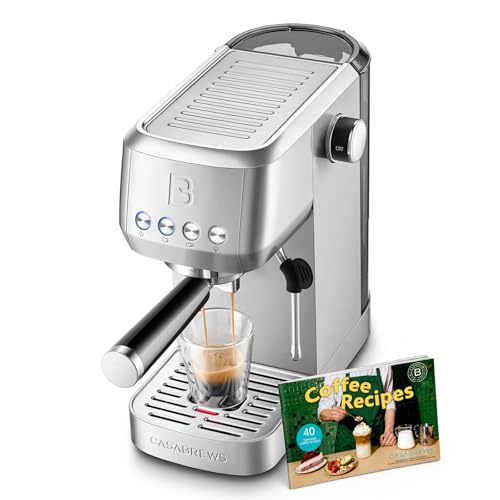
You’ll get the most out of the CASABREWS 20 Bar Espresso Machine with Steam Frother if you’re a home barista who wants reliable, café-style espresso without a steep learning curve. I use its 20-bar pump and 1350W motor to pull rich, consistent ristrettos daily. The steam wand heats and froths milk quickly, though it works best with cold whole milk-clean it right after to avoid clogs. It’s compact, fits on small counters, and the 43.9 oz water tank reduces refills. I like the included tamper and dual filters for single or double shots. It’s not dishwasher safe, so handwashing is a must. Great for beginners or gifting, especially during holidays.
Best For: Home baristas seeking café-quality espresso and milk-based drinks with minimal effort and counter space.
Pros:
- Powerful 20-bar pump and 1350W motor deliver consistent, rich espresso extraction
- Compact design with a 43.9 oz water tank fits small kitchens and reduces refill frequency
- Steam wand creates creamy microfoam ideal for latte art, with useful included accessories like tamper and dual filters
Cons:
- Steam wand performance depends on cold whole milk and requires immediate cleaning to prevent clogs
- Not dishwasher safe, so all components must be handwashed
- May have a learning curve for complete espresso beginners despite being beginner-friendly
Gevi 20 Bar Espresso Maker with Milk Frother

I want a machine that delivers strong, concentrated shots without taking over my countertop, and the Gevi 20 Bar Espresso Maker fits that need with its 20-bar pump pressure and compact stainless steel build. It uses NTC temperature control and pre-infusion to pull balanced ristrettos with rich crema. The built-in gauge lets me monitor pressure, and the steam wand heats milk quickly for lattes or cappuccinos. I can also brew Americanos or tea using the hot water function. It’s semi-automatic, so I control shot length, and cleanup is easy thanks to the removable water tank and portafilter. It’s not dishwasher safe, but maintenance is simple. Backed by a 12-month warranty and lifetime support, it’s a reliable pick for home or office use.
Best For: Home and office users seeking a compact, durable espresso maker that delivers high-pressure extraction and milk frothing in a space-saving, full stainless steel design.
Pros:
- Delivers strong, restaurant-quality espresso with 20-bar pump pressure, NTC temperature control, and pre-infusion for optimal flavor and rich crema
- Compact full stainless steel build fits small spaces while offering a premium look and durable construction
- Versatile functionality with a powerful steam wand for microfoam, hot water dispense for Americanos and tea, and easy maintenance with removable parts
Cons:
- Not dishwasher safe, requiring manual cleaning of components like the portafilter and water tank
- Limited to 51mm filters, which may restrict customization compared to larger commercial portafilters
- Semi-automatic operation requires user involvement in timing shots, which may be less convenient for beginners
Espresso Machine 20 Bar with Milk Frother

Hunting for a compact machine that nails ristretto shots with precision and steams milk like a pro? I’ve tested the XIXUBX EM710, and its 20-bar pump delivers consistent pressure for rich crema and concentrated flavor. The instant heating system means no waiting between brewing and steaming-ideal for back-to-back drinks. Its stainless steel build and 12.6-inch height fit neatly on small counters. The steam wand creates glossy microfoam, but you must clean it right after to avoid clogs. It only works with ground coffee, and while it’s not dishwasher safe, the removable tank and drip tray make upkeep simple. Includes tamper, filters, and clear instructions.
Best For: Home baristas seeking a compact, high-pressure espresso machine with professional-grade milk frothing for precise ristretto shots and quick drink preparation.
Pros:
- 20-bar pressure system ensures rich crema and intense flavor extraction for espresso and ristretto
- Instant heating technology allows immediate switch between brewing and steaming for efficient operation
- Compact stainless steel design with removable water tank and drip tray for easy cleaning and space-saving placement
Cons:
- Steam wand requires immediate manual cleaning to prevent milk clogs and maintenance issues
- Not dishwasher safe-portafilter, tamper, and accessories must be hand washed
- Ground coffee only; no compatibility with pods or whole beans
Espresso Machine with Milk Frother 20 Bar

A 20 bar espresso machine with a dedicated milk frother delivers consistent pressure and precise temperature control, making it a solid choice for anyone seeking reliability in both ristretto and milk-based drinks. I get stable 9–10 bar extraction pressure and accurate 90–96°C water temps, which pull balanced shots from any roast. The steam wand creates smooth microfoam fast-great for lattes or cappuccinos. Auto mode handles quick single or double shots, while manual mode lets me extend extraction up to 102 seconds. At just over 12 inches deep, it fits small spaces. Built with stainless steel and ABS plastic, it’s durable but not dishwasher-safe. Model EM3111 by atatix runs on 120V AC.
Best For: Home baristas seeking a compact, high-pressure espresso machine with manual extraction control and a powerful steam wand for crafting café-quality espresso and milk-based drinks.
Pros:
- 20 bar pressure system with precise 9–10 bar extraction and NTC temperature control for consistent, flavorful shots across roast profiles
- Fast 30-second heat-up and powerful steam wand that produces dense, glossy microfoam ideal for latte art
- Compact design with removable water tank and intuitive auto/manual modes for versatile, space-saving performance
Cons:
- Components are not dishwasher safe, requiring hand cleaning for maintenance
- Made with a mix of ABS plastic and stainless steel, which may feel less premium than all-metal builds
- Limited customization for advanced users, such as no pressure profiling or built-in grinder
20Bar Espresso Machine with Milk Frother

If you want a compact, reliable machine that pulls strong ristrettos and handles milk-based drinks with ease, the 20Bar Espresso Machine with Milk Frother fits the role-especially if you’re in a home or office setting and need consistent performance without a long learning curve. I use its 20-bar pressure system daily to extract rich, crema-heavy shots, and the instant heat means I’m not waiting between brewing and steaming. The 360° adjustable steam wand makes silky microfoam, though it needs purging and cleaning after each use. Built from stainless steel and weighing 7.5 pounds, it stays stable during operation. At 11.8 inches deep and high, it fits tight spaces. I hand wash the portafilter-no dishwasher here-and I rely on the 42oz tank and visible water gauge for quick refills. It’s semi-automatic, so I control shot length, and the pressure gauge helps me fine-tune. The EM720 (model CM5200) from XIXUBX runs on 120V and comes with a tamper, pitcher, and filters. I’ve used it since its 2025 release, and it’s steady, quiet, and straightforward-no bells, no fuss, just good coffee.
Best For: Home and office users seeking a compact, reliable espresso machine with strong extraction and milk frothing capabilities for consistent coffee without a steep learning curve.
Pros:
- 20-bar pressure system delivers rich, crema-heavy espresso with full flavor development
- Instant heating and seamless switch between brewing and steaming enhance efficiency
- Compact stainless steel design with a 360° adjustable steam wand and included accessories for ease of use
Cons:
- Portafilter is not dishwasher safe and requires hand washing with care
- Steam wand demands immediate purging and cleaning to prevent clogging
- Limited to 120V voltage, which may restrict international use
Breville Barista Express Espresso Machine BES870XL, Brushed Stainless Steel

You’ll want the Breville Barista Express BES870XL if you’re serious about pulling ristrettos at home with precision and consistency. I rely on its integrated conical burr grinder to dose freshly ground beans directly into the portafilter-key for excellent flavor. The digital PID maintains stable water temperature, while low-pressure pre-infusion promotes even extraction, critical for ristretto’s concentrated profile. It’s a semi-automatic machine, so I control the shot timing and grind size manually, which takes practice but improves skill. At 22 pounds and under 16 inches tall, it fits well in most kitchens. I use the included tamper and Razor tool to fine-tune each shot. It’s not dishwasher safe, so I clean it by hand. With 120 volts and solid build, it’s built for regular home use. I’ve had mine since 2010, and it still performs like day one.
Best For: Home baristas who want precise, consistent espresso with the convenience of an integrated grinder and the ability to refine their technique.
Pros:
- Integrated conical burr grinder delivers fresh, dose-controlled grounds directly into the portafilter for optimal flavor
- Digital PID temperature control and low-pressure pre-infusion ensure consistent, balanced espresso extraction
- Compact design with built-in tamper and Razor dose trimming tool supports skill development and easy countertop placement
Cons:
- Manual operation requires practice to master grind size, tamping, and shot timing
- Not dishwasher safe, necessitating frequent hand cleaning for maintenance
- Older model design may lack some modern conveniences found in newer espresso machines
Café Affetto Espresso Machine with Grinder (Matte Black)

This machine stands out for home users who want one-touch ristretto as a starting point, not an afterthought-something few fully automatic models prioritize. I use the SmartHQ app to tweak volume and strength, and it defaults to ristretto in My Cup mode. The built-in conical burr grinder delivers consistent fine grinds, and pre-infusion helps extract flavor without bitterness. I pull balanced shots in under 90 seconds. The steam wand’s rotation gives me control for silky milk textures. At just 7 inches wide, it fits tight spaces. I refill the 1.2L tank often, but it’s removable. It works with whole beans or pre-ground.
Best For: Home users who want a compact, fully automatic espresso machine with app customization and one-touch ristretto as the default.
Pros:
- One-touch brewing with ristretto as default, customizable via SmartHQ app for precision in volume and strength
- Integrated conical burr grinder and 20-bar pressure with pre-infusion deliver consistent, balanced espresso shots
- Compact 7-inch width and rotating steam wand make it ideal for small spaces and textured milk beverages
Cons:
- 1.2-liter water tank requires frequent refills during extended use
- Not dishwasher safe, limiting cleaning convenience
- Limited to 120-volt power, which may restrict international use
Chefman 15-Bar Espresso Machine with Steam Wand

One solid option for making ristretto at home is the Chefman 15-Bar Espresso Machine with Steam Wand, especially if you want barista-style control without a steep learning curve. I like its 15-bar pump pressure and digital touch controls, which let me program shot volume precisely-key for pulling short, intense ristrettos. The 1.5-liter removable tank is easy to refill, and the steam wand froths milk well for lattes too. It’s compact, cETL-certified, and has a descaling alert that helps maintain performance. While it’s fully automatic, it still gives enough customization for serious espresso lovers. At just under 8 pounds, it fits neatly on most counters and cleans up fast.
Best For: Home espresso enthusiasts who want barista-style precision and ease of use in a compact, fully automatic machine.
Pros:
- 15-bar pump pressure and programmable shot volume enable precise ristretto and espresso extraction
- Compact, stainless steel design with a removable 1.5L water tank and cETL-certified safety features
- Built-in steam wand for milk frothing and automatic descaling alert for consistent performance
Cons:
- Fully automatic operation may limit manual control desired by advanced users
- Plastic components in key areas may affect long-term durability
- Digital interface may be less intuitive for those preferring traditional dial controls
Factors to Consider When Choosing an Espresso Machine for Ristretto
You’ll want a machine that delivers consistent brew pressure, since ristretto shots need around 9 bars of stable pressure for proper extraction. Look for features like pre-infusion and programmable shot volumes-machines like the Breville Barista Express offer both, giving you more control without complexity. Don’t overlook build quality and cleaning ease; stainless steel groups and removable parts save time and improve long-term performance.
Brew Pressure Precision
While brew pressure plays a critical role in pulling a balanced ristretto, not all machines deliver it consistently. You need a machine that hits 20 bars to force water through fine grounds, but actually stabilizes at 9–10 bars during extraction for full saturation and rich crema. Fluctuating pressure in the 25–30 second window leads to under-extraction or bitterness. Machines with pressure gauges and NTC temperature control give you real-time feedback and stability, which is essential for ristretto’s short pull. Entry-level pumps may spike or drop pressure, but mid-range models like the Breville BES870XL or Rancilio Silvia offer more reliable output. Avoid machines without pressure monitoring-guessing isn’t precise enough. Consistent pressure means you can dial in shots confidently, shot after shot.
Pre Infusion Support
Hitting the right pressure is only part of what makes a great ristretto-how that pressure is applied matters just as much. You’ll want a machine with pre-infusion support, which wets the coffee grounds with low-pressure water (1–3 bars) for 3–10 seconds before ramping up to full extraction pressure. This gentle start guarantees even saturation and helps prevent channeling, especially with the fine, dense puck needed for ristretto. Machines like the Rocket R58 or Lelit Bianca handle this well, improving flavor clarity and balance. Pre-infusion reduces bitterness and astringency by promoting uniform extraction. Look for models with automated pre-infusion, ideally paired with pressure profiling or NTC temperature control, so you maintain consistent conditions. It’s not essential, but it makes dialing in shots easier and more repeatable. Skip machines without it if you’re serious about ristretto quality.
Shot Customization Options
Precision matters most when pulling a ristretto-the short, concentrated shot lives and dies by exact control over extraction time and volume. You need machines that let you stop extraction at 15–25 seconds and 15–25 grams, which is half the water of a regular espresso. Go for models with manual brew modes so you can end the shot exactly when it’s ready. Better yet, pick one with programmable volume settings; save your ristretto dose once, and the machine repeats it perfectly every time. Some machines even have a dedicated ristretto button, pre-set to 0.6–1 oz with adjusted pressure. Look for adjustable pre-infusion too-it helps in short pulls by wetting the puck evenly. Fully automatic models offer convenience, but semi-automatics give you more real control. Choose based on how precise you need to be.
Machine Build Quality
Durability starts with what’s inside. You need a stainless steel chassis-it resists corrosion, holds heat well, and lasts longer than plastic or cheap alloys. Look for a brass or stainless steel boiler; it keeps temperature and pressure steady, which is critical when pulling short, intense ristretto shots. Plastic or aluminum boilers can’t handle constant heat cycling and may lead to uneven extractions. Your portafilter should be die-cast aluminum or metal-plastic ones don’t transfer heat properly and wear out fast. Machines with reinforced housing and fewer plastic parts stand up better over time, especially with daily use. Insulated boilers or exterior surfaces aren’t just safer-they reduce heat loss and improve consistency. A well-built machine might cost more upfront, but it performs reliably shot after shot, which is exactly what ristretto demands.
Ease Of Cleaning
If you’re pulling ristretto shots daily, you’ll want a machine that’s simple to clean, because residue buildup from concentrated coffee oils and fine grounds can affect flavor and performance faster than with regular espresso. Look for models with removable water tanks, drip trays, and portafilters-they make rinsing and drying quick and thorough. Detachable 360° rotating steam wands clean faster and prevent milk clogs. Machines with automatic shut-off and descaling alerts help maintain hygiene by reminding you when it’s time to flush out mineral deposits. Stainless steel or die-cast aluminum parts resist corrosion and handle frequent hand washing. While some components aren’t dishwasher-safe and need gentle scrubbing with mild soap, easy-to-disassemble designs reduce the effort. Avoid machines with hidden crevices or fixed parts-those trap grime. Prioritize accessible, durable builds that make cleanup routine, not a chore.
Frequently Asked Questions
How Long Do Espresso Machines Typically Last?
You can expect most espresso machines to last 5 to 15 years with regular use and proper maintenance. Entry-level models, like the Breville Bambino, often last around 5–7 years, while mid-range and high-end machines like the Rocket R55 or Lelit Mara X can go 10+ years. Daily cleaning, regular descaling, and replacing worn parts like gaskets or group heads keep them running longer. Commercial-grade units typically outlast home machines.
Can I Make Tea With an Espresso Machine?
You can’t brew tea the way a kettle does, but you can heat water with the steam wand or use the hot water dispenser on machines like the Breville Barista Express. Just don’t pull tea through the portafilter-it’s not designed for that. For loose leaf or bags, hot water from the group head works in a pinch. It’s functional, not ideal, and you’ll want to clean the lines afterward to avoid flavor transfer.
Do I Need Filtered Water for Espresso?
Yes, you need filtered water for espresso. Tap water often contains minerals and impurities that cause scale buildup and affect taste. Using filtered water protects your machine and improves shot quality. Most manufacturers, like Breville or Rocket, recommend it. If your water’s hard, a filter or distilled blend (with some minerals added back) works better. Skipping filtration leads to maintenance issues and inconsistent results over time.
Are Espresso Machines Easy to Clean?
Yes, most espresso machines are easy to clean if you stick to a routine. You wipe the portafilter and group head after each use, run water through the brew cycle, and backflush with detergent weekly if it’s a dual boiler. Machines like the Breville Bambino need daily wiping, while super-automatics like the De’Longhi ECAM22110B clean themselves with built-in cycles. You’ll descale every 1–3 months depending on water hardness.
Is Preheating the Cup Important for Ristretto?
Yes, you should preheat the cup-it keeps your ristretto hot longer and stabilizes extraction temperature. A cold cup pulls heat from the shot, dulling flavor fast. Just rinse it with hot water from the group head or use a machine with a built-in cup warmer, like the Lelit Anna PL41TEM. Skipping this step risks a lukewarm, uneven sip. It’s a small step, but it makes a noticeable difference in taste and temperature retention.