Top-Rated Drum Roasters for Coffee Lovers Who Crave Freshness
You’ll get the freshest coffee by matching your batch size to your roaster’s capacity, from 300g up to 4kg. For hands-off operation, try the 500g Automatic Roaster with smoke control. If you prefer open-flame roasting, the DYVEE or 14.5L gas models offer direct heat control. Hand-crank and electric drum roasters like the SA&MC or 0.3–1.2kg models give flexibility for home or outdoor use. Each balances build quality, airflow, and monitoring to suit different needs - and your ideal roast may depend on which features matter most in practice.
We are supported by our audience. When you purchase through links on our site, we may earn an affiliate commission, at no extra cost for you. Learn more. Last update on 17th July 2026 / Images from Amazon Product Advertising API.
Notable Insights
- Automatic 500g roasters with smoke filters deliver fresh, consistent batches and real-time monitoring for home users.
- Stainless steel drum construction ensures durability, even heat distribution, and easy cleaning for long-term freshness.
- Models with built-in cooling fans and trays prevent over-roasting, preserving bean quality and flavor precision.
- Adjustable batch sizes from 300g to 1.2kg allow flexibility while maintaining optimal drum fill for even roasting.
- Digital controls with preset profiles and manual modes enable customization, enhancing freshness through precise roasting.
500g Automatic Coffee Roaster with Smoke Filter

If you’re a home roaster who values convenience and clean operation, the 500g Automatic Coffee Roaster with Smoke Filter is built for you. I use it for small-batch roasting, and it handles 350–400g evenly, though max capacity is 500g. It’s not for heavy use-routine runs may wear components. With 9 preset profiles, I roast light to dark beans automatically, or switch to manual with airflow control. The smoke filter works for light roasts; for darker batches, I attach the included aluminum pipes to vent outside. A cooling fan and tray stop over-roasting fast. Stainless steel parts clean easily, and the electric system stays stable on 110V.
Best For: Home roasters who want a compact, user-friendly machine with automated settings and effective smoke control for small-batch coffee roasting.
Pros:
- Offers 9 preset roasting profiles and manual mode for full control over roast intensity and airflow
- Equipped with a built-in smoke purifier and optional outdoor venting pipes for clean indoor operation
- Features rapid cooling with a dedicated fan and tray to preserve flavor and prevent over-roasting
Cons:
- Not suitable for commercial or frequent use due to potential component wear
- Smoke filter is only effective for light roasts; dark roasting requires outdoor venting
- Maximum 500g batch size may be limiting for larger households or frequent roasting
Coffee Roaster for Home Use
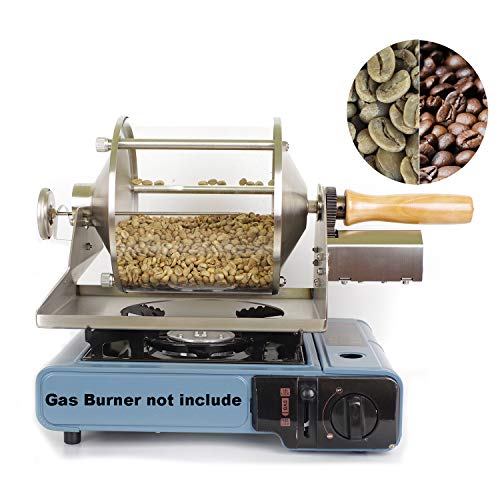
I rely on the DYVEE Tostador de café when I want full control over my roast at home, and that’s what makes this drum roaster ideal for hands-on coffee enthusiasts who value transparency in every stage of roasting. Its quartz glass drum lets me watch the beans change in real time, while the 304 stainless steel frame guarantees durability. I use it with a gas burner for direct heat, roasting 200–300 grams per batch-perfect for home scale. It runs on a 12V motor, which is safer than standard 110V models, and requires manual operation, so I stay engaged throughout. While it’s not dishwasher safe, the included funnel and manual make prep simple.
Best For: Hands-on home roasters who want full control and real-time visibility during the coffee bean roasting process.
Pros:
- Quartz glass drum allows real-time visual monitoring of roast progression
- Durable 304 stainless steel frame and 12V motor for enhanced safety
- Suitable for both coffee beans and peanuts with a practical 200–300 gram batch capacity
Cons:
- Manual operation required, which demands constant attention
- Not dishwasher safe, making cleaning more labor-intensive
- Larger footprint and specialized use may not suit casual users
SA&MC Hand-Crank Coffee Roaster Machine

The SA&MC Hand-Crank Coffee Roaster Machine is a solid pick for hands-on coffee lovers who want full control over their roast without relying on electricity. I use it on my gas stove, but it works just as well on BBQs or camping burners. Weighing just 2 pounds, it’s light and easy to bring along. The hand-crank turns the drum for even roasting, and the large viewing window lets me track color changes. I keep an eye on the built-in thermometer to avoid scorching. It’s not dishwasher safe, so I clean it by hand. The stainless steel build feels durable, and the serrated base stays put while I crank. I get one roast at a time, but that’s fine for small batches.
Best For: Coffee enthusiasts who prefer manual, small-batch roasting with full control over the process and enjoy using it at home or while camping.
Pros:
- Hand-crank operation allows precise control and works without electricity
- Even roasting thanks to rotating drum and real-time monitoring via large viewing window
- Compact, lightweight, and compatible with gas stoves, grills, and camping burners
Cons:
- Not dishwasher safe, requires hand cleaning after each use
- Limited to single batches, not ideal for large-scale roasting
- Requires constant attention to temperature and crank turning for consistent results
Electric Coffee Bean Roaster 0.3-1.2kg

You’ll find the Electric Coffee Bean Roaster 0.3–1.2kg best suits home roasters who want consistent, small-batch results without sacrificing durability or control. I use its 3.8L stainless steel drum to roast 0.3–1.2kg per batch, and the double baffles keep beans moving evenly. The built-in thermometer and adjustable motor (5–60 RPM) give me precise control, while the heat-sink holes improve airflow. It works on electric and gas stoves, and the included cooler with 6 and 40 Mesh sieves stops over-roasting fast. At nearly 10 pounds, it’s heavy but stable. Assembly’s required, but the manual makes it straightforward. I’ve used mine for coffee, peanuts, and soybeans-it handles all well.
Best For: Home roasters seeking precise control and durable construction for small-batch roasting of coffee beans, nuts, and soybeans.
Pros:
- Durable stainless steel construction with heat-sink holes for efficient airflow and even roasting
- Adjustable motor speed (5–60 RPM) and built-in thermometer for precise roasting control
- Comes with a fast cooler and dual reusable sieves for quick post-roast cooling and versatility
Cons:
- Requires assembly, which may be time-consuming for some users
- Heavy at nearly 10 pounds, limiting portability
- Limited capacity (up to 1.2kg) may not suit high-volume needs
Electric Coffee Roaster Machine (Smokeless)

A smokeless electric coffee roaster suits home roasters who want cleaner indoor operation without venting issues. I use the BAMI-T500, a 500g-capacity drum roaster that filters smoke and dust through an internal purifier. Its direct-fire imitation system heats evenly, and I can start preheating the next batch while the last one cools. I’ve tried all three modes-Auto, Assistant, and Manual-and each gives measurable control over temperature, airflow, and roast curve. It’s heavy at 22 pounds, but the build feels solid. For under $600, it’s a practical upgrade from stovetop methods, especially if you live in an apartment.
Best For: Home roasters seeking a smokeless, high-capacity electric coffee roaster with advanced control options for consistent, customizable roasting indoors.
Pros:
- Smokeless operation with built-in purifier enables clean indoor use without venting
- Three roasting modes (Auto, Assistant, Manual) offer precise control for beginners to advanced users
- Efficient workflow with ability to preheat next batch during cooldown of current batch
Cons:
- Heavy at 22 pounds, limiting portability
- Large footprint may require significant counter space
- Premium features come at a higher price point compared to basic stovetop roasters
KALDI WIDE Coffee Gas Roaster 300g
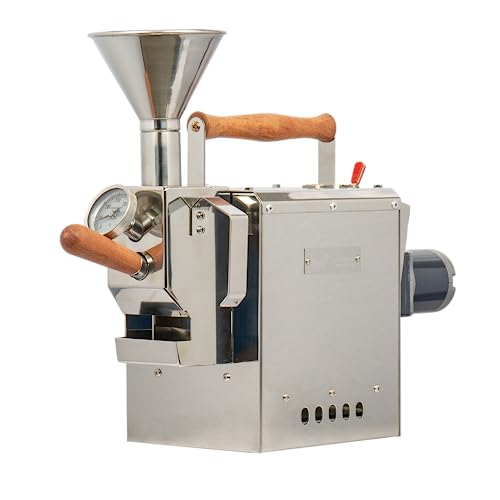
Looking for a compact, reliable way to roast small batches of coffee at home without sacrificing control or build quality? I’ve used the KALDI WIDE 300g gas roaster, and it delivers. Its 2mm stainless steel drum with 3mm holes and three stirring blades guarantees even roasting, while the flame arrest mesh boosts heat efficiency. It needs an external gas burner and runs on 12V DC. No thermocouple, but the included analog thermometer helps monitor temps. The chaff tray and tilt-to-discharge design make cleanup easy. It’s not flashy, but it’s sturdy, precise, and great for hands-on roasters who want control.
Best For: Home coffee roasters who want precise control and high build quality in a compact 300g-capacity gas roasting setup.
Pros:
- Durable 2mm-thick stainless steel drum with optimized hole pattern ensures even roasting and longevity
- Flame arrest mesh plate improves heat efficiency and enables stable conductive and convective heat transfer
- Convenient features like tilt-to-discharge handle, chaff tray, and analog thermometer enhance usability and cleanup
Cons:
- Requires an external gas burner and separate 12V DC power supply for operation
- Lacks a thermocouple for precise temperature monitoring during roast cycles
- No digital controls or automation, which may limit appeal for beginners or those seeking hands-off roasting
Rotisserie Oven Basket Grill Roaster

If you’re using a rotisserie oven and want a reliable way to roast small batches of coffee beans or nuts at home, the Mochiglory Rotisserie Oven Basket Grill Roaster Drum is a practical choice. It holds up to 900g, though I stick to 500–700g for even results. Made of durable stainless steel, it resists rust and deformation, and its 360-degree rotation guarantees consistent heating. The center hole (0.25 inch) fits most rotisserie shafts securely. I’ve used it for coffee beans, peanuts, and teas with solid outcomes. Just slide it onto the rotating rod, and you’re set. It’s not flashy, but it works-no extra gadgets, just reliable, straightforward roasting.
Best For: Home roasters and cooking enthusiasts who want a simple, durable stainless steel basket for evenly roasting small batches of coffee beans, nuts, or teas in a rotisserie oven.
Pros:
- Durable stainless steel construction resists rust and deformation for long-term use
- 360-degree rotation ensures uniform heating and consistent roasting results
- Fits securely on most rotisserie shafts with a 0.25-inch center hole for stable operation
Cons:
- Limited capacity; best suited for small batches up to 700g for optimal performance
- No additional features or temperature controls-requires manual monitoring
- Slight measurement variations may occur due to manual manufacturing processes
Electric Coffee Bean Roaster (0.3-0.5kg)

When you’re roasting small batches of coffee at home but want consistent, commercial-grade results, the Bokknppo Electric Coffee Bean Roaster (0.3–0.5kg) makes a practical choice, especially if you value precision and durability. I use it for coffee, nuts, and soybeans, and its stainless steel build handles heat well. The 3.8L drum fits up to 1.1lbs, and adjustable RPMs (5–60) let me control roast profiles. A built-in thermometer and transparent window help monitor progress. It’s not dishwasher safe, and assembly is required, but the included sieves and cooler make cleanup easier. Just plug it into 110–120V power.
Best For: Home baristas, small-batch coffee enthusiasts, and gourmet food hobbyists seeking precise, durable, and versatile roasting capabilities for coffee beans, nuts, and soybeans.
Pros:
- Adjustable drum speed (5–60 RPM) and built-in thermometer enable precise control over roast profiles
- Durable stainless steel construction with a reusable sieve system and included cooler for efficient roasting and processing
- Transparent window, lockable drum door, and anti-scald handle allow safe, real-time monitoring and handling
Cons:
- Requires manual assembly before first use
- Not dishwasher safe, making cleaning more labor-intensive
- Limited to 110–120V power, which may restrict use in regions with different voltage standards
Coffee Bean Roaster with Speed Controller

This drum roaster is built for anyone serious about small-batch, consistent roasting-especially home roasters and small café operators who want control without the hassle of manual turning. I rely on its 14W motor and speed controller to rotate the drum smoothly between 5–45 rpm, ensuring even heat distribution. The 14.5L capacity handles 5.51–6.61 lbs per batch, perfect for medium loads. Its stainless steel build resists wear, heat, and corrosion, while the side-swing door with viewing hole lets me watch the roast and check temperature. Cleanup’s quick, thanks to the smooth interior. It’s ideal for coffee beans, nuts, or soybeans over 0.04 inches in diameter.
Best For: Home roasters and small café operators seeking consistent, small-batch roasting with minimal effort and excellent heat control.
Pros:
- Durable stainless steel construction resists wear, corrosion, and high temperatures for long-term use
- Adjustable 5–45 rpm rotation with a 14W motor ensures even roasting and improved efficiency
- Large 14.5L capacity handles 5.51–6.61 lbs per batch and accommodates various roasting materials
Cons:
- Limited to materials with a diameter over 0.04 inches, excluding very small beans or seeds
- No built-in temperature display despite viewing hole for monitoring
- Relatively heavy at 13.21 pounds, which may reduce portability
Coffee Bean Roaster 14.5L Drum Type

I rely on the Coffee Bean Roaster 14.5L Drum Type when I need consistent, small-batch roasting for my coffee beans, peanuts, or nuts-perfect for home roasters or small-scale vendors who want control without industrial bulk. Its 14.5L drum handles 3.5–4.0kg per batch and works with gas stoves, so it’s flexible but not electric. Stainless steel construction resists rust and simplifies cleaning, though it’s not dishwasher safe. The external motor and included tools-like the shovel, thermometer, and S-hook-make maintenance and use straightforward. Cooling holes and double baffles promote even roasting, and the thermometer helps track heat accurately. At just under 7 pounds, it’s light but sturdy. Ideal for hands-on roasters who prefer direct control and durability in a compact setup.
Best For: Home roasters and small-scale vendors seeking a durable, gas-powered drum roaster for consistent, small-batch roasting of coffee beans, nuts, and similar materials.
Pros:
- Stainless steel construction ensures durability, rust resistance, and easy cleaning
- External motor design and included tools (shovel, thermometer, S-hook) simplify maintenance and operation
- Cooling holes and double baffles promote even heating and uniform roasting
Cons:
- Not electric-requires a gas or kitchen stove, limiting use in electric-only setups
- Not dishwasher safe, requiring manual cleaning
- Limited to materials over 2mm in diameter, excluding smaller seeds or grains
Factors to Consider When Choosing Drum Roasters
You’ll want to think about capacity and batch size first-bigger drums let you roast more at once, but they can be overkill if you’re just making coffee for one or two. Consider the power source too, since electric models are easier to set up, while gas ones give you more control over the roast. Also check the build quality, temperature controls, and how easy it is to clean-these things add up in the long run.
Capacity And Batch Size
Most drum roasters handle between 300 grams and 4 kilograms per batch, but for even results, aim to fill the drum to 70%–80% of its max capacity. If you’re roasting less than 300g, the beans might heat unevenly-there’s not enough mass to absorb heat consistently, and airflow can go haywire. That often leads to patchy development or baked flavors. On the flip side, overloading slows heat transfer, causing scorching or stalled roasts. You’ll want to match the batch size to your needs: home roasters usually do fine with 300g to 500g per batch, especially if you’re tasting single origins or roasting for a small household. But if you’re supplying a café or batch roasting for weekly use, models like the Toper Afra 2 or Probat BR-35 that handle over 1kg make more sense. Keep it balanced-too few or too many beans and your roast loses control fast.
Power Source Options
How will you power your roaster-electricity, gas, or a hybrid setup? If you’re using an electric drum roaster, it likely runs on standard 110–120V AC power, so you can plug it into a regular household outlet-ideal for indoor spaces without gas access. Some models use 12V DC motors powered by AC adapters, which boosts electrical safety while still relying on mains power. Gas-powered roasters depend on external burners for heat but often use small electric motors (like 12V) to turn the drum. Then there are dual-power systems: they use gas for heating and electricity for motors, cooling fans, or digital controls, meaning you’ll need both power sources. Check voltage compatibility-especially if you’re in North America, where 100–120V systems are common. Make sure your setup matches your roaster’s requirements.
Material And Build Quality
Stainless steel construction sets a strong foundation for any drum roaster, especially when you’re balancing performance with long-term reliability. You’ll want thicker drums-like 2mm stainless steel-as they hold heat evenly and resist warping over time. A polished or sandblasted interior boosts heat reflection and makes cleanup easier after each batch. Look for reinforced base brackets and rectangular frames; they keep the roaster stable during rotation, reducing vibration that can throw off roast consistency. Inside the drum, double internal baffles or stirring blades help stir beans evenly, preventing hot spots and ensuring every bean roasts at the same rate. These features matter most if you’re roasting daily or in larger volumes. Skimping on build quality means more wear, uneven roasts, and shorter lifespan. Invest in solid construction now, and you’ll get reliable performance for years.
Temperature Control Features
When you’re aiming for repeatable roasts, precise temperature control becomes your most important tool. You’ll want a drum roaster with a built-in thermometer so you can monitor bean temperature in real time. Models with temperature probes and advanced controls maintain steady heat, giving you consistent results batch after batch. Adjustable airflow-like keeping a minimum of 60 in manual mode-helps manage drum temperature and prevents scorching. Some roasters include heat-sink holes that improve airflow, stabilizing heat during longer roasts. If you’re roasting different profiles regularly, look for programmable settings that follow multi-stage heating curves. These let you automate light, medium, or dark roasts with accuracy. Not all machines offer this, so consider how much control you actually need. Basic models work fine for beginners, but advanced features pay off when consistency matters.
Ease Of Cleaning And Maintenance
Regularly cleaning your drum roaster keeps it running efficiently and guarantees your coffee tastes fresh, so choose a model that makes maintenance straightforward. Look for removable chaff collectors and roasting drums-they let you clean hard-to-reach areas fast. Stainless steel parts are ideal because they resist corrosion and wipe clean easily, cutting down on oil and chaff buildup. Opt for drums with smooth interiors and few crevices, which reduce residue and make scrubbing simpler. Models with detachable cooling trays or built-in cooling systems mean less bean handling and less mess. If you roast often, pick a design with accessible heating elements and motors, like open-frame units, so you can quickly remove debris and check components. These features save time and keep your machine running strong. Skip overly complex builds-they cost more in cleanup. Choose smart, practical designs that make cleanup routine, not a chore.
Frequently Asked Questions
Can I Roast Decaf Beans in a Drum Roaster?
Yes, you can roast decaf beans in a drum roaster-they behave just like regular green beans. Just remember, decafs usually roast slower and need close temp control, especially in later stages. Watch for stalling or uneven development. Preheat your roaster properly, use steady heat, and track time. Brands like Behmor or Poppery handle decafs well. Clean the drum after oily decafs to avoid residue. Roast them the same way, but stay alert for subtle differences in crack timing and color.
Are Drum Roasters Suitable for Commercial Use?
Yes, you can use drum roasters for commercial purposes-they’re built for it. You’ll get consistent, even roasts at scale, especially with models like the Probat One, Loring S15, or Giesen W1. They handle high volumes, offer precise control, and last years with maintenance. While they cost more upfront than air roasters, their durability and roast quality make them a solid investment for serious operations.
How Do I Dispose of Chaff After Roasting?
You collect chaff in the roaster’s built-in chaff tray or collector box-empty it after each roast. For small batches, you toss it in the trash or compost it if no plastic or metal residue’s present. With larger systems like Probat or Loring, you’ll use a connected chaff bin or dust collector; just seal it in a bag before disposal. Never let it build up-chaff’s flammable and clogs vents fast.
Can I Use a Drum Roaster Indoors Safely?
You can use a drum roaster indoors, but you’ll need proper ventilation. These roasters produce smoke and chaff, especially past light roasts. Without a range hood or dedicated exhaust, your space will fill with smoke and set off alarms. Smaller models like the FreshRoast SR540 are safer indoors since they roast slower and smoke less. You’ll still need a way to vent air outside. Consider using a ductless filter if you can’t exhaust fumes directly.
Do Drum Roasters Work at High Altitudes?
Yes, you can use drum roasters at high altitudes, but you’ll need to adjust your approach. Lower air pressure means water boils off faster and heat transfer changes, so roasts take longer and may behave unevenly. You’ll likely need more time to reach first crack and should expect less control during development. Models like the FreshRoast SR540 or Behmor 2000 handle elevation better with manual mode tweaks. Monitor bean color and smells closely-it’s less predictable, but doable with practice.