Best High-End Espresso Machines: Diletta Bello+ vs Breville
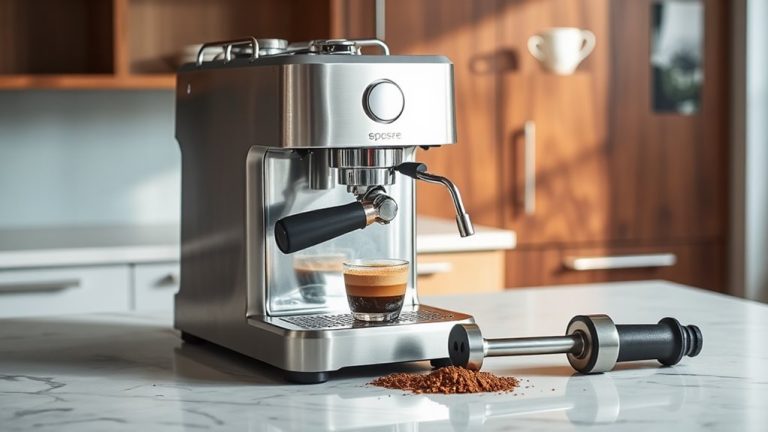
You want precision and pro-level results at home, so consider machines like the Diletta Bello+ or Rocket Appartamento for their E61 group heads and heat-exchange boilers, which allow simultaneous brewing and steaming. Models like the Breville Oracle Jet automate grinding, tamping, and milk texturing, saving effort. If speed matters, ThermoJet systems heat in 3 seconds. Dual boilers offer stability; single boilers require patience. Built-in grinders improve freshness, but require cleaning. Reliable temperature control through PID is standard. Machines like the Bambino suit smaller spaces, while 2-group commercial units need dedicated plumbing and 220V power. For those who value consistency and build quality, investing in stainless steel and copper internals makes a difference over time. You’ll find the best fit depends on your workflow, space, and how much control you want over each step. The details that matter most become clear once you understand what each system prioritizes.
We are supported by our audience. When you purchase through links on our site, we may earn an affiliate commission, at no extra cost for you. Learn more. Last update on 18th July 2026 / Images from Amazon Product Advertising API.
Notable Insights
- High-end machines like the Rocket Appartamento use E61 group heads and heat-exchange boilers for precise, stable brewing temperatures.
- Dual boiler systems in commercial units enable simultaneous brewing and steaming, ideal for high-volume coffee enthusiasts.
- PID temperature control ensures ±1°F accuracy, critical for consistent extraction in top-rated espresso machines.
- Built-in grinders with conical burrs, like on the Breville Barista Express, deliver fresh, uniform grounds for optimal flavor.
- Machines such as the Breville Oracle Jet offer automated tamping, dosing, and milk texturing for barista-level results at home.
Diletta Bello+ Espresso Machine (Black)
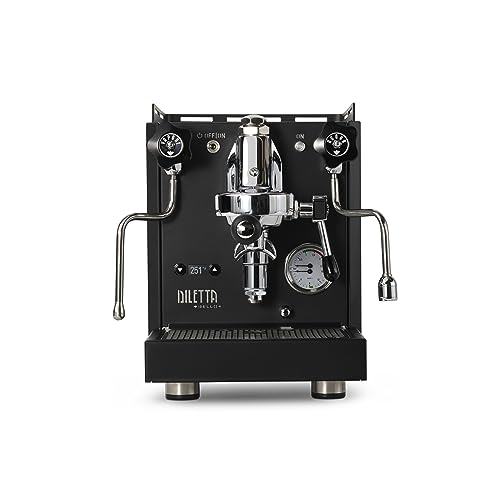
If you’re after a machine that brings Italian craftsmanship into your kitchen, the Diletta Bello+ Espresso Machine (Black) is built for you. Handmade in Milan, it’s built tough with stainless steel inside and out, weighing nearly 52 pounds. It uses an E61 group head and heat-exchange boiler, so you can brew and steam at the same time. The PID control keeps temps steady, and the front screen doubles as a shot timer. I like that preinfusion is programmable up to 10 seconds-it helps with even extraction. Manual controls let you fine-tune your technique, ideal for learning. It’s fully automatic in operation but still gives pro-level control. Comes with a 58mm portafilter, tamper, and baskets. The deep drip tray cuts mess. Eco-mode saves power by lowering boiler heat when idle but still reheats fast. It’s for home use, but feels commercial-grade. Not small, though-check your counter space. Dimensions are 17.75D x 11W x 14.5H. If you want espresso, cappuccino, or latte with consistency, this machine delivers without fuss.
Best For: Home baristas who want a durable, professional-grade espresso machine with manual control and Italian craftsmanship for consistent espresso, cappuccino, and latte preparation.
Pros:
- Combines an E61 group head and heat-exchange boiler for simultaneous brewing and steaming
- Features PID temperature control and programmable preinfusion for improved shot consistency
- Includes eco-mode for energy savings without sacrificing quick recovery to brew temperature
Cons:
- Heavy at 51.9 pounds, requiring sturdy countertop space and limiting portability
- Fully automatic operation may offer less control than semi-automatic or manual machines for advanced users
- High upfront cost may be a barrier for casual espresso drinkers
Breville Barista Express Espresso Machine BES870XL, Brushed Stainless Steel

The Breville Barista Express BES870XL is ideal for hands-on coffee lovers who want full control over their espresso without needing a separate grinder. I use its built-in conical burr grinder to dose straight into the portafilter, saving time and reducing mess. The PID-controlled temperature and low-pressure pre-infusion deliver consistent, balanced shots that match specialty coffee standards. It’s compact at 15.9 inches tall, stainless steel, and fits most countertops. I’ve found the included tamper and dose-trimming tool help refine puck prep. While it’s not for beginners wanting push-button ease, I appreciate how it builds real barista skills. Registering it gets you two free specialty coffee bags-worth claiming.
Best For: Home baristas who want full control over espresso brewing with an integrated grinder and real skill development.
Pros:
- Integrated conical burr grinder doses directly into the portafilter for freshness and convenience
- PID temperature control and pre-infusion ensure consistent, balanced espresso extraction
- Compact stainless steel design with included tools (tamper, dose trimer) enhances ease of use and puck preparation
Cons:
- Steeper learning curve makes it less ideal for beginners seeking automatic operation
- Manual brewing process requires time and practice to master
- Non-dishwasher safe components increase cleaning effort
Breville Bambino Espresso Machine BES450BSS, Brushed Stainless Steel
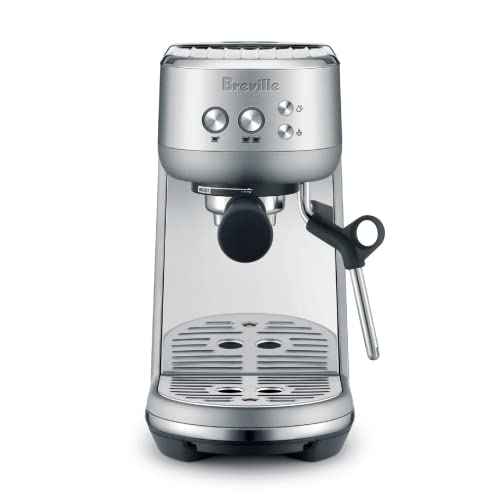
I rely on the Breville Bambino® for fast, quality espresso pulls when I don’t have time to wait, making it a top pick for home baristas who want speed and consistency without stepping into commercial machines. Its Thermojet heating system hits the right temperature in 3 seconds, and the PID control keeps water stable for even extraction. The 54mm portafilter handles 19 grams, giving full flavor with little effort. I appreciate the low-pressure pre-infusion-it boosts clarity in the cup. The auto steam wand textures milk fast, creating microfoam for lattes without practice. It’s compact, weighs 10.9 pounds, and fits small spaces. I clean the dishwasher-safe parts easily. While it lacks a built-in grinder, it saves time and space for quick drinks. I’ve used it daily since 2022, and it holds up well. The 1-year warranty helps, and registering the machine gets you two free coffee bags-worth grabbing. For fast, reliable espresso without complexity, this machine delivers.
Best For: Home baristas who want fast, consistent espresso with minimal effort and limited counter space.
Pros:
- Heats up in 3 seconds with Thermojet system and maintains precise temperature via PID control for optimal extraction
- Auto steam wand creates barista-quality microfoam quickly, making milk-based drinks easy and hands-free
- Compact design and dishwasher-safe parts make it convenient for small kitchens and daily use
Cons:
- Lacks a built-in grinder, requiring a separate purchase for fresh grounds
- 1-year warranty is shorter than some competitors offer
- No automatic brew volume customization beyond 1 or 2 cup presets
Commercial 2-Group Espresso Machine 220V

Built for heavy-duty performance, this 220V commercial 2-group espresso machine handles high-volume output with ease, making it ideal for coffee shops, hotels, or bakeries that demand consistency all day long. I rely on its dual 550ml coffee boilers and 5.5L steam boiler for nonstop shots and quick steaming. Copper water pipes boost efficiency, and the rotary pump delivers steady pressure. It’s built tough-stainless steel and copper throughout-though it weighs 119 lbs and needs pro installation. You’ll need a 220V line and plumbing hookups, so it’s not for home use. Programmable buttons and flow meters guarantee precision, while LED lighting and snap-in group heads simplify service.
Best For: Commercial establishments like coffee shops, hotels, and bakeries that require high-volume, consistent espresso output with professional-grade equipment.
Pros:
- Dual 550ml coffee boilers and a 5.5L steam boiler enable continuous, high-performance operation for busy environments
- Copper water pipes and a rotary vane pump ensure efficient heating and consistent brew pressure
- Programmable button controls with flow meters allow for precise, repeatable shot volumes and easy customization
Cons:
- Requires 220V electrical setup and professional plumbing installation, limiting use to commercial spaces
- Heavy at 119 lbs, requiring freight shipping and professional handling during setup
- Not suitable for home use or DIY installation due to complex setup and commercial design
Breville Oracle Jet Espresso Machine, Brushed Stainless Steel

If you’re serious about pulling café-quality espresso at home without the guesswork, the Breville Oracle Jet Espresso Machine in brushed stainless steel is built for you. I use its 58mm portafilter and ThermoJet heating system for precise, ±1°F control and fast heat-up. The integrated grinder auto-doses and tamps, while Barista Guidance helps me fix extraction issues. I customize milk texture and temperature-up to 167°F-with the Auto MilQ system, ideal for oat or dairy milk. It’s fully automatic, runs on 120 volts, and includes a 480ml milk jug and filter baskets. At 26.7 pounds, it’s heavy but sturdy. I don’t put parts in the dishwasher.
Best For: Home baristas who want café-quality espresso with minimal effort and advanced automation for consistent results.
Pros:
- Integrated grinder with auto-dose, tamp, and Barista Guidance for optimal extraction
- Auto MilQ system offers customizable milk texture and temperature for various milk types
- ThermoJet heating system enables rapid heat-up and precise ±1°F temperature control
Cons:
- Heavy at 26.7 pounds, making it difficult to move once placed
- Not dishwasher safe, requiring hand cleaning for all components
- High price point may be prohibitive for casual coffee drinkers
Gaggia RI9380/46 E24 Espresso Machine, Brushed Stainless Steel
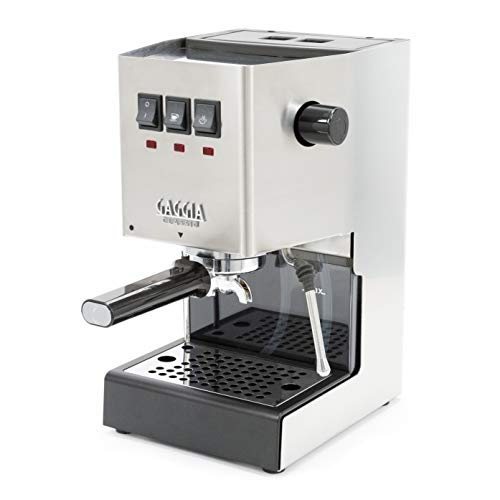
While it won’t pull the same nuanced shots as a $2,000 machine, the Gaggia RI9380/46 E24 Espresso Machine delivers reliable 9-bar pressure extraction that’s ideal for home baristas who want prosumer performance without complexity. I use its 58mm commercial portafilter and three-way valve for consistent results, and the steam wand froths milk well for lattes. Made in Italy with a stainless steel build, it’s durable and resists scale thanks to an updated boiler. It’s semi-automatic, so I control the brew time, and it works with grounds or ESE pods. I clean it manually-nothing’s dishwasher safe-but the design makes maintenance straightforward. For under $600, it’s a practical step up from beginner machines.
Best For: Home baristas seeking prosumer-level espresso performance with a durable, semi-automatic machine that balances quality and simplicity under $600.
Pros:
- Delivers consistent 9-bar pressure extractions with a commercial-grade 58mm portafilter and three-way solenoid valve
- Features a stainless steel build made in Italy, offering durability and resistance to scale with an updated boiler
- Offers versatility with support for both ground coffee and ESE pods, plus a powerful steam wand for latte art
Cons:
- Not dishwasher safe, requiring manual cleaning for all components
- Semi-automatic operation demands user involvement in brew timing, which may challenge beginners
- Lower nuanced shot quality compared to high-end $2,000 machines
Breville Barista Express Espresso Machine BES870BSXL, Black Sesame

The Breville Barista Express BES870BSXL in Black Sesame is the go-to machine for hands-on coffee lovers who want full control over their espresso without needing a separate grinder. I use its integrated conical burr grinder daily-it delivers consistent, fresh grounds straight into the portafilter. With PID temperature control and low-pressure pre-infusion, my shots pull evenly, enhancing flavor. The 15-bar pump pressure meets specialty coffee standards, and the stainless steel build fits well on my counter. At 22 pounds, it’s stable but not too heavy. It runs on 120 volts, so it works in any U.S. kitchen. I also got two free bags of specialty coffee after registering it-just follow the terms.
Best For: Coffee enthusiasts who want full control over their espresso-making process with the convenience of an integrated grinder and advanced extraction technology.
Pros:
- Integrated conical burr grinder delivers fresh, consistent grounds directly into the portafilter for optimal flavor
- PID temperature control and low-pressure pre-infusion ensure even extraction and specialty-grade espresso
- Compact, stainless steel design with 15-bar pump pressure offers durability and professional performance in a home-friendly footprint
Cons:
- At 22.1 pounds, the machine is heavy and less portable despite its compact size
- Dial-based interface may feel less intuitive for beginners compared to fully automatic models
- Requires registration to claim bonus specialty coffee, with terms and conditions limiting redemption
Breville Barista Touch Espresso Machine BES880BSS, Brushed Stainless Steel

You’ll want the Breville Barista Touch BES880BSS if you’re serious about espresso but don’t have barista training-this machine bridges the gap between pro-level results and home use with its intuitive touchscreen and fully automatic workflow. I use the built-in conical burr grinder for fresh beans-to-espresso in under a minute. The ThermoJet heats up in 3 seconds, and PID control keeps water temp precise. Pre-infusion guarantees even extraction. I customize grind, strength, and milk texture-microfoam for lattes is easy with the auto steam wand. It stores 8 profiles and includes a milk jug, filter, and dose tool. 2-year warranty.
Best For: Home espresso enthusiasts who want café-quality results with minimal effort and no prior barista experience.
Pros:
- Integrated conical burr grinder delivers fresh, consistent grinds on demand for optimal flavor
- Intuitive touchscreen interface with automated grinding, brewing, and milk texturing simplifies espresso making
- Customizable settings for grind size, coffee strength, milk texture, and temperature with storage for 8 user profiles
Cons:
- Relatively high price point compared to entry-level espresso machines
- Milk jug and accessories are not dishwasher safe, requiring hand cleaning
- 67 oz water tank may require frequent refills during heavy use or entertaining
Philips 5500 Espresso Machine with LatteGo

If you want barista-style milk drinks without the cleanup, the Philips 5500 Espresso Machine with LatteGo stands out for its quick, low-maintenance frothing system. I use the LatteGo daily-it steams milk smoothly and rinses clean in 10 seconds, with no tubes to clog. Its 15-bar pump and integrated grinder deliver consistent extraction, and I appreciate the 20 drink presets, including iced options. I’ve saved my favorite latte profile, and the color screen makes navigation simple. It powers up in 3 seconds and runs quietly, thanks to SilentBrew. The AquaClean filter means I won’t descale for up to 5,000 cups. At just under 9.7 inches deep, it fits neatly on my counter.
Best For: Home baristas seeking a low-maintenance, fully automatic espresso machine with quick cleanup and barista-style milk drinks.
Pros:
- LatteGo milk system froths smoothly and cleans in 10 seconds, with no tubes or hidden parts
- QuickStart technology ready to brew in 3 seconds and operates quietly with SilentBrew
- AquaClean filter eliminates descaling for up to 5,000 cups and supports 20 drink presets with customizable profiles
Cons:
- 230V voltage limits compatibility in regions using 120V, such as North America
- Limited user profile storage with only 4 customizable drink settings
- Higher upfront cost compared to semi-automatic or pod-based systems
Rocket Espresso Appartamento E61 Heat Exchanger

A copper-clad workhorse with a 1.8-liter heat exchanger boiler makes the Rocket Espresso Appartamento ideal for home baristas who demand true dual functionality-pulling espresso shots while steaming milk at the same time. I use its 1200-watt power and E61 group head for stable temperatures and repeatable pulls. The 2.5-liter reservoir suits my morning routine, though I refill mid-day. It’s heavy at 58 pounds, but that adds stability. I appreciate the included tools and three-year warranty, but cleaning’s manual-no auto-rinse. It’s not dishwasher safe, so I wipe parts daily. If you want pro performance at home and don’t mind hands-on care, this machine delivers.
Best For: Home baristas who want professional-level espresso performance with the ability to brew and steam simultaneously.
Pros:
- Powerful 1200-watt heating system with a 1.8L heat exchanger boiler enables simultaneous brewing and steaming
- Includes essential accessories like dual portafilters, baskets, and a tamper, plus a comprehensive three-year warranty
- Stable, heavy-duty copper construction with an E61 group head for consistent temperature and extraction
Cons:
- Manual cleaning required-no automatic rinse cycle and parts are not dishwasher safe
- 2.5-liter water reservoir may require refilling during extended use
- Heavy at 58 pounds, which limits portability and placement flexibility
Factors to Consider When Choosing a High End Espresso Machine
You want a machine that’s built to last, so check the build quality and materials-stainless steel groups and solid casing mean durability. Think about the brewing system too, as E61 groups offer stability while saturated boilers give better heat consistency. And don’t overlook temperature control, grinder compatibility, and steam power-they all shape how easily you can pull great shots and froth milk daily.
Build Quality And Materials
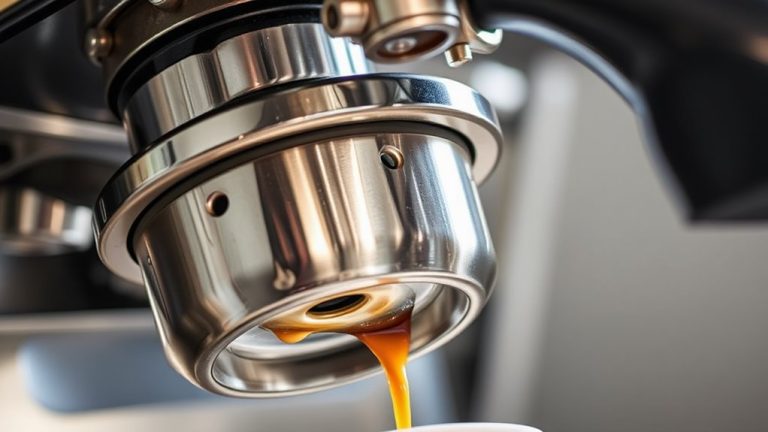
Stainless steel forms the backbone of most high-end espresso machines, delivering durability, consistent heat retention, and resistance to corrosion across the chassis, boiler, and group head. You’ll find copper used in boilers and water pathways too-it boosts thermal conductivity, helping maintain stable brew temperatures. Machines built with solid metal frames often weigh over 50 pounds, minimizing vibration and improving stability during use. That heft signals robust construction, not wasted bulk. Look for polished or brushed finishes; they resist fingerprints and scratches better than glossy coatings. Your portafilter matters just as much-opt for a commercial-style 58mm stainless steel model, which holds heat well and works perfectly with precision filter baskets. These materials don’t just look professional-they perform. They respond predictably to tuning, endure daily use, and support consistent shot quality. Skipping on build quality means sacrificing longevity and performance. You want metal where it counts, not plastic hiding under chrome.
Brewing System Type
When pulling espresso and steaming milk at the same time matters to your workflow, a dual boiler system is the clear choice, giving you independent temperature control for each function. You’ll get professional results without waiting-ideal for busy mornings or café-style service. If you’re on a budget but still want to brew and steam in one session, heat exchangers use a single boiler with a water tube to pull shots while heating milk, though temperature stability isn’t quite as precise. Single boiler models are simpler and cheaper, but you’ll have to brew and steam one after the other, slowing down your process. Thermoblock systems heat water on demand through coils, offering fast recovery and steady temps during back-to-back drinks. Volumetric machines add consistency by using flow meters to dose shot volume automatically, cutting guesswork. Pick based on speed, multitasking needs, and how often you make milk drinks.
Temperature Control Precision
While consistent temperature is critical for balanced espresso, not all machines deliver it the same way. You’ll want PID control-it lets you tweak water temp in ±1°F steps for reliable extraction. Machines with digital temperature control give you precise, set-it-and-forget-it accuracy, which matters when pulling smooth, even shots. If you’re after speed, thermojet systems heat up in just 3 seconds, cutting wait time and boosting consistency. Heat exchanger boilers let you brew and steam at once, using constant water flow to maintain stable temps. And don’t overlook low-pressure pre-infusion-it gently starts extraction, helping stabilize temperature and improve flavor evenness. These features work together so your shots taste right every time. Look for models that combine PID with solid thermal design; they give you control and consistency without fuss. It’s not just about heat-it’s about precision you can trust.
Grinder Integration Options
A built-in grinder can streamline your espresso routine by pairing precision grinding with your machine’s brewing system. You’ll get fresh grounds delivered straight to the portafilter, cutting air exposure and preserving flavor. Most high-end models use conical burr grinders with 45+ settings, so you can fine-tune particle size for better extraction. Look for dose control that lets you program grind amounts down to the gram-useful for dialing in repeatable shots. Some machines automate grinding, dosing, and even tamping, reducing user error. Hardened steel burrs and slow grinding reduce heat, protecting bean quality. While integrated grinders save counter space and simplify workflow, they may limit upgrade paths later. If consistency and convenience matter to you, a built-in grinder from brands like Slayer or Expobar delivers serious hands-on benefits without extra gear.
Milk Steaming Capability
If you’re making lattes or cappuccinos regularly, steam performance matters just as much as brew quality. Machines with thermoblock or dual-boiler systems heat milk faster and maintain steady steam pressure, unlike single-boiler models that struggle with back-to-back drinks. Look for a steam wand with adjustable pressure and temperature-these give you real control over texture, making microfoam for latte art easier. Digital PID controllers boost consistency by precisely managing boiler heat, cutting the risk of scalding. Steam recovery time is critical if you’re serving multiple drinks; faster recovery keeps your workflow smooth. Some high-end models offer automatic milk systems that heat and froth hands-free, with presets for different milk types-convenient, though less customizable. While automatic systems save effort, manual wands give you more precision. Choose based on how much control you want and how often you’re steaming.
User Interface Design
What kind of control do you want at your fingertips? If you love precision, touchscreen interfaces with customizable profiles let you save coffee strength, milk texture, and temperature for repeatable results. You’ll appreciate front-mounted PID screens that show real-time water temps and allow adjustments in ±1°F-perfect for dialing in the ideal shot. Digital displays with built-in shot timers and programmable preinfusion help you fine-tune extraction for better consistency. But if you prefer hands-on control, mechanical dials and manual buttons give tactile feedback and direct access to brewing settings. Some machines even combine both, offering touch controls with physical overrides. For beginners or those who want simpler operation, look for step-guided interfaces with visual or audio cues that walk you through grinding, tamping, and steaming. Your choice depends on your skill level and how much control you want during brewing.
Energy Efficiency Features
You’ll want to take into account how energy efficiency affects both your electricity bill and daily workflow when choosing a high-end espresso machine. Models with eco-mode cut power by lowering boiler temps during idle times, saving energy while still brewing fast when needed. ThermoJet systems heat up in just 3 seconds-up to 32% more efficient than standard thermoblocks-so you waste less time and power. PID controls keep water temperature steady, preventing the energy drain of overheating or constant reheating. Many machines also auto-shift to a low-power state after inactivity, avoiding full reboots. Internal tests show advanced heating tech can deliver speed and consistency while using less energy over time. If you pull shots frequently, these features mean lower costs and less downtime. Machines like the Rocket R58 or Lelit Victoria PS-LR include such systems, giving you performance and efficiency without compromise. Think about how often you use your machine-efficiency matters most with daily, heavy use.
Warranty And Support Terms
While performance and design often take center stage, don’t overlook the warranty and support terms when investing in a high-end espresso machine, as they directly affect long-term reliability. Most warranties last 1–3 years, with select models extending coverage for boilers or pumps. Commercial-grade units usually require registration and professional installation to activate the warranty. You’ll want access to authorized service centers, phone support, and replacement parts-most manufacturers guarantee parts availability for 5–7 years post-discontinuation. Some brands, like La Marzocco or Slayer, include labor coverage for complex repairs, not just parts. Keep in mind: your warranty often depends on regular descaling, using filtered water, and sticking to recommended servicing schedules. Skip maintenance, and you risk voiding coverage. Always read the fine print so you know what’s included and what falls on you.
Frequently Asked Questions
How Often Should I Descale My Espresso Machine?
You should descale your espresso machine every 1–3 months, depending on use and water hardness. If you brew daily, go with monthly. Hard water means more frequent cleaning. Look for slowed shots or gurgling sounds-they signal scale buildup. Use recommended descaling solutions like Urnex or Durgol for best results. Avoid vinegar; it’s less effective and can damage seals. Always rinse thoroughly after. Regular descaling keeps boiler efficiency high and extends machine life.
Can I Use Regular Coffee Beans in These Machines?
You can use regular coffee beans, but you shouldn’t. Regular beans aren’t roasted or ground for espresso’s high pressure, so they clog grinders and produce flat, sour shots. Espresso machines need fine, consistent grounds and dark or medium-dark roasts that extract evenly. For best results, use beans roasted specifically for espresso-like those from Lavazza, Illy, or Stumptown. They’re balanced, rich, and designed to handle the pressure.
Do I Need a Separate Grinder for Best Results?
Yes, you need a separate grinder for best results. Built-in grinders often lack consistency, which hurts espresso quality. A dedicated burr grinder gives you precise control over particle size, improving extraction and flavor. Models like the Baratza Virtuoso or Timemore C2 offer grind uniformity that blade or low-tier grinders can’t match. Freshly ground beans mean more aroma, better crema, and fewer bitter notes. If you’re serious about espresso, investing in a good standalone grinder isn’t optional-it’s essential.
Are These Machines Compatible With Pod Systems?
no, these machines aren’t built for pods-you’re meant to use fresh beans and a grinder. most high-end models, like the lamarzocco linea or la spaziale vogue, focus on manual espresso control, not pod compatibility. if you want pods, you’d need a combo machine or a separate pod-friendly unit. using pods limits flavor and pressure control, which defeats the purpose of a pro-grade espresso setup. stick to beans for best results.
What’s the Average Lifespan of a High-End Espresso Machine?
You can expect a high-end espresso machine to last 7 to 15 years with regular use and proper care. Machines like the La Marzocco Linea Mini or Rocket R55 often last longer thanks to commercial-grade parts. You’ll extend its life by descaling monthly, changing water filters often, and getting yearly service. Cheaper models wear out faster-investing in build quality and maintenance pays off in reliability and consistent shot performance over time.