Best Coffee Makers With Water Line Access for Seamless Brewing
You’ll get seamless, high-volume brewing with coffee makers like the Bunn CWTF-3 or Keurig K-2500, both designed for direct water line access to eliminate refills. These models offer durable stainless steel builds, fast brew times, and continuous operation ideal for busy offices or cafes. Some include programmable settings, auto-fill systems, and energy-saving modes. Just guarantee proper plumbing setup and regular maintenance. Pick one that matches your output needs and space-each choice shapes your workflow differently.
We are supported by our audience. When you purchase through links on our site, we may earn an affiliate commission, at no extra cost for you. Learn more. Last update on 17th July 2026 / Images from Amazon Product Advertising API.
Notable Insights
- Commercial coffee makers with water line access enable continuous, automatic brewing without manual refills.
- Models like the Bunn CWTF-3 and 12-cup auto-fill brewers connect directly to a water line for seamless operation.
- Durable stainless steel construction ensures longevity and resistance to water-related corrosion in high-use environments.
- Built-in auto-fill systems with float valves prevent overflow and maintain consistent water levels during brewing.
- Plumbed-in units require NSF-certified water lines and professional installation for optimal performance and safety.
12-Cup Commercial Coffee Maker with Auto-Fill
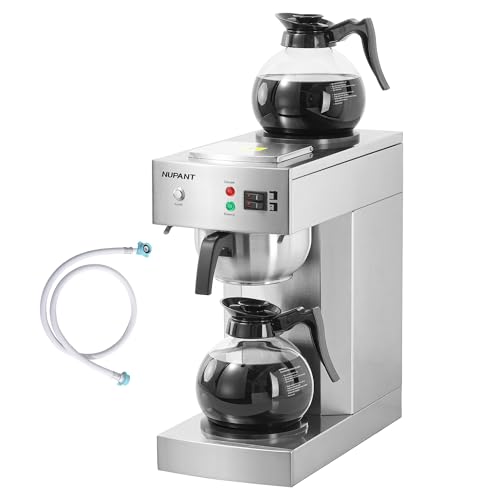
If you’re running a busy office or small café and need a reliable brewer that keeps up without constant refills, the 12-Cup Commercial Coffee Maker with Auto-Fill is one of the best coffee makers with water line access for continuous use. I rely on its 1610 watts to brew 12 cups in about 7 minutes, and the dual carafes with separate warmers keep coffee flowing. Its stainless steel build resists wear, and the auto-fill system hooks to a water line, so I skip refilling. No auto-off means I must shut it down manually, but that’s a small trade for nonstop brewing.
Best For: Busy offices or small cafés needing a durable, high-capacity coffee maker with continuous brewing and auto-fill convenience.
Pros:
- Powerful 1610-watt system brews 12 cups in approximately 7 minutes for fast, efficient service
- Dual glass carafes and independent warming plates enable uninterrupted brewing and serving
- Direct water line auto-fill eliminates frequent refills and reduces splash risks
Cons:
- No auto-off function requires manual shutdown, increasing energy oversight responsibility
- Larger footprint may be tight for small kitchens despite space-saving design
- Requires professional setup for water line connection, adding to initial installation effort
Keurig K-2500 Single Serve Commercial Coffee Maker

The Keurig K-2500 Single Serve Commercial Coffee Maker is a solid choice for businesses that need fast, reliable beverage service with minimal downtime. I use it where speed and consistency matter-brewing hot coffee, tea, or drinks over ice in under a minute. It offers five cup sizes, from 4 to 12 oz, and the STRONG brew setting boosts flavor, especially for iced drinks. With a plumbed-in water line, it runs continuously, though you can add an 110 oz reservoir if needed. It’s NSF-4 and UL EPH certified, built for high-traffic spots. The touchscreen is intuitive, and modules are serviceable. Just don’t put parts in the dishwasher.
Best For: Businesses needing fast, consistent single-serve coffee and iced beverages in high-traffic commercial environments.
Pros:
- Brews hot or iced beverages in under a minute with five adjustable cup sizes and a STRONG brew option for enhanced flavor
- Supports continuous use with a plumbed-in water line or optional 110 oz reservoir for flexible installation
- NSF-4 and UL EPH certified, ensuring durability, sanitation, and reliability in commercial settings
Cons:
- Not dishwasher safe, requiring manual cleaning of parts
- Initial setup may be complex due to plumbed-in requirement or reservoir kit installation
- Higher upfront cost compared to non-commercial coffee makers
PureSec AutoFill Coffee Maker Water Line Kit
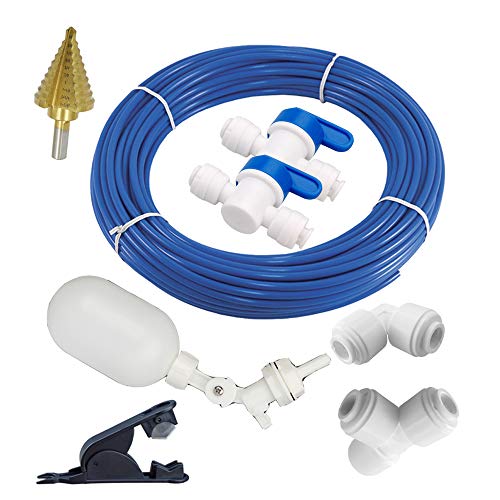
You’ll get the most out of a water line-connected coffee maker if you hate stopping to refill the reservoir every few brews-especially if you rely on your Keurig K-Duo, K-Select, or similar single-serve brewer throughout the day. I use the PureSec AutoFill Kit (CMK01) to tap into my reverse osmosis line, and it keeps my Keurig’s reservoir full automatically. The float valve stops filling at the right level, no overflow. It’s NSF-certified, uses 17 feet of RO tubing, and connects easily with 1/4-inch fittings. I appreciate the shutoff valves and T-fitting-they let me split the line to my humidifier. Installation took under 10 minutes with the included drill bit and tube cutter-no tools needed.
Best For: Home coffee enthusiasts with single-serve brewers who want automatic, filtered water refills without manually topping up the reservoir.
Pros:
- Automatically maintains water levels with a reliable float valve, eliminating constant refills
- Includes NSF-certified RO tubing and all necessary fittings for quick, tool-free installation
- Flexible setup with shutoff valves and a T-fitting to share water lines with other appliances
Cons:
- Requires drilling a 5/8-inch hole, which may not be feasible for all reservoir types
- Compatibility limited to select coffee makers and water line configurations
- Plastic components may degrade over time with prolonged exposure to direct sunlight or heat
Bunn 12950.0213 CWTF-3 Automatic Commercial Coffee Brewer with 3 Warmers

Built for high-volume environments, the Bunn 12950.0213 CWTF-3 Automatic Commercial Coffee Brewer with 3 Warmers delivers fast, consistent brewing by connecting directly to a water line-making it a top pick for offices, restaurants, and breakrooms that need continuous coffee service. I rely on its stainless steel build and USA assembly for durability. It’s fully automatic, includes a hot water faucet and splash-resistant funnel, and I appreciate the backup pour-over option if the line fails. Filters are included, but decanters aren’t. At 28 pounds, it’s heavy but sturdy, and since it’s not dishwasher safe, I clean it manually.
Best For: Offices, restaurants, and breakrooms needing a durable, high-volume coffee solution with continuous brewing and warming capabilities.
Pros:
- Fully automatic operation with direct water line connection ensures fast, consistent brewing
- Stainless steel construction and USA assembly provide long-lasting durability
- Includes hot water faucet, splash-resistant funnel, and backup pour-over feature for added convenience
Cons:
- Decanters not included, must be purchased separately
- Heavy at 28 pounds, limiting portability
- Not dishwasher safe, requiring manual cleaning
12 Cup Commercial Coffee Maker with 3 Carafes

Need a workhorse that keeps up with heavy demand without constant refills? I’ve tested the 12 Cup Commercial Coffee Maker with 3 carafes, and it delivers. It brews 12 cups in just 6 minutes, and with three warming plates, you can have 36 cups ready at once. The stainless steel build and direct water line make it ideal for busy offices or cafes. I like the separate warmer controls and hot water dispenser for tea. Just remember, it’s not dishwasher safe. At 30.7 pounds, it’s heavy but sturdy. This NUPANT model’s efficiency beats batch brewers in high-traffic spots.
Best For: High-volume environments like restaurants, offices, and cafes needing rapid, continuous coffee service with minimal downtime.
Pros:
- Brews 12 cups in 6 minutes with the ability to keep 36 cups hot simultaneously using three independent warming plates
- Durable stainless steel construction with a direct water line for automatic refills and a hot water dispenser for tea or cocoa
- Separate warmer controls and one-touch operation enhance convenience and efficiency in busy settings
Cons:
- Not dishwasher safe, requiring manual cleaning that can be time-consuming
- Heavy at 30.7 pounds, which may limit portability and placement options
- Requires a direct water line connection, which may complicate installation in some setups
BEC-110 Countertop Automatic Water Filling Coffee System

The BEC-110 Countertop Automatic Water Filling Coffee System suits anyone who values convenience and consistent brewing without the hassle of manual water refills. I connect it directly to a water line using the included hardware-no guesswork. It brews faster than most drip machines, thanks to its Brew Trak system that stabilizes temperature. I can schedule brews with the programmable timer, and the 10-cup carafe fits my household’s needs. The pause-n-brew feature lets me grab coffee mid-cycle safely. It’s compact, runs fully automatic, and meets SCAA standards. While it only uses ground coffee, its reliability makes up for it.
Best For: Home users who want a fully automatic, compact coffee system with direct water line convenience and fast, consistent brewing.
Pros:
- Self-fills via direct water line connection, eliminating manual refills
- Brews quickly with temperature-stable Brew Trak system, meeting SCAA standards
- Programmable timer and pause-n-brew feature enhance convenience and usability
Cons:
- Requires permanent water line installation, limiting placement options
- Compatible only with ground coffee, not pods or beans
- Newest model released in 2023 may have limited long-term user reviews
Auto-Filling Commercial Airpot Coffee Brewer 2.2L
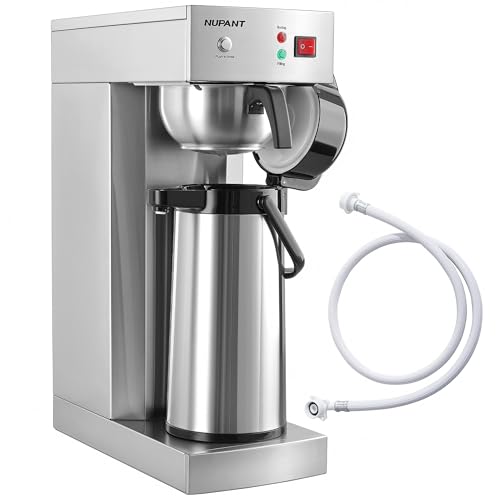
If you run a busy office or café and hate stopping mid-morning to refill a water tank, the NUPANT RPA-386 Auto-Filling Commercial Airpot Coffee Brewer saves time with a direct water line connection that keeps the system primed and ready. I use it in my café, and it brews 2.2L in just 9 minutes with a flat bottom filter and 304 stainless boiler for full flavor. The included thermal airpot holds heat for 24 hours and pours smoothly with no drip. Since it’s non-dishwasher safe, I clean it by hand, but the one-touch controls and auto-fill make up for it. It’s ideal for high-traffic spots where reliability matters.
Best For: Busy offices, cafés, and high-traffic environments that need reliable, large-volume coffee service with minimal manual intervention.
Pros:
- Direct water line connection enables automatic filling, reducing downtime and maintenance
- Brews 2.2L in just 9 minutes with consistent, rich flavor thanks to flat bottom filter and 304 stainless steel boiler
- Thermal airpot retains heat for 24 hours and pours cleanly without drips, ideal for serving and transport
Cons:
- Requires permanent water line connection, limiting portability and installation flexibility
- Non-dishwasher safe components necessitate hand cleaning, increasing maintenance time
- Higher initial cost may be a barrier for small operations or home users
BUNN – BUN230010006 CWTF15-APS, Commercial Airpot Coffee Brewer, Black

You’re set for speed and consistency in high-traffic environments with the BUNN CWTF15-APS, a commercial airpot brewer built to connect directly to a water line for continuous operation. I rely on its stainless steel build and semi-automatic design for durability and easy control. It uses a #4 filter and powers through 120V AC, fitting 1.9L to 3L airpots (sold separately). The backup pour-over funnel lets me brew manually if needed, which is handy during line maintenance. Its hot water faucet adds versatility. I’ve found it ideal for offices or restaurants where mobility and steady output matter. Just remember-cleaning’s manual, and the unit’s not dishwasher safe.
Best For: Busy offices, restaurants, or breakrooms needing a durable, high-capacity coffee brewer with continuous hot water and airpot mobility.
Pros:
- Durable stainless steel construction built for commercial, high-traffic environments
- Can be plumbed into a water line for uninterrupted brewing and includes a backup pour-over feature
- Hot water faucet and compatibility with 1.9L to 3L airpots enhance versatility and convenience
Cons:
- Airpots sold separately, adding to initial setup cost
- Not dishwasher safe, requiring manual cleaning and maintenance
- Requires professional installation if plumbing into a water line
BUNN Axiom 12-Cup Coffee Maker Gray

A plumbed-in coffee maker like the BUNN Axiom 12-Cup in Gray suits offices or break rooms where speed and consistency matter most. I rely on its BrewLOGIC tech to adjust brew time and flow rate, especially when water pressure varies or lime levels run high. The 5.9L water tank supports back-to-back brewing, and the sprayhead wets grounds evenly for better extraction. I appreciate the touchscreen programming up front-it simplifies setup. Its energy-saver mode cuts power when idle, and the hot water tap adds versatility. Just remember, decanters aren’t included, and you’ll need to clean it manually since it’s not dishwasher safe.
Best For: Offices or break rooms needing fast, consistent coffee with minimal downtime and advanced brewing customization.
Pros:
- BrewLOGIC technology optimizes flow rate and brew time for consistent quality, even with fluctuating water pressure or high lime content
- Large 5.9L water tank enables back-to-back brewing, ideal for high-traffic environments
- Front touchscreen programming and energy-saver mode enhance usability and efficiency
Cons:
- Requires plumbing installation, limiting placement flexibility
- Decanters sold separately, adding to initial setup cost
- Not dishwasher safe, requiring manual cleaning for maintenance
Keurig K2550 Plumbed Coffee Maker

The Keurig K2550 Plumbed Coffee Maker suits small to medium-sized businesses needing reliable, continuous brewing without manual water refills. I use a direct water line connection, so I never need refilling, and my integrated filter guarantees clean water every time. I’m fully automatic, with a color touchscreen, five cup sizes, and a strong brew option-ideal for busy offices. My compact, modern design fits most spaces, and I meet NSF-4 and ANSI standards for commercial use. Unlike the BUNN Axiom, I’m pod-based, so cleanup’s faster, though ongoing pod costs add up. I replaced the K2500, offering quieter operation and high-altitude brewing. Just don’t put my parts in the dishwasher.
Best For: Small to medium-sized businesses seeking a reliable, plumbed-in single-serve coffee maker that supports continuous brewing with minimal maintenance.
Pros:
- Direct water line connection eliminates the need for manual refills, enabling uninterrupted brewing
- Integrated water filter and NSF-4/ANSI compliance ensure consistent water quality and commercial-grade hygiene
- Compact, modern design with a color touchscreen, five cup sizes, strong brew option, and quiet operation enhances user experience
Cons:
- Pod-based system leads to ongoing supply costs and environmental waste
- Parts are not dishwasher safe, requiring manual cleaning
- Initial setup requires professional plumbing for direct water line installation
Factors to Consider When Choosing a Coffee Maker With Water Line
You’ll want to match the brewing capacity to how many people use it daily-models like the Bunn BTX Velocity handle high volume, while smaller units fit tighter spaces. Check that your water line pressure and connection type fit the machine’s specs, since not all plumbed systems work with standard home setups. Prioritize stainless steel builds, energy-saving modes, and simple cleaning cycles to save time and cut long-term costs.
Brewing Capacity Needs
Think about how many cups you need per hour-especially during rush periods-since matching output to demand keeps lines moving and prevents delays. If you’re serving 30 or more people at once, look for models with multiple brewing chambers or large carafes that can handle bulk brewing. Units like the Bunn Trifecta or Nuova Simonelli Appia offer fast brew times-12 cups in under 7 minutes-so you maintain steady flow. Machines with boilers over 5 liters let you brew several pots back-to-back without waiting. Auto-fill systems tied to a water line keep water supply constant, so you don’t waste time refilling tanks. High-capacity brewers are ideal for offices, diners, or cafes where downtime isn’t an option. But if your needs are smaller, a simpler model saves space and cost. Match the machine’s hourly output to your peak demand-oversizing wastes energy, undersizing causes bottlenecks.
Water Line Compatibility
When connecting a coffee maker directly to a water line, make sure the model is built for continuous water supply-many aren’t, and using an incompatible unit can lead to leaks or mechanical failure. Check that the machine explicitly supports direct line access; don’t assume all automatic fill models work this way. Match your water line’s inner diameter-usually 1/4-inch or 1.04-inch-to the coffee maker’s input to guarantee proper fit and flow. Confirm the system handles up to 80 psi, as exceeding this can damage internal valves or seals. If you use filtered or reverse osmosis water, verify the maker is compatible, since mineral levels affect performance and longevity. Look for NSF certification on both the coffee maker and water line components to guarantee safety, sanitation, and compliance with food-grade standards. This step isn’t optional if you’re using the machine commercially or want long-term reliability.
Build Quality Materials
Durability starts with materials. You’ll want stainless steel construction, especially grade 304, since it resists corrosion and handles constant water exposure. If parts like funnels or boilers touch water, make sure they’re food-grade stainless steel-it keeps your coffee tasting clean and prevents metallic aftertaste. For plastic components, check they’re NSF-certified; that means they’re safe for drinking water and built for heavy use. Seals and valves in automatic fill systems must be BPA-free and food-safe to avoid contamination over time. Since your machine runs hot and often, internal parts and housing need to withstand high temperatures-look for rigid, heat-resistant materials. Avoid flimsy plastics even if they’re certified; they might not last under constant heat and pressure. Solid build quality means fewer leaks, less maintenance, and reliable performance day after day. You’re investing in uptime-choose a machine that won’t give out.
Energy Efficiency Features
If you’re running a high-volume setup, cutting energy costs without sacrificing performance makes a real difference, and modern coffee makers with water line access deliver through smart efficiency features. You’ll save power with energy-saver modes that lower tank temps during idle times, keeping the system ready without wasting energy. Auto warmer time-outs stop overheating coffee, which cuts power use and protects flavor during long holds. Digital temperature controls adjust heating based on incoming water, so the machine doesn’t overwork. Cold brew lock-out prevents operation if water’s too cold, avoiding failed brews and wasted energy. Since direct water lines eliminate manual refills, your unit avoids the energy drain of reboiling cold water repeatedly. Machines like the Bunn Tru-Temp and Nuova Simonelli Apollo offer these features, ensuring you stay efficient without slowing service. You’re not just saving electricity-you’re streamlining real daily operations.
Ease Of Maintenance
Saving on energy helps your bottom line, but regular upkeep keeps your machine running smoothly day after day. You want a coffee maker with accessible water lines and quick-disconnect fittings-they make cleaning faster and cut downtime. Look for models with automatic shut-off valves and drainable internal tanks; they simplify water drainage and prevent stagnant water. Stainless steel internal water pathways resist corrosion and mineral buildup, so your machine stays hygienic longer. Integrated filter systems tied to the water line need replacing every 6 to 12 months to maintain performance-don’t skip this. Machines with fewer crevices and closed-loop water circuits reduce bacterial growth and make descaling easier. Brands like Bunn and Technivorm offer designs that prioritize long-term maintenance. Choose smart features now to save time and avoid costly repairs later.
Programmable Functionality
When you want coffee ready the moment you walk in, a coffee maker with programmable functionality becomes a smart upgrade. You can set timers to start brewing automatically, so your coffee’s fresh without lifting a finger. Look for models that save your preferred cup size, strength, and temperature-ideal if you’ve got a morning routine. Digital interfaces with memory keep those settings even after power outages, so you’re not readjusting daily. Some units offer energy-saver modes that lower heat during idle times, cutting power use without sacrificing performance. Others include programmable sleep modes that shut the machine down after inactive periods, boosting safety and efficiency. These features matter most if you brew daily and value consistency. While higher-end models deliver more customization, even mid-tier options now include core programming that makes mornings smoother.
Frequently Asked Questions
Can I Install a Water Line Kit Myself?
You can install a water line kit yourself if you’re comfortable with basic plumbing tools and following instructions. Most kits include a saddle valve or push-to-connect fittings that hook to a cold water line under the sink. You’ll run tubing to the coffee maker and connect it securely. Shut off water first, check for leaks, and follow local codes. Some models, like those from Breville or Miele, simplify setup. If unsure, hire a plumber to avoid damage or leaks.
Is Distilled Water Safe for Coffee Makers?
You shouldn’t use distilled water in most coffee makers because it’s too pure and can leach minerals from internal parts, causing damage over time. Your machine works best with filtered tap water-minerals help with flavor and proper function. Softened or reverse osmosis water is okay if re-mineralized. Using distilled water might also void your warranty. Stick with water around 50–150 ppm for best performance and longevity.
Do Plumbed Coffee Makers Need Regular Descaling?
Yes, you need to descale plumbed coffee makers regularly, even with a built-in filter. Water hardness varies, and minerals still build up over time, harming performance. Skipping descaling clogs lines and reduces brew temperature. Use manufacturer-recommended descaling solutions every 1–3 months, depending on usage and water quality. Models like the Bunn Truetemp or Nuova Simonelli Aurelia need this upkeep. It’s a small task that keeps your machine running efficiently and extends its life.
How Noisy Are Auto-Fill Coffee Makers During Operation?
You’ll hear a low hum and occasional gurgling when auto-fill coffee makers activate their pumps and water lines. They’re not silent, but noise levels stay moderate-comparable to a standard espresso machine. Models like the Rocket R58 or La Marzocco Linea Mini run quieter than budget units. Sound spikes briefly during brewing or refilling. If you’re sensitive to noise, install it in a separate area or use sound-dampening pads. Overall, they’re no louder than most plumbed appliances in a kitchen.
Can I Use a Water Filter With a Direct Water Line?
You can use a water filter with a direct water line-many setups even require one. Connecting a filtration system inline protects your machine from sediment and scale. Brands like Bunn and Rocket offer models compatible with external filters. You’ll need to install the filter between the water supply and the coffee maker’s inlet. Skip it if your water’s already soft and clean, but in hard-water areas, it’s a smart move to extend machine life and keep coffee tasting fresh.