How to Choose an Espresso Machine With Optimal Steam Recovery
Pick a dual boiler machine like the Rocket R58 or Lelit Anna Lux DL if you pull shots and steam milk back-to-back. Dual boilers let you brew and steam simultaneously without pressure drops. Bigger boilers (1.8L or more) recover faster under heavy use. For tighter budgets, a well-designed heat exchanger like the Lelit Anna offers quicker recovery than single boilers. Add PID control for stable temps. If you’re making multiple drinks, recovery speed directly affects drink quality - and your next choice could make it easier.
Notable Insights
- Prioritize dual boiler or high-quality heat exchanger systems for consistent steam pressure and faster recovery.
- Choose a machine with a large boiler (1.8L or more) to maintain steam power during back-to-back use.
- Look for PID temperature control to ensure stable brew and steam temperatures under heavy demand.
- Fast steam recovery prevents group head cooling and maintains espresso consistency during busy periods.
- Ensure the pump and insulation support pressure stability and quick reheating after steaming milk.
Why Steam Recovery Speed Matters
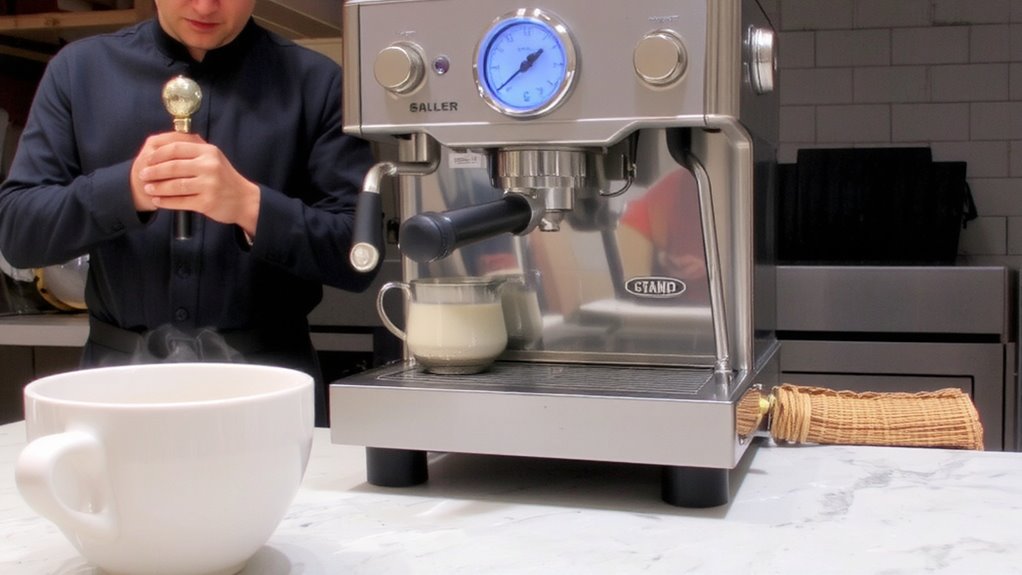
While you’re steaming milk for a latte, the time it takes for your machine to recover steam pressure can make or break your workflow. Slow recovery means waiting, and that hurts service during busy times. Steam efficiency determines how quickly the boiler reheats after use, while pressure consistency guarantees the steam stays strong throughout each session. Machines with poor recovery struggle to handle multiple drinks back-to-back, leading to uneven milk texture and longer wait times. For home baristas making two lattes, this might not matter much-but for frequent use, it adds up. Entry-level single boilers often lack strong steam efficiency, cycling on and off, which disrupts pressure consistency. Mid-range models improve here, using better insulation and recovery settings. If you regularly serve more than one milk-based drink, recovery speed isn’t just convenient-it’s essential for reliable results. Prioritize models known for steady performance, like the Rocket Appartamento or Rancilio Silvia. A key factor in minimizing downtime is choosing one of the best automatic espresso machines, which often feature dual boilers or thermoblocks for faster steam recovery.
Pick a Dual Boiler for Instant Reuse
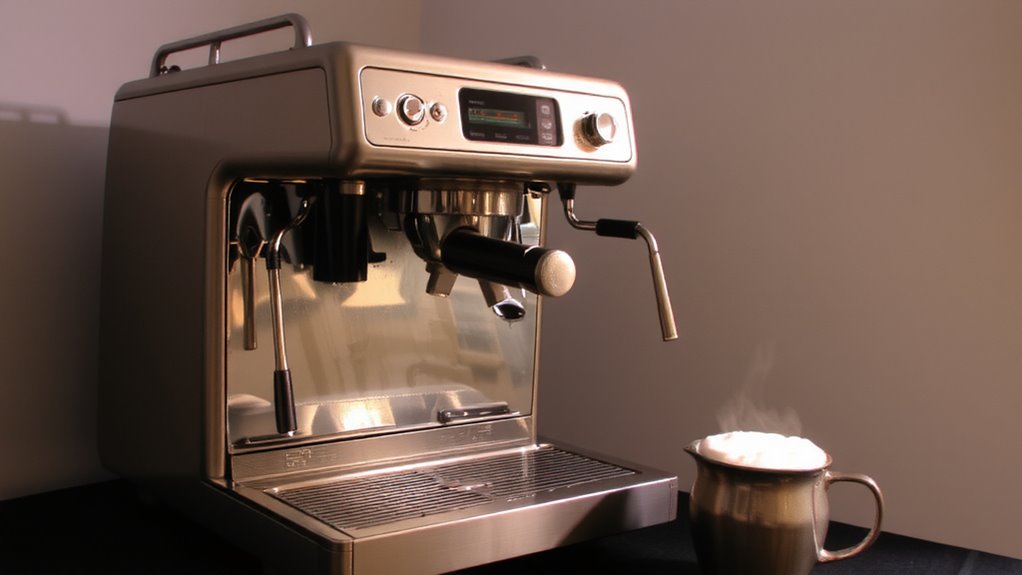
If you’re pulling one espresso after another or steaming milk right behind a shot, a dual boiler machine gives you the instant reuse most single boilers can’t match. With a separate boiler for brewing and steaming, you don’t have to wait for temperature recovery. That means you can brew your next shot while steaming milk-no downtime. A dual boiler setup guarantees stable brew temps and consistent steam pressure, which is key for back-to-back drinks. Machines like the Rocket R58 or Lelit Anna Lux DL offer true instant reuse, making them ideal for busy mornings or café-style service at home. While they cost more and take up more space than single boilers, the efficiency boost is clear. If you value speed and consistency and make multiple drinks in a row, a dual boiler is a smart pick. It’s the simplest way to get reliable instant reuse without compromise. For more top options, check out the Best Espresso Machines on Amazon to explore models that fit your home setup and budget.
Size Your Boiler for Shot Volume
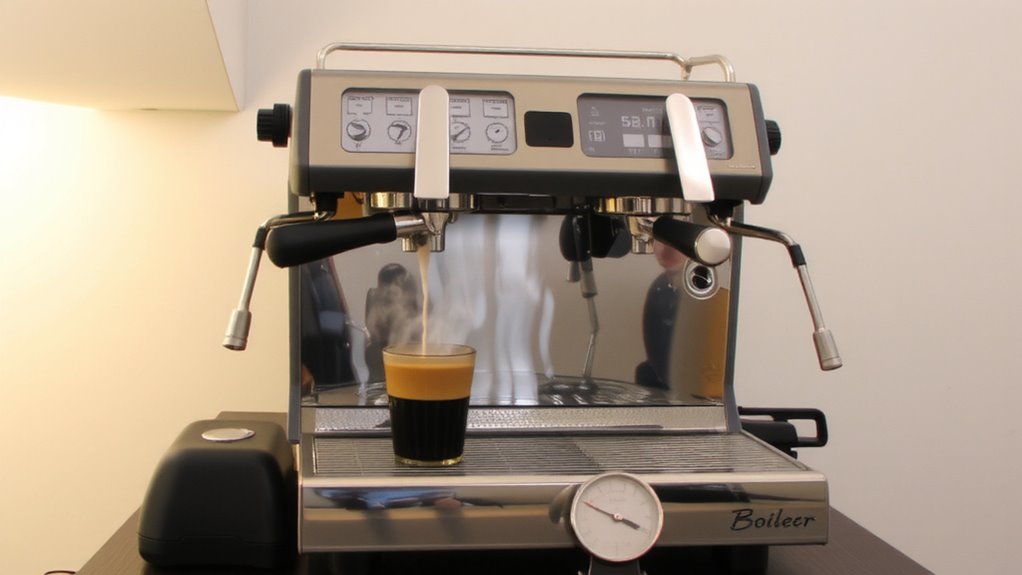
A larger boiler isn’t always better, but it does give you more power to pull multiple shots in a row without temperature drops. Your boiler capacity directly affects shot consistency, especially during busy moments. If you’re making two or three espressos back-to-back, a 1.8L to 2L boiler in a dual boiler machine like the Rocket R58 handles the load well. Smaller boilers, under 1.5L, may struggle and lead to warm-up delays or uneven extraction. For home use with light demand, that’s often fine. But if you regularly serve more than one person, the extra capacity keeps temps stable and shots even. Think about your typical shot volume-more users or frequent use means you’ll want a larger boiler. It’s not about size alone, but matching boiler capacity to your brewing rhythm to maintain reliable shot consistency day after day. For those on a budget, models under $250 can still offer solid performance with best espresso machines under $250.
Use PIDs to Maintain Steam Pressure
Boiler size affects not just shot consistency but also steam performance, and that’s where a PID controller becomes useful. You get better steam accuracy and pressure stability compared to machines relying on basic thermostats. With a PID, you’re not just guessing-temperature stays locked within a degree or two, so steam power is consistent from the first froth to the last.
| Feature | Benefit |
|---|---|
| Precise temp control | Improves steam accuracy |
| Real-time adjustments | Enhances pressure stability |
| Faster recovery | Ready for back-to-back drinks |
| Less temp swing | Reliable performance |
That means your milk texture stays even, especially during busy sessions. Machines like the Breville Dual Boiler or Rocket R58 use PIDs effectively. You’ll pay more, but if you steam milk regularly, the control is worth it. No more waiting or adjusting on the fly-just steady, predictable results.
Choose Heat Exchangers for Faster Recovery
Many semi-pro and busy home baristas find heat exchanger (HX) machines deliver the best balance of performance and efficiency when pulling shots and steaming milk in quick succession. You get faster steam recovery because the HX design keeps water hot in a single boiler by using a separate tube for espresso water, heated by surrounding steam water. This setup improves heat exchanger efficiency by leveraging constant thermal dynamics-steam heat transfers to the espresso water without needing a second boiler. Machines like the Lelit Anna or Rocket R55 use this design well. You’ll pull consecutive shots and steam milk quicker than with single boilers, though temperature stability isn’t as precise as dual boiler models. HX units are pricier than basic machines but cheaper than dual boilers. If you regularly serve multiple drinks, the trade-off makes sense. Just remember: it’s not about peak precision, it’s about speed and consistency during busy runs.
Compare Real-World Recovery Prediction
You can’t rely on specs alone to know how fast your machine will keep up during morning rushes. Real-world recovery depends on steam duration and pressure stability-how well the boiler replenishes steam and maintains steady brew pressure after pulls. Machines like the Lelit Mara X offer strong recovery thanks to dual boilers, while heat exchangers like in the Rocket R55 have trade-offs in pressure stability. User reports and videos often reveal more than manufacturer claims.
| Feature | What It Tells You |
|---|---|
| Steam duration | How long you can steam before running out |
| Pressure stability | How consistent brew pressure stays |
| Boiler size | Larger = better recovery, usually |
| Pump type | Vibratory vs rotary affects consistency |
| Pre-infusion | Can impact pressure behavior |
2444444444444-244 “240000000044-24444444-24 10-22231000 00004.00 22 2000-124444020224100510 120 23100110001102111 10100’t 310’t 2111’t 100’t11011”-10 02#cacacacacacacacacacaca0044424410 24 2 Text 110! the 10000001001 “i110210111111001 ?111110111111111111101111111111111111111111111111111111111111 111111111144111111111111 11111110010″011111111111111111111111111111111111111111111111111111111111111111111111111111111111111111111111111111111111111111111111111111111111111111111111111111111111111111111111111111111111111111111111111111111111111111111111111111111111111111111111111111111111111111111111111111111111111111111111111111111111111111111111111111111111111111111111111111111111111111111111111111111111111111111111111111111111111111111111111111111111111111111111111111111111111111111111111111111111111131111111111111111111111111111111111111111111111111111111111111111111111111111111111111111111111111111111111111111111111111111111111111111111111111111111111111111111111111111111111111111111111111111111111111111111111111111111111111111111111111111111111111111111111111111111111111111111111111111111111111111111111111111111111111111111111111111111111111111111111111111111111111111111111111111111111111111111111111111111111111111111111111111111141111111111111111111111111111111111111111111111111111111111111111111111111111111111111111111111111111111111111111111111111111111111111111111111111111111111511111111111111111111111111111111111111111111111111111111111111111111111111111111111111111111111111111111111111111111111111111111111111111111111111111111111111111111111111111111111111111111111111111111111111111111111111111111111111111111111111111111111111111111111111111111111111111111111111111111111111111111111111111111111111111111111111111111111111111111111111111111111111111111111111111111111111111111111111111111111111111111111111111111111111111111111111111111111111111111111111111111111111111111111111111111111111111111111111111111111111111111111111111111111111111111111111111111111111111111111111111111111111111111111111111111111111111111111111111111111111111111111111111111111111111111111111111111111111111111111111111111111111111111111111111111111111111111111111111111111111111111111 11111111111111111111111111111111119111111111111111111111111111111111111111111111111111111111111111111111111111111111111111111111111111111111111111111111111111111111111111111111111111111111111111111111111111111111111111111111111111111111111111111111111111111111111111111111111111111111111111111111111111111111111111111111111111111111111111111111111111111111111111111111111111111111111111111111111111111111111111111111111111111111111,1111111111111111111111111111111111111111111111111111111111111111111111111111111111111111111111111111111111110111111111111111111111111111111111111111111111111111111111111111111111111111111111111111111111111111111114111111111111111111111111111111111111111111111111111111111111111111111111111111111111111111111111111111111111111111111111111111111111111111111111111111111111111111111111111111111111111111111111111111111111111111111111111111111111111111111111111111111111111111111111111111111111111111111111111111111112111111111111111111111111111111111111111111111111111111111111111111111111111111111111111111111111111111111111111111111111111111111111111111111111111111111111111111111111111111111111111111111111111111111121111111111111111111111111111111111111111111111111111111111111111111111111111111111111111111111111111111111111111111111111111111111111111111111111111111111111111111111111111111111111111111111111111111111111111111111111111111111111111111111111111111111111111111111111111111111111111111111111111111111111111111111111111111111111111111111111111111111111111111111111111111111111111111111111112111111111111111111111111111111111111111111111111111111111111111111111111111111111111111111111111111111111111111111111111111111111111111111111111111111111111111111111111111111111111111111111111111111111111111111111111111121111111111111111111111111111111111111121111111111111111111111111111111111111111111111111111111111111111111
What sets one espresso machine apart from another when it comes to consistency under pressure? It’s how quickly it recovers steam and maintains stable brew temperatures. If you’re pulling back-to-back shots, poor recovery means fluctuating pressure and weak flavor. Machines with dual boilers or powerful heat exchangers keep brewing efficiency high by separating steam and brew functions. That means less waiting and more consistent extraction. For milk drinks, fast steam recovery guarantees you get silky milk texture without cooling the group head. Look for models like the Rocket R58 or Lelit Marco, which balance recovery speed and temperature control. Machines with large boilers reheat faster, but they take up more space. Smaller units might struggle during busy mornings. Your usage patterns matter-high volume demands better recovery. Don’t overlook insulation and pump quality, both affect performance. Prioritize build features that support quick recovery to maintain quality across multiple drinks. That’s how you stay efficient without sacrificing taste.
On a final note
You’ll want fast steam recovery if you’re pulling shots back-to-back. Dual boilers, like on the Rocket R58, give instant reuse without pressure drops. Heat exchangers, such as in the Lelit Anna PL40, recover quickly but need brief cooldowns. Bigger boilers hold more steam, but take longer to heat. PIDs help maintain stable pressure. Match the machine to your routine-home users may do fine with a heat exchanger, while high-volume needs favor dual boilers.