What Makes Arusha Coffee Resemble High-Grade Kenyan Profiles
You get similar bright, wine-like acidity in Arusha and high-grade Kenyan coffees because both grow at high altitudes on volcanic soil rich in potassium and magnesium, which boosts sugar and acid development. Washed processing in both regions sharpens clarity, while cool nights slow cherry ripening, enhancing flavor complexity. SL28 and Arusha heirlooms share citrus and blackcurrant notes. Denser beans mean you’ll need consistent grind size and even extraction-there’s more to how terroir shapes your cup than you might think.
Notable Insights
- Arusha and Kenyan coffees share SL28 and SL34 varietals, known for bright acidity and complex fruit notes.
- Volcanic soils in both regions enrich beans with minerals, enhancing acidity and producing wine-like flavor clarity.
- High altitudes slow bean maturation, increasing density, sugar content, and flavor complexity in both origins.
- Washed processing with controlled fermentation is standard, preserving clean, vibrant profiles typical of high-grade Kenyan coffee.
- Similar cool, high-elevation climates with distinct seasons promote even ripening and pronounced citrus and berry notes.
Why Arusha and Kenyan Coffees Taste So Similar
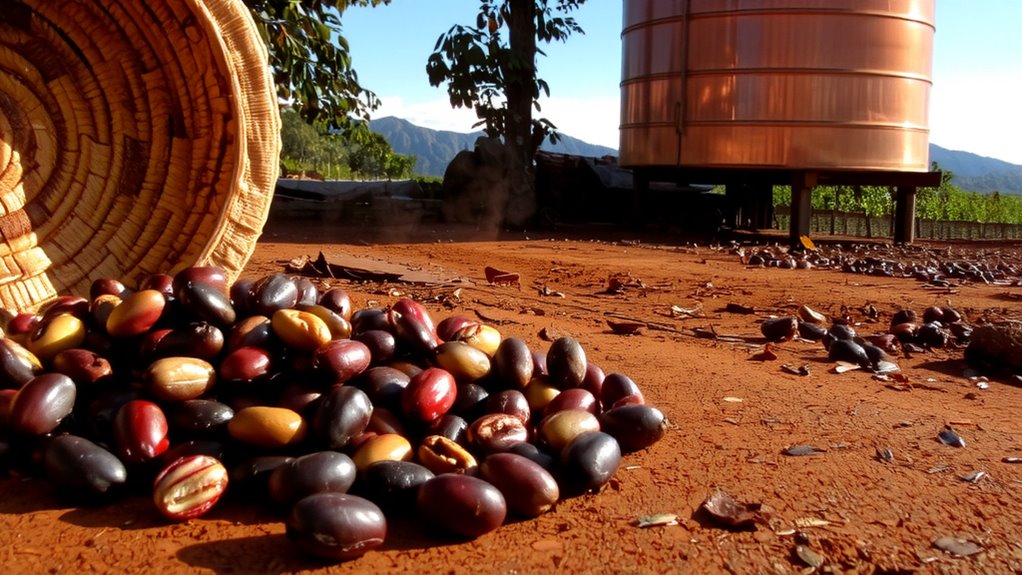
While the origins differ, you’ll often notice Arusha and Kenyan coffees taste strikingly alike because both rely heavily on the SL28 and SL34 varietals-genes known for bright acidity and complex fruit notes. You can thank similar bean processing methods for much of that consistency. Most producers in both regions use washed processing, which removes the fruit before drying, enhancing clarity and acidity. Fermentation techniques are also nearly identical: a 24–48 hour water soak that carefully breaks down mucilage, stabilizing flavor. Some farms now experiment with extended fermentation for complexity, but traditional methods remain standard for export-grade lots. These choices aren’t accidental-they’re calibrated to highlight the beans’ natural brightness. If you’re brewing at home, a Kalita Wave or V60 works best to showcase these clean, vibrant profiles. Consistency in bean processing and fermentation techniques across borders is why your morning cup tastes reliably crisp, no matter the label.
How Volcanic Soil Builds Bright, Wine-Like Acidity
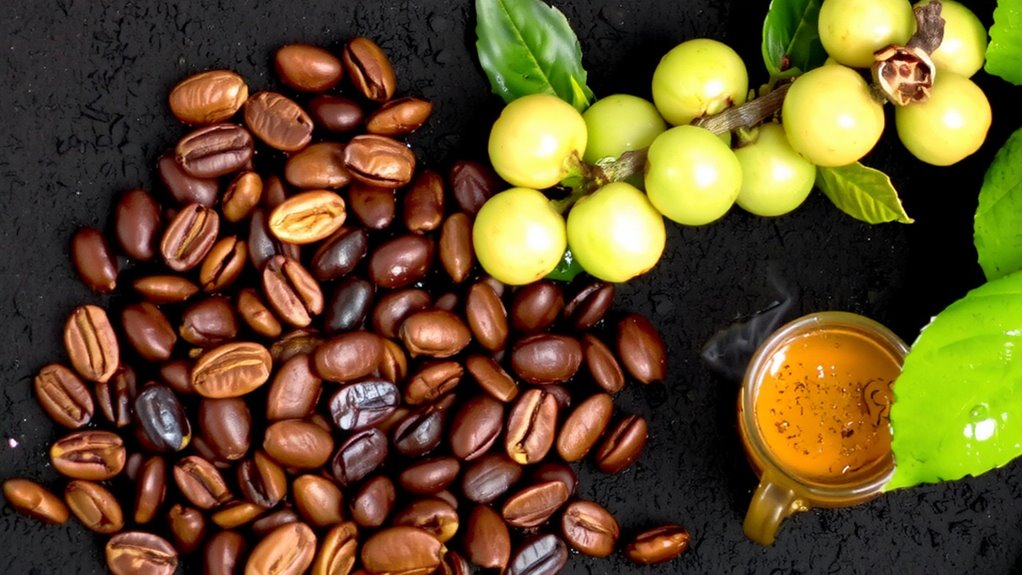
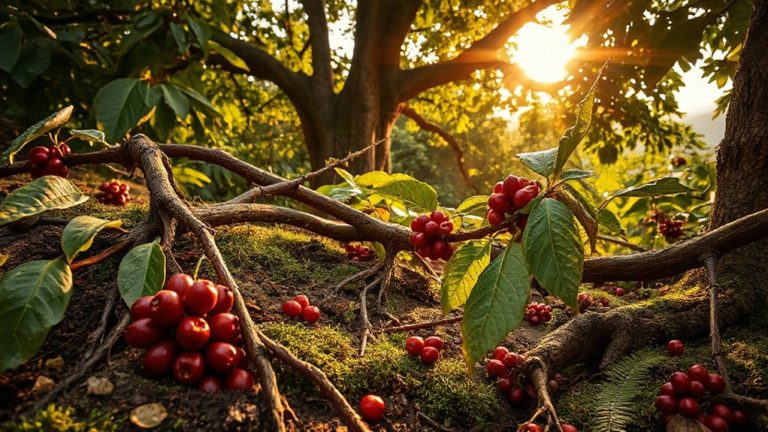
A good chunk of the bright, wine-like acidity in Arusha and Kenyan coffees comes from the volcanic soils where the coffee grows. You’re tasting the direct result of soil composition shaped by ancient eruptions, rich in potassium, phosphorus, and magnesium. This mineral richness feeds the coffee plants, boosting sugar development and acid formation in the beans. Volcanic soil drains well but retains enough moisture, creating balanced stress that sharpens flavor. Compared to clay-heavy or sandy soils, volcanic types offer a more consistent nutrient profile, which translates to cleaner, livelier cups. When you brew these coffees using a pour-over like a Hario V60, you’ll notice how the soil-driven acidity shines-bright, structured, almost like red wine. Just make sure your grind size is medium-fine and your water isn’t too hot, or you’ll risk over-extracting those delicate acids. The terrain gives the advantage, but your gear and technique decide how clearly you taste it.
How Altitude Concentrates Flavor in Arusha and Kenyan Beans
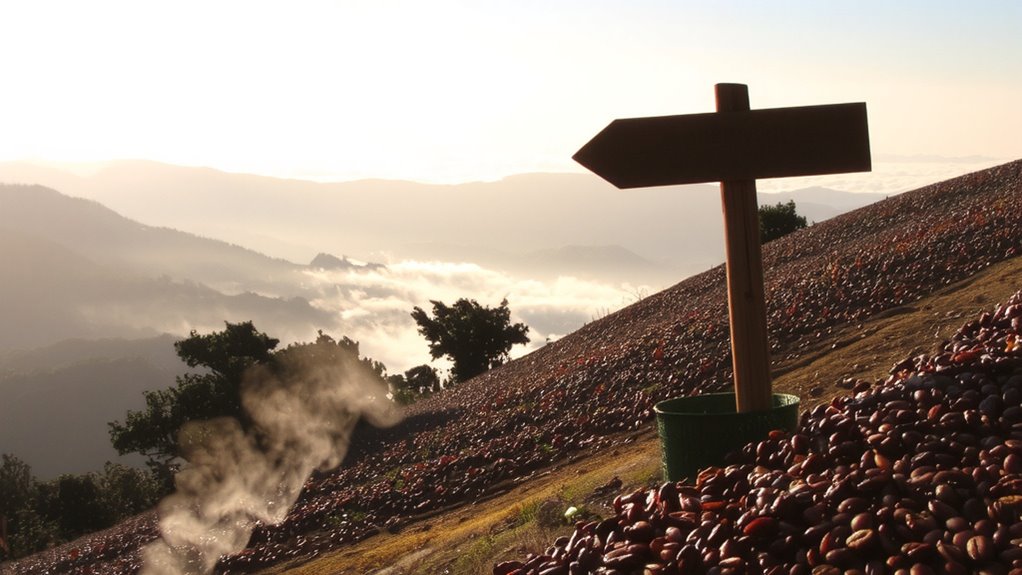
Because the coffee plants grow at high elevations, they develop denser beans packed with more sugars and acids, which translates directly into richer, more complex flavors in your cup. You’ll notice that both Arusha and Kenyan beans benefit from this altitude-driven bean density, leading to brighter acidity and deeper sweetness. Higher elevations slow maturation, allowing more time for flavor development. This is a key part of the terroir influence in both regions-elevation, temperature swings, and sunlight intensity all shape how the beans develop. If you’re brewing these coffees, use a precise grinder and water just off the boil to extract the most nuance. Denser beans require slightly longer brew times or finer grinds for ideal extraction. Ignoring that may leave you with underdeveloped, sour notes. Pay attention to elevation markers on bean labels; they’re not just marketing-they signal real differences in structure and potential flavor.
Arusha’s Heirlooms vs. Kenya’s SL28: Flavor Match?
Now that you understand how altitude shapes bean density and flavor complexity in both Arusha and Kenyan coffees, it’s time to look at what really sets them apart-their actual coffee varieties. You’re likely wondering if Arusha’s heirlooms truly match Kenya’s famous SL28. While both share similar flavor intensity, their genetic lineage differs. SL28 was bred for drought resistance and has a known, uniform bean morphology. Arusha’s heirlooms are locally adapted, with mixed genetics and variable bean morphology, making consistency trickier. Yet, some lots surprise with bright citrus and blackcurrant notes just like SL28.
| Feature | Arusha Heirlooms | Kenya SL28 |
|---|---|---|
| Genetic Lineage | Mixed landrace | Selected variety |
| Bean Morphology | Variable size/shape | Uniform, elongated |
| Flavor Potential | Bright, fruity | Intense berry/citrus |
| Processing Fit | Washed or natural | Best washed |
| Consistency | Moderate | High |
Cool Nights and Rainfall: Why Arusha’s Climate Mimics Kenya’s
Even though Arusha and Kenya lie on opposite sides of the East African Rift, you’ll find their coffee-growing conditions are more alike than not. Cool nights slow cherry development, boosting acidity and bean density-just like in Kenya’s highlands. You get similar rainfall patterns too, with distinct wet and dry seasons that support even ripening. Arusha’s altitude brings frequent cloud cover, shielding plants from harsh sun and stabilizing temperatures. That same elevation, however, introduces a slight frost risk-rare but possible during unusually cold snaps. While Kenya has managed this for decades, Arusha farmers are adopting similar strategies, like planting shade trees to buffer extremes. These climate parallels mean your grinder settings and brew times for Kenyan coffee likely work well for Arusha beans too. Consistent temps and moisture equal more predictable roasts and extractions. Treat them the same way, and you’ll get the most from both.
Blackcurrant, Citrus, and Bright Acidity: Matching Arusha and Kenyan Cup Notes
What if your morning cup could deliver the same vibrant punch whether it’s from Kenya or Arusha? You’re not imagining it-both share blackcurrant, citrus, and bright acidity in the cup. The secret lies in tight control over fermentation methods and drying techniques. In Kenya, extended fermentation in tanks builds complexity, while Arusha producers often mimic this with precise, small-batch wet fermentation. Both regions rely on raised beds for drying, allowing steady airflow that evenly reduces moisture without baking the beans. Sun exposure is monitored to avoid over-drying, preserving those lively acids. These shared practices help Arusha match Kenya’s famed profile, even if their terroir differs slightly. If you prefer clarity and sparkle in your pour-over, look for lots processed this way. Adjust your grinder a touch finer to highlight sweetness and avoid muddled flavors. Drip brewing works, but V60 or Kalita Wave brings out more nuance.
On a final note
You’ll get the best from Arusha and Kenyan beans with a pour-over, like a Hario V60, which highlights their bright acidity and blackcurrant notes. Grind fresh, use filtered water at 200°F, and brew quickly. These coffees thrive in similar high-altitude, volcanic conditions, so don’t expect big differences in the cup. If you enjoy Kenyan profiles, Arusha’s a solid, often more affordable, alternative.