Understanding Coffee Refractometers and Their Role in Extraction Analysis
You use a coffee refractometer to measure total dissolved solids (TDS) and track extraction yield, getting precise data on how much flavor is pulled from your grounds. Devices like the VST Lab III or Reichert CoffeeSure give fast, reliable readings, helping you avoid sour under-extraction or bitter over-extraction. Proper use means calibrating with distilled water, stirring your brew well, and cleaning the prism after each test. You’ll get consistent, repeatable results that a scale alone can’t provide. Practical tips and common pitfalls will help you fine-tune your process further.
Notable Insights
- A coffee refractometer measures total dissolved solids (TDS) to quantify extraction in brewed coffee.
- It provides objective data on extraction yield, helping achieve a balanced brew between 18–22%.
- Proper use involves calibration with distilled water and thorough stirring before sampling.
- Refractometers enable precise adjustments to grind size, brew time, and temperature for consistency.
- Common mistakes include poor calibration and dirty prisms, both leading to inaccurate extraction analysis.
What Is a Coffee Refractometer?
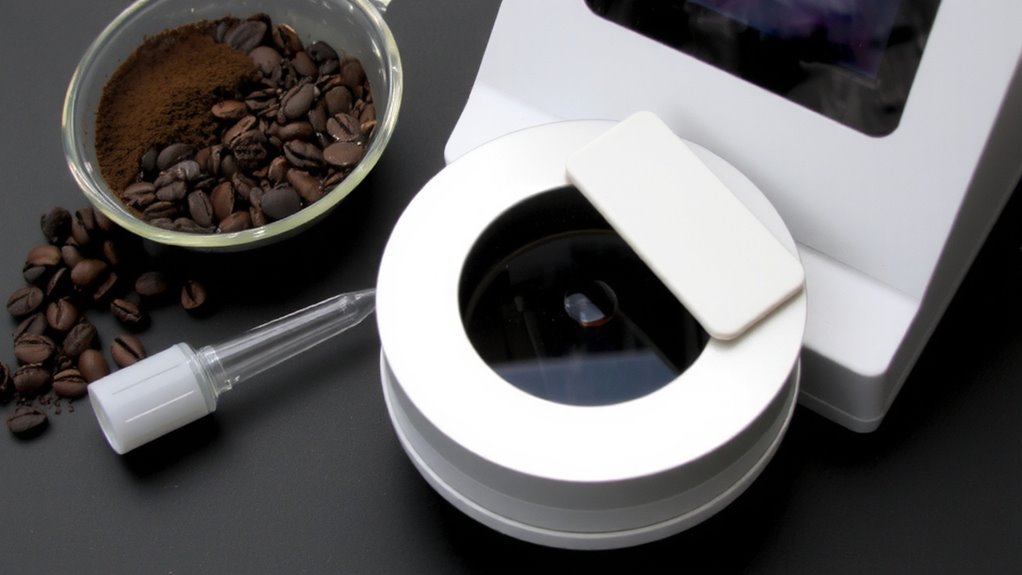
A refractometer might sound like lab equipment, but in coffee, it’s just a small digital tool that measures how much dissolved coffee is in your brew. You’ll use it to track total dissolved solids (TDS), a key number in coffee science that helps determine extraction. Instead of guessing if your pour-over or espresso is balanced, you get real data-this is brewing precision. Devices like the VST Lab III or Reichert CoffeeSure are popular, giving accurate readings in seconds. While pricier than a scale, they pay off if you’re dialing in beans or comparing roast profiles. They don’t replace taste, but they support smarter tweaks. Keep in mind: calibration matters, and temperature affects results. For café quality control or serious home use, this tool brings clarity most other gear can’t. It turns subjective sips into objective insight-useful, practical, and grounded in measurable outcomes.
How to Use a Coffee Refractometer: Step by Step
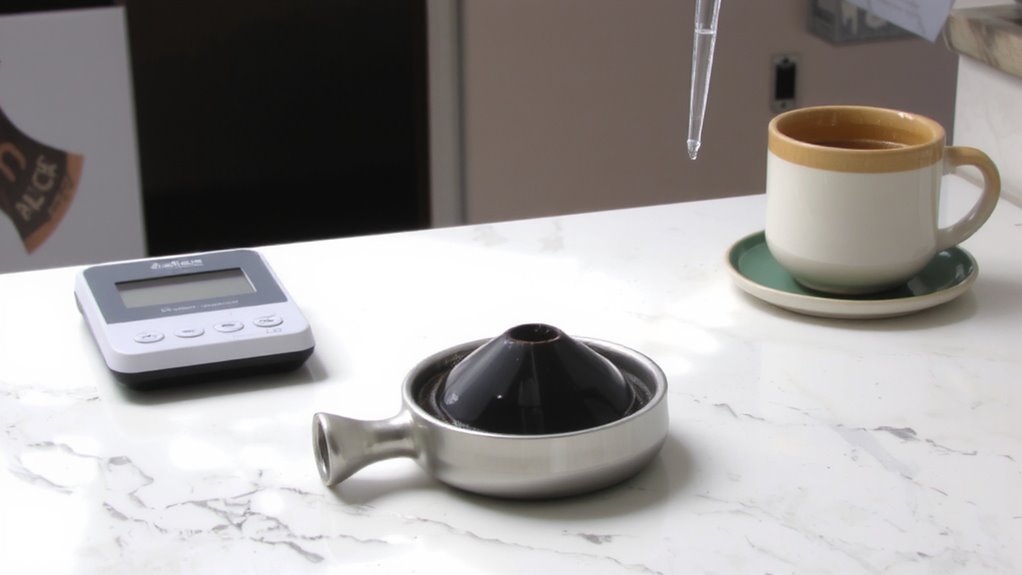
One quick reading from your refractometer can save you hours of guesswork when dialing in a new coffee. Start by turning on the device and letting it warm up. Calibrate it with distilled water-this prevents calibration drift and guarantees accuracy. Next, brew your coffee as usual, then stir the sample well before extracting a few drops. Place them on the prism and close the cover gently. Wait for the reading to stabilize. Avoid letting coffee sit too long on the surface, as residue causes sample contamination. Clean the prism immediately with a soft cloth and water. For best results, take multiple readings and average them. Use a consistent method every time-small inconsistencies lead to misleading data. A digital refractometer like the VST or ATAGO gives reliable results if maintained properly. Always recalibrate between batches to keep things accurate.
What Your TDS and Extraction Yield Mean
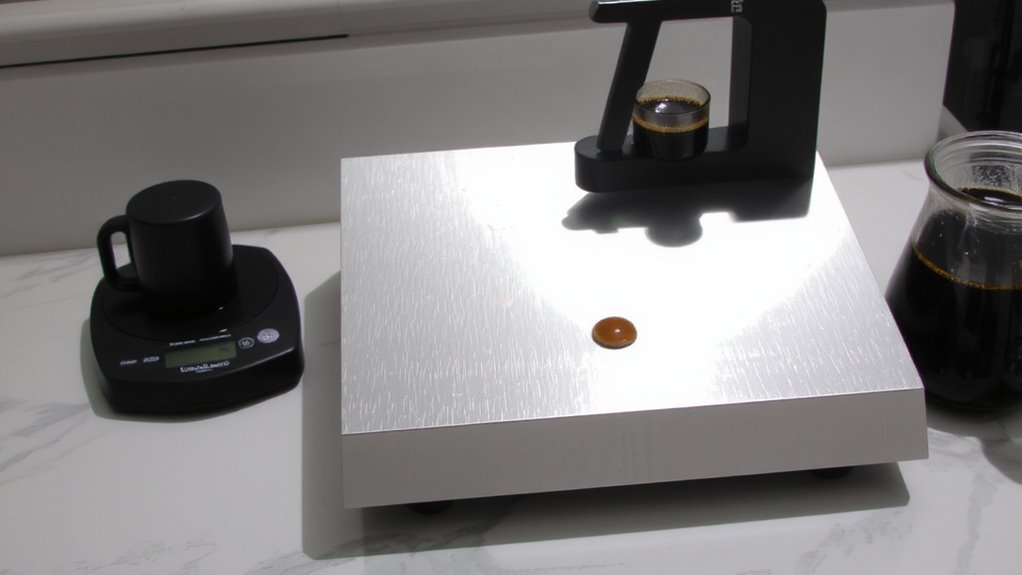
Why does your coffee sometimes taste flat or too bitter? It likely comes down to your TDS and extraction yield. TDS (Total Dissolved Solids) tells you how much coffee is in your brew, while extraction yield reveals how much flavor was pulled from the grounds. Too low, and your coffee tastes sour or weak-lacking flavor balance. Too high, and bitterness control becomes a real issue, with harsh, drying notes dominating.
| Extraction Level | Taste & Emotion |
|---|---|
| Under-extracted | Frustrating, thin, disappointing |
| Balanced | Satisfying, smooth, just right |
| Over-extracted | Harsh, bitter, regretful |
You want around 18–22% extraction for most brews. Stay in that range, and you’ll hit the sweet spot between acidity and bitterness, ensuring consistent flavor balance without guesswork.
Why Proper Extraction Makes Better Coffee
When you consistently hit the right extraction yield, your coffee doesn’t just taste better-it becomes more predictable and easier to fine-tune. Proper extraction brings out ideal flavor balance, meaning you avoid underdeveloped sourness and bitter harshness. You get the sweetness, brightness, and body the bean can offer. It also reveals greater aroma complexity, letting subtle notes-like citrus, chocolate, or floral tones-emerge clearly. Without proper extraction, those nuances stay locked in the grounds. Using a refractometer helps you measure this precisely, so you’re not guessing. You adjust grind size, water temperature, or brew time based on data, not just taste. This is especially useful if you dial in espresso or serve coffee regularly. Getting extraction right means repeatable results, cup after cup. It’s not about perfection-it’s about consistency, control, and making the most of your coffee and gear.
Common Refractometer Mistakes (And How to Fix Them)
A refractometer can give you accurate extraction readings, but only if you use it correctly-common mistakes like incorrect calibration, dirty prisms, or inconsistent sample preparation can throw off your results by as much as 0.2% in extraction yield, which is enough to misguide your brew adjustments. Much of this comes down to user error and ignoring early signs of calibration drift. You’ve got to clean the prism with a soft, lint-free cloth after every use and recalibrate before each session using distilled water. Letting coffee oils build up or skipping calibration checks leads to unreliable data. Here’s how to stay on track:
| Mistake | Problem | Fix |
|---|---|---|
| Dirty prism | Skewed readings | Wipe with microfiber cloth |
| Poor calibration | Calibration drift occurs | Recalibrate with every use |
| Uneven sample | Inconsistent extraction | Stir brew thoroughly before sampling |
Stay consistent, and your data will too.
Use a Refractometer for Repeatable Coffee Quality
While brewing great coffee consistently isn’t just about numbers, using a refractometer gives you a clear, measurable way to lock in your process. When you test each batch, you get actual data on brew strength and extraction, so you’re not guessing. For reliable results, calibration consistency matters-always calibrate with the same standard solution before each use. Skipping this step leads to inaccurate readings and poor decisions. Once you’ve got your sample, clean data interpretation helps you adjust grind, water, or time with confidence. Tools like VST Coffee Lab or Reeve Brewlab simplify analysis, but you still need to understand what the numbers mean. Use the refractometer daily in a café setting to maintain quality, or during recipe development to replicate results. It’s not magic-it’s measurement. With practice, you’ll spot variances early and keep every cup on target.
On a final note
You now understand how a coffee refractometer helps you measure TDS and extraction yield accurately. It’s a practical tool for dialing in shots or batches with consistency. While it takes a little practice and proper cleanup, models like the VST or ATAGO deliver reliable results. Skip the guesswork-use it to refine your brews, troubleshoot issues, and match targets every time. For serious coffee, it’s a small step that makes a real difference.