How to Use a Coffee Particle Sizer to Fine-Tune Grinder Settings
You use a coffee particle sizer to check your grinder’s output by measuring hundreds of particles with laser diffraction in seconds. Load a small sample, and the device shows particle size distribution, spotting fines and boulders that hurt extraction. A narrow peak means even grinds; a wide spread signals inconsistency. Adjust your burrs based on the data-tighten for fewer fines, recalibrate if wear is visible. Track changes over time to maintain balance. More insights follow.
Notable Insights
- Use laser diffraction to measure particle size distribution quickly and accurately from a small coffee sample.
- Analyze the graph for a narrow peak, indicating uniform grind size and even extraction potential.
- Identify fines and boulders in the distribution, which cause over- and under-extraction, respectively.
- Adjust burr alignment or grind setting incrementally, then retest to observe changes in particle consistency.
- Regularly calibrate the sizer and clean the lens to maintain accuracy across repeated measurements.
Why Your Grind Consistency Needs A Coffee Particle Sizer
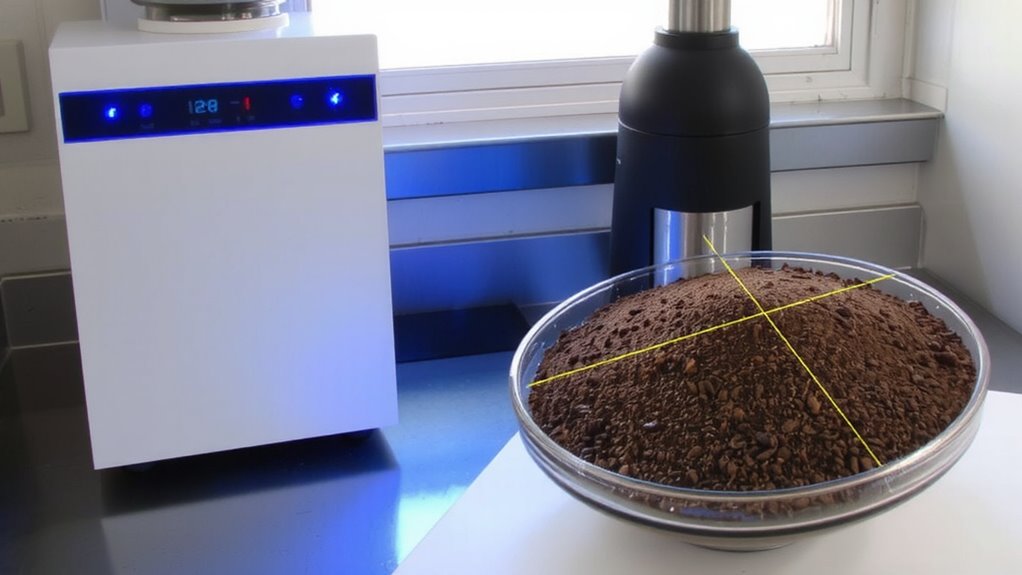
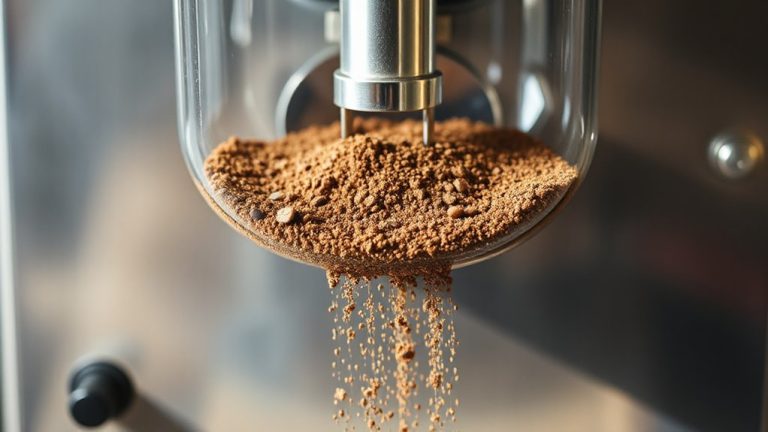
Grind size matters more than you might think. If your coffee tastes off, inconsistent grind particles are likely the culprit. Too many fines or boulders wreck extraction yield, pulling out some flavors too fast while leaving others untouched. You’re not just grinding beans-you’re controlling how water interacts with them. Even with fresh bean freshness, poor consistency skews results. That’s where a coffee particle sizer helps. It doesn’t adjust your grinder, but it shows what you’re actually producing. Without one, you’re tuning blindly, guessing if changes improve uniformity. Models like the KRUUV or MokaPuck Pro give measurable feedback, linking grind settings to real output. You see how wear, humidity, or bean roast affects particles. It’s not magic-it’s data. And with better data, you get repeatable shots or brews. Skip the guesswork. Use the tool to verify, not just assume. Your brew will thank you.
How A Coffee Particle Sizer Shows Grind Uniformity
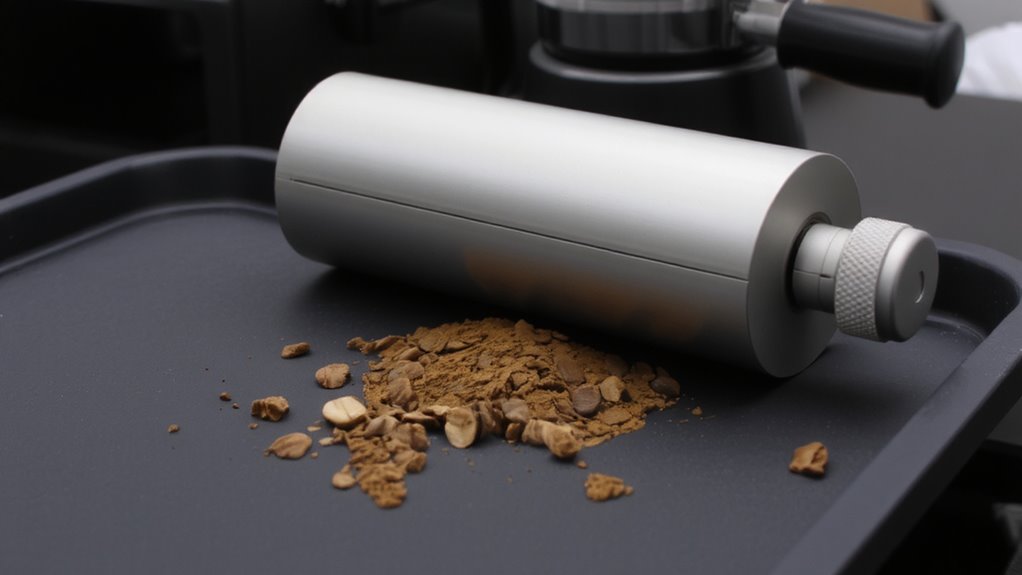
You already know inconsistent grinds sabotage extraction, but seeing it firsthand changes everything. A coffee particle sizer reveals exactly how uniform your grind actually is, using optical dispersion to measure thousands of particles in seconds. Unlike old-school sieve analysis, which sorts grounds by size through stacked mesh screens, this tool gives you instant, detailed data without manual labor. You’ll see spikes in the distribution showing fines or boulders-those tiny or oversized bits that pull unevenly. Optical dispersion captures particle shape and size more accurately than sieves, especially for irregular fragments. That means you can spot inconsistencies your grinder introduces, whether it’s blade wear or burr alignment. And while sieve analysis still works for basic checks, it’s slower and less precise. With a particle sizer, you’re not guessing-you’re tracking real changes across grinders or adjustments. It’s the clearest way to confirm uniformity and dial in better shots.
How To Measure Grind Size With A Particle Sizer
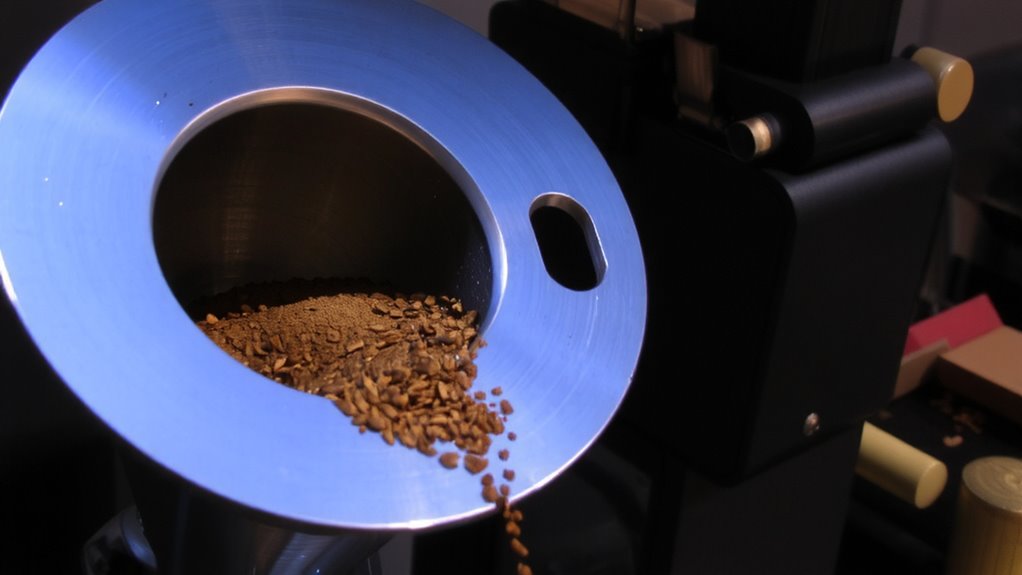
How do you actually determine the average grind precipice of your coffee? You use a coffee particle sizer that relies on laser diffraction and optical analysis to measure particle diameters accurately. Simply load a small sample into the device, start the scan, and let the tech do the rest. Below is what you’ll typically see:
| Particle Size (µm) | Count | Intensity |
|---|---|---|
| 50 | Low | Medium |
| 100 | High | High |
| 200 | Medium | Medium |
| 400 | Low | Low |
Laser diffraction gives fast, repeatable results across hundreds of particles. Optical analysis helps distinguish fine nuances in size that sieves miss. While more expensive than manual methods, particle sizers offer precision vital for dialing in grinders. You’ll get consistent data, essential for quality control, especially with espresso. Just keep the lens clean and calibrate regularly for reliable readings.
Reading Your Grind Distribution Graph
What does your coffee’s grind profile really look like? Your particle sizer’s graph shows the range of grind sizes produced by your grinder. A narrow peak means most particles are similar-ideal for even extraction. Wider distributions suggest inconsistency, often causing sour or bitter notes. Look for particle clustering, where fragments group at certain sizes-this indicates retention or burr issues. Grind shape analysis isn’t direct from the graph, but size patterns hint at it; elongated or fractured particles can skew results. Peaks on both ends (fines and boulders) mean poor grind quality. Flat, wide curves usually come from blade grinders. Burr grinders should give tighter, bell-shaped curves. Don’t chase perfection-aim for reproducibility and clarity in the cup. Use the graph to spot flaws, not just averages. You’ll see how small changes affect output, even if you’re not adjusting yet.
How To Adjust Your Grinder Using Sizer Data
A clear grind distribution graph sets the stage for making informed tweaks to your grinder, turning data into real-world adjustments. If you see wide particle clustering, your grind isn’t uniform-fine particles may over-extract while coarse ones under-extract. Start with grinder calibration: adjust the burrs incrementally, then retest with the sizer. A tighter peak on the graph means better consistency. Blade wear or misalignment often causes clustering, so check burr condition regularly. For grinders like the Baratza Encore or Eureka Mignon, even small steps make visible differences. Always adjust only one variable at a time-preferably grind size-and allow several samples to stabilize. Repeat sizer scans to confirm changes. Over time, this feedback loop sharpens repeatability. Remember, grinder calibration isn’t one-and-done; it needs regular checks, especially after heavy use or豆 changes. Data-driven tweaks beat guesswork every time. Upgrading to a high-quality mill grinder can significantly improve particle uniformity and overall extraction efficiency.
Fix Bitterness and Sourness With Sizer Feedback
Ever wonder why your espresso tastes bitter one day and sour the next, even when using the same beans and settings? Your grinder’s inconsistency might be the culprit. A coffee particle sizer helps you see exactly how grind size variance affects extraction. Bitterness often comes from over-extraction due to too many fines, while sourness signals under-extraction from coarse particles. With sizer feedback, you can adjust your grinder to reduce these extremes. Check your brew temperature-if it’s too high, it exaggerates bitterness, especially with fine grinds. Poor water quality can also skew extraction, masking true flavor imbalances. By pairing sizer data with stable variables like proper brew temperature and balanced water, you pinpoint whether the issue is grind or environment. Adjust incrementally, test, and re-measure. This methodical approach gives you control, leading to sweeter, more balanced shots without guesswork.
Keep Your Grind Consistent Over Time
Most grinders drift over time, and even small changes in particle size can throw off your shot. You’ll notice inconsistent extraction, off-flavors, or fluctuating brew times-all signs your grinder isn’t holding steady. That’s where regular grinder calibration comes in. Using a coffee particle sizer lets you detect subtle shifts early, so you can adjust settings before quality drops. It’s not just about tweaking once; it’s part of long term maintenance. Stepped grinders, like the Baratza Encore, may need monthly checks, while stepless models, such as the Forté, still drift from burr wear. Recalibrating every few weeks guarantees repeatable results. Skip it, and your morning espresso might taste great one day, sour the next. Track particle distribution over time, log adjustments, and clean burrs regularly. This routine keeps output stable, improves shot consistency, and extends grinder life-no guesswork, just measurable precision.
On a final note
You now have the tool and the know-how to get your grinder dialed in with real data, not guesswork. A particle sizer highlights inconsistencies the eye can’t see, helping you fix bitter or sour shots. Models like the Kruve or Rocky EQ provide clear feedback. Use the graphs to tweak settings gradually. Check weekly, especially after cleaning or burr changes. Consistent size means balanced, repeatable espresso-every time.