Predicting Extraction Time Windows Based Solely on Grind Particle Diameter
You can predict extraction time more accurately by measuring grind particle diameter than relying on grinder settings alone. Smaller particles increase surface area, speeding up extraction but slowing water flow, especially in espresso. Finer grinds create higher flow resistance, extending contact time. Uniform grinds from burr grinders improve consistency, while blade grinders cause uneven extraction. Dense beans like Ethiopians need finer cuts. Adjusting diameter fine-tunes timing-tightening it brings more control over under- or over-extraction risks and helps hit your ideal window with repeatable precision.
Notable Insights
- Smaller grind particles increase surface area, accelerating extraction and shortening brew time significantly.
- Uniform fine grinds enhance extraction speed but risk over-extraction due to faster water diffusion.
- Particle size distribution affects extraction consistency, with fines extracting rapidly and boulders lagging behind.
- Flow resistance rises with finer grinds, slowing water passage and extending effective extraction duration.
- Bean density and roast level modulate the impact of particle diameter on extraction timing.
Why Grind Size Controls Coffee Extraction Time
While grind size might seem like a small detail, it actually has a direct and powerful effect on how fast your coffee extracts. The smaller your grounds, the more surface area water contacts, speeding up extraction. But it’s not just about size-coffee density and bean origin matter too. Harder, denser beans from high-altitude regions like Ethiopia or Colombia resist water penetration, needing finer grinds or longer times. Softer, less dense beans from lower elevations extract faster, even with coarser settings. If you’re using a dense roast from Kenya, you’ll likely need a finer grind than for a light Brazilian bean, even on the same brewer. Your grinder’s consistency also impacts results-cheap blade grinders create uneven particles, leading to over- and under-extraction. A quality burr grinder gives uniform particles, making timing predictable. Match grind size to your bean’s traits, and you’ll nail extraction windows more reliably. For the most reliable results, consider investing in one of the best coffee and espresso grinders that offer precision and consistency across brew styles.
How Finer Grinds Slow Down Water Flow
You’ve seen how grind size affects extraction speed by changing surface area and how bean density influences your grind choice, but there’s another factor at play: water flow. When you use a finer grind, the particles pack more tightly, increasing flow resistance. This means water moves slower through the bed, especially in espresso machines where pressure matters. Higher flow resistance can cause longer brew times and risk over-extraction if not adjusted. Water diffusion into coffee particles still happens, but trapped water lingers too long in dense grinds. That’s why a fine setting on a burr grinder like the Baratza Encore needs precise timing-too slow, and your shot drags. Adjusting grind size isn’t just about surface area-it’s about managing both flow resistance and water diffusion. You’ll need to balance both for even extraction. Keep your brew ratio steady and tweak grind first.
Measure Particle Size to Predict Brew Time
Since grind size directly influences both water flow and extraction, measuring particle size can help you predict and control brew time more accurately. You can use sieving methods to separate grounds by size, giving you a clear profile of your grind distribution. Standard mesh sieves are affordable and simple, but they only offer broad size ranges. For more precision, optical sorting analyzes particles with cameras and software, detecting细微 differences in diameter. It’s faster and more detailed than sieving, though the equipment’s costlier and less common for home use. Whether you’re dialing in a espresso recipe or optimizing a pour-over, knowing your grind size helps set expected brew times. Sieving works well for routine checks, while optical sorting suits labs or high-end setups needing consistency. Either way, measuring particle size gives you actionable data-turning guesswork into repeatable results. Investing in a high-quality mill grinder can significantly improve grind uniformity and overall brewing precision.
How Grind Uniformity Shapes Extraction Timing
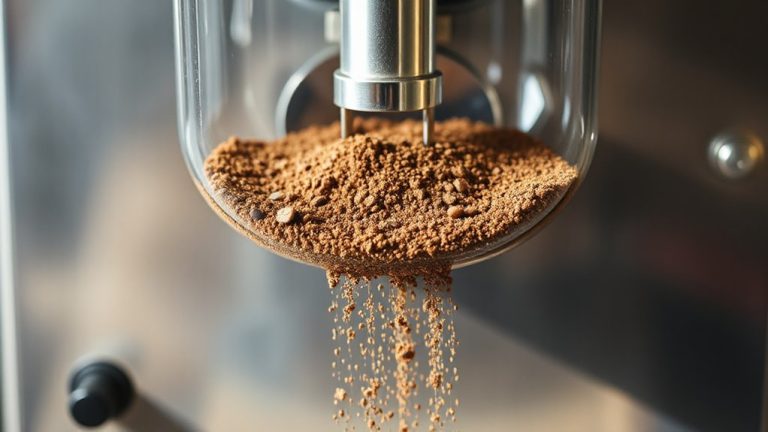
Even if you’ve nailed your average grind size, uneven particle distribution can still throw off your extraction timing. Inconsistent grinds cause some particles to extract too fast, others too slow-leading to flavor variance and poor brew consistency. A burr grinder with high uniformity, like the Baratza Encore or EG-1, minimizes this issue. To visualize the impact:
| Particle Type | Extraction Speed | Effect on Brew |
|---|---|---|
| Fines | Very Fast | Bitter notes, over-extracted |
| Ideal | Balanced | Clean, even flavor |
| Boulders | Too Slow | Sour, under-extracted |
| Mixed | Variable | Unpredictable timing |
You’ll get more reliable results when most particles fall into the “ideal” range. Uniformity isn’t just about average size-it’s the key to repeatable extraction windows, stable flavor, and better brew consistency across shots or cups. Choosing a high-quality coffee grinder can significantly improve particle uniformity and overall brew performance.
Predict Brew Time From Grinder Settings
Grind uniformity sets the stage for consistent extraction, but knowing how your grinder’s settings translate to actual brew time is where control really starts. Your grinder’s setting isn’t just about fineness-it interacts with bean density and roast level to shape flow rate. Dense beans, like high-grown Ethiopians, resist water more, slowing extraction even at medium-fine grinds. Lighter roasts, which are usually denser, often need finer settings than darker, more brittle roasts to hit the same brew time. A Setting 12 on a Baratza Virtuoso might give you 28 seconds for a light roast, but the same setting on a dark roast could run 35 seconds due to lowered bean density. Without adjusting for these factors, your time predictions fail. You’ve got to log your settings alongside bean type and roast level. That way, you start seeing patterns-not guesswork. It’s how you build reliable brew time estimates drink after drink.
Adjust Your Grinder to Hit Target Extraction Windows
Most of the time, hitting your ideal extraction window comes down to making small, deliberate tweaks to your grinder. If your shots pull too fast, go finer; if too slow, adjust coarser. Even a half-notch change can shift brew time by several seconds. Keep your brew temperature steady-fluctuations of just 2–3°C can throw off extraction, making grind adjustments misleading. You’ll also want consistent water quality; hard water over-extracts, while soft water under-extracts, skewing results no matter how precise your grind. Use a TDS meter to check your water and stick to a stable brew temperature, ideally between 92–96°C. Machines like the Rocket R58 or Lelit Anna allow tighter control. Remember, the grinder sets the foundation, but temperature and water work together-fine-tune all three to consistently hit your target window.
On a final note
You can predict extraction time by measuring grind size, since finer grinds slow water flow and increase contact time. Uniform particles lead to more consistent results. Entry-level grinders like the Baratza Encore improve predictability, while budget blade grinders don’t. Adjust your grinder in small increments, then time shots or brews to find your window. Water temp and dose matter too, but grind size is the fastest control.