Best All-in-One Brewing Systems: VEVOR 35L & 60L Compared
You want consistent, high-quality beer with minimal hassle, and all-in-one systems like the VEVOR 35L or G30³ deliver precise temperature control, programmable mashing, and built-in pumps for recirculation. Models with 304 stainless steel and immersion chillers cool wort fast, while app-connected options like Connect Complete offer real-time monitoring. Choose based on batch size, power needs, and automation level-your setup should match your space and brewing goals. The details that matter come next.
We are supported by our audience. When you purchase through links on our site, we may earn an affiliate commission, at no extra cost for you. Learn more. Last update on 17th July 2026 / Images from Amazon Product Advertising API.
Notable Insights
- Advanced temperature control ensures precise mashing and boiling for consistent, high-quality brews every time.
- Programmable multi-step mashing and delayed start features enable hands-free operation and recipe repeatability.
- Durable 304 stainless steel construction resists corrosion and guarantees long-term performance and hygiene.
- Integrated pump and recirculation systems enhance extraction efficiency and prevent channeling during sparging.
- Compact, all-in-one design with intuitive digital interfaces simplifies brewing for both beginners and experts.
VEVOR 35L Electric Brewing System All-in-One

If you’re a serious homebrewer who wants full control over every stage of the brewing process without the hassle of multiple pieces of equipment, the VEVOR 35L Electric Brewing System All-in-One is one of the most practical choices on the market. I use it in my garage, and it handles mashing, boiling, and recirculation with ease. The 35L stainless steel pot holds up to 8 gallons of beer, and the 7-step programmable mashing gives me precision. I set custom recipes, control temp (25–100℃), and power (100–1800W), and let it run. A built-in pump and filter save time, and the 28.8-foot cooling coil drops wort temps fast. It’s compact, durable, and simplifies cleanup.
Best For: Homebrewers who want an all-in-one electric brewing system with precise temperature control and automation for batch consistency.
Pros:
- All-in-one design integrates mashing, boiling, recirculation, and cooling in a compact unit
- 7-step programmable mashing and customizable recipes with intuitive LCD control
- Durable 304 stainless steel pot and built-in pump with rapid cooling via 28.8-ft coil
Cons:
- Heavy at 29.2 pounds, limiting portability
- Learning curve for beginners unfamiliar with automated brewing systems
- Limited to 8-gallon output despite 35L (9.2 gal) pot capacity
VEVOR 60L All-in-One Beer Brewing Kit
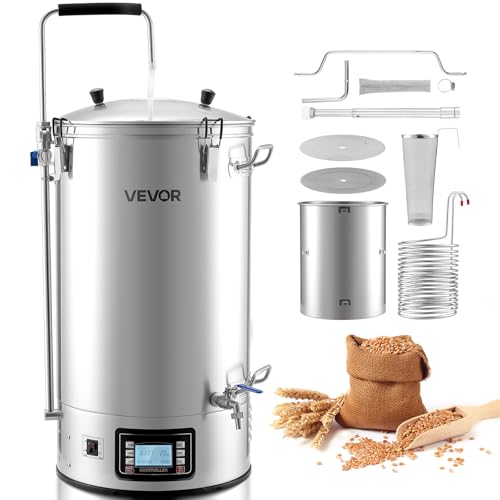
The VEVOR 60L All-in-One Beer Brewing Kit stands out for homebrewers who want a high-capacity system that bridges the gap between hobbyist and small-scale commercial use, especially if space or setup time is limited. I use its 60L tank to brew full 16-gallon batches, handling up to 33 lbs of malt. The 7-step programmable mashing, recirculation pump, and 28.8 ft chiller coil boost efficiency and consistency. Its digital LCD lets me set power, temperature, and time, with memory for 10 recipes. Food-grade 304 stainless steel guarantees safety, while removable parts simplify cleaning. At 31.8 lbs and under 37 inches tall, it fits well in most spaces.
Best For: Homebrewers and small-scale commercial brewers seeking a high-capacity, all-in-one system with automated controls for consistent, large-volume beer production.
Pros:
- Large 60L capacity supports up to 33 lbs of malt per batch, ideal for full 16-gallon brews
- Programmable 7-step mashing with recirculation pump and rapid 28.8 ft chiller coil for precise, efficient brewing
- Food-grade 304 stainless steel construction with removable parts ensures safety, durability, and easy cleaning
Cons:
- Heavy at 31.8 lbs, which may limit portability despite compact footprint
- High power consumption due to 3000W system and dual heating elements
- Limited recipe storage with only 10 programmable profiles, potentially restrictive for advanced users
Foundry 10.5 Gallon All-In-One Brewing System With Pump

I’ve found the Foundry 10.5 Gallon All-In-One Brewing System With Pump works best for intermediate homebrewers who want electrical flexibility and faster heat-up times without stepping up to commercial gear. It switches between 120V (1600W) and 240V (2800W), giving you stronger boils on higher voltage. The double-wall insulation holds mash temps well and speeds up heating. Its grain basket has 150% more perforations, so stuck sparges are rare. A stainless immersion chiller comes included, with hoses and fittings ready to go. It pumps wort efficiently and supports distillation if needed. At 36.9 pounds, it’s heavy but manageable. Just confirm your outlet matches the voltage you plan to use.
Best For: Intermediate homebrewers seeking a versatile, electric all-in-one brewing system with dual-voltage capability and efficient heat management.
Pros:
- Switchable between 120V and 240V for flexible, faster heating and stronger boils
- Double-wall insulation improves temperature retention and heating efficiency
- High-flow grain basket with 150% more perforations reduces risk of stuck sparges
Cons:
- Weighs 36.9 pounds, making it heavy and less portable
- Requires compatible 240V outlet for optimal performance, which may not be available in all homes
- High initial cost may be prohibitive for beginner brewers
Brewer’s Edge SERIES 2 Mash & Boil

You’ll want the Brewer’s Edge SERIES 2 Mash & Boil if you’re an all-grain homebrewer looking for a compact, electric system that fits on a countertop and runs on standard 110V power. I use it for mashes up to 16 lbs of malt and boils up to 7.5 gallons-perfect for full batches without extra gear. The integrated pump makes recirculation easy, and the high-flow sparging basket cuts stuck sparge risks. A low-density heating element prevents scorching, while the digital thermostat gives precise control. It’s programmable, with a delayed start up to 24 hours, and the timer shuts it off safely after 3.5 hours.
Best For: Homebrewers who want a compact, electric all-in-one system for all-grain brewing on a standard 110V outlet with precise temperature control and automated features.
Pros:
- Integrated pump and high-flow sparging basket enable efficient recirculation and reduce risk of stuck sparges
- Programmable delayed start and auto shutoff timer allow unattended operation with enhanced safety
- Runs on standard 110V power with 1600W heating element capable of boiling up to 7.5 gallons in a single vessel
Cons:
- Limited to 16 lbs of grain and 7.5-gallon batches, which may not suit large-scale brewers
- Requires careful cleaning to maintain pump and sparging basket performance
- Plastic exterior components may feel less durable compared to all-metal builds
G30³ All-in-One Electric Homebrewing System, Stainless Steel

Brewers who want precise control and professional results without the clutter of multiple systems will find the G30³ All-in-One Electric Homebrewing System, Stainless Steel fits their needs perfectly-especially those upgrading from basic setups or brewing in limited spaces. I use its wireless app to monitor temps and adjust on the fly, which makes brewing way easier. It’s built tough with stainless steel, so it’ll last, and the compact design works indoors or out. Just know it doesn’t come with a counterflow chiller anymore. Grainfather’s 2019, 2020, and 2022 Top Brew Gear wins prove it’s a solid pick.
Best For: Homebrewers seeking a compact, all-in-one electric brewing system with app connectivity for precise control and professional results in limited spaces.
Pros:
- Award-winning design with advanced temperature control for consistent brewing
- Wireless app connectivity allows real-time monitoring and adjustments
- Durable stainless steel construction suitable for indoor or outdoor use
Cons:
- No counterflow wort chiller included in the latest model
- Heavier at 35.6 pounds, which may limit portability
- Higher price point compared to basic homebrewing setups
Northern Brewer Stainless Steel Beer Kit

For homebrewers stepping up from basic extract kits to something more durable and efficient, the Northern Brewer Stainless Steel Beer Kit stands out as a complete, all-in-one solution built for quality and convenience. I’ve found it perfect for brewing 5-gallon batches with pro-level gear like a stainless conical fermenter and 8-gallon kettle with a ball valve. Unlike plastic kits, everything’s easy to clean and built to last. The included wort chiller, burner, and brewing essentials mean you can start right away. While it’s pricier than entry kits, its durability and efficiency make it worth it for serious beginners.
Best For: Homebrewers ready to upgrade from basic extract kits to a durable, all-in-one stainless steel brewing system for consistent, high-quality 5-gallon batches.
Pros:
- Full stainless steel construction ensures durability, easy cleaning, and professional-grade performance
- Includes essential equipment like a conical fermenter, wort chiller, and burner for a complete brewing setup
- Streamlined design with a ball valve and siphonless fermenter improves efficiency and reduces contamination risk
Cons:
- Higher price point compared to entry-level homebrew kits may deter casual brewers
- Large 8-gallon kettle and full setup require significant storage and workspace
- Overkill for those only interested in small or occasional batches
Kegland 35L BrewZilla Stainless Steel (Gen 3.1.1)

The Kegland 35L BrewZilla Gen 3.1.1 stands out as a solid choice for homebrewers stepping up from extract kits or partial boils and ready to dive into all-grain brewing without the hassle of multiple burners or complex setups. I use its 35L capacity to brew 5–6 gallons of beer, and the dual heating elements (1000W + 500W) give me precise control. The built-in pump and recirculation make lautering smooth, while the 6-stage programmable mashing saves time. I set delays when needed and chill fast with the included immersion chiller. It’s 110V, so it works on standard outlets, and the stainless steel build feels durable. At 32 pounds, it’s portable enough for my garage or patio.
Best For: Homebrewers upgrading from extract kits or new to all-grain brewing who want a compact, electric, all-in-one system for consistent 5–6 gallon batches.
Pros:
- All-in-one design with dual heating elements, recirculation pump, and built-in chiller simplifies the brewing process
- Programmable 6-stage mashing and delayed start offer precision and convenience
- Durable stainless steel construction with 110V power compatibility for indoor or outdoor use
Cons:
- 35L capacity limits full-volume batches to 5–6 gallons, which may not suit larger brewing needs
- At 32 pounds, it can be heavy to move when filled or during cleaning
- Requires careful cleaning of the pump and tubing to prevent clogs and residue buildup
Connect Complete All In One Home Beer Brewing System, 8 gallons

When precision and convenience matter most, the Connect Complete All In One Home Beer Brewing System, 8 gallons stands out-especially if you’re a home brewer who values automation and consistent results without needing extra burners or complex setups. I use its 1,800-watt element to go from mash to boil in as little as 20 minutes, and the magnetic drive pump keeps recirculation smooth. The Connect app lets me program step mashes or delay starts remotely via Bluetooth. It holds up to 20 lbs of grain and includes a wort chiller to reduce contamination. Just discard the yellow strip before first use. I’ve found it reliable, well-supported, and backed by a 24-month warranty-ideal for consistent, all-electric indoor brewing without guesswork.
Best For: Home brewers seeking a fully automated, all-electric indoor brewing system with precise temperature control and app-enabled programmability for consistent, repeatable beer batches.
Pros:
- Enables precise, automated brewing with Connect app control for step mashing, delayed starts, and real-time monitoring via Bluetooth
- Integrated 1,800-watt heating element and 1,800 RPM magnetic drive pump allow rapid heat-up and efficient recirculation without scorching
- All-in-one design includes grain basket, wort chiller, and 8-gallon capacity for batches up to 6 gallons, reducing contamination risk and simplifying cleanup
Cons:
- High initial cost may be prohibitive for beginner or casual home brewers
- Limited to indoor use and requires a dedicated 120V electrical outlet with adequate power supply
- Bluetooth range restricts remote app control to short distances, limiting true remote monitoring flexibility
Brewer’s Edge SERIES 2 MASH AND BOIL V2

You’ll find the Brewer’s Edge Series 2 Mash and Boil V2 shines if you’re an all-grain homebrewer working in a tight space or without access to a 220V outlet. I use it in my small apartment and appreciate that it runs on a standard 110V plug, drawing 1600 watts. It handles up to 16 lbs of malt and boils 7.5 gallons, which covers most batches. The double-wall stainless steel keeps heat steady, and the low-density heating element prevents scorching. I like the built-in sparging basket-it flows 150% better than older models, reducing stuck sparges. I program the digital thermostat and timer, even setting a 24-hour delayed start. It’s compact, easy to clean, and cuts down on gear since I mash and boil in one vessel.
Best For: All-grain homebrewers with limited space or without access to 220V power who want a compact, electric, all-in-one brewing system.
Pros:
- Runs on standard 110V outlet with 1600W power, ideal for apartments or indoor brewing
- Double-wall stainless steel construction and low-density heating element prevent scorching and maintain stable temperatures
- Integrated high-flow sparging basket allows mash and boil in one vessel, reducing equipment needs and stuck sparges
Cons:
- Limited to 7.5-gallon boil capacity, which may restrict larger batch sizes
- 1600W heating element boils slower than higher-wattage or propane systems
- No temperature probes or advanced automation beyond basic programmable timer and thermostat
iGulu F1 Automated Home Brewer 3.8L

iGulu’s F1 Automated Home Brewer 3.8L stands out for anyone who wants full control over fermentation without the hassle of manual adjustments, especially home brewers who value precision and simplicity. I use its Fermentech Control™ to manage temperature (-35°F to 104°F) and pressure (up to 14 psi) with ease. The 3-step process and 9 preset recipes make brewing beer, kombucha, cider, or wine straightforward. I start with a tap of an RFID tag, and the system auto-loads the right settings. Freshness lasts up to 30 days, and adding a CO2 tank boosts carbonation. At 35.9 pounds and 3.8L capacity, it’s compact but heavy. It’s ideal for consistent, hands-off brewing.
Best For: Home brewers who want precise, hands-off fermentation control with easy one-click brewing for beer, kombucha, cider, or wine.
Pros:
- Automated Fermentech Control™ ensures precise temperature (-35°F to 104°F) and pressure (up to 14 psi) management
- RFID scanning and 9 pre-built recipes enable simple, consistent brewing for all skill levels
- Maintains beverage freshness up to 30 days with optional CO2 carbonation boost
Cons:
- Requires additional CO2 cylinder for enhanced carbonation, sold separately
- Relatively heavy at 35.9 pounds, limiting portability
- Limited capacity at 3.8L for larger batch enthusiasts
Factors to Consider When Choosing an All in One Brewing System
You’ll want to match the brewing capacity to how much coffee you typically make-small batches suit one or two people, while larger systems like the 3.8L iGulu F1 work well for families or entertaining. Good temperature control matters for flavor, so look for models that let you adjust and hold temps precisely during brewing. Don’t overlook power needs, material durability, and how much automation you actually want-fully automated units save time, but simpler systems give you more hands-on control.
Brewing Capacity
A typical all-in-one brewing system supports batches ranging from 3.8 liters to over 60 liters, with most homebrewers finding 35-liter models sufficient for producing up to 6 gallons of finished beer. If you’re just starting out or short on space, a smaller unit-under 10 gallons-lets you brew 5–6 gallon batches without crowding your kitchen. These compact systems are easier to store and require standard electrical outlets. But if you want to scale up, larger systems handle 5 to 8 gallons or more, with some models mashing up to 33 pounds of malt per batch, ideal for stronger beers or frequent entertaining. Just keep in mind: bigger kettles take up more space and often need dedicated 240V power. Your batch size needs should match your space, electrical setup, and brewing goals-don’t overbuy, but plan for growth.
Temperature Control
How well does your system manage heat when making the beer? Precise temperature control between 25°C and 100°C guarantees accurate mashing, boiling, and step infusions, which are essential for enzyme activity and consistent wort. You’ll want a digital thermostat with ±1°C accuracy to maintain stable heat during long mashes-this cuts the risk of scorching or poor sugar conversion. Look for adjustable power settings from 100W to 1800W; they let you heat gradually or reach boil quickly while controlling ramp rates. If you brew diverse styles, choose a system that supports up to 7 programmable temperature stages for complex mashing schedules. Being able to switch between Celsius and Fahrenheit on display helps you follow international recipes with precision. These features give you real control, batch after batch.
Power Requirements
When picking an all-in-one brewing system, power requirements play a key role in performance and setup. You’ll find most models run on standard 110V/120V household outlets, drawing between 100W and 3000W. Higher wattage means faster heat-up and a strong boil, but it can trip breakers if your circuit’s overloaded. Many 110V systems use low-density heating elements and double-wall insulation to reach a rolling boil without exceeding 15-20 amps. If you opt for a 220V/240V model, you’ll need a dedicated outlet-common with high-wattage units-but you’ll get faster boils and better efficiency. Look for power adjustability, like 100W to 1800W, so you can fine-tune temps for mashing or simmering. Always plug into a GFI-protected outlet; it’s a safety must due to water and high power use.
Material Quality
While you’re focused on performance and ease of use, don’t overlook the importance of sturdy, high-quality materials in your all-in-one brewing system. You’ll want 304-grade stainless steel-it resists corrosion and stays safe for food contact. Make sure the inner vessel is at least 0.5 mm thick to handle repeated heating without warping and to transfer heat evenly. Double-wall insulation helps hold temperature during mashing while keeping the outside cool, which boosts safety and efficiency. Avoid any surfaces with coatings or platings that might chip or leach over time; stick to bare, food-grade steel for long-term reliability. Filter baskets and recirculation arms should also be made from the same 304 steel to prevent contamination and guarantee durability. Choosing consistent, high-quality materials means easier cleaning, safer brews, and a system that lasts through years of regular use.
Automation Features
Sturdy materials lay the foundation for a reliable brewing system, but smart automation brings precision and convenience to your brewing process. You’ll want programmable step mashing with up to 7 stages, so you can control temperature and timing exactly. Delayed start timers-useful for unattended heating-can be set up to 24 hours ahead. Digital panels let you adjust power (100–1800W), temps from 25°C to 100°C, and timers up to 180 minutes with ease. Some models give hop addition alerts during the boil, helping you nail flavor and bitterness. If you brew the same recipes often, look for systems that store up to 10 custom profiles-this cuts guesswork and boosts consistency. Not every system has all these features, so check what matters most. More automation means fewer manual steps, but also higher cost and complexity. Pick based on how much control and repeatable results you need.
Cooling Efficiency
Since rapid cooling helps preserve beer quality and reduce contamination risks, you’ll want an all-in-one brewing system with a high-efficiency chiller. Look for immersion chillers with long copper coils-often over 28 feet-as they increase surface area and speed up cooling. Copper’s high thermal conductivity makes it ideal, especially when the coil walls aren’t too thick. Recirculating the wort during chilling moves hot liquid continuously through the coil, cooling it faster and more evenly. Systems with built-in counterflow or immersion chillers can drop temps from boiling to fermentation range in under 30 minutes. For best results, use pre-chilled water or ice water with a high-flow pump to boost performance. Don’t rely on tap water alone-it’s often too slow. Efficient cooling isn’t just convenient; it’s key to clean, consistent beer.
Portability And Design
Whether you brew indoors or move your setup outdoors, portability and design play a critical role in how easily you can use and store your all-in-one brewing system. Models with compact footprints-16 to 19 inches wide-fit neatly on countertops, in garages, or on patios without taking up excess space. Weights range from 25 to 37 pounds; lighter units are easier to move, while heavier ones often mean larger capacity and sturdier build. Look for built-in handles, removable parts, or integrated wheels if you plan to relocate your system often. Double-wall insulation keeps the exterior cool, improves heat retention, and boosts energy efficiency. Just note that vertical designs over 30 inches tall need overhead clearance, especially when boiling with the lid open. Choose based on your available space and how frequently you plan to move the unit.
Frequently Asked Questions
Can I Use This System for Wine or Mead Making?
you can’t use standard all-in-one brewing systems for wine or mead making-they’re designed for coffee or beer, with temperature controls and software tuned for those processes. wine and mead need longer fermentation times, precise ethanol-friendly environments, and different sanitation standards. instead, use dedicated fermentation setups like carboys with airlocks or programmable conical fermenters. some advanced combo units might support it with modifications, but they’re not ideal. stick to purpose-built equipment for best results.
Is There a Warranty Included With Purchase?
Yes, you get a warranty with your purchase-most brands include at least a 1-year limited coverage. Companies like Brewvana, Grainfather, and Anvil offer 2- to 3-year warranties, covering key parts like heating elements and control boards. You’ll need to register it online. Damage from misuse or unapproved mods isn’t covered. Keep your receipt. For longer protection, some sellers offer extended plans you can buy.
How Loud Is the Pump During Operation?
The pump runs quietly, usually under 45 decibels, so it won’t disrupt your space. You’ll hear a soft hum during pre-infusion and brewing, similar to a refrigerator. Some models, like the Breville Dual Boiler, stay quieter than pod machines. Cheaper units may buzz slightly louder, especially under heavy use. If noise matters, check specs for decibel ratings before buying. Overall, most people find the sound unobtrusive in a typical kitchen.
Can I Brew Extract Batches With These Systems?
You can brew extract batches with these systems-no problem. Just heat water, mix in extract, and proceed. Since you’re skipping the mash, skip the grain basket and use the pump to circulate the wort gently. Avoid high flow rates to prevent splashing and oxidation. Many brewers use systems like the BrewZilla or GrainFather this way for partial boils. It’s efficient, temperature-controlled, and frees up time. Just monitor hop additions and sanitation closely.
Are Replacement Parts Easy to Find and Affordable?
Yes, you can usually find replacement parts easily and affordably for most all-in-one brewing systems. Brands like BrewZilla and GrainFather offer clear part lists and sell components directly. O-rings, heating elements, and pumps generally cost $20–$60. Cheaper models may have fewer available parts, making repairs harder. Always check manufacturer support and third-party suppliers. Keeping spares on hand saves downtime. Compatibility varies, so verify specs before buying.