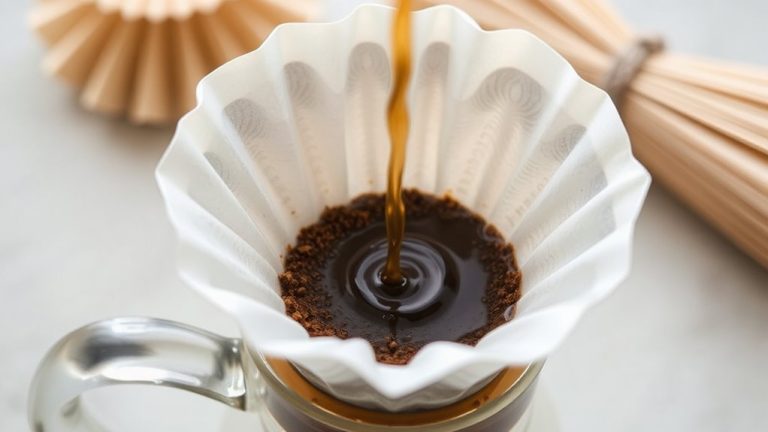
Best Home Coffee Roasters Serious Brewers Swear By
You’ll get the best results with roasters like the SR540 or SR800 if you want precision and speed for small batches, or the 500g–800g models like JIAWANSHUN for larger, consistent roasts. Look for digital controls, smoke management, and non-stick interiors. Some handle nuts or seeds too. Compact ones suit small spaces but need ventilation. Your choice depends on batch size, control level, and how often you roast-knowing the details makes all the difference.
We are supported by our audience. When you purchase through links on our site, we may earn an affiliate commission, at no extra cost for you. Learn more. Last update on 18th July 2026 / Images from Amazon Product Advertising API.
Notable Insights
- The SR800 Coffee Roaster offers precise digital controls and roasts up to 8 oz evenly in under 10 minutes, ideal for serious home brewers.
- Models like the 500g Automatic Coffee Roaster feature nine preset profiles and built-in smoke purifiers for repeatable, clean indoor roasting.
- High-wattage roasters (1500W) with closed-loop temperature control deliver consistent heat for custom roast profiles and better bean development.
- Serious brewers prefer roasters with manual heat and fan settings, allowing full control over roast curves and flavor precision.
- Venting options, such as aluminum smoke pipes and dual chimneys, are critical for managing smoke during dark roasts in home environments.
SR540 Automatic Coffee Bean Roaster

If you’re someone who values freshness and control in your coffee without wanting to babysit the roasting process, the SR540 Automatic Coffee Bean Roaster is one of the best home coffee roasters for getting consistently great results. I use it to roast 7–14 cups in under 10 minutes with 120 grams of green beans. Its nine power levels, fan control, and real-time temp display let me tweak roasts for espresso or drip. The fluid motion tech guarantees even roasting, and it handles organic, decaf, or exotic beans just fine. It’s compact, lightweight, and made in the USA. Just don’t put the glass chamber in the dishwasher.
Best For: Home coffee enthusiasts who want fast, consistent roasting with full control over roast profiles without constant supervision.
Pros:
- Roasts 7–14 cups in under 10 minutes with precise control via nine power levels, fan settings, and real-time temperature display
- Handles a wide variety of beans including organic, decaf, and exotic varieties with even roasting thanks to fluid motion technology
- Compact, lightweight design with USA manufacturing and direct customer support
Cons:
- Glass roasting chamber is not dishwasher safe, requiring careful hand cleaning
- Limited to 120 grams per batch, which may be small for larger households or frequent use
- Higher learning curve for beginners aiming to master custom roast profiles despite beginner-friendly interface
Automatic Coffee Roaster Machine 500g with Smoke Filter

The NIASIA PKF-500g Automatic Coffee Roaster Machine with Smoke Filter works best for home users who want consistent, hands-off roasting with minimal smoke buildup indoors. I use it for batches of 350–400g, which roast evenly thanks to its precise temperature control and stainless steel drum. It has nine preset profiles, so I can easily switch between light, medium, and dark roasts. The built-in smoke purifier helps during lighter roasts, but for darker ones, I attach the included aluminum pipes to vent outside. After roasting, the cooling fan and separate tray drop the temperature fast, locking in flavor. It’s not for heavy daily use, but for home roasting, it’s reliable, straightforward, and efficient.
Best For: Home coffee enthusiasts seeking a reliable, user-friendly automatic roaster with effective smoke control for small-batch roasting.
Pros:
- Offers 9 preset roasting profiles for consistent light, medium, and dark roasts with minimal effort
- Effective smoke management system with built-in purifier and optional outdoor venting via aluminum pipes
- Rapid cooling fan and separate cooling tray preserve flavor by quickly stabilizing bean temperature post-roast
Cons:
- Not suitable for commercial or frequent daily use due to potential component wear
- Smoke purifier only effective for light roasts; darker roasts require outdoor venting
- Optimal performance depends on high-quality, low-defect green beans to avoid jamming
SR800 Coffee Roaster – Home Roasting Made Easy

I choose the Fresh Roast SR800 when I want full control over my roast without needing a degree in coffee science. It roasts 6–8 oz of green beans in under 10 minutes, giving me 14–28 cups per batch. The digital display shows real-time temp, and 11 manual settings let me tweak heat and fan for even results. I can mix decaf, organic, or fair trade beans and craft custom blends. At 1750 watts, it’s powerful but compact-just 8” x 8” x 14”. Weighing under 6 pounds, it’s light but sturdy, with heat-resistant plastic and stainless steel. Fresh beans stay good for two years, so I roast small batches as needed. It won’t eliminate smoke, but it’s simple, reliable, and made in the USA.
Best For: Home coffee enthusiasts who want precise control over small-batch roasting without complex equipment or extensive experience.
Pros:
- Roasts 6–8 oz of beans in under 10 minutes with even results using manual heat and fan controls
- Digital temperature display and 11-level settings allow customization for various bean types and roast profiles
- Compact, lightweight design with durable materials, made in the USA for reliable home use
Cons:
- Produces some smoke during roasting, which may require ventilation or additional setup considerations
- Limited capacity for larger households or those who consume coffee heavily
- Learning curve for beginners to master custom roast profiles despite user-friendly design
Electric Coffee Roaster Machine 750g

You’ll get the most out of the Electric Coffee Roaster Machine 750g if you’re a home roaster who values control and versatility without stepping into commercial territory. I use it for batches of 300–500g, which roast evenly thanks to the automatic stirrer and 1200W heating. The 100–240°C range lets me tweak profiles for beans or grains, and the transparent lid helps me watch the process. I always insert a thermometer through the glass plate hole for accuracy. The non-stick Teflon coating makes cleanup easy, though I hand-wash it. At 13.6 inches wide, it fits my countertop fine. Made by ZEVELOO, it’s reliable for serious home use.
Best For: Home roasters seeking precise control and versatility for small to medium batches without commercial-scale equipment.
Pros:
- Automatic stirring and adjustable 100–240°C temperature range ensure even, customizable roasting for various beans and grains
- Transparent lid and built-in thermometer hole allow real-time monitoring for roast precision
- Non-stick honeycomb Teflon coating and compact design make it easy to use and fit on most countertops
Cons:
- Not dishwasher safe, requiring careful hand-cleaning to maintain non-stick coating
- Roasting times can be lengthy (up to 40 minutes for coffee beans), limiting quick turnaround
- Limited to 110V power, which may restrict use in regions with different voltage standards
Coffee Roaster Bundle with Accessories
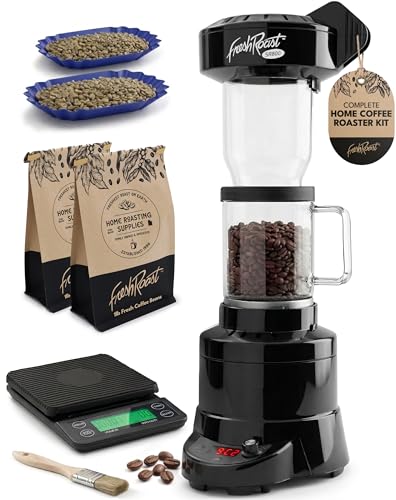
While beginners might prefer simpler setups, a bundle like the Fresh Roast SR800 Coffee Roasting Bundle suits home roasters who want an all-in-one system that covers roasting, cooling, and prep without buying parts separately. I use the 6–8 oz capacity daily, and the glass extension tube boosts heat flow for even roasts. The included digital scale has a timer and silicone pad, helping me track weight loss and brew pour-overs accurately. Two pounds of green beans, sample trays, and a chaff brush make starting easy. It’s manual, so I control every stage, and the 11.88-pound unit fits neatly on my counter. No extra purchases needed-just plug in, roast, and refine.
Best For: Home coffee roasting enthusiasts who want a complete, all-in-one manual system for roasting, cooling, and brewing with minimal setup.
Pros:
- Includes essential accessories like a digital scale, glass extension tube, and 2 lbs of green beans for a seamless start
- Manual operation allows full control over the roasting process for precision and customization
- Compact design and integrated components eliminate the need for additional purchases
Cons:
- Manual operation may overwhelm beginners unfamiliar with roasting techniques
- Maximum 8 oz batch size limits output for larger households or frequent use
- Requires counter space and external grinder, not included in the bundle
Coffee Roaster Machine 800g Electric 110V

The DIYAREA CR-01 Electric Coffee Roaster handles up to 800g per batch, making it a solid pick for home roasters who want consistent results without stepping into commercial-scale equipment. I use it best with 300–500g loads for even roasting. It runs on 110V and pulls 1200W, fitting standard U.S. outlets. The digital timer and 0–240℃ range give me control, while the non-stick interior simplifies cleanup. It’s fully automatic with button controls-simple and functional. I’ve roasted coffee beans and even peanuts successfully. Just note: it’s not dishwasher safe. At under 5 pounds, it’s light and compact for small kitchens or cafés.
Best For: Home roasters seeking a compact, electric coffee roaster with consistent results and the flexibility to roast small to medium batches.
Pros:
- Handles up to 800g per batch with optimal performance at 300–500g for even roasting
- Fully automatic operation with digital timer and precise 0–240℃ temperature control
- Compact, lightweight design with non-stick interior for easy cleaning and countertop storage
Cons:
- Not dishwasher safe, requiring manual cleaning
- Limited color options and unspecified interior color
- May produce inconsistent results when roasting above the recommended 500g capacity
Electric Coffee Bean Roaster 1500W 100g

If you’re looking to roast small batches of coffee at home with consistent results, the Electric Coffee Bean Roaster 1500W 100g fits well in compact kitchens and appeals to beginners or casual drinkers who want control without complexity. I like that it uses hot air circulation to roast evenly, so I never have to stir the beans. With 1500W power and 100g capacity, it handles light to dark roasts cleanly, and the adjustable timer and temperature let me fine-tune flavors. The clear lid lets me watch the process, and the chaff collector makes cleanup simple. It’s small, stable, and easy to store.
Best For: Home coffee enthusiasts who want to roast small, consistent batches of beans with minimal effort and space.
Pros:
- Even roasting with hot air circulation eliminates the need for stirring and prevents scorching
- Adjustable temperature and timer allow precise control over roast profiles
- Compact design with transparent lid and removable chaff collector for easy monitoring and cleanup
Cons:
- Limited 100g capacity may not suit larger households or frequent brewing
- Only 4.0-star average from limited customer reviews indicates potential consistency issues
- Not ideal for users seeking very large batches or commercial-grade output
LUEUR Electric Coffee Bean Roaster (100g)
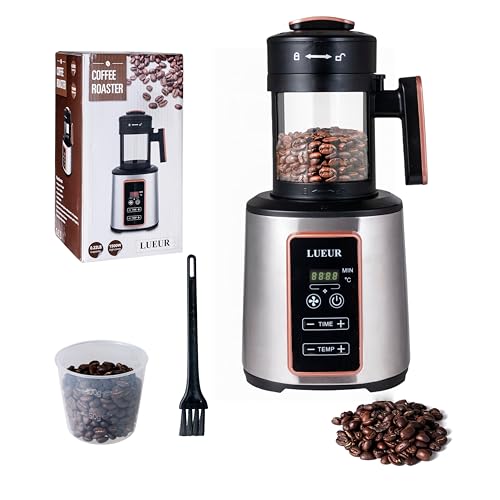
You get reliable batch roasting for up to 100g of beans with the 1500W LUEUR Electric Coffee Bean Roaster, making it a strong pick for home users who want consistent results without overspending. I use its adjustable timer and temperature controls to fine-tune roasts from light to dark, while the variable fan keeps airflow steady. The compact 12.5D x 7.1W x 7.1H design fits neatly on my counter, and the chaff basket makes cleanup easy. It’s not dishwasher safe, so I wipe it down after each use. With a #4 filter and AC power, it’s ideal for fresh whole beans-great for Americanos and daily brewing.
Best For: Home coffee enthusiasts seeking a compact, affordable electric roaster for consistent small-batch roasting with customizable light to dark profiles.
Pros:
- 1500W hot air circulation ensures even, efficient roasting with no hot spots
- Adjustable timer, temperature controls, and variable fan allow precise roast customization
- Detachable chaff basket and compact design enhance usability and countertop convenience
Cons:
- Not dishwasher safe, requiring manual cleaning after each use
- Limited capacity of 100g per batch may not suit larger needs
- Availability date listed as future (August 6, 2025), suggesting potential supply delays
JIAWANSHUN Electric Coffee Bean Roaster 1.1lb
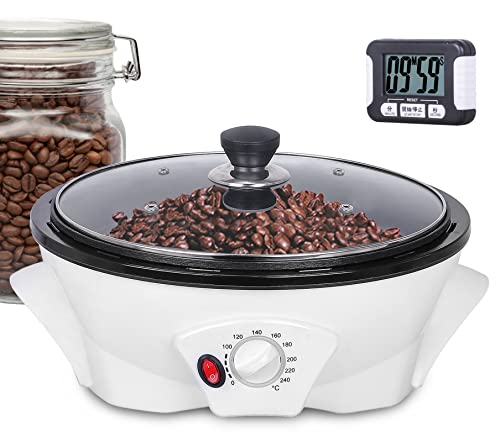
Looking for a no-fuss electric roaster that handles a full pound of beans without breaking a sweat? I’ve used the JIAWANSHUN 1.1lb model, and it’s built for home roasting without extra hassle. It holds up to 800g, though I get best results with 300–500g per batch-skimp below that, and roasting turns uneven. With adjustable heat (100°C–240°C) and a 25-minute cycle, it’s precise and fast. The glass lid lets me watch the beans, while the mixing rod keeps them moving. I clean the non-stick pan with a quick wipe. It’s not just for coffee-I’ve roasted nuts and popcorn too. At 1200W and 110–120V, it powers up quickly, and the classic white design fits any kitchen.
Best For: Home coffee enthusiasts and beginners seeking an affordable, easy-to-use electric roaster for small to medium batches with multi-use functionality.
Pros:
- Adjustable temperature (100°C–240°C) and built-in timer allow precise control for consistent roasting
- Transparent glass lid and automatic mixing rod enable even roasting and real-time monitoring
- Versatile use for roasting coffee beans, nuts, seeds, and popcorn with a non-stick, easy-clean interior
Cons:
- Requires minimum 300g load for optimal performance; underloading causes uneven roasting
- Limited to 110–120V, making it unsuitable for international voltages without a converter
- Plastic and glass construction may feel less durable compared to metal-heavy roasters
1Pound Electric Coffee Roaster for Home

The PRECISION PKF-500 stands out for home roasters who want control without complexity, offering a balanced mix of automatic, assisted, and manual modes that suit beginners and experienced users alike. I use it for light roasting, where its clear observation window and sample spoon help me track progress in real time. It handles most bean types, and the simple interface makes starting easy. With a smoke filter, dual chimney tubes, and chaff collector, it vents cleanly-ideal for indoor use. Weighing 26 pounds, it’s sturdy but not bulky. I keep mine near a window for airflow, since it’s not dishwasher safe and needs basic wiping down. It’s built for home, not commercial runs, so I rely on it for consistent, small-batch roasting without mess or fuss.
Best For: Home coffee enthusiasts who want a user-friendly, versatile electric roaster with real-time monitoring and clean indoor operation.
Pros:
- Offers automatic, assisted, and manual roasting modes to suit various skill levels
- Features a clear observation window and sample spoon for real-time roast tracking
- Includes smoke filter, dual chimney tubes, and chaff collector for clean, indoor-friendly operation
Cons:
- Not dishwasher safe, requiring manual cleaning after each use
- Limited to home use with no support for commercial or large-batch roasting
- Requires external ventilation setup for optimal smoke management
Factors to Consider When Choosing Home Coffee Roasters
You’ll want to check the roast capacity first-most home models handle between 100 and 500 grams per batch, so pick one that fits your household’s coffee habits. Look for machines with adjustable power settings and precise temperature control, like the Behmor 1600 or FreshRoast SR800, since those give you flexibility to roast light or dark without burning beans. Don’t overlook smoke management and user interface either; built-in fans or venting options help reduce odors, while simple dials or digital displays make roasting easier and more consistent.
Roast Capacity
A 100g to 800g roast capacity defines what most home coffee roasters can handle in a single batch, with smaller models suiting solo drinkers or light use and larger ones fitting families or frequent entertaining. You’ll get about 6–8 cups from a 100g batch, while 500g or more yields up to 28 cups. For best results, roast at 70–80% of the max capacity-going too low disrupts heat flow and hurts consistency, especially in air roasters like the Popcorn or FreshRoast models. Larger batches demand more kitchen space, power, and cooling time, so consider your setup before upgrading. Matching your batch size to the roaster’s design guarantees even roasting and better flavor control. If you mostly drink one or two cups a day, a smaller, compact unit makes sense. Bigger households or weekend hosts benefit from higher-capacity models that save time and boost efficiency.
Power Settings
Once you’ve matched your batch size to your roasting needs, the next step is controlling how that batch develops through precise heat management. Look for roasters with adjustable power settings-some offer up to 11 levels-so you can fine-tune from light to dark roasts with accuracy. Higher wattage models, like 1500W units, heat faster and hold temperature more consistently, which helps avoid stalling or scorching. Variable heat controls let you follow specific roast profiles, improving flavor and reducing errors. Many roasters pair power settings with adjustable convection fan speeds to balance airflow, ensuring even bean development. A digital temperature display gives real-time feedback, so you can tweak settings on the fly. These features give you real control, but they require attention. If you’re detail-oriented, the precision pays off. If you prefer simplicity, stick with preset modes-but expect less flexibility.
Smoke Management
To keep your kitchen air clear during roasting, pay close attention to smoke management features. If you’re doing light roasts, models with built-in smoke purifiers work well by reducing indoor smoke. But for medium to dark roasts, which create more smoke, look for roasters with aluminum alloy smoke pipes that vent outdoors. Many systems pair chaff collectors with ventilation to limit airborne particles and keep your setup clean. Effective airflow control helps, too-it keeps beans moving evenly, which cuts down on charring and excess smoke. Some roasters have transparent lids with vent holes, letting you watch the roast while allowing some smoke to escape. Just note, these often need extra filtration if you’re roasting indoors. Don’t rely on passive vents alone for frequent or dark roasts-they might not clear the air enough. Choose a system that matches your roast style and space.
Temperature Control
While roasting at home, you’ll want full command over heat to match your preferred roast style, and precise temperature control makes that possible. You can adjust temps between 100°C and 240°C, letting you nail light, medium, or dark roasts with accuracy. Digital displays and built-in probes give real-time feedback, so you’ll avoid underdeveloped or burnt beans. Models with 9 to 11 heat levels let you fine-tune the roast curve, especially useful for beans with different moisture contents. Advanced roasters use closed-loop systems with sensors to correct fluctuations, keeping the environment stable. Don’t overlook airflow-adjustable fan speeds work with heat control to prevent hot spots and guarantee even roasting. If consistency matters, pick a model that combines precise heating, real-time monitoring, and responsive feedback. It’s not just about max temperature-it’s about control throughout the process.
User Interface
What makes a coffee roaster easy to use? A clear user interface does. Look for models with digital displays that show real-time temperature-this lets you monitor and adjust the roast precisely. Dial-based controls or simple buttons make operation straightforward, whether you’re new or experienced. Multiple control modes-fully automatic, semi-automatic, or manual-give you flexibility depending on your skill level. If you want convenience, preset programs for light, medium, or dark roasts deliver consistency with minimal effort. For more control, adjustable heat and fan settings let you fine-tune the roast profile. Independent controls mean you’re not locked into fixed patterns. You’ll want this if you experiment with different beans or flavors. A well-designed interface balances simplicity and control, so you can focus on results, not guesswork.
Accessories Included
If you’re serious about mastering home roasting, the accessories included with a coffee roaster can make a real difference in both convenience and results. You’ll often get tools like digital scales, sample trays, and cooling trays that help you track weight, compare flavors, and manage beans post-roast. Look for models with detachable chaff baskets or chaff brushes-they make cleanup easier and keep your machine running well. Some roasters include transparent lids or observation windows, so you can watch bean color change in real time without interrupting the roast. Smoke filters and venting pipes help reduce indoor smoke, a real plus if you’re roasting in a small space. Bonus items like sample packs of green beans let you start experimenting right away. These extras aren’t just gimmicks-they save time, improve control, and support better roasting habits from day one.
Frequently Asked Questions
How Long Does It Take to Roast a Batch of Coffee Beans?
It usually takes you 10 to 15 minutes to roast a batch of coffee beans at home. Smaller electric roasters like the FreshRoast SR800 finish in about 10–12 minutes, while fluid-bed models such as the iRoast2 run slightly longer. Drum roasters, including the Gene Café, give you more control but can take up to 15 minutes. Roast time depends on your machine, batch size, and desired roast level-darker roasts take longer.
Can I Use Green Tea Leaves in a Coffee Roaster?
No, you shouldn’t use green tea leaves in a coffee roaster. They’re too light and dry, so they roast unevenly or burn fast. Coffee roasters heat denser beans, not delicate leaves. If you try it, you’ll likely end up with smoke, scorched bits, and no proper flavor development. Stick to roasting tea in a dedicated pan or oven method instead. It gives you more control and better results without risking your roaster or wasting materials.
Do Home Coffee Roasters Require Special Ventilation?
You do need proper ventilation when using home coffee roasters. They produce chaff, smoke, and odors, especially during darker roasts. Without ventilation,油烟 and smells can overwhelm your space. You’ll want to roast near a window with a strong exhaust fan or use a ducted system. Some like the FreshRoast SR540 for its built-in fan, but even that’s not enough alone. Outdoor roasting with a chimney or vented hood works best.
Are Replacement Parts Readily Available for These Models?
Yes, you can usually find replacement parts for most popular home coffee roaster models. Brands like Behmor, Popcorn Popper, and Genio offer readily available elements like heating coils, drums, and chaff trays. Third-party sellers also stock common components. However, obscure or older models might have limited support, so check manufacturer websites or forums before buying. Keeping spare gaskets or fuses on hand saves downtime. Always confirm part compatibility-using the wrong one risks damage or poor performance.
Is It Safe to Leave the Roaster Unattended During Operation?
You shouldn’t leave the roaster unattended during operation-fires can happen, especially with hot internal components and chaff buildup. Even reliable models like the Poppery II or Gene Café need monitoring. You’re better off staying nearby to adjust heat or stop the roast if needed. Some units have safety cutoffs, but they’re not foolproof. Staying present helps you catch issues early and guarantees a consistent roast. It’s a small ask for better control and safety.