The Effect of Dose Packing Density on Percolation Flow in V60 Brewing
Your V60’s flow rate tells you if your coffee bed is too dense or too loose. Packed too tightly, water slows and risks over-extraction; too loose, and it flows fast, causing sour, weak coffee. Aim for even distribution with a fork or Weiss distributor-avoid heavy tamping. Use a gooseneck kettle for precise pours. Match a medium-fine grind to a balanced pack, and adjust based on how water moves through the bed. Watch the drip timing-it’s your best clue to better results.
Notable Insights
- Dense packing slows percolation, risking over-extraction due to reduced permeability and channeling.
- Loose packing accelerates flow, causing under-extraction from uneven resistance and weak flavor.
- Uniform distribution without compaction ensures even saturation and consistent drawdown.
- Pooling or delayed drainage indicates excessive density; rapid flow suggests insufficient packing.
- Optimal bed density mimics damp sand, enabling steady, even water flow through the coffee bed.
What Your V60 Flow Says About Coffee Bed Density
Why does your brew water sometimes race through the grounds, while other times it barely drips? Your pour-over’s flow rate reveals how evenly your coffee bed is packed. If water rushes down the sides or through one spot, poor water dispersion likely means uneven bed stratification-coarser particles settle where water flows fastest, creating channels. A slow, struggling drawdown often points to over-packing or too fine a grind, compressing the bed and reducing permeability. You’re not just adding water-you’re testing bed structure. An ideal pour triggers even wetting and consistent resistance. If you see bubbles or splashing during bloom, your dispersion might be too aggressive, disturbing the bed. A gooseneck kettle helps control this. Using a precision pour gooseneck kettle enhances control over water placement, minimizing disturbance and promoting uniform saturation. Remember, uniform bed density prevents extremes. When flow stabilizes without intervention, you’ve likely achieved balanced dispersion and minimal stratification-simple, repeatable, and effective.
Fix Channeling by Balancing Packing Density
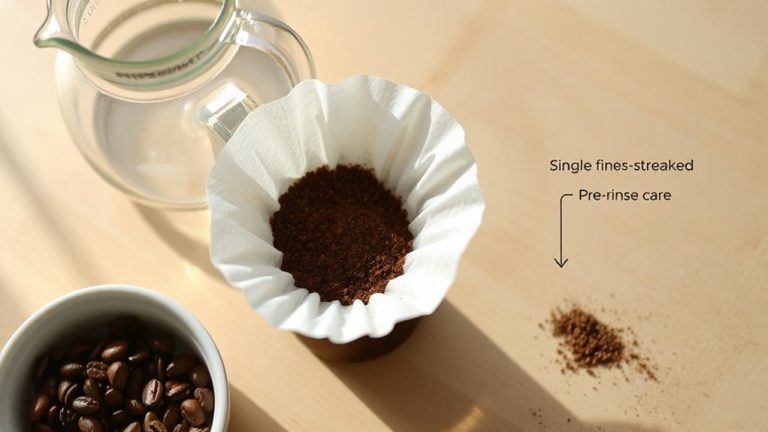
A well-distributed coffee bed can make or break your V60 brew, especially when fighting channeling. You need uniform compaction to prevent water from carving paths through loose spots. When your grounds are unevenly packed, flow becomes unpredictable and extraction suffers. Aim for ideal saturation by ensuring no dry pockets remain after the bloom. Stir gently or use a distribution tool like a small fork or paddle to level the bed before pouring. Avoid pressing down hard-over-tamping creates resistance and restricts flow. A leveled, loosely even bed allows water to move uniformly. Use a consistent pouring technique with steady spiral motions to maintain balance. With uniform compaction, you’ll see smoother drawdown and better flavor clarity. This method works reliably with standard 15g doses in 01 filters. Fine adjustments here directly reduce channeling without changing grind or water. For optimal results, consider using a stainless steel V60 dripper known for consistent heat retention.
How to Check If Your Coffee Bed Is Too Tight or Loose
You just leveled your grounds and started pouring, but how do you know if the bed’s actually ready for even extraction? Watch how the water moves. If it pools or drains too slowly, your bed’s likely too tight, restricting water distribution and risking over-extraction. A loose bed, on the other hand, lets water rush through unevenly, causing weak, sour coffee. Ideal bed structure looks uniform and slightly firm-like damp sand-holding its shape without compacting. When you pour, water should spread evenly across the surface, sinking steadily without channeling down the sides or surging through one spot. Pre-wet the filter and check the first drip: it should start within 10–15 seconds. Too fast? Bed’s too loose. Too slow? Too dense. Adjust grind size or dose first before changing your prep. These signs help you fine-tune for balanced results.
Use Gentle Tools for Consistent Dose Packing
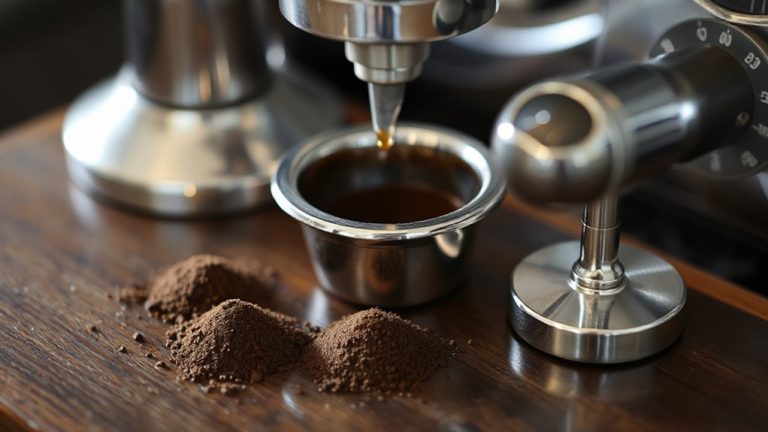
While tampers and forceful pressing might seem like the go-to for preparing a dose, they’re not ideal for a V60, where uniformity matters more than compression. Instead, use gentle tools that encourage soft compression without compacting the bed. A distribution tool like a Weiss distributor or even a simple finger tap evens the grounds without creating dry channels. After leveling, apply only a light shake or a deliberate twist-graceful tamping, if you will-to settle the dose just enough to promote even flow. Over-packing restricts water, causing uneven extraction or channeling. Tools like the Puqpress aren’t designed for this brewer and often do more harm than good. Stick with soft compression techniques that preserve bed structure. For V60s, consistency comes from uniformity, not pressure. Your tool should aid evenness, not override it. This approach works best with medium to medium-coarse grinds, supporting flow without resistance. A well-chosen coffee distribution tool can make a significant difference in achieving uniform extraction.
Match Grind and Pour to Your Pack for Even Extraction
Getting the dose packed right sets the stage, but it’s how you pair that prep with the right grind and pour that determines extraction quality. If your dose is evenly packed, a consistent grind pairing guarantees water meets uniform resistance. Too fine, and you risk clogging, especially with dense packs; too coarse, and you’ll under-extract, losing sweetness. Your pour alignment-centered and controlled-keeps flow steady through the bed. A gooseneck kettle helps, offering precision most spout kettles lack. Pours off-center can channel, particularly in tightly packed doses, wasting your careful prep. Match a medium-fine grind to a medium-dense pack for best results with a 60g/L brew ratio. Adjust slightly if using a metal filter instead of paper-its faster flow needs finer grinding. Always weigh and time your brew: a 2:30 pour with 15-second pulses usually works. Small tweaks in grind pairing or pour alignment make big differences.
On a final note
Your V60’s flow tells you if the coffee bed density is off-too slow means over-packed, too fast suggests it’s too loose. Uneven packing causes channeling, hurting extraction. Use a gentle tamp or leveler like the Tamp Bros Nivel or a light stir to even the bed without compacting. Pair your pack with a matching grind and pour rate: finer needs slower pours, coarser flows faster. Adjusting these boosts consistency.