Adjusting Coarse Grind Size for High-Altitude French Press Brewing
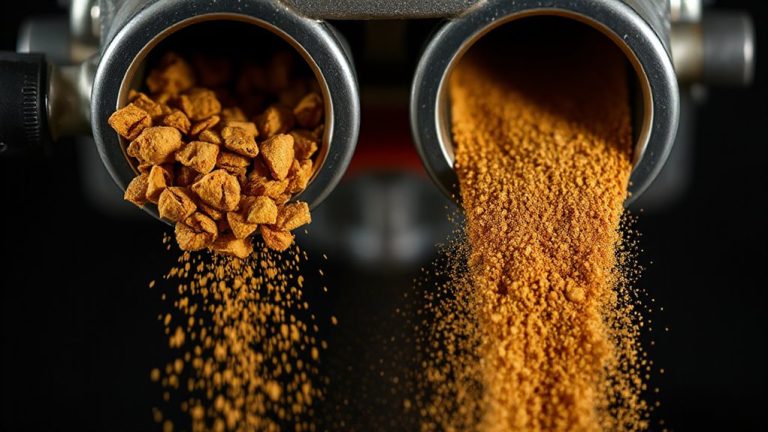
At high altitudes, water boils cooler-around 203°F at 5,000 feet-so you need a slightly finer grind to improve extraction in your French press. Use a burr grinder like the Baratza Encore and adjust one notch finer than medium coarse, aiming for rough sand texture. This helps offset slower extraction without clogging the press. Pair with 4–5 minute brew time and preheated water. Keep your beans fresh and water filtered. There’s more to fine-tuning your mountain brew.
Notable Insights
- At high altitudes, use a slightly finer grind than coarse, approaching medium-coarse, to compensate for cooler water temperatures.
- Aim for a consistency similar to rough sand to improve extraction without clogging the French press filter.
- Avoid overly fine grinds, which can lead to over-extraction and hinder plunger function.
- Use a burr grinder for uniform particle size, ensuring even saturation despite lower atmospheric pressure.
- Adjust incrementally-one notch finer per 1,000 feet above 3,000 feet-and log results for consistency.
Why French Press Fails at High Altitude
While you might not expect altitude to affect your French press, the lower atmospheric pressure at high elevations changes how water behaves, and that directly impacts brewing. At higher altitudes, reduced water pressure means water boils at a lower temperature, but more subtly, it affects how evenly water penetrates coffee grounds. Combined with the natural variance in bean density-especially in high-grown beans like Ethiopians or Colombians-this leads to uneven extraction even with a coarse grind. Denser beans require more thorough saturation, but low pressure hinders that. The result? Flat, weak, or unbalanced coffee despite proper brewing time and ratios. Standard sea-level French press methods just aren’t built for these conditions. You’ll need to adjust more than just grind-you’ll need to rethink immersion and contact dynamics. But first, recognize that altitude changes the foundation of your brew: water behavior and bean response. Achieving optimal results starts with understanding the importance of the perfect French press coffee grind.
How Lower Boiling Point Under-Extracts Coffee
Because water boils at a lower temperature as elevation increases, you’re likely brewing below the ideal range for proper extraction-usually around 195°F to 205°F at sea level. At 5,000 feet, the boiling point drops to about 203°F, and it keeps falling the higher you go. This lower boiling point means your water isn’t hot enough to fully dissolve the sugars and aromatics in coffee. As a result, extraction efficiency drops, leading to under-extracted coffee that tastes sour or flat. You might notice weak body and muted flavors, even with standard brew times. Since French press relies on steeping rather than pressure, it’s especially sensitive to these heat differences. Without enough thermal energy, the water can’t properly penetrate coffee particles to pull out desirable compounds. This isn’t a gear flaw-it’s physics. But adjusting other variables can help compensate.
Adjust Your Grind for High-Altitude Brewing
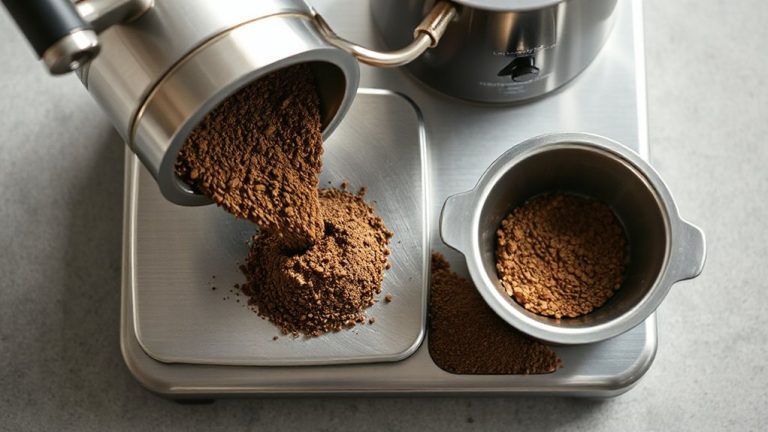
You can’t control the boiling point at higher elevations, but you can adjust your grind size to get better extraction from your French press. At high altitudes, water boils cooler, slowing extraction, so a slightly finer grind helps compensate. Don’t go too fine-aim for something just shy of medium coarse, like rough sand. This increases surface area without risking over-extraction or clogging the press. Consistency matters, so check your grinder calibration regularly; uneven particles lead to weak, bitter mixes. Burr grinders perform better than blade types here. Also, remember that pressure equilibrium shifts in thin air, affecting how water moves through grounds. A uniform grind promotes even saturation despite this. Adjust in small increments and track results. If your coffee tastes flat, tweak the grind finer. If it’s harsh, go coarser. Small changes make a big difference. For optimal results, consider the best coffee grinds for pour-over mastery when fine-tuning your grind profile, as best coffee grinds provide valuable insights into extraction balance.
Brew the Perfect Cup in Thin Air
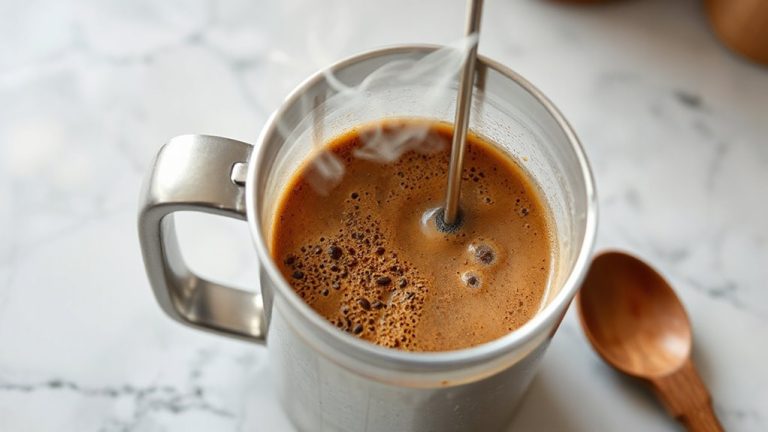
Since water boils at a lower temperature in high-altitude environments, you’ll need to adjust your brew time to guarantee proper extraction. Aim for four to five minutes instead of the standard four to compensate for slower extraction. Keep in mind water hardness-soft water may under-extract, while very hard water can over-extract and leave a harsh taste. If your water’s too hard, consider a simple filtered option like Brita to balance mineral content. Also, minimize contact time after brewing to reduce coffee oxidation, which degrades flavor quickly in thin air. Don’t let your press sit longer than five minutes post-plunge. Use a timer, stick to fresh medium-coarse grounds, and serve immediately. These steps secure clarity, body, and brightness in each cup-exactly what good French press should deliver, even above 5,000 feet. For optimal results, choose one of the Best French Press Picks for 2024.
Fix Weak Coffee at Altitude
When brewing French press at high altitudes, weak coffee often comes down to under-extraction caused by lower boiling temperatures. Water isn’t hot enough to properly dissolve flavors, so even with a coarse grind, you’re likely pulling less from the grounds. This is compounded by reduced water pressure at elevation, which affects how thoroughly hot water penetrates coffee particles. To fix this, check your bean age-stale beans lose oils and volatility, worsening extraction. Use beans roasted within the past two to three weeks and store them airtight. You can also preheat your French press to retain heat, helping maintain ideal brewing temps longer. While you might not fully offset altitude effects without adjusting grind later, fresher beans and retained heat go a long way. Don’t overlook simple fixes before reworking your entire setup.
Dial In Your Grinder for Mountain Heights
Though standard coarse grind settings might work at sea level, they often fall short in high-altitude French press brewing where water boils below 200°F. You’ll need finer particles to offset faster extraction from lower boiling temps. That’s where grinder calibration comes in-adjust your burr grinder incrementally, testing between settings. Elevation compensation isn’t automatic, so don’t rely on preset grind charts. If you’re above 3,000 feet, start one notch finer than usual and brew a test batch. Taste matters more than numbers. A consistent grind improves flavor clarity, reducing sour or weak notes. Blade grinders struggle here-opt for a burr model like the Baratza Encore or 1ZPresso Q2 for precision. Make small changes, log your adjustments, and expect to re-dial if you move locations. Proper calibration means better extraction, even in thin mountain air.
On a final note
You’ll need a coarser grind to counter the lower boiling point at high altitudes, which slows extraction. If your French press coffee tastes weak or flat, adjust your burr grinder-try a setting 1–2 clicks wider than sea level. Conical grinders like the Baratza Encore handle this well. Boil water fully, then let it cool 15 seconds before pouring. This small tweak improves body and flavor in thin air.