Matching Grind Size to Target Brew Window in Any Filter Setup
You control brew time by adjusting grind size-coarser grinds speed up flow, risking sourness; finer grinds slow it, risking bitterness. Aim for a 2:30 to 4:00 minute window. Match your grind to your brewer: medium-fine for V60, coarse for French press. Use a burr grinder like the Baratza Encore for consistency. If flavor’s off, tweak the grind first. Fresh beans respond best. You’ll learn how small changes make a big difference.
Notable Insights
- Grind size is the primary control for adjusting brew time, with finer grinds slowing flow and extending extraction.
- Aim for a brew window of 2:30 to 4:00 minutes by refining grind until target time and flavor are achieved.
- Sour coffee suggests under-extraction; adjust to a finer grind to increase contact time and improve extraction.
- Bitterness indicates over-extraction; use a coarser grind to reduce over-extracted compounds and balance flavor.
- Calibrate grinders regularly and match starting grind size to brewing method for consistent, repeatable results.
What Is Brew Window and Why Grind Size Matters
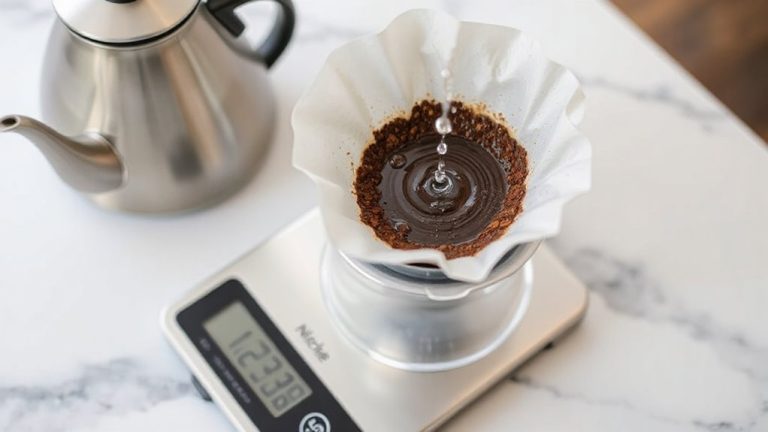
Brew time-the span from when water first hits coffee grounds to when dripping stops-directly shapes how your coffee tastes, and grind size is the biggest lever you can pull to control it. If your grind’s too coarse, water rushes through, leading to weak, fast extraction. Too fine, and flow slows, risking over-extraction and clogging. Ideal brew windows-typically 2:30 to 4:00 depending on method-help balance flavor. Grind size directly affects this window, more than any other variable. You can adjust brew temperature (usually 195–205°F) or improve water quality (like using filtered or third-wave water), but those fine-tune. Grind adjustment is primary. A consistent burr grinder is essential-blade grinders won’t cut it. For pour-over, aim for medium-fine; for Chemex, slightly coarser. Match grind to your target time, then tweak temp and water if needed. For maximum precision, consider a grinder with built-in scale to eliminate variables in dose consistency.
Fix Sour or Bitter Coffee by Adjusting Grind
Why does your coffee taste sharp or harsh? If it’s sour, your grind is likely too coarse, causing under-extraction-water passes through too fast, pulling out only the harsh acids. Try a finer grind to increase surface area and extend contact time. If your coffee tastes bitter, it’s probably over-extracted, meaning the grind is too fine; slow water flow pulls out undesirable compounds. Adjust coarser to fix it. Consider water hardness-hard water can exaggerate bitterness, while soft water may heighten sourness. Also, check bean age: older beans lose gases and solubles, making them harder to extract evenly, often tasting flat or off. Freshly roasted beans (within 2–6 weeks) respond better to grind changes. Dialing in isn’t just about flavor-it’s about matching grind to your coffee’s condition and your water. Small tweaks make the difference. For consistent results, use a high-quality burr grinder designed for filter coffee grinders.
Choose the Right Grind for Your Brewer
You’ve seen how grind size affects flavor, fixing sourness or bitterness by syncing with extraction time-and now it’s time to match that grind to your specific brewer. Every device-pour-over, Chemex, AeroPress, or immersion brewer-needs a precise grind to work well. A coarse grind suits French press to avoid sludge; too fine and you’ll over-extract or clog the filter. Pour-overs like V60 need medium-fine grind for even flow. Grinder calibration matters here-most blade grinders can’t deliver the consistency you need. You’ll want a burr grinder to control particle distribution, ensuring most grounds are the same size. Uneven distribution leads to under- and over-extraction at once. If your coffee tastes off despite correct brew time, check your grinder calibration first. It’s cheaper than buying new gear and makes the biggest difference in daily results. For pour-over brewing, investing in one of the best coffee grinders for pour-over can significantly improve your brew consistency and flavor clarity.
How Extraction Works in Filter Coffee
While water moves through your coffee bed during a pour-over, it dissolves soluble compounds that give the drink its flavor, body, and aroma. You’re not just pulling flavor-you’re managing solubility rates, as different compounds extract at different speeds. Sugars and acids come first, followed by balanced notes, and then bitterness if overdone. Since cellulose breakdown doesn’t noticeably occur in normal brewing, the structure of the grounds stays mostly intact, limiting extraction to surface-level and internal pore access. That’s why grind size matters so much-it controls surface area and water flow. Too fine, and you risk over-extracting bitter compounds; too coarse, and you under-extract, leaving weak, sour coffee. Water temperature and contact time also shift solubility rates, but without extreme heat or pressure, you won’t break down cellulose like in espresso. Your goal: hit the sweet spot where extraction is complete but not excessive.
Match Brew Time to Grind Size for Balance
Grind size directly shapes how long water takes to pass through your coffee bed, and that timing affects every drop of your final brew. If your grind is too fine, water struggles to move through, extending brew time and risking over-extraction-think bitter, flat flavors. Too coarse, and water rushes through, shortening brew time and often yielding sour, weak results. You’re tuning brew dynamics with each adjustment. A balanced extraction lives in the sweet spot where brew time matches your target window-usually 2:30 to 4:30 minutes, depending on method. This balance enables precise flavor calibration, letting you highlight sweetness, clarity, and body. For example, a V60 typically needs a medium-fine grind to maintain flow without channeling, while a batch brewer might use a medium-coarse setting for consistent saturation. Adjust incrementally, monitor time, and taste the outcome-small changes make clear differences.
Test Your Grind for Consistency
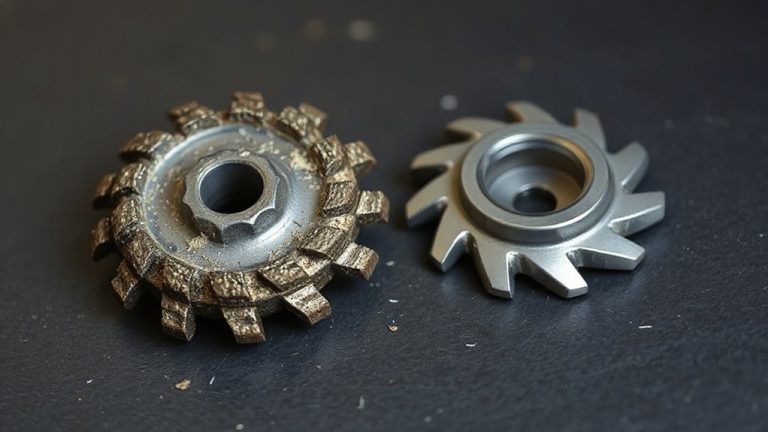
A consistent grind sets the foundation for a repeatable, high-quality brew, and checking it regularly keeps your results predictable. You need even particle distribution to avoid under- and over-extraction-too many fines or boulders skews flavor. Run a quick visual check: spread a sample on white paper. If you see lots of very small and very large bits, your grinder calibration is off. Most grinders, like the Baratza Encore or 1Zpresso Q2, allow micro-adjustments to fix this. Blade grinders create uneven particle distribution and aren’t suitable. Burr grinders-especially conical or flat steel-are better for consistency. Regular grinder calibration guarantees particle size stays uniform over time, especially as burrs wear. Do this every few weeks or after changing beans. It’s simple but critical: consistent grind means consistent taste. No guesswork, just control.
Dial In Any Coffee: Pro Tips
How do you get from average coffee to exceptional? You start by adjusting your grind to match your brew method and desired extraction window. For pour-over, a medium-fine grind brings out bright flavor notes without slipping into bitterness. With a French press, go coarse-too fine and you’ll clog the plunger or pull a murky cup. For cold brew, an extra-coarse grind prevents over-extraction and harshness over long steep times. Always test in small batches. If your coffee tastes flat, try a finer grind; if it’s too sharp, go coarser. Rotate beans often, since roast level affects grind needs. A quality burr grinder gives consistent results, unlike blade models. Note how each change affects flavor notes-clarity, sweetness, acidity. Small tweaks make big differences, whether you’re brewing hot or cold brew. Dial it in, taste, adjust.
On a final note
You now know how grind size shapes your brew window and flavor. Go too fine, and coffee turns bitter; too coarse, it’ll taste sour. Match your grind to the brewer-pour-over needs medium-fine, batch brew leans medium. Adjust to hit a 3–4 minute brew time for balance. Use a quality burr grinder for consistency. Test, tweak, then lock in what works. It’s not magic-just method.