Why Coarse Grind Is Essential for Cold Brew Extraction Success
You need a coarse grind for cold brew because the long steep time extracts more from coffee, and fine grounds would release too many bitter compounds. Coarse particles, like sea salt, slow extraction, giving a smoother, sweeter result. They also settle faster, making filtration cleaner with a French press or cloth. A burr grinder-like the Baratza Encore-gives the evenness you need. Skip blade grinders; they create uneven bits that ruin balance. For best results, match grind to steep time-this sets the foundation for everything that follows.
Notable Insights
- Coarse grinds prevent over-extraction, avoiding bitterness during cold brew’s long steep time.
- Large grind size slows extraction, balancing flavor development over 12–24 hours without harshness.
- Coarse particles reduce sludge and sediment, improving clarity and mouthfeel in the final brew.
- Uniform coarse grounds extract evenly, especially when using French press or mason jar steeping methods.
- Fine grinds increase surface area, releasing bitter compounds; coarse mimics sea salt for optimal results.
Why Grind Size Makes or Breaks Cold Brew
One wrong grind can ruin your entire batch. Using a fine grind for cold brew leads to over-extraction and bitterness, since the coffee particles expose too much surface area during long steeping. You need a coarse grind-it slows extraction and reduces sludge. Cold brew relies on time, not heat, so water temperature stays low, usually room temp or colder. That means the grind must compensate by allowing steady flavor release over 12–24 hours. A French press or large mason jar often serves as the brewing vessel, and with these, coarse grounds settle easier, making filtration simpler. Fine grinds cloud your brew and clog filters. A quality burr grinder gives consistent results; blade grinders often don’t. If your cold brew tastes muddy or is hard to strain, your grind is likely too fine. Adjusting it is the fastest fix.
Cold Brew’s Secret: Time, Not Heat
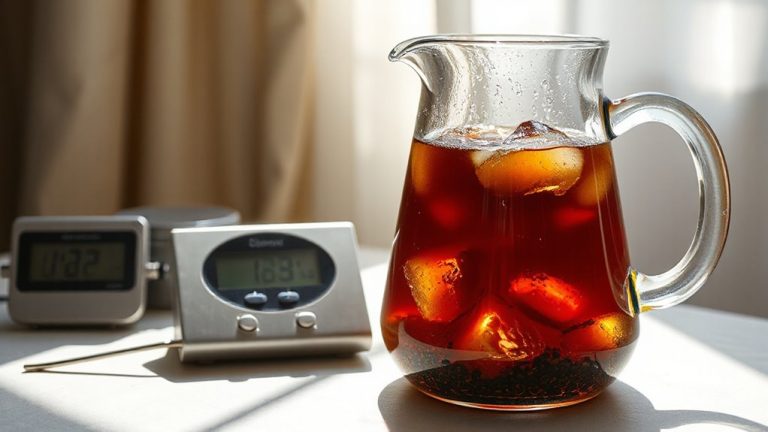
While heat speeds up extraction in most brewing methods, cold brew relies entirely on time to pull flavor from the grounds-typically 12 to 24 hours at room temperature or in the fridge. Your brewing duration directly impacts strength and clarity, making timing a key part of the steeping science. Too short, and your coffee tastes weak; too long, and it risks over-extraction, even with coarse grinds. A well-chosen cold brew coffee maker can simplify this process and ensure consistent results.
| Factor | Effect on Cold Brew |
|---|---|
| 12-hour steep | Lighter body, milder taste |
| 16-hour steep | Balanced extraction |
| 24-hour steep | Fuller body, more caffeine |
| Room temp | Faster extraction |
| Fridge | Slower, smoother results |
You control the outcome by adjusting time and temperature. For best results, stick to filtered water and consistent brewing duration. The steeping science isn’t complicated-just precise.
Why Coarse Grinds Keep Cold Brew Smooth, Not Bitter
You’ve seen how time shapes cold brew’s strength and smoothness, but the grind size plays an equally decisive role in keeping flavors clean and bitterness at bay. Using a coarse grind prevents over-extraction, even during long steep times, which means fewer harsh compounds end up in your cup. Fine grounds increase surface area, speeding up extraction and often releasing bitter, astringent notes-exactly what cold brew tries to avoid. A coarse grind, like what you’d use for a French press, guarantees a slower, more even draw, supporting better mouthfeel consistency and avoiding a gritty or rough texture. It also improves sediment control, especially if you’re filtering with a cloth or paper-minimal fines mean less sludge at the bottom of your bottle. Machines like the Baratza Encore or even a simple hand grinder set to the widest setting make this easy. Stick to coarse, and your brew stays smooth, clean, and balanced-every time. For optimal results, consider using one of the best coffee grinders for cold brew.
Use a Coarse Grind: The #1 Rule for Great Cold Brew
Getting the grind right is the most important step in making great cold brew-skip this, and even the best beans won’t save your brew. You need a coarse grind to match cold brew’s long steep time. Fine grounds over-extract, turning your drink bitter and muddy. A coarse grind slows extraction, letting clean, sweet flavors come through without the harshness. Think of it like French press: both use immersion and coarse grounds to avoid sludge and bitterness. Most home grinders have a setting for French press-use that. If you’re using a slow drip cold brew tower, a consistent coarse grind is still key, even though the water moves slowly. Inconsistent grinds lead to uneven extraction, no matter the method. Always grind fresh, and make sure your particles are uniform-sandy, not powdery. This isn’t just detail work-it’s the foundation of good cold brew.
Common Grind Mistakes That Ruin Cold Brew Taste
If you’re making cold brew at home, skipping the right grind size is the fastest way to end up with a flat or bitter drink. Using a fine grind, like what you’d use for drip coffee, increases overextraction risks during the long steep-you pull out too many harsh compounds, leading to bitterness and flavor degradation. A blade grinder often creates uneven particles, so some grounds overextract while others underextract, muddying the balance. Even a burr grinder set too tight causes similar issues. The sweet spot is a consistent, coarse grind-think sea salt or breadcrumbs. That evenness lets water move slowly through, extracting sweetness and body without harshness. Skipping a proper burr grinder or mis-setting it might save time, but you’ll sacrifice quality. For reliable results, invest in a grinder with coarse settings, like the Baratza Encore or 1Zpresso hand grinders. Your cold brew will taste cleaner, smoother, and closer to what you’d get from a specialty shop. A top pick for cold brew grinders delivers the consistency and range needed for optimal extraction.
On a final note
You need a coarse grind for cold brew because slow extraction over 12–24 hours pulls too much bitterness from fine grounds. A burr grinder, like the Baratza Encore, gives you consistent coarse crumbs-think sea salt-so water extracts flavor evenly without harshness. French press or cold brew-specific makers work best with this grind. Skip fine or espresso grinds; they’ll make sour, muddy coffee. Coarse is reliable, smooth, and forgiving. It’s not just a tip-it’s the rule.