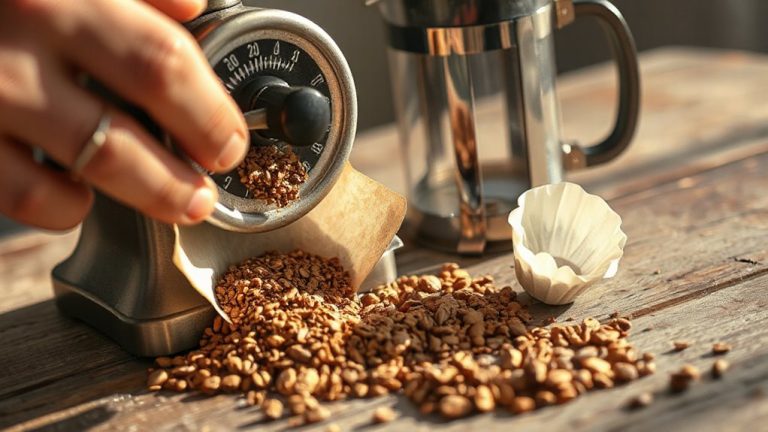
Adjusting Grind Sizes for Different AeroPress Recipes to Enhance Flavor Complexity and Intensity
You should adjust your grind size to match your AeroPress method for better flavor. Use a medium-fine grind, like table salt, for the classic method, and go slightly finer-closer to granulated sugar-for the inverted setup to prevent leaks. A finer grind boosts body and intensity, but avoid ultra-fine to limit sediment. Coarser grinds work well with metal filters or long steeps, giving a cleaner, tea-like cup. Tweaking your grind improves strength and balance faster than changing other variables-your next best brew starts here.
Notable Insights
- Match grind size to brew method: medium-fine for classic, slightly finer for inverted AeroPress to optimize extraction and prevent leaks.
- A finer grind increases surface area, enhancing flavor complexity and body, especially with paper filters for espresso-like intensity.
- Use a burr grinder to ensure uniform particles, avoiding channeling and promoting even extraction for balanced flavor.
- For cleaner, brighter cups, choose a coarser grind to reduce over-extraction and highlight clarity in light roast coffees.
- Adjust grind incrementally: finer for weak/sour coffee, coarser for bitter brews, before changing other brewing variables.
Why Grind Size Shapes AeroPress Flavor
Grind size is the silent driver behind your AeroPress brew’s taste. Too fine, and your coffee turns bitter and slow to press; too coarse, and it’s weak and watery. You need balance. A medium-fine grind, like table salt, works best for most recipes. It extracts evenly without clogging the filter, especially at standard brew temperature-around 175–205°F. Water quality matters just as much; minerals in hard water can amplify over-extraction, while soft or distilled water dulls flavor. Freshly ground beans react better to clean water and stable heat. If your tap water tastes off, use filtered. That clarity lets the grind do its job: controlling surface area and contact time. Consistency in particle size prevents channeling, where water shortcuts through the bed. A burr grinder beats blade types every time. Adjusting grind size is your primary tool-not brew temperature or water quality-to fine-tune strength and clarity. For optimal results with freshly roasted beans, consider using one of the best coffee grinders designed to preserve nuance and aroma.
Classic vs. Inverted: What Grind Works Best
You’ve got your grind dialed in for clarity and balance, but now your brewing method matters just as much. In the Classic method, water flows through the coffee and filter uninterrupted, so a medium-fine grind guarantees even extraction and brew symmetry-no channeling, no waste. The Inverted method, though, changes the pressure dynamics: the plunger’s at the top, steeping happens longer, and you flip to depress. Here, a slightly finer grind helps resist premature dripping and improves consistency during the press. Because the Inverted style holds water under more tension, grind size affects how smoothly the plunger meets resistance. Too coarse, and you’ll get weak, uneven brew; too fine, and pressure builds too fast. Aim for uniformity-think granulated sugar. Match your grind to your method, and you’ll maintain control, repeatability, and balance in every cup. For optimal results, refer to a coffee grind chart that aligns grind size with specific brewing techniques.
When a Fine Grind Boosts Body and Flavor
While a finer grind isn’t always the answer, it can make a noticeable difference when you’re after a fuller body and more intense flavor in your AeroPress brew. You’ll get closer to espresso extraction when using a fine grind, which helps pull out more oils and complexity from the coffee. This works especially well if you’re using the standard right-side-up method with a paper filter-just be cautious with sediment control. A very fine grind might let some fines slip through, adding grit to your cup. To balance this, pair the fine grind with a high-quality AeroPress paper filter, like the official metal or thick cellulose ones, which reduce clogging while keeping muck out. Don’t go too fine, though-aim for slightly finer than table salt. That way, you boost body and flavor without sacrificing clarity or ending up with sludge at the bottom. For consistent results, consider using a best manual coffee grinder to achieve precise and uniform particle size.
When to Use a Coarser Grind in AeroPress Brewing
If you’re aiming for a cleaner, more tea-like cup with less risk of over-extraction, a coarser grind can work to your advantage in AeroPress brewing. It slows water flow, reducing bitterness and emphasizing clarity, especially with lighter roasts. A coarser setting also improves metal filter compatibility-since metal filters don’t trap fines like paper ones, a coarser grind helps prevent clogging and sediment in your cup. This makes cleanup easier and prolongs filter life. Plus, if you’re experimenting with cold brew integration, starting with a coarser grind is essential. Cold-steeping coarse grounds for 12+ hours avoids harshness while extracting smooth, mild flavors. You can then dilute and serve over ice or blend with hot water for a hybrid concentrate. Coarser isn’t always weaker-it’s strategic. It suits longer brews, alternative filtration, or when you want nuanced brightness without grit or over-extraction risks.
Fix Bitter or Weak Coffee: Grind Adjustments That Work
Bitterness or weakness in your AeroPress coffee often comes down to one adjustable factor: grind size. If your brew tastes bitter, your grounds are likely too fine, over-extracting even with proper water temperature and short contact time. Try a slightly coarser grind to reduce intensity and harshness. On the flip side, weak or sour coffee usually means under-extraction-your grind is too coarse, so water passes through too quickly in the brew vessel. Go finer to increase surface area and extraction efficiency. Always adjust just one level at a time. A consistent burr grinder helps. Pair your grind tweaks with stable water temperature (195–205°F) for reliable results. These small changes make a big difference in clarity and strength, and they’re more effective than changing your entire recipe. You’ll balance flavor without guesswork.
Balance Dose, Time, and Grind for Better Flavor
You’ve got the right grind, but your AeroPress brew still isn’t quite there? Fine-tuning dose, brew time, and grind together-along with water quality and brew temperature-can make all the difference. Use filtered water and aim for a brew temperature around 175–205°F for balanced extraction. Too harsh? Reduce dose or shorten time. Too thin? Try a finer grind or longer steep.
Here’s a quick reference:
| Dose (g) | Brew Time (s) |
|---|---|
| 12 | 60 |
| 14 | 90 |
| 15 | 120 |
| 16 | 60 |
| 17 | 90 |
Adjust one variable at a time. Better water quality improves clarity. Stable brew temperature guarantees consistency. Small changes yield big results-dial it in slowly.
On a final note
You’ve seen how grind size directly affects flavor, body, and extraction in your AeroPress. Fine grinds work well for short, intense brews like the classic method, boosting richness but risking bitterness if over-extracted. Coarser grinds suit longer, inverted brews, reducing harshness and improving clarity. Adjusting grind helps fix weak or bitter coffee fast. Pair the right grind with your dose and time, and you’ll consistently brew balanced, flavorful coffee-no guesswork needed.