Fine-Tuning Pour Over Techniques Based on Various Coffee Beans to Suit Desired Flavor Profiles
Match your grind size to the roast: go finer for dense light roasts to avoid sourness, coarser for porous dark roasts to prevent bitterness. Use hotter water (200°F) for light roasts, slightly cooler (190–195°F) for dark. Extend bloom time to 45–60 seconds for naturals and honey-processed beans. Pour faster for bright, fruity notes or slower for sweeter, chocolatey tones. Aim for a 2:45–3:15 brew time with high-altitude beans, shorter for low-density ones. A gooseneck kettle gives you the control you need-consistent pours make all the difference, especially when adjusting for flavor balance. You’ll find small tweaks lead to better results every time.
Notable Insights
- Match grind size to roast: finer for dense light roasts, coarser for porous dark roasts to balance extraction.
- Adjust water temperature: 200°F for light roasts, 190–195°F for dark roasts to optimize flavor clarity.
- Extend bloom time to 45–60 seconds for natural and honey-process beans to ensure even saturation.
- Control pour speed: faster for bright acids in Africans, slower to enhance body in Central Americans.
- Tailor brew time: 2:45–3:15 for high-altitude light roasts, 2:15–2:45 for low-density or dark-roasted beans.
Match Light Vs. Dark Roast to Your Pour-Over Grind Size
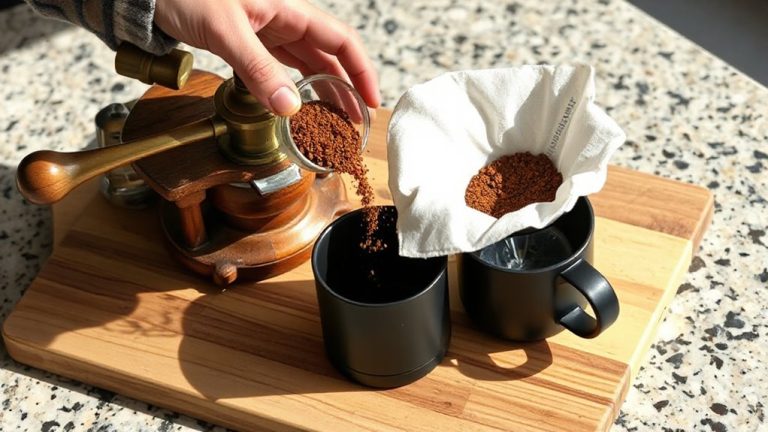
Most light roasts need a finer grind than dark roasts when you’re using a pour-over setup. That’s because light roasts are denser and less soluble, so they extract slower. A finer grind helps compensate, giving you balanced flavor. Dark roasts are more porous and extract faster, so they do better with a slightly coarser setting to avoid over-extraction and bitterness. No matter the roast, grind consistency is essential-uneven particles lead to mixed extraction, with some under-extracted and others bitter. Blade grinders often create inconsistent results; burr grinders are better for uniformity. Roast age matters too: beans lose CO2 over time, so older roasts may need slightly finer grinding to maintain extraction efficiency. With light roasts, aim for a grind like table salt; for dark, try something closer to sea salt. Adjust based on taste, but start here. For optimal results, match your grind size to your brewing method using a coffee grind guide.
Adjust Water Temperature for Balanced Pour-Over Extraction
You’ve already dialed in your grind size based on roast level, but even the right grind won’t save you from off flavors if your water’s too hot or too cool. Light roasts usually need hotter water-around 200°F-to extract their complex acids and sugars fully. Dark roasts taste smoother and less bitter with slightly cooler water, about 190–195°F, to avoid over-extracting harsh compounds. Water hardness matters too-soft water can make coffee taste flat, while overly hard water causes scaling and uneven extraction. Ideal mineral content includes balanced levels of calcium and magnesium, which help pull flavor from the grounds. Use filtered water if your tap’s too soft or too hard. A temperature-controlled kettle gives you precision, letting you adjust based on bean type and water quality. It’s a small change that makes a real difference in clarity and balance. For optimal results, aim for the Perfect Coffee Brewing Temperature as recommended by brewing experts.
Extend Bloom Time for Natural and Honey-Process Beans
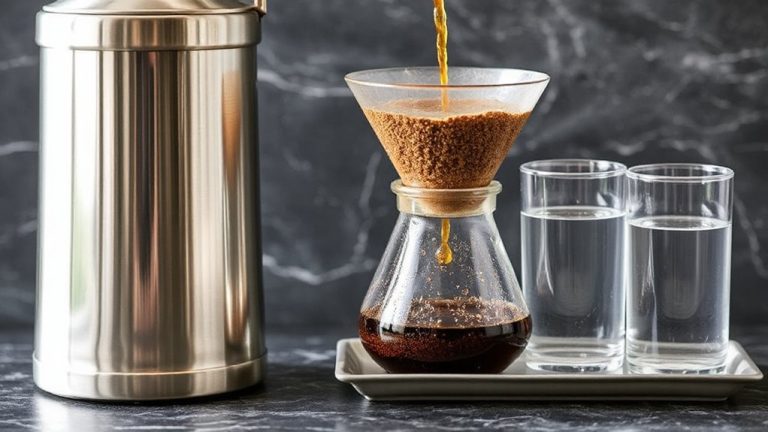
Since natural and honey-process beans retain more fruit and mucilage during drying, they tend to trap more carbon dioxide, which means they need a longer bloom time to degas fully. You’ll see better extraction with extended blooming-typically 45 to 60 seconds-because it reduces gas retention that can block water flow and create uneven saturation. A gooseneck kettle is especially effective for precision pouring, a feature highlighted in top pour-over coffee makers for achieving optimal bloom and extraction.
| Bean Type | Recommended Bloom Time | Water Used (% of total) |
|---|---|---|
| Natural Ethiopia | 50–60 sec | 2x bean weight |
| Honey Costa Rica | 45–55 sec | 2x bean weight |
| Washed Colombian | 30–40 sec | 2x bean weight |
Extended blooming helps stabilize the brew while improving clarity and flavor consistency. Don’t rush it-let the coffee settle naturally before continuing pours. Using a gooseneck kettle guarantees controlled saturation without disturbing the bed. This small tweak makes a noticeable difference, especially with dense, less-evenly roasted lots.
Control Pour Speed to Bring Out Bright or Chocolatey Notes
When you want to highlight either the bright acidity or deep chocolatey notes in your pour over, controlling the pour speed becomes a key lever. A faster flow rate extracts more evenly but briefly, which boosts bright, fruity acids-ideal for light-roast Africans like Ethiopian Yirgacheffe. Slower pours extend contact time, building body and pulling out chocolatey, nutty tones common in medium-roast Central Americans, like Guatemalan Bourbon. Your flavor emphasis shifts depending on this timing: too fast and you under-extract, too slow and you risk over-extraction, especially with fine grinds. Aim for a steady 2-3 minute total brew time. Adjusting pour speed gives you direct control over solubility and balance. It’s not about power, but precision-small changes in flow rate reshape your cup’s profile. Practice helps you match the bean to the desired outcome without relying on gear alone.
Use a Gooseneck Kettle for Consistent Pour-Over Flow
Though precision matters in every phase of pour-over brewing, the tools you use can make or break your control-especially the kettle. A gooseneck kettle gives you unmatched pour precision and better kettle balance, letting you regulate water flow with accuracy. Unlike regular kettles, its narrow, swan-like spout slows the pour, helping saturate grounds evenly. This control matters most with light roasts or dense beans that need a steady, mindful pour.
| Feature | Gooseneck Kettle | Standard Kettle |
|---|---|---|
| Pour Precision | High | Low |
| Kettle Balance | Stable, controlled | Uneven, splashy |
| Best For | Pour-over | French press, espresso |
| Learning Curve | Moderate | Low |
Goosenecks cost more, but serious pour-over drinkers find them worth it. Manual kettles like the Fellow Stagg or Kalita offer excellent feedback-you feel every tilt and drip.
Set Total Brew Time Based on Bean Origin and Roast Level
Depending on where your beans come from and how dark they’re roasted, you’ll want to adjust your total brew time to get the best flavor out of your pour-over. Lighter roasts from high-altitude regions like Ethiopia or Kenya tend to have higher bean density, so they need more time-usually 2:45 to 3:15-to fully extract without tasting sour. The extra time helps improve roast development, bringing out complex florals and bright acids. For lower-density beans from places like Brazil or Sumatra, especially if dark roasted, aim for 2:15 to 2:45. These beans extract faster due to porous structure and advanced roast development, and going too long can lead to bitterness. Always tweak based on taste-too sharp? Extend brew time. Too harsh? Shorten it. A consistent grind and gooseneck kettle help keep things repeatable.
On a final note
You’ve got the tools and timing down-now tweak your pour-over to match each bean. Light roasts need finer grinds and hotter water to lift bright, fruity notes, while dark roasts do better coarser and slightly cooler to avoid bitterness. Use a gooseneck kettle for control, adjust bloom time for process type, and aim for 2:30–3:30 total brew time. Small changes make clear differences.