Achieving Stable Tamping Pressure With Consistent Fine Grind in Portafilters
You need a consistent fine grind and stable tamping pressure to avoid channeling and achieve balanced espresso. Use a high-quality grinder like the Niche Zero for uniform particles and check burr alignment regularly. Tamp with 30 pounds of pressure using a calibrated tamper like the Pullman Chisel, keeping your wrist straight. Pair proper distribution-try the Nutsedge Twister-with a level, even press. With the right tools and habits, your shots will stay sweet, clean, and repeatable. There’s more to fine-tuning your setup just ahead.
Notable Insights
- Use a calibrated tamper to apply exactly 30 pounds of pressure for consistent puck compaction.
- Maintain a straight wrist and engage shoulder muscles to ensure even, stable tamping force.
- Grind coffee with properly aligned burrs to achieve uniform particle size and prevent channeling.
- Distribute grounds evenly using tools like the Nutsedge Twister before tamping for uniform density.
- Pair fine grind settings with consistent tamp pressure to avoid over-extraction and maintain stability.
Why Tamping and Grind Make or Break Espresso
Every shot of espresso starts with how evenly the coffee is ground and how consistently it’s tamped-two factors that directly control water flow through the puck. You can’t ignore bean density, because denser beans resist water penetration, demanding precise tamping pressure to avoid channeling. If your tamp is uneven, water will exploit weak spots, especially when paired with incorrect water temperature. Too hot, and you risk scalding; too cool, and extraction stalls. You need stable pressure-typically 30 pounds-applied squarely. Distributors like the Nutsedge Twister help, but consistency hinges on technique. Some use calibrated tampers like Pullman’s, which add repeatability. Remember, no matter how good your grinder, without even tamping and proper dose, you’ll fight extraction issues. Bean density varies daily-your tamp must adapt. Water temperature should stay between 195°F and 205°F to balance solubility and avoid bitterness, letting grind and tamp work as a team. Upgrading to a high-quality best coffee portafilter can further enhance group head alignment and pressure stability for more consistent extractions.
Dial In a Consistent Fine Grind
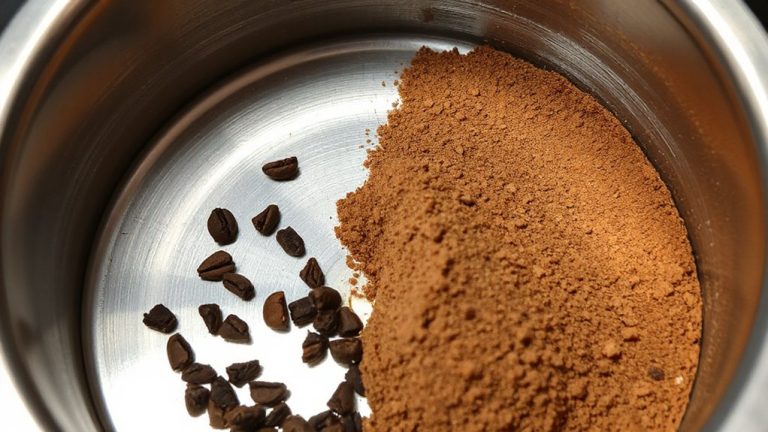
A good espresso grind isn’t about going fine-it’s about going consistent. You need even particle size so water flows uniformly through the puck. Start by checking your grinder’s burr alignment-misaligned burrs create fines and boulders, wrecking extraction. If your shots channel or stream unevenly, that’s often the culprit. Grinders like the Niche Zero or Eureka Mignon offer easy burr alignment checks; others may need professional servicing. Pair correct alignment with mindful dose distribution-tap the portafilter gently or use a tool like a Leveler to spread grounds evenly before tamping. Uneven distribution leads to uneven extraction, no matter how precise your grind. Adjust in small increments: turn your grinder finer or coarser by 1 full step, then test shot time and taste. Aim for balance-sweetness without bitterness, body without sourness. Consistency here sets the stage for stable tamping pressure downstream. For those seeking peak performance, investing in one of the best coffee and espresso grinders can dramatically improve grind uniformity and shot repeatability.
Tamp Like a Pro: Pressure, Leveling, and Technique
While you’ve already dialed in a consistent grind and distributed the grounds evenly, all that work can go to waste if your tamp isn’t level and firm. Apply about 30 pounds of pressure-enough to compact the bed without straining. Use a calibrated tamper or one with a built-in gauge if you’re unsure. Keep your wrist straight and use your shoulder for control, guaranteeing even force. Always distribute first to avoid channels. A popular method is the OCD twist, which levels grounds before tamping. Avoid tamp rotation after pressing; it doesn’t improve evenness and can disrupt the surface. Instead, lift straight up. A flat, level tamp guarantees uniform water flow. If your portafilter basket sits unevenly, check the group head or try a leveling tool. Consistency matters more than flair-repeatable technique beats tricks every time. Upgrading to a high-quality premium portafilter can enhance dose retention and extraction stability.
Stop Sour or Bitter Shots: Fix Tamping and Grind Mistakes
You’ve got a level tamp and consistent grind dialed in, but if your espresso still comes out sour or bitter, the issue might be how those two factors interact. Uneven tamping with too fine a grind can over-extract, leading to bitterness, while a light tamp with a coarse grind causes sourness from under-extraction. You need balance. Check your machine calibration-brew pressure and temperature stability directly affect extraction. A poorly calibrated machine can’t deliver consistent results, no matter how good your technique. Also, don’t overlook water quality. Hard water alters extraction and damages equipment, while soft or unbalanced water flattens flavor. Use filtered water with proper mineral balance-brands like Third Wave Water offer tailored solutions. Fixing sour or bitter shots isn’t just about tamping or grind alone-it’s how they work with machine calibration and water quality. Adjust one, check the result, then move on. Keep it methodical.
Dial In Consistently: Tools for Stable Tamping and Grind
What if your tamp pressure varied by just five pounds each shot? That small difference can wreck espresso consistency, leading to uneven extraction. To fix this, start with tamp calibration-use a digital scale or a calibrated tamper like the Pullman Chisel to guarantee you’re applying the same force every time. Even slight hand pressure changes add up. Pair this with grind profiling: your grinder’s settings直接影响 flow rate and resistance. Tools like the Compak Smart Grinder Pro let you save profiles, making repeatable dosing easier. Always dial in after changing beans or humidity shifts. A consistent dose, combined with stable tamp pressure and precise grind size, is the backbone of great espresso. Don’t guess-measure, adjust, and lock in your settings. Stabilize one variable at a time. Tamp calibration and grind profiling together cut shot variance and keep your coffee tasting sharp, shot after shot.
On a final note
You’ve got the tools and the technique-now stay consistent. A steady tamp pressure and fine, even grind size are non-negotiable for balanced espresso. Use a calibrated tamper and burr grinder like the Baratza Sette or Eureka Mignon for repeatable results. Adjust one variable at a time, check shot time, and clean equipment daily. Small tweaks make the difference between sour and sweet.