Measuring True Fineness: Micron Analysis of Espresso Grind Standards
Your grinder’s setting number doesn’t show actual particle size-two grinders on “fine” can produce very different results. Micron analysis, using laser or sieve tools, reveals true fineness: espresso grinds average 100–200 microns, with better grinders like the Compak K3 or My Asar delivering tighter, more consistent spreads. Poor grinds cause channeling and uneven extraction, no matter how perfect your dose or tamp. Knowing your grind’s real size helps you fix flavor issues fast-there’s more to discover about dialing in.
Notable Insights
- Grinder settings alone cannot determine true fineness due to variations between machines, beans, and environments.
- Micron analysis measures actual particle size, providing accurate data beyond arbitrary grinder settings.
- A narrow particle size distribution between 100–200 microns ensures even extraction in espresso.
- Entry-level grinders produce wider particle spreads with more fines and boulders than high-end models.
- Burr wear and static buildup degrade grind consistency, impacting dose accuracy and extraction performance.
Why Your Grinder Setting Doesn’t Tell the Whole Story
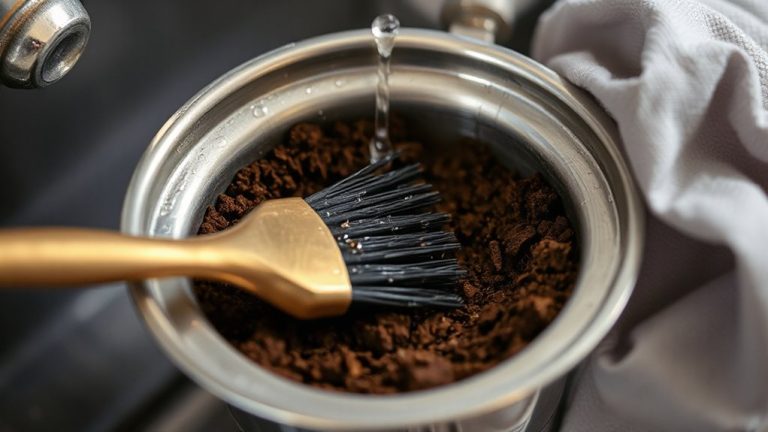
Even though your grinder’s setting number might seem like a reliable guide, it doesn’t account for differences between grinders, beans, or environmental conditions. Two grinders on the same setting can produce vastly different particle sizes. As your grinder ages, wear on the burrs reduces precision, leading to inconsistent grinds and poor extraction. Older models, like a five-year-old entry-level Mazzer, often struggle with uniformity even at mid-settings. Static buildup worsens this issue, especially in dry climates or during winter, causing fines to clump or stick to the grinder’s chute-wasting coffee and skewing dose accuracy. You might think you’re dialing in correctly, but unseen variables sabotage results. To maintain control, clean your grinder monthly, use a anti-static device if needed, and recalibrate your baseline settings every few months. Relying solely on the numbered dial ignores real-world changes. True consistency means adjusting beyond the number. For those seeking reliable performance without breaking the bank, the best espresso grinders under $500 offer a balance of build quality and grind uniformity essential for precision brewing.
How Micron Analysis Measures True Grind Fineness
A few microns can make or break your espresso shot, and that’s where micron analysis comes in. It measures actual particle size, going beyond grinder settings to reveal true fineness. You’re not just grinding coffee-you’re building a uniform bed for water to penetrate. Micron analysis quantifies grinding consistency, showing how spread out your particles are. A narrow distribution means better extraction control. Wide spreads? Expect uneven results, even with the same timer or dose.
| Particle Size (µm) | Emotion It Triggers |
|---|---|
| 100–200 | Frustration – too fine, bitter |
| 300–400 | Satisfaction – balanced, sweet |
| 500–600 | Disappointment – weak, sour |
| 700+ | Confusion – under-extracted, thin |
Tools like lasers or sieves give you hard data, not guesses. That precision helps dial in grinders like the Ditting or Eureka, where small adjustments matter. Best coffee grinders deliver both consistency and precision, making them essential for serious espresso preparation.
How Uneven Grind Particles Break Espresso Extraction
Think of your coffee bed like a city’s infrastructure-when the roads are uneven, traffic jams happen, and in espresso, that traffic jam is channeling. If your grinder produces inconsistent particles, you’re setting yourself up for failure. Larger chunks extract too slowly, while fines overload and clog. This unevenness leads to particle segregation, where fine and coarse grounds separate during dosing and tamping, creating weak spots. Water follows the path of least resistance, rushing through coarse zones and ignoring denser areas. That’s where channel formation begins-uneven flow undermines even extraction. You’ll taste it: sour, sharp, or burnt in spots. Even tamp technique can’t fix this. A broad grind spread destabilizes the entire shot. Your machine’s pressure, puck prep, and dose matter, but none can compensate for poor particle consistency. Choose gear that minimizes spread-your espresso depends on uniformity, not just average fineness. Investing in one of the best espresso grinders can significantly improve particle consistency and overall shot quality.
How Different Grinders Perform at the Micron Level
Your grinder’s consistency directly determines how evenly those particles extract, and not all grinders deliver the same results at the micron level. Entry-level models, like the Baratza Encore, produce more fines and boulders compared to high-end options such as the Compak K3 or My Asar. These premium grinders maintain tighter particle distribution, essential for balanced espresso. Grinder age plays a bigger role than many realize-older units lose precision over time. That’s largely due to burr wear, which dulls edges and creates inconsistent grind sizes. Even after two years of heavy use, noticeable degradation can occur, especially with softer steel burrs. Flat burrs typically outperform conical ones in consistency at fine settings, but both suffer as burr wear progresses. If you’re pulling shots daily, checking your grinder’s output every six months helps spot trends. Rebuilding or replacing worn parts isn’t just maintenance-it’s essential for quality.
Use Micron Data to Improve Your Espresso
How do you know if your grind is actually right for espresso? Micron data gives you a clear answer by revealing the true fineness and spread of your particles. Most espresso requires a median particle size between 100–200 microns, but consistent results depend on particle consistency and low fineness variance. High variance means some particles are too fine (causing over-extraction) while others are too coarse (leading to under-extraction). Dialing in isn’t just about taste-it’s about measuring and adjusting.
| Grinder Type | Avg. Microns | Fineness Variance |
|---|---|---|
| Flat Burr (Entry) | 120 | High |
| Flat Burr (High-End) | 115 | Medium |
| Conical Burr | 130 | Medium-High |
| Manual (Premium) | 110 | Low |
Use this data to choose grinders that improve particle consistency and reduce variance for better shots.
On a final note
Your grinder’s setting number doesn’t reveal actual particle size, which directly affects espresso quality. Micron analysis shows true fineness and grind consistency, helping you spot issues invisible to the eye. Even high-end grinders like the EK43 or Mythos produce different results at the same setting. Use micron data to fine-tune your grind, improve extraction, and get better shots. It’s not about gear-it’s about precision.