Burr Grinder Selection Criteria Based on Desired Final Grind Size Accuracy
Pick a burr grinder that matches your brew method-espresso needs fine, consistent grinds, while French press uses coarse. Flat burrs, like on the EK43, offer top uniformity; conical burrs, like in the Baratza Encore, are quieter and cooler. For precision, stepless grinders like the Niche Zero let you fine-tune. Low retention (under 0.5g) saves beans and keeps doses accurate. Slow, high-torque motors reduce heat, preserving flavor. You’ll see how small changes impact results.
Notable Insights
- Choose flat burr grinders for superior grind size uniformity, especially critical for espresso precision.
- Opt for stepless adjustment grinders to fine-tune final grind size with maximum accuracy.
- Select low-retention grinders to minimize stale residue and improve dosing consistency.
- Prioritize conical or flat burrs with tight tolerances to reduce particle size variation.
- Use slower, low-heat motors to preserve bean integrity and maintain consistent grind quality.
Choose the Right Grind Size for Your Brew Method
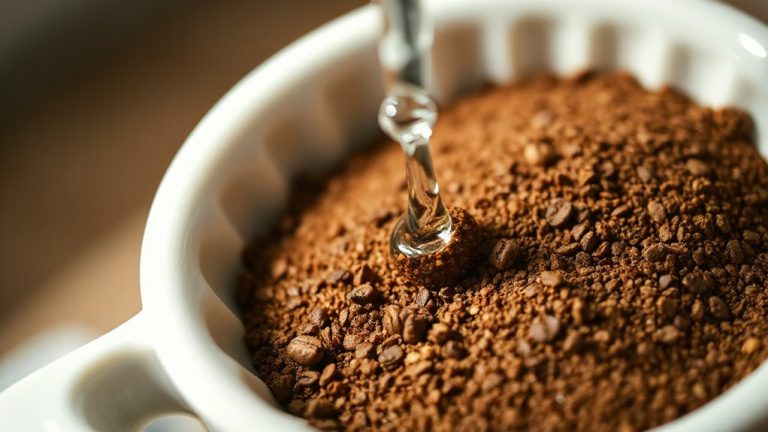
Grind size matters-get it wrong and even great beans won’t save your cup. You need to match the grind to your brew method, or extraction suffers. Too fine for a pour-over? Bitter and overextracted. Too coarse for espresso? Weak and watery. Every brew method demands a specific range: espresso needs fine, French press needs coarse, and everything else fits in between. A quality burr grinder gives you control, but more importantly, it guarantees a consistent particle distribution. That means most grounds are the same size, so they extract evenly. Inconsistent grinds lead to some particles over-brewing while others under-extract. If you use a blade grinder, you’ll struggle here-uneven distribution ruins balance. For Aeropress, try medium-fine; for Chemex, go coarse-medium. Adjust slightly based on taste. Your perfect cup starts with matching grind size to your brew method and holding particle distribution steady. For French press brewing, using the correct coarse grind size ensures optimal flavor without excessive sediment.
Flat vs. Conical Burrs: Which Delivers Better Consistency?
You’ve matched your grind size to your brew method-now it’s time to contemplate what’s actually doing the grinding. Flat burrs typically deliver superior grind uniformity because their parallel plates allow for precise burr alignment, producing consistent particle size. They’re often found in high-end grinders like the EK43 and excel in espresso where consistency matters most. Conical burrs, like those in the Baratza Virtuoso+, tend to generate less heat and noise, making them great for home use, especially with medium to coarse settings. While generally less uniform than flat burrs, modern conical designs have narrowed the gap. Your pick depends on brew style and priorities. If grind uniformity is critical-like for espresso-flat burrs often win. For versatility and quieter operation, conical is a solid everyday choice. A key factor in achieving optimal flavor is selecting the right grinder based on your brewing needs, and top coffee and espresso grinders can vary significantly in performance and price.
Minimize Waste With a Low-Retention Burr Grinder
While high grind consistency matters for extraction, minimizing waste is just as important-especially if you brew single servings or tune recipes often. A low-retention grinder guarantees nearly every ground particle makes it into your portafilter or brewer, not trapped in grinder guts. High grind retention wastes coffee and skews freshness, especially with dense beans where static increases cling. Bean density affects how much sticks to burrs and chamber walls-denser beans like Ethiopians often create more retention. The table below shows retention differences across models:
| Grinder Model | Average Grind Retention (grams) |
|---|---|
| Baratza Encore | 0.9 |
| Timemore S3 | 0.5 |
| Wilfa Svart Precision | 0.4 |
| Eureka Mignon Zero | 0.2 |
| 1ZPresso JX-Pro | 0.3 |
Lower retention saves beans and improves shot reproducibility. For those seeking top performance, expert picks for the best espresso grinders highlight models that balance low retention with grind precision.
Step vs. Stepless: Pick Your Grind Size Control
How much control do you really need over your grind size? If you stick to one brew method and rarely tweak, a step grinder like the Baratza Encore offers solid grind precision and reliable calibration stability. It’s simple, affordable, and repeatable-just dial in once and go. But if you experiment across espresso, pour over, or AeroPress, a stepless grinder gives you infinite adjustment. Models like the Niche Zero or Eureka Magnifico S let you fine-tune for exact results, which is key for dialing in quickly. Stepless grinders often have better long-term calibration stability since there are no predefined clicks to wear down. You’ll pay more, but the control is unmatched. Your choice depends on how often you adjust and how critical grind precision is to your coffee. Don’t overbuy if you don’t need it-match the control type to your routine.
Avoid Heat Buildup: Why Motor Speed Matters
Grind consistency isn’t the only factor that shapes your coffee’s flavor-heat plays a role too, especially when it builds up during grinding. You want a grinder that minimizes heat transfer to the beans, because excess warmth can degrade volatile compounds and dull your cup. That’s where motor speed comes in: slower motors generate less friction heat, preserving flavor integrity. High-speed motors may grind faster, but they often sacrifice thermal management, leading to inconsistent results. Look for grinders with motor efficiency built in-like gear-reduction systems in models such as the Baratza Virtuoso+ or 1Zpresso J-Max. These maintain lower RPMs without sacrificing grind quality. Effective thermal management isn’t just about the motor; it includes burr design and housing ventilation. If you grind daily or in volume, low-speed, high-torque motors reduce heat buildup over time. Choosing smart motor speed means fresher, more accurate grinds-cup after cup.
On a final note
Pick a burr grinder that matches your brew method’s grind size needs. Conical burrs often give finer, more even results than flat ones, especially for espresso. If you waste grounds, choose a low-retention model like the Niche Zero. For precise control, go stepless-models like the Eureka Moment allow tiny tweaks. Step grinders, like the Baratza Encore, work fine for general use. Always pick slower motors-they reduce heat, preserving flavor. Match the grinder to your routine, and you’ll get better, more consistent coffee every time.