How to Adjust Brew Ratios for Siphon and Vacuum Brewing
Use a 1:15 coffee-to-water ratio as a starting point for siphon brewing, adjusting based on bean type and flavor goals. Lighter beans like Ethiopian Yirgacheffe may do better at 1:16 for brightness, while denser Sumatran beans can handle 1:14 for richer body. Always weigh your doses, use a medium-fine grind, and keep water between 195–205°F. Fine-tune grind size before changing ratios to fix sour or bitter notes. Control heat carefully for consistent brew times of 1:15 to 1:20. More precise adjustments depend on your equipment and taste preferences.
Notable Insights
- Use a 1:15 coffee-to-water ratio as a starting point for balanced siphon brewing extraction.
- Adjust to 1:14 for denser beans like Sumatran to enhance body and richness.
- Lighter, fruity coffees such as Ethiopian Yirgacheffe may perform better at 1:16 to highlight brightness.
- Always weigh coffee and water for accuracy-volume measurements lack precision in siphon systems.
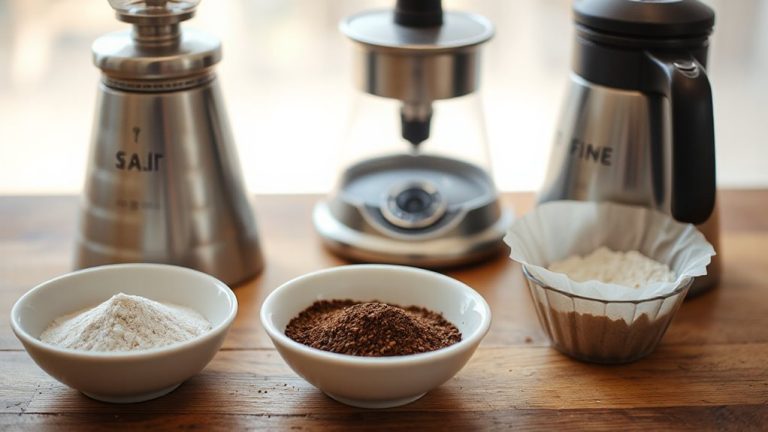
- Fine-tune grind size before adjusting ratio; medium-fine, like table salt, optimizes extraction.
Why Siphon Brewing Needs Special Ratios
While most brewing methods rely on a straightforward coffee-to-water ratio, siphon brewing operates under unique physics that demand more precise adjustments. You’re dealing with vacuum pressure and vapor-driven water displacement, which directly affect brew dynamics. The equipment design-typically a two-chamber glass system with a filter between-creates a longer contact time and more controlled temperature than pour-over or French press. That means small ratio changes have amplified effects on extraction. Unlike simpler brewers, where you can wing it with 1:16, siphon pots like the Hario or Yama need tighter control to avoid over- or under-extraction. The narrow tube and sealed environment alter flow and saturation, so your grind and ratio must align closely with the method’s demands. Adjusting isn’t optional-it’s essential to match the brew dynamics built into the equipment design. For best results, consider starting with recommended siphon coffee makers that balance design precision with user control.
Best Coffee-to-Water Ratios for Siphon Brewing
You’ve seen how siphon brewing’s vacuum-driven process changes the game-now it’s time to get into the numbers that make it work. A good starting ratio is 1:15-1 gram of coffee to 15 grams of water. For a standard 500ml serving size, that’s about 33 grams of coffee. This gives you a balanced cup without over-extracting. If your coffee origin is bright and fruity, like a Ethiopian Yirgacheffe, you might prefer 1:16 for a lighter profile. For denser beans, such as a Sumatran, 1:14 can boost body and intensity. Always weigh your doses-volume measures aren’t accurate enough. Adjust slightly based on taste, but keep notes so you can repeat what works. These ratios work well for most siphon setups, including the Hario or Yama models. Consistency here means better control, especially when comparing origins or fine-tuning your brew.
How Grind Size Impacts Your Siphon Ratio
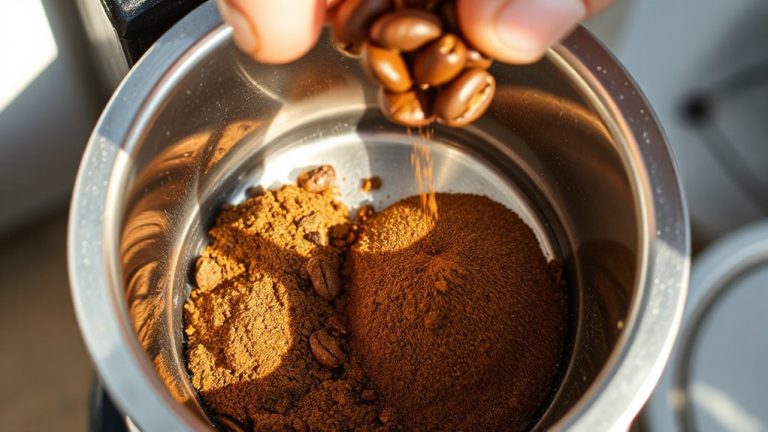
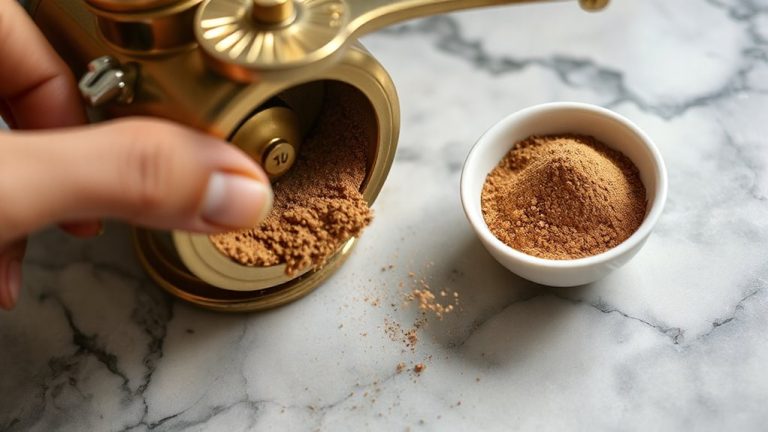
Grind size plays a crucial role in how your coffee extracts during siphon brewing, directly influencing which brew ratio works best. If your grind is too fine, over-extraction can occur, making coffee bitter even with a lower coffee-to-water ratio. A coarse grind may under-extract, requiring a higher ratio to compensate for weak flavor. For siphon brewing, a medium-fine grind-similar to table salt-works well for most standard 1:15 ratios. Consistent grind consistency guarantees even extraction, while poor particle distribution leads to uneven brewing and off-flavors. Blade grinders often create erratic particle distribution, so a burr grinder is preferred. If you notice sour or bitter notes, adjust your grind before changing the ratio. Small tweaks in grind size can have a bigger impact than ratio changes, so prioritize grind consistency when dialing in your siphon brew. A high-quality burr grinder ensures uniform particle size for optimal siphon brewing results.
Adjust Ratios for Brew Time and Temperature
Now that you’ve dialed in your grind size for even extraction, it’s time to contemplate how brew time and temperature affect your ideal siphon ratio. Brew time and temperature directly influence heat transfer during brewing, altering extraction efficiency. If your water’s too hot-above 205°F-you risk over-extracting bitter compounds, especially with a longer brew time. Cooler temps, around 195°F, slow heat transfer and may require a slightly finer grind or longer brew window. Water pressure in siphon brewing is stable, so you can rely on consistent upward flow, but timing your heat application matters. Aim for 1:15 to 1:20 brew time from when water rises. Adjusting your heat source-like lowering the flame on a butane burner-helps control temperature precisely. These variables shape how your coffee dissolves solubles, so tweak temp or time before altering your ratio. Small changes make measurable differences.
Balance Flavor and Body With Ratio Tweaks
A well-chosen brew ratio can make the difference between a thin, sour cup and one with balanced body and flavor. You control both flavor clarity and body intensity by adjusting coffee-to-water ratios. For more flavor clarity, try a lighter ratio like 1:16-this highlights delicate notes but may reduce body. If you prefer heavier body intensity, go richer with 1:13 or even 1:12, which pulls out more oils and heavier compounds. Siphon brewing’s clean extraction makes it ideal for tweaking ratios without losing balance. Just remember: higher concentration increases body but can mask subtle flavors. Start at 1:15, then adjust in small steps based on your bean and taste. Use a scale, keep notes, and change only one variable at a time. With siphon, precision gives you control-use it to match the intensity and clarity your palate prefers.
Fix Common Siphon Brewing Ratio Mistakes
You’ve already seen how small ratio changes can fine-tune flavor and body to match your taste, but even precise adjustments won’t help if common mistakes are throwing off your brew from the start. One frequent error is inconsistent grind size, which leads to uneven flavor extraction-some particles over-extract while others under-extract, muddying your cup. Always check your grinder settings and clean it regularly for consistency. Another issue is poor equipment calibration; if your siphon’s seal is weak or the filter isn’t seated right, pressure imbalances can alter brew time and water distribution. Even a well-calculated ratio fails if water doesn’t move smoothly between chambers. Also, neglecting to pre-heat both chambers can cause premature condensation, shortening contact time. These small flaws add up, distorting your intended ratio. Fix them first-then refine your ratios with confidence.
Use a Scale and Thermometer for Perfect Ratios
How do you guarantee your siphon brew hits the exact ratio every time? Use a digital scale and thermometer-they’re non-negotiable for accuracy. Measuring coffee and water by weight assures consistency, while monitoring temperature prevents under- or over-extraction. Great water quality matters, too: use filtered water to avoid off-flavors and maintain pressure stability during brewing. Unstable heat sources disrupt vapor pressure, leading to uneven draws and poor flavor. For the most precise measurements, consider a scale with a high-precision sensor designed specifically for coffee brewing.
| Tool | Purpose | Example |
|---|---|---|
| Digital Scale | Measure coffee and water precisely | Hario V60 Drip Scale |
| Thermometer | Monitor brew temp (ideal: 195–205°F) | Thermapen Jr |
| Gooseneck Kettle | Control pouring and heat | Fellow Stagg EKG |
Pairing these tools with steady heat assures repeatable results, cup after cup.
On a final note
You’ll get the best siphon results by using a 1:15 coffee-to-water ratio as a starting point. Adjust slightly richer (1:14) for more body or weaker (1:16) for clarity. Always weigh your doses with a scale and monitor water temperature-ideally between 195°F and 205°F. Fine-tune grind size and timing to match your ratio, ensuring even extraction without over- or under-brewing.