How to Choose the Right Grind Size for Siphon and Vacuum Pot Brewing
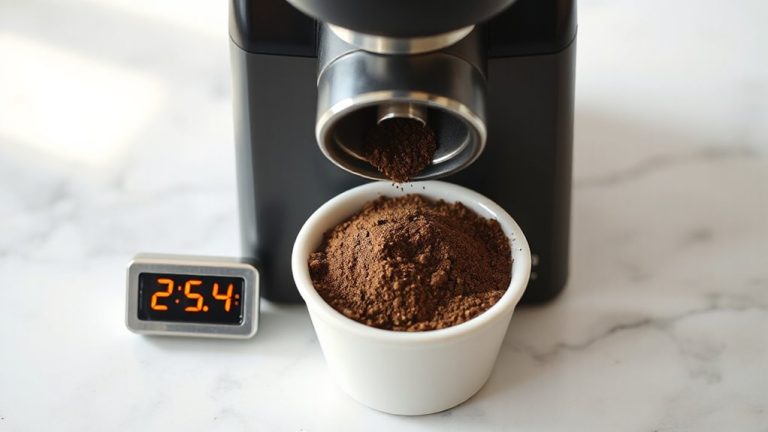
Use a medium-fine grind, like table salt, for siphon and vacuum pot brewing. It balances extraction time and clarity without clogging the filter. Light roasts need it slightly finer; dark roasts work better a touch coarser. Avoid blade grinders-use a burr grinder like a Baratza Sette for consistency. If coffee tastes bitter or drains slow, your grind’s too fine. If it’s weak or fast, it’s too coarse. Adjust in small steps, then taste and tweak-your ideal cup is just a few changes away.
Notable Insights
- Use a medium-fine grind, similar to table salt, for optimal extraction in siphon brewing.
- Adjust grind size based on roast: finer for dense light roasts, slightly coarser for porous dark roasts.
- Avoid overly fine grinds to prevent clogged filters and over-extraction, which causes bitterness.
- Ensure grind uniformity with a high-quality burr grinder to achieve balanced, consistent results.
- Monitor brew time (1:45–2:30 minutes); adjust grind coarser if too slow, finer if too fast.
How Siphon Coffee Brewers Work (And Why Grind Matters)
Heat, vapor pressure, and timing-the three forces behind every siphon brew. You see, when you apply heat to water in the lower chamber, vapor pressure builds and pushes water up into the upper chamber where it mixes with coffee. Once heat stops, the vapor cools, creating a vacuum that pulls the brewed coffee back down through a filter. The design relies on precise physics, and grind size directly impacts flow and extraction. The invention dates back to the 1830s, with a long evolution shaped by German and Japanese engineering. Though the history is rich, function matters most today. Modern models like the Hario Syphon or Yama Tabletop reflect refined design for consistent heat and seal integrity. Understanding this process helps you control variables. A poor grind choice? It’ll clog or rush the drawdown. You need consistency-too fine risks over-extraction, too coarse lacks flavor. For those exploring options, checking out the best siphon coffee makers can guide you toward models that enhance precision and performance.
What Grind Size You Should Actually Use
The sweet spot for siphon brewing lies in a medium-fine grind-think table salt with a few finer particles mixed in. This size supports ideal brew time, typically between 1:45 and 2:30 minutes, ensuring thorough extraction without clogging the filter. Too fine, and your brew time drags, risking bitterness; too coarse, and it rushes through, yielding weak coffee with poor flavor balance. A quality burr grinder gives you the control you need-blade grinders often create uneven particles, which hurt consistency. Brands like Baratza Encore or Fellow Ode offer reliable performance for this method. With a medium-fine grind, the siphon extracts vibrant acidity and rich body in harmony, enhancing clarity and sweetness. Adjust slightly based on your beans and water temperature, but stick close to this range. It’s the most repeatable way to get balanced, clean cups every time-no guesswork needed. For consistent results, consider investing in one of the best mill grinders for precision grinding.
Why Light and Dark Roasts Need Different Grinds
While both light and dark roasts can work with a medium-fine grind, you’ll get better results by tweaking the setting based on roast level. Light roasts are denser-higher bean density means they resist water penetration, so you’ll need a finer grind to extract enough flavor. Think of beans like Ethiopia Yirgacheffe: hard and tight, needing more surface area exposed. Dark roasts are less dense and more porous due to longer roasting, so they extract faster. Go too fine, and you risk over-extraction, especially with older beans. Roast age matters, too: stale dark roasts lose gases and extract quicker, so a slightly coarser grind helps. Fresh light roasts? Stick finer. Adjusting by roast type and age gives better balance. It’s not just tradition-it’s physics and timing. Match your grind to the bean’s structure and freshness for cleaner, sweeter cups.
Signs Your Grind Is Too Fine (And How to Fix It)
If your coffee tastes bitter or overly astringent, that’s a strong sign your grind is too fine for siphon or vacuum pot brewing-these methods rely on precise water contact time, and too much surface area from an over-ground coffee slows drainage and increases extraction. You’ll likely notice bitter overtones that linger unpleasantly, a sign the coffee has been over-extracted. A clogged filter is another red flag; if the coffee sludge blocks the cloth or glass filter, the brew can’t flow properly, leading to uneven results or even overflow risks. This often happens when using grinders set too finely, like those meant for espresso. To fix it, adjust your grinder to a medium-fine setting-similar to table salt. This allows proper flow and balanced extraction. Always check that the filter is clean and unobstructed before brewing to avoid pressure issues.
Signs Your Grind Is Too Coarse (And How to Fix It)
Weak, sour brew could be your first clue-when the grind’s too coarse, water rushes through too fast, pulling out bright, underdeveloped flavors instead of balanced richness. That sharp acidity without body signals weak extraction, where not enough desirable compounds dissolve. You won’t get a bitter taste here-that’s from over-extraction or dark roasts-so don’t mistake sourness for strength. Instead, your coffee just tastes thin and lifeless. To fix it, adjust your grinder one step finer; even a small change can slow water flow enough to improve extraction. Siphon and vacuum pot brewing needs a medium-fine to medium grind, like table salt, for ideal contact time. Too coarse, and you’ll miss the sweetness and depth these brewers can deliver. Always tweak gradually, brew, then taste. Consistent results come from small corrections, not guesses.
Use the Right Grinder and Calibrate for Consistency
Grind consistency is the real key to pulling off a great siphon or vacuum pot brew. You need even particles to guarantee uniform extraction, and that starts with a burr grinder-blade grinders won’t cut it. High-quality burr precision matters because it minimizes fines and boulders, giving you a cleaner, more flavorful cup. Look for grinders like the Baratza Sette or 1ZPresso models known for consistent output. But even the best grinder drifts over time, which is why calibration frequency is critical. You should recalibrate every few weeks, or after switching beans, to maintain accuracy. Skipping this step leads to inconsistent brews, no matter how precise your technique. Spend the few extra minutes adjusting your settings and checking output. It’s a small effort that pays off in stability and flavor reliability every time you brew. For a full overview of top-performing models and key features to consider, check out our best coffee grinders guide.
Dialing In: Taste, Adjust, Perfect Your Brew
How do you know when your brew’s really dialed in? You taste it. Start with a clean cupping spoon and sip-notice the brew balance first. Is it too sharp or flat? If sour, your grind’s probably too coarse; if bitter, it’s likely too fine. Adjust in small increments. A good siphon brew should have bright, distinct notes with clear flavor clarity-no muddiness. Try tweaking the grind before changing water temp or brew time. A quality burr grinder makes this easier; blade grinders won’t cut it. Aim for consistency so each adjustment means something. Retaste after every change. When acidity, sweetness, and body align, you’ve hit balance. That clean, layered taste? That’s flavor clarity. It means your grind size matches your coffee, roast, and method. Keep notes. Repeat. Perfect your process, not just one cup. It’s practical, not magic.
On a final note
You’ve got the basics: use a medium-fine grind, like table salt, for most siphon brewing. Light roasts may need it slightly finer; dark roasts, a touch coarser. If your coffee tastes bitter or slow-draining, go coarser. If it’s weak or fast-brewing, go finer. Use a burr grinder-like the Baratza Encore-for consistency. Calibrate each batch, taste objectively, and adjust. Precision beats guesswork every time.