How to Use a Timer to Standardize Grind Duration and Improve Consistency
Use a timer to lock in consistent grind duration, which helps achieve uniform particle size and even espresso extraction. Pick a precise timer like the Acaia Lunar or use your grinder’s built-in function to avoid phone lag. Start with an 18g dose and 20-second grind, then adjust in small steps based on taste. Once dialed in, set your grind time-say 18 seconds-for repeatable results. You’ll minimize error and improve shot consistency every time. More details follow on fine-tuning the process.
Notable Insights
- Use a precise timer to ensure consistent grind duration, which promotes uniform particle size for even extraction.
- Choose a high-accuracy hardware timer like Acaia Lunar or Baratza Sette, avoiding lag-prone phone apps.
- Establish a baseline grind time using a fixed dose, bean type, and environment for reliable starting reference.
- Adjust grind size incrementally to fine-tune extraction, maintaining consistent grind duration for repeatability.
- Employ timed dosing on compatible grinders to automate dose delivery and reduce human error in shot preparation.
Why Consistent Grind Time Improves Espresso
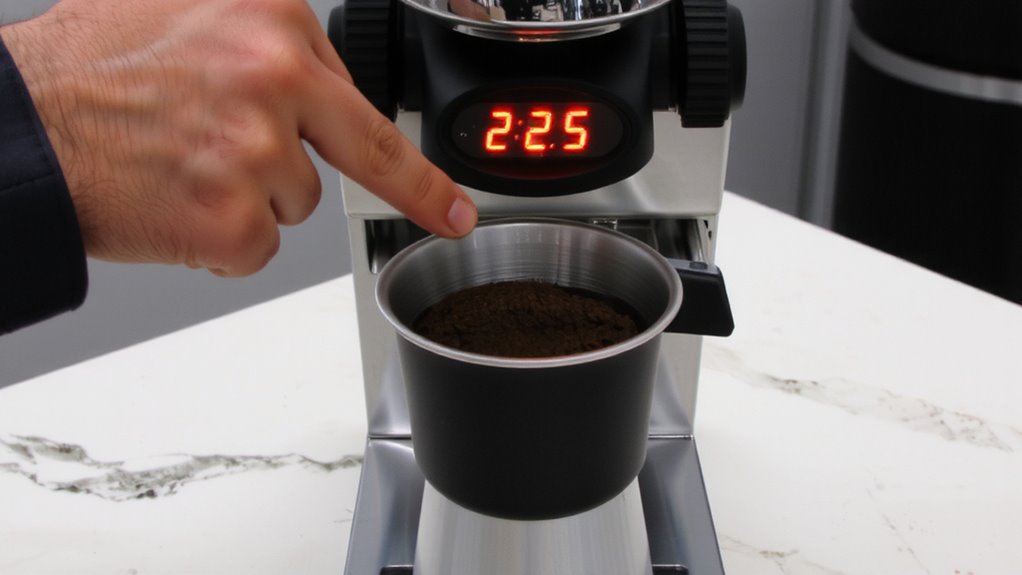
While it might seem minor, keeping your grind time consistent can make a noticeable difference in espresso quality. When you grind for the same duration each time, you get more uniform particle size, which directly affects shot quality. Inconsistent grind times lead to uneven extraction-some particles are too fine, others too coarse-skewing flavor balance. With steady grind times, the water flows evenly through the puck, pulling out flavors more predictably. That means sweeter notes, less bitterness, and better shot quality overall. Machines like the Mazzer Mini or Eureka Mignon rely on timer settings, so repeating the same grind time guarantees batch-to-batch reliability. You’re not chasing flavor balance blindly; you’re building a repeatable process. While grind time isn’t the only variable, it’s one you can control easily. Adjusting your dose or tamp won’t fix a wildly inconsistent grind. Stay consistent here first, and the rest becomes easier to manage. For those looking to optimize their setup, choosing one of the best coffee brewing timers can further enhance precision and control.
Pick a Timer for Your Grinder Setup
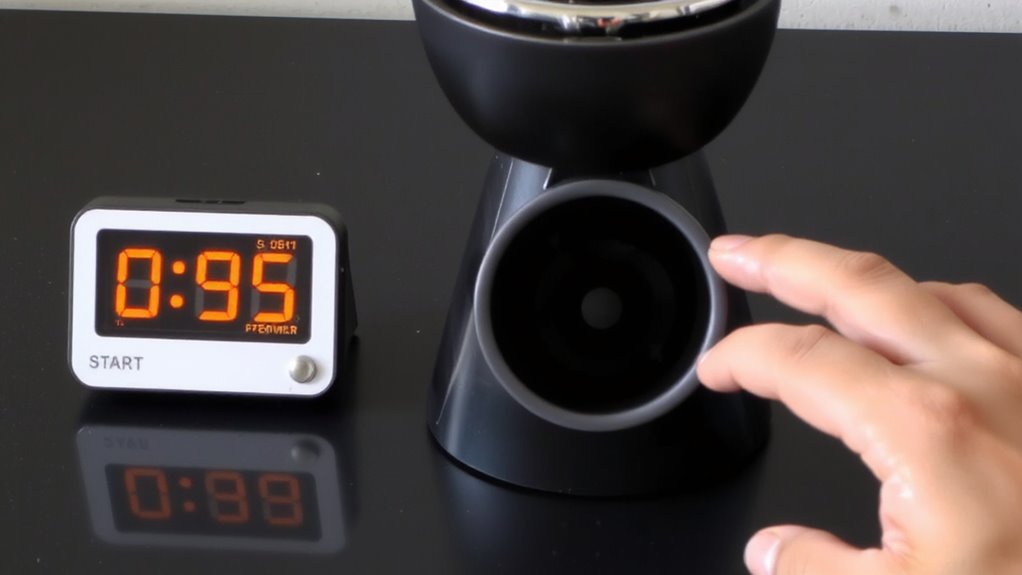
How do you make sure your grinder delivers the same results every time? Start by picking a timer that fits your setup. Timer accuracy is key-look for models that trigger within 0.1 seconds of activation, like the Acaia Lunar or Baratza Sette timer. Even small delays can affect dose and extraction. Don’t just buy any timer; check brand compatibility. Some grinders, like certain Niche or Eureka models, work best with specific add-ons or built-in timer boards. Aftermarket timers may need adapters or firmware updates. If you’re using a smart grinder, use its native timer function where possible-integration reduces errors. Avoid phone apps for timing; they often have lag. Instead, go for dedicated hardware. Matching your timer to your grinder guarantees better repeatability. It’s not just about seconds-it’s about consistency you can rely on, shot after shot. For precision grinding, consider upgrading to one of the best mill grinders recommended for consistency and dose control.
Find Your Baseline Grind Time
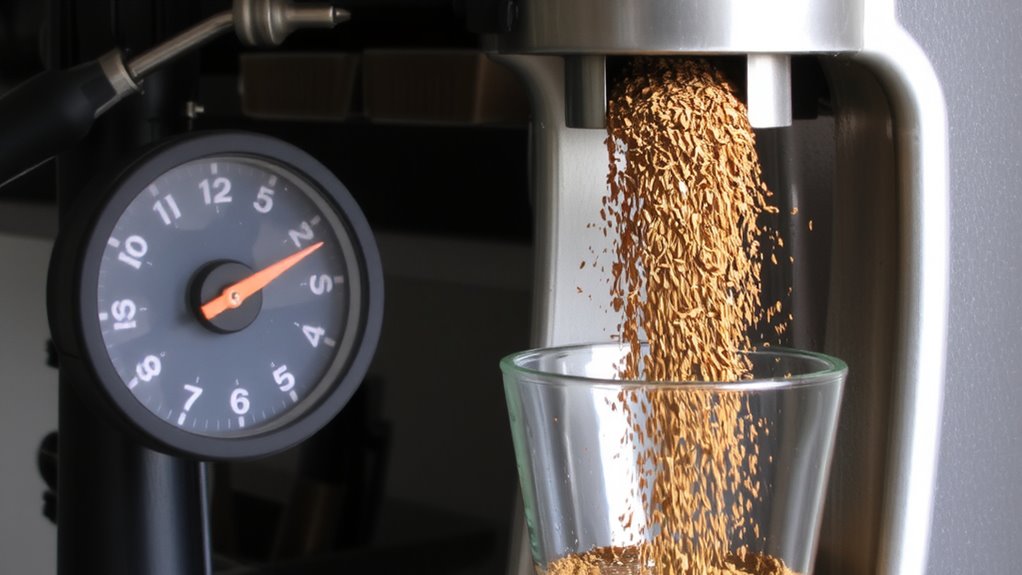
What’s the right grind time for your coffee? Start with a consistent dose-like 18g-and grind for 20 seconds as a baseline. Use the same beans, grinder, and environment to limit variables. Bean temperature effects can shift results, so store beans properly and let them settle to room temperature before grinding. Freshness matters too-conduct a grind age comparison by testing the same dose from 1-day-old and 7-day-old beans. Note how output and texture differ.
| Variable | Tip |
|---|---|
| Grind Time | Start at 20 sec for 18g dose |
| Bean Temp | Use room-temp beans to reduce static |
| Grind Age | Compare outputs over 1–7 days |
| Environment | Control humidity and dose accuracy |
Repeat the test three times, then average the results. This builds your true starting point.
Adjust Grind Size to Dial In Timing
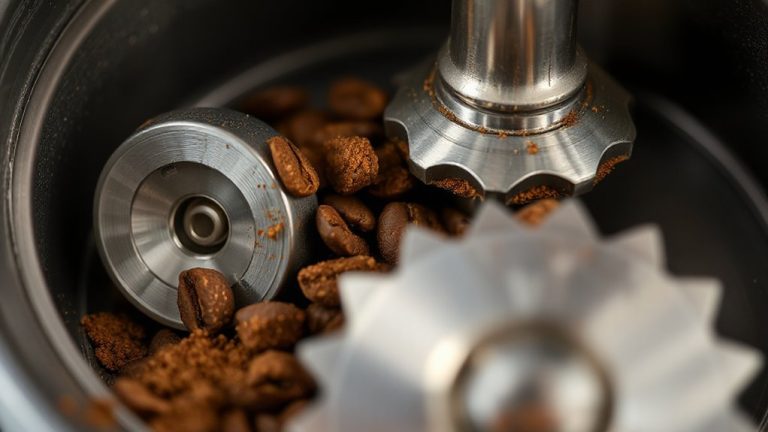
Timing’s just one part of the equation-grind size is where you’ll make precise adjustments to nail your shot. If your timer shows extraction is too fast, your grind’s likely too coarse; if too slow, it’s too fine. Small tweaks matter: turning your grinder’s dial one notch can shift timing by several seconds. Grind calibration isn’t a one-time fix-it’s ongoing, especially as beans age or humidity shifts. Consistency starts with particle uniformity. Blade grinders create uneven chunks and fines, messing with flow. Burr grinders, especially flat or conical types, deliver more uniform particles, leading to even extraction. Adjust in small increments and retime after each change. Wait at least 30 seconds between grinds to avoid heat build-up skewing results. With a stable dose and consistent machine pressure, grind size becomes your most powerful tool. Get it right, and your shots will be balanced, sweet, and repeatable. For those seeking precision, a high-quality manual espresso grinder can greatly enhance control over grind size and uniformity.
Use Timed Dosing for Shot Consistency
Why do so many baristas swear by timed dosing? Because it gives you reliable shot timing and better dose precision-two keys to consistent espresso. When you use a timer to control grind duration, you standardize how much coffee flows into the portafilter, shot after shot. This method works especially well with doserless grinders like the Eureka Mignon or Mazzer Mini, where you tweak the timer instead of adjusting a doser. You set the grind size first, then lock in motor run time to get your target dose-say, 18 seconds for 18 grams. It’s faster than weighing every dose and cuts variability. Sure, bean density and humidity still matter, but timed dosing reduces human error. For most cafes and serious home baristas, it’s the quickest path to repeatable shots without constant scale checks. You gain control without slowing down service.
Fix Common Grind Time Issues
You’ve got your timer set and your shots are landing close to target, but inconsistencies still pop up-maybe your dose drifts over time or your grind feels off despite the same settings. That’s often a sign your grinder needs attention. Poor burr alignment can create uneven particle size, leading to erratic extraction even with consistent grind times. You might notice more fines or boulders, which screw up your flow and flavor. Check your burrs for wear or misalignment, especially if you’re using a flat-burr grinder like a Niche Zero or Eureka Preciso. Realigning or replacing them can make a big difference. Also, revisit grinder calibration-some models, like the Fellow Ode, allow micro-adjustments that restore timing accuracy. Recalibrate whenever you change beans or after heavy use. These steps keep your timed doses reliable and your espresso steady.
On a final note
You’ll get more consistent shots by timing your grind. Use a simple timer or one built into grinders like the Dosing Aid Pro or Niche Zero. Start with a baseline-say, 25 seconds-and adjust grind size until your shot hits 18–20g in 25–30 seconds. Timed dosing cuts waste and boosts repeatability. If shots stall or rush, tweak grind texture, not time. It’s faster than weighing every dose and works well for daily precision.