Extraction Yield Formula: Validate Grind Size (18-22% TDS)
You need a refractometer, precise scale, and timer to measure extraction yield and check if your grind size is right. Brew normally, stir the coffee, then test a filtered sample to get TDS. Use the formula: (TDS × brewed mass) ÷ coffee dose. A result below 18% means your grind’s too coarse; above 22% means it’s too fine. Adjust in small steps-10 microns can make a difference. Keep water and time consistent, and you’ll balance flavor fast. More insights follow on fine-tuning each variable.
Notable Insights
- Use a refractometer to measure TDS and calculate extraction yield with the formula: (TDS × brewed coffee mass) ÷ dry coffee mass.
- Ensure accurate measurements using a 0.01g-precision scale, timer, and filtered water for consistent brewing conditions.
- Adjust grind size finer if extraction yield is below 18% to increase solubles extraction.
- Adjust grind size coarser if extraction yield exceeds 22% to reduce overextraction and bitterness.
- Make small, incremental grind changes while keeping brew time, temperature, and agitation constant for reliable results.
Why Extraction Yield Matters for Better Coffee
Brewing great coffee isn’t just about the beans or the machine-it’s about how much flavor you pull from the grounds, and that’s where extraction yield comes in. It tells you how much of the coffee’s soluble material ended up in your cup, directly affecting flavor balance and brew consistency. Too low, and your coffee tastes sour or weak; too high, and it turns bitter or harsh. You want to hit that sweet spot-typically between 18% and 22%-where sweetness, acidity, and body come together cleanly. Getting there consistently means understanding how grind size impacts extraction. If your grind’s too coarse, you under-extract; too fine, and you over-extract. Dialing it in helps you maintain control across batches, especially when switching beans or brew methods. It’s not magic-it’s measurable, repeatable, and essential for anyone serious about making better coffee day after day.
Tools You Need to Measure Extraction
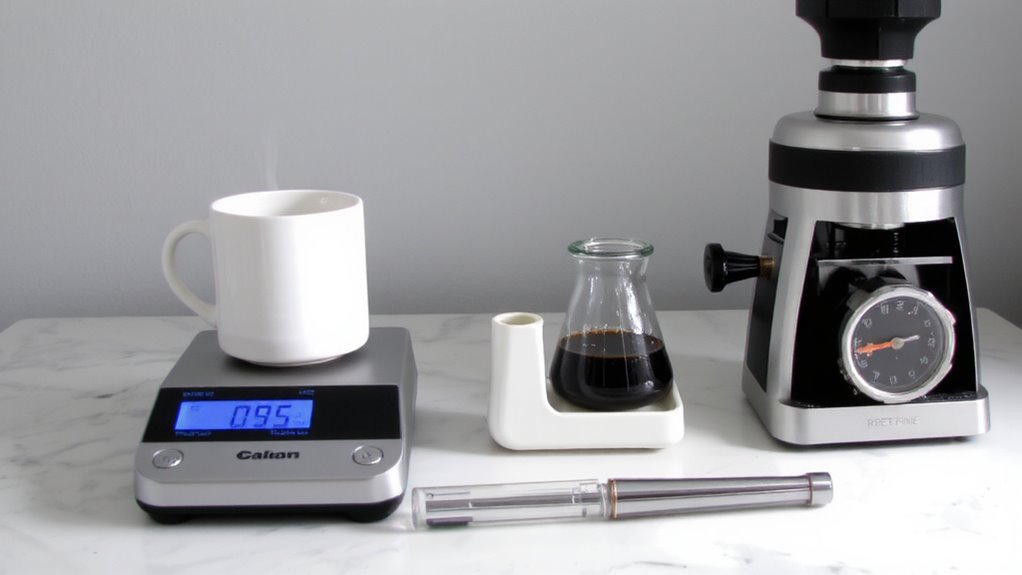
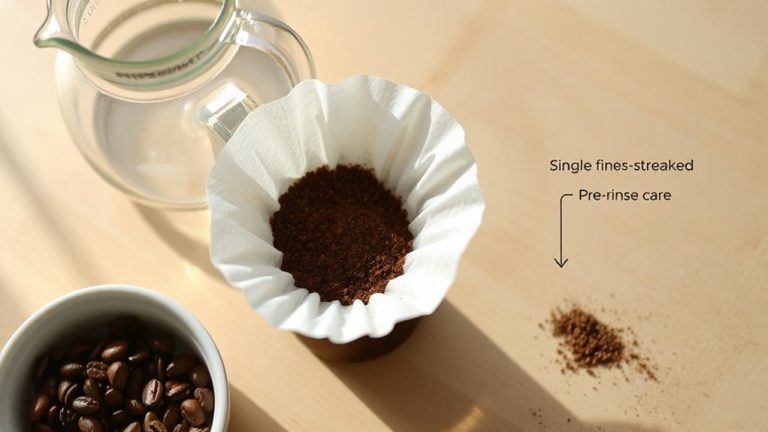
While you can’t see extraction yield with the naked eye, you can measure it accurately with the right tools and a bit of practice. The key tool is a refractometer, which measures dissolved coffee solids in your brew. Look for one designed for coffee, like the VST or Atago, since they offer better refractometer accuracy and temperature compensation. You’ll also need a digital scale (0.01g precision), a timer to track brewing time, and a fine-mesh syringe filter to remove grounds from your sample. Cheaper refractometers might save money but often lack the accuracy needed for reliable readings. Make sure your sample is clear and at room temperature before testing. Keep in mind that brewing time affects extraction, so record it for every brew. With consistent tools and technique, you’ll get repeatable data to fine-tune your grind size. For precise measurements, consider using one of the best coffee scales for consistent brewing results, such as those highlighted in reviews of top precision brewing scales.
Calculate Your Extraction Yield in 3 Steps
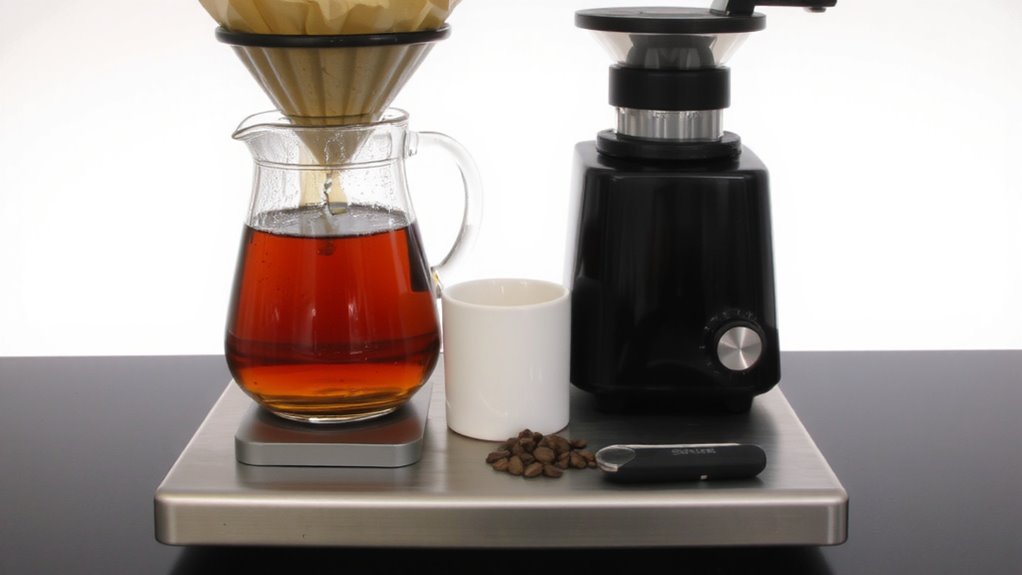
You’ve got your refractometer, scale, and filter ready-now it’s time to put them to work. First, brew your coffee as usual, noting your brew temperature and water quality, since both directly impact extraction. Use filtered water with balanced minerals for consistent results. Second, stir your brewed coffee well, then place a few drops on the refractometer to get your TDS (total dissolved solids) reading-this shows strength, not yield. Third, plug numbers into the yield formula: (TDS × brewed coffee mass) ÷ dry coffee mass. That gives your extraction yield percentage. Aim for 18–22% for most methods. If your yield’s off, don’t tweak brew time or temperature yet-adjust grind size first. Your water quality and stable brew temperature guarantee the readings truly reflect your grind’s effect.
Fix Weak or Bitter Coffee Using Your Yield Number
If your coffee tastes weak or bitter, your extraction yield number can tell you exactly what’s wrong and how to fix it. A low yield-below 18%-means underextraction symptoms like sourness or lack of sweetness, usually from grind size being too coarse or brew time too short. You’re not pulling enough compounds from the grounds. On the flip side, a yield above 22% points to overextraction causes: bitter flavors, astringency, and dryness. This happens when the grind is too fine or agitation is excessive, pulling out too many harsh compounds. The sweet spot sits between 18–22%, where balance occurs. Use your measured yield to diagnose flavor issues fast. If it’s low, your coffee lacks development; if high, it’s overdeveloped. Yield numbers remove guesswork, giving you proof of what’s happening in the cup. That clarity lets you make precise changes-once you know the problem.
Adjust Grind Size Based on Your Extraction Results
Now that you know your extraction yield, it’s time to use that number to fine-tune your grind size. If your yield is below 18%, your coffee’s under-extracted-try a finer grind. If it’s above 22%, it’s over-extracted-go coarser. Small adjustments matter; even 10 microns can shift results. Always keep brew temperature stable, ideally between 195°F and 205°F, so you’re only testing grind changes. Consistent brew time and water quality help too. Grind consistency is just as important as size; uneven particles cause over- and under-extraction simultaneously. A quality burr grinder like the Baratza Encore or 1Zpresso Q2 delivers more uniform particles than blade grinders. After each change, re-measure your yield. Repeat until you hit 18–22%. This methodical approach removes guesswork and helps you dial in faster, especially with finicky beans or new equipment.
On a final note
You’ve got the tools and steps to measure extraction yield, so use them to fine-tune your grind. If your coffee tastes weak, your yield is likely too low-grind finer. If it’s bitter, you’re over-extracting-go coarser. A refractometer like the VST Coffee Lab III gives precise readings, but a basic scale and calculator work in a pinch. Test, adjust, retest. It’s not magic-it’s measurement.