The Impact of Grinder Motor Speed on Fines Production in Fine Grinds
Higher motor speeds tend to create more fines in fine grinds, especially during back-to-back use, as heat builds and beans fragment unevenly. Low-speed, high-torque motors-like those in the Niche Zero or Turin Speedster-grind cooler and more consistently, preserving bean structure. This reduces fines, improves puck stability, and supports even espresso extraction. If you’re chasing balanced shots with less bitterness, motor speed matters more than you might think-there’s a deeper layer to how it shapes your daily pull.
Notable Insights
- Higher motor speeds increase friction and heat, leading to greater fines production during fine grinding.
- Low-speed, high-torque motors maintain consistent grind speed, reducing particle fragmentation and fines.
- Dull or inconsistently spinning blades at high speeds tear beans, significantly increasing fine particles.
- Excess fines from high-speed grinding raise puck density and cause channeling during espresso extraction.
- Slower grinders with gear reduction preserve bean structure, yielding more uniform fine grinds with fewer fines.
How Motor Speed Affects Espresso Grind Quality
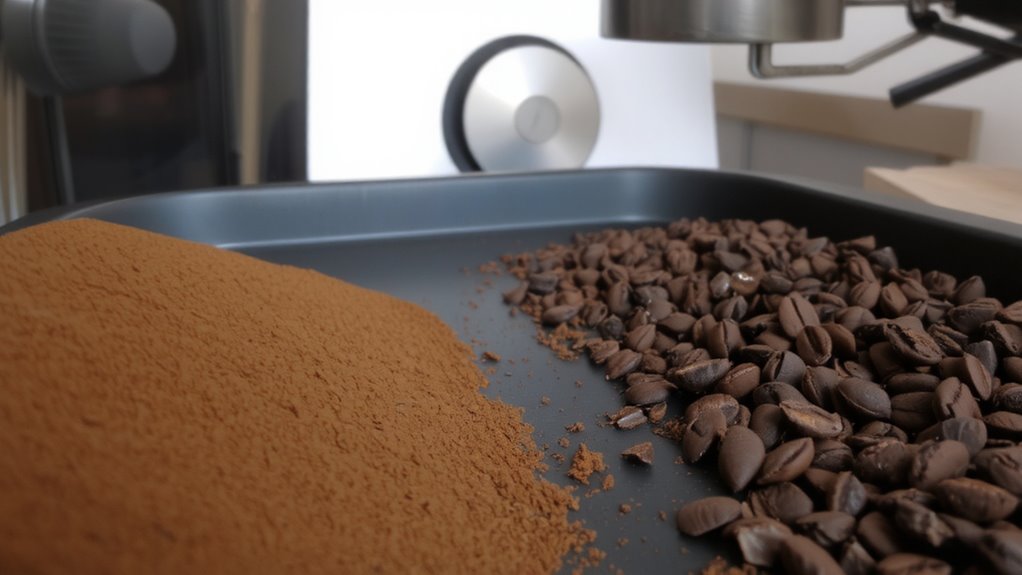
Why do some grinders produce more fines than others? Your grinder’s motor speed plays a big role. Higher speeds often mean more fines, but it’s not that simple. A motor with low torque can’t maintain consistent speed under load, causing uneven grinding and extra fines. You’ll see this in cheaper grinders-blades slow down when beans hit, creating inconsistent particles. Meanwhile, high torque motors, like those in the Eureka Ox or Baratza Forté, keep steady speeds, reducing erratic crushes. Blade sharpness matters just as much. Dull blades tear beans instead of slicing them, increasing fines. Even with perfect speed, worn blades ruin grind quality. That’s why maintenance is key. For espresso, you need both controlled speed and sharp, durable blades. A grinder like the Niche Zero offers adjustable speed and strong torque, giving you more control. Match it with regular blade checks, and you’ll get cleaner, more consistent shots. One of the best espresso grinders for balancing speed and grind consistency is the Baratza Forté.
Heat and Fines: The Cost of High-Speed Grinding
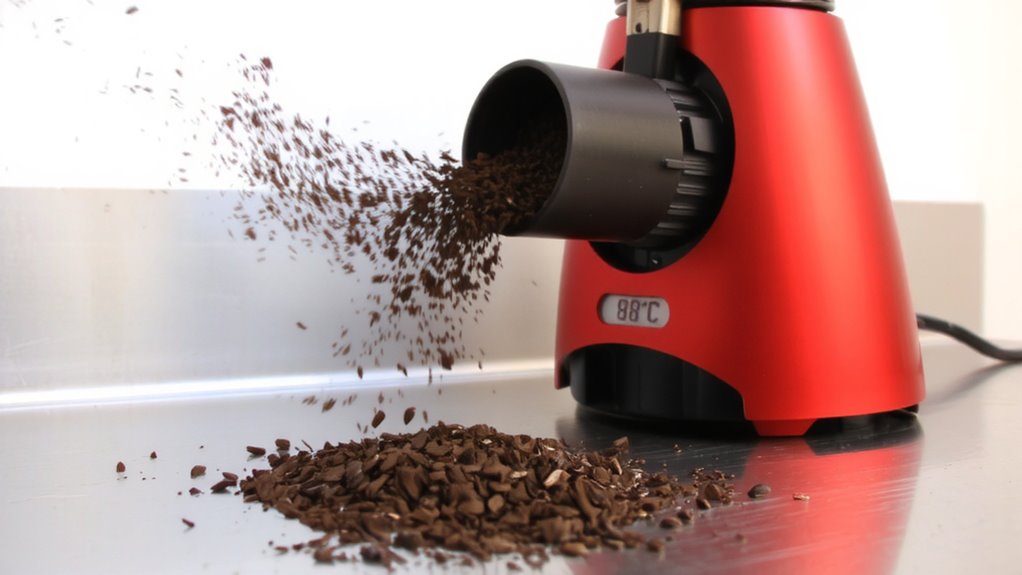
While high-speed motors can grind coffee quickly, they also generate more heat, and that heat comes at a cost. You risk thermal degradation, especially with prolonged grinding, which dulls flavor before brewing even starts. The extra heat softens coffee penalizes, making them more prone to particle fragmentation-this means more inconsistent fines even if the grind setting stays the same. Though fast grinders like the Eureka Atom 63 or Baratza Virtuoso+ are convenient, they’re more likely to overheat during back-to-back grinds. If you’re pulling espresso, that uncontrolled heat and excess fines hurt shot stability. Slower grinders with lower RPMs, such as the Niche Zero or DF64 with a DC motor, reduce both heat and unnecessary particle breakdown. You get cleaner, more predictable results. For daily espresso, minimizing thermal stress isn’t just ideal-it’s essential for accuracy and flavor control over time. According to expert reviews, choosing the right best mill grinders can significantly influence heat management and grind consistency.
How Fines Trigger Channeling and Bitterness
How do your espresso shots end up uneven and harsh, even when you’ve nailed the dose and tamp? It’s likely fines-tiny coffee particles created during grinding-are to blame. When you use high-speed grinders, excess fines clog parts of the puck, forcing water to find weaker paths, a flaw called channeling. This leads to uneven extraction: some parts over-extract, others under-extract. You taste that as bitterness, even if your tamping pressure was consistent. High fines also make the puck denser, increasing resistance. That forces water, especially at standard water temperature (around 93–96°C), to push harder through gaps, worsening channeling. You’re not fixing the root cause by adjusting tamping pressure alone-it might even make things worse by compacting fines further. The problem starts with particle inconsistency, not your technique. Control fines at the source-your grinder-so water flows evenly and extracts cleanly. Choosing a grinder with lower motor speed can significantly reduce heat and friction, preserving bean integrity and minimizing unwanted fines in the final grind.
Low-Speed Motors for Uniform Grind Particles
If you’re chasing a more balanced espresso shot, switching to a grinder with a low-speed motor might be worth considering. These motors reduce heat and friction during grinding, which helps preserve bean integrity and limits excessive fines. With gear reduction, the motor spins slower while maintaining power, leading to a more uniform particle size. That consistency improves extraction and minimizes channeling. Torque control plays a key role too-consistent force means fewer burs stalling or chipping grounds. Grinders like the Niche Zero or Turin Speedster use this setup effectively. While low-speed models often cost more and grind slower, the payoff is in shot stability and flavor clarity. They work especially well with light roasts or finicky beans where precision matters. Just don’t expect speed; these grinders prioritize control over output. For dedicated espresso users, the trade-off usually makes sense.
Optimize Speed for Your Espresso Variables
Since your grinder’s motor speed affects particle distribution, matching it to your roast profile and dose makes a real difference in shot performance. If you’re pulling shots from a light, dense roast, a higher motor torque helps maintain consistent speed under load, reducing clumping and heat. This consistency lowers fines production and improves shot stability. For darker roasts, which are more brittle, a slightly slower speed can limit over-pulverization without sacrificing extraction. You’ll also see less grind retention in grinders with well-tuned motor torque and efficient burr design, meaning fewer stale particles tainting your next shot. Adjusting motor speed isn’t just about RPM-it’s about balancing extraction, shot time, and freshness. Always test in small steps: tweak speed, then evaluate taste, puck clarity, and dose-to-yield ratio. The right setting depends on your beans, humidity, and machine pressure. Find what works, then stick with it until variables change.
Pick the Best Grinder by RPM and Brew Style
You’ve seen how adjusting motor speed influences particle distribution and shot consistency based on roast and dose, so now it’s time to use that knowledge when choosing a grinder. Match RPM and brew style carefully-lower speeds with gear reduction reduce heat and fines variability, which helps espresso shots stay balanced. Higher RPM grinders are faster but often increase noise levels and heat, potentially harming delicate shots.
| Brew Style | Ideal RPM Range |
|---|---|
| Espresso | 1,200–1,800 |
| Pour Over | 1,800–2,400 |
| French Press | 2,400–3,000 |
| Cold Brew | 2,400–3,000 |
| AeroPress | 1,800–2,400 |
Grinders like the Niche Zero use gear reduction for precision and low noise levels, while entry-level models may cut corners. Pick a grinder that aligns RPM with your primary brew method and prioritizes consistency over speed.
On a final note
You’ll get more fines with high-speed grinders, like those above 1,500 RPM, because they generate heat and uneven particles. That boosts bitterness and channeling in espresso. Low-speed, flat-burrs-say, 900–1,200 RPM-tend to give a more uniform grind, improving shot consistency. If you pull espresso daily, prioritize motor speed and burr quality. Grinders like the Niche Zero or Doserless Vario balance speed and precision. Adjust based on roast and roast age, but match your grinder’s output to your machine’s needs.