How to Determine the Ideal Brew Time for Siphon Coffee Brewing
Start your timer when water fully reaches the upper chamber and aim for 1:30 to 2:00 total brew time. Use a medium-fine grind, like table salt, and adjust slightly based on roast-lighter beans often need closer to 2 minutes. Keep water around 205°F and account for altitude; higher elevations slow brewing. A steady drawdown means your grind and heat are balanced. Watch the process closely-small tweaks make big differences in flavor. There’s more to fine-tuning than just time.
Notable Insights
- Start timing when water fully reaches the upper chamber to ensure consistent measurement of brew duration.
- Aim for a total brew time of 1:30 to 2:00 minutes for balanced extraction and optimal flavor clarity.
- Adjust grind size to medium-fine, like table salt, to achieve proper drawdown speed and prevent over- or under-extraction.
- Account for altitude-higher elevations require longer brew times due to lower boiling points and reduced pressure.
- Use a digital timer and maintain stable heat to accurately track phases and ensure reproducible results.
Why Brew Time Matters in Siphon Coffee
While you might think the flavor of your siphon coffee depends mostly on the beans, the brew time plays a crucial role in how balanced or off your cup turns out. Too short, and you’ll get under-extracted, sour notes; too long, and bitterness creeps in. Brew consistency relies on precise timing, especially since siphon brewing uses pressure dynamics created by vapor and cooling. These shifts affect how water moves between chambers and how evenly coffee saturates. Without controlled brew time, pressure changes can lead to uneven extraction or stalled flow, especially in models like the Hario TCA or Yama Glass. A steady timer helps guarantee each batch pulls the same way, shot after shot. You don’t need fancy tools-just a dependable stopwatch and attention to when water rises and falls. Consistent time means consistent results, making it easier to tweak grind size or heat instead of guessing why one cup works and another doesn’t. For those exploring their options, checking reviews on the best siphon coffee makers can provide insight into models that offer optimal control over brew time.
What Is the Ideal Siphon Brew Time?
Most experienced siphon brewers aim for a total brew time of 1 minute 30 seconds to 2 minutes, and that range usually delivers the best balance of clarity and body. Your coffee origin plays a key role-lighter roasts from Ethiopia may shine in that sweet spot, while denser beans from Sumatra might need the full 2 minutes. The brewing mood also matters: a calm, focused approach helps maintain consistency. Rushing leads to uneven extraction, no matter the timer.
| Phase | Time Range | Visual Cue |
|---|---|---|
| Infusion | 0:00–0:30 | Coffee blooms, slurry bubbles |
| Main Drawdown | 0:30–1:30 | Steady bubble rhythm |
| Final Pull | 1:30–2:00 | Lower chamber clears slowly |
| Cooling | 2:00–2:15 | Amber liquid settles |
How to Time Your Siphon Brew Correctly
How do you guarantee your siphon brew hits that ideal 1:30 to 2:00 window with consistency? Start your timer the moment water enters the upper chamber. Use a digital timer-you’ll need precision, not estimation. Your brewing posture matters: stand straight, keep the heat source steady, and avoid shifting the siphon setup mid-brew, as movement can disrupt flow and timing. Stay near the unit the whole time-this isn’t a hands-off method. Regular siphon maintenance guarantees seals are tight and the filter is clean, both of which affect how quickly water transfers and brews. A clogged filter or leaky connection skews time and extraction. Keep your equipment in top shape and maintain consistent technique. Small slips in posture or upkeep can push your brew under or over the ideal window. Stay sharp, stay consistent.
How Grind Size Affects Siphon Brew Time
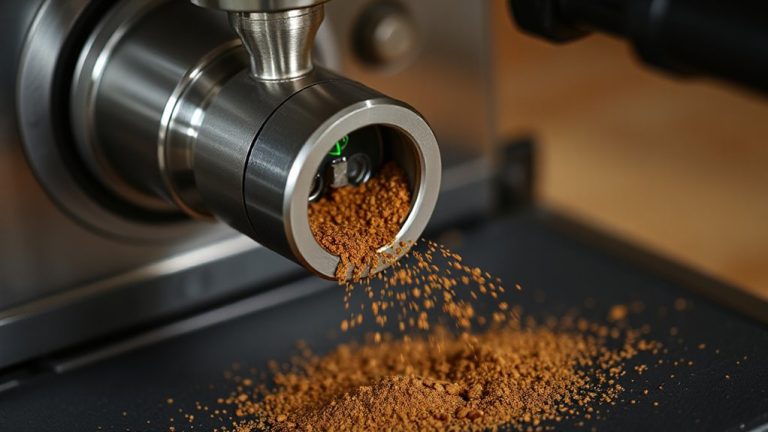
You’ve got your timing down-starting the clock when water rises to the upper chamber, staying close, and keeping your setup stable-but if your grind size is off, even perfect technique won’t save your brew. Too fine, and water can’t flow through during drawdown, over-extracting bitter notes. Too coarse, and you’ll get weak, sour coffee in seconds. Siphon brewing needs a medium-fine grind, like table salt, for balanced extraction. Grind consistency is critical-uneven particle distribution pulls differently, creating both sour and bitter flavors in one cup. Use a quality burr grinder; blade grinders create erratic particle distribution, hurting flavor clarity. Adjust in tiny increments: a few seconds longer or shorter drawdown tells you if your grind’s right. Consistent grind size means predictable brew times and better control. When your grind consistency improves, so does every part of your siphon brew-flavor, clarity, and repeatability. For precise adjustments, consider a grinder with built-in scale functionality to streamline dosing accuracy.
Water Temperature’s Effect on Siphon Brew Time
While water temperature doesn’t change how fast your siphon brews in the same way grind size does, it still plays a key role in extraction speed and drawdown timing. Higher temperatures increase vapor pressure, pushing water into the upper chamber more rapidly. Once brewing starts, hotter water speeds up extraction but can lead to over-extraction if unchecked. Cooler water slows extraction and may under-extract, yielding sour notes. Water expansion due to heat also affects how much water moves between chambers, subtly altering contact time.
| Temperature (°F) | Effect on Vapor Pressure & Drawdown |
|---|---|
| 195 | Lower vapor pressure, slower rise |
| 205 | Ideal balance, steady drawdown |
| 212 | Rapid expansion, aggressive flow |
Keep your water just off boil-around 205°F-for the most consistent results. Too hot or too cool throws off timing and flavor.
How Altitude Affects Siphon Brew Time
Ever wonder why your siphon brew time changes when you’re brewing at high elevation? It’s all about atmospheric pressure. At higher altitudes, atmospheric pressure drops, which lowers the boiling point of water. That means water boils below 212°F-sometimes as low as 200°F at 5,000 feet. Since siphon brewing relies on vapor pressure to move water upward, this lower boiling point slows the process. You’ll notice a longer climb phase and potentially extended total brew time. Your coffee might under-extract if you don’t account for it. For example, in Denver (5,280 ft), you could see a 30–45 second increase versus sea-level brewing. While some siphon setups handle this better than others-like those with adjustable heat sources-most require awareness of altitude-based timing shifts. Always monitor your brew clock and stage progressions closely when elevation changes.
Adjusting Siphon Brew Time for Better Flavor
What if the key to accessing cleaner, more balanced siphon coffee isn’t just your grind or beans, but the clock? You can tweak brew time to fine-tune flavor, especially when using different siphon designs. The brew vessel shape affects how evenly water circulates-wider cones may extract faster, needing a slightly shorter time, while narrower ones often require 10–15 extra seconds. If your coffee tastes flat, stale, or sour, check coffee freshness first; beans over two weeks past roast lose CO2, slowing bloom and stalling extraction. For peak flavor, aim for a 1:15 to 1:45 brew window after water rises. Adjust heat to shorten or extend contact time. Too bitter? Reduce time or coarsen the grind. It’s not just ritual-it’s timing, gear, and fresh beans working together.
On a final note
You’ve now got the tools to nail your siphon brew time. Aim for 1:30 to 2:30 minutes, adjusting based on grind, temperature, and altitude. Use a timer, stay consistent, and tweak in small steps. Too bitter? Shorten time or coarsen the grind. Too weak? Extend time or go finer. It’s not magic-just method. With practice, you’ll pull balanced, flavorful cups every time.