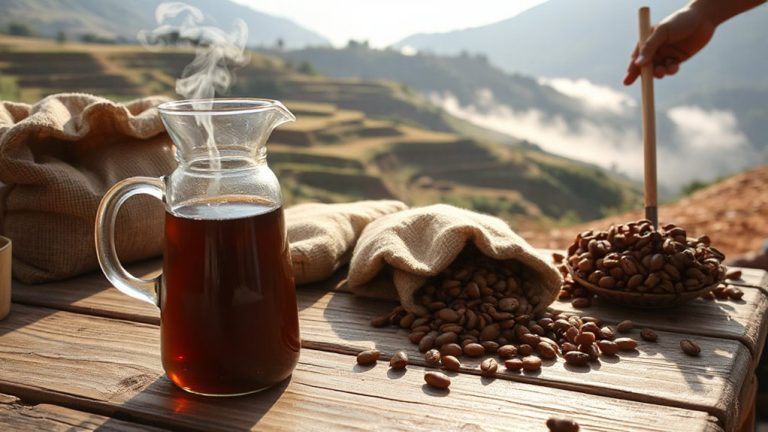
Exploring the Impact of Catuai on Brazil’s Position in the Global Coffee Market
You’re seeing Catuaí strengthen Brazil’s global coffee lead by delivering high yields, disease resistance, and climate resilience in key regions like Minas Gerais. Its compact size cuts labor costs and allows dense planting, while resistance to rust and nematodes reduces chemical use. It handles heat and drought better than Bourbon, maintains cup quality under full sun, and produces a balanced, roast-stable flavor ideal for commercial blends-traits that keep Brazilian output scalable and competitive. There’s more behind how it compares to older varieties and why farms keep choosing it.
Notable Insights
- Catuaí’s high yield and compact growth enable increased plantation density and efficient mechanized harvesting in Brazil.
- Early fruiting and disease resistance reduce production costs and crop losses, boosting supply consistency for global markets.
- Its climate resilience supports stable production amid changing weather patterns in key coffee-growing regions of Brazil.
- Uniform bean quality ensures reliable processing and roasting, strengthening Brazil’s reputation for commercial coffee consistency.
- Catuaí’s balance of productivity and cup quality reinforces Brazil’s dominance as the world’s largest coffee exporter.
What Is Catuaí and Why It’s Reshaping Brazilian Coffee
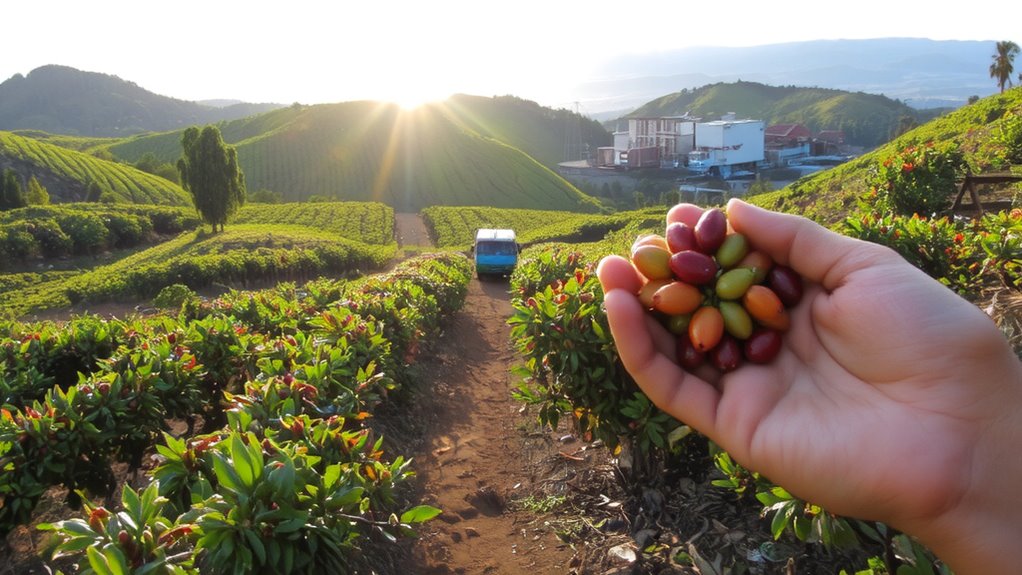
You’ve probably heard the name *Catuaí* popping up in conversations about Brazilian coffee, and for good reason. Developed in the mid-20th century, Catuaí emerged from Brazil’s efforts to improve coffee farming through selective breeding. Its historical origins trace back to crosses between Mundo Novo and Caturra, combining high yield potential with compact growth. This genetic lineage gives Catuaí strong plant structure and dense fruiting, making it efficient for mechanized harvesting. Unlike taller varieties, its short stature reduces labor costs and increases harvest precision. Farmers across Minas Gerais and São Paulo now favor it for consistent performance in full-sun and traditional shaded farms alike. While it doesn’t resist all diseases naturally, its form and productivity fit modern farm economics. When choosing processing methods, Catuaí responds well to both pulped natural and full-washed approaches, supporting cleaner cup profiles. It’s not a miracle bean, but its design meets real-world farming demands effectively.
How Catuaí Increases Yields and Survives Disease
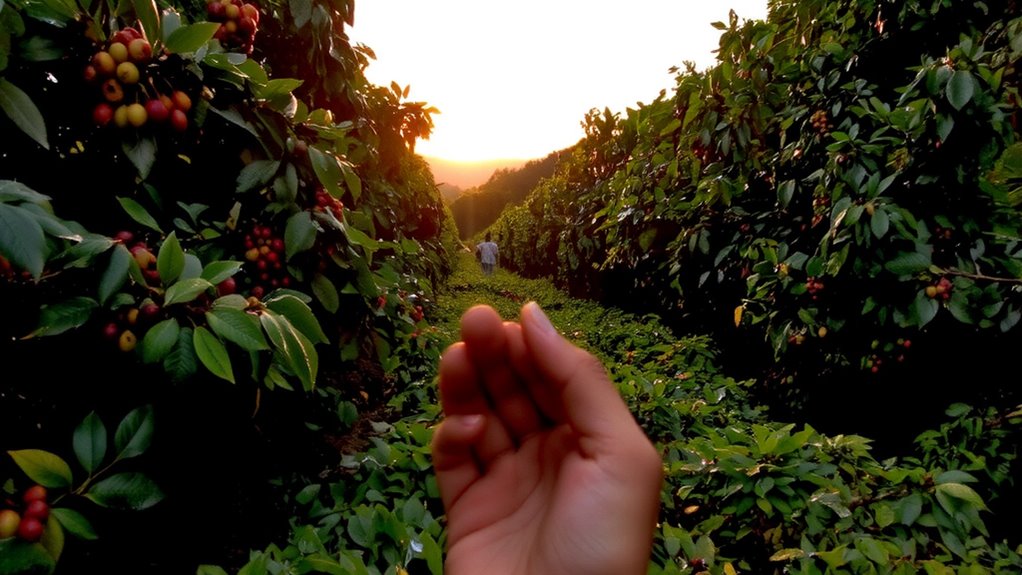
Higher yields and disease resilience define Catuaí’s role in modern coffee farming. You benefit from its compact growth, which supports dense planting and easier harvesting-key for yield optimization. Its disease resistance, especially against rust and root-knot nematodes, reduces crop loss and cuts chemical use. Farmers in Brazil rely on these traits to maintain productivity with lower input costs.
| Feature | Benefit |
|---|---|
| Compact stature | Enables higher plant density per hectare |
| Early fruiting | Speeds return on investment |
| Disease resistance | Lowers risk of infection and spread |
| Yield optimization | Delivers consistent, high-volume harvests |
You’ll find Catuaí performs best with proper spacing and pruning. While not immune to all threats, its resilience makes it a practical choice where disease pressure is high. It’s no wonder it dominates so many Brazilian farms.
Why Catuaí Thrives in a Warming Climate
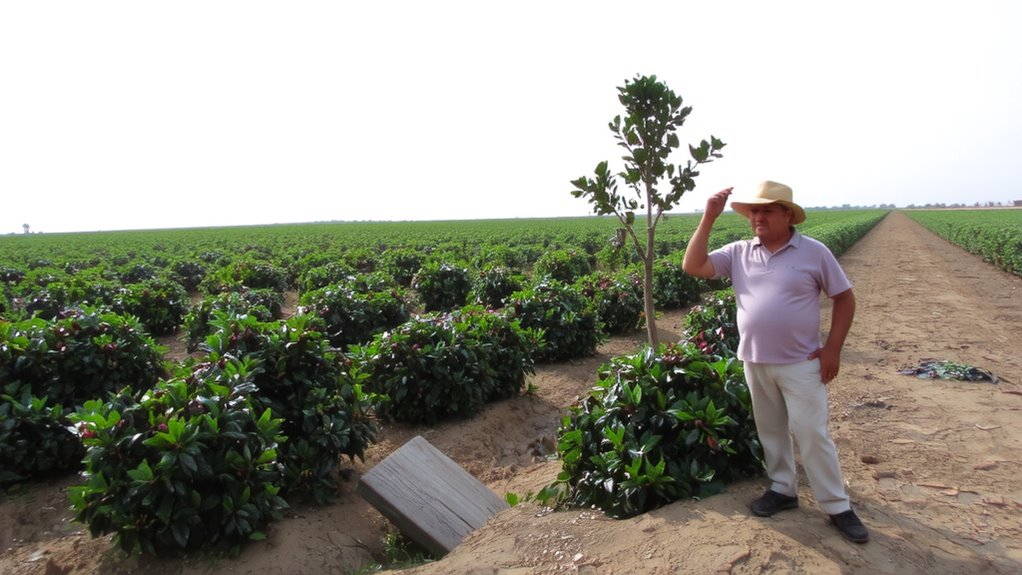
Though climate conditions vary across regions, Catuaí’s adaptability gives it an edge as temperatures rise. You’ll find it handles heat tolerance better than many traditional varieties, maintaining productivity even when the mercury climbs. Its compact structure reduces water loss, boosting drought resilience in drier stretches. Farmers in Brazil’s Central-Southern regions, like Minas Gerais, rely on this trait as rainfall patterns shift. Unlike Bourbon, which struggles under prolonged sun, Catuaí keeps growing with less irrigation-cutting costs and labor. It’s not invincible; extreme heat still risks bean development, but with proper shade management and soil cover, it outperforms most. You don’t need specialized gear to grow it successfully-just smart planning. These features make Catuaí a practical choice when adapting to warmer, less predictable seasons. It’s a resilient option where climate stress threatens yield stability.
How Catuaí Delivers Balanced, Market-Ready Flavor
Because flavor stability matters just as much as yield in commercial coffee, Catuaí delivers a balanced cup that meets market demands without requiring specialty pricing. You’ll notice its aroma profile is consistent-often with mild nutty, chocolatey notes-making it reliable for large-scale roasting. While it doesn’t offer the intense cup complexity of heirlooms like Bourbon, it avoids harshness or excessive acidity, which helps maintain blend stability. Roasters favor it for everyday medium roasts where predictability matters. It performs well under standard brewing conditions, from drip coffee makers to commercial espresso machines, with no need for precise water temperature or long extraction times. Because the beans are uniform in size and density, they respond evenly during roasting. If you’re building a cost-effective, consistent blend, Catuaí provides a dependable base-flavor isn’t flashy, but it’s clean, approachable, and ready for real-world use.
Catuaí vs. Mundo Novo and Bourbon: Yield, Quality, Profit
Catuaí holds its own when stacked against Mundo Novo and Bourbon, especially if you’re weighing yield, cup quality, and long-term profitability. Your choice depends on soil composition, climate, and harvest timing. Catuaí offers high yields and consistent quality, thriving in well-drained soils. Mundo Novo tolerates varied soil composition but ripens later, affecting harvest timing. Bourbon delivers exceptional cup quality but has lower yields and higher maintenance.
| Variety | Yield | Cup Quality | Harvest Timing |
|---|---|---|---|
| Catuaí | High | Medium-High | Early-Mid |
| Mundo Novo | High | Medium | Late |
| Bourbon | Low-Medium | High | Early |
Choose Catuaí for reliable returns, especially if your soil composition supports dense planting and you need efficient harvest timing.
How Catuaí Strengthens Brazil’s Coffee Dominance
When it comes to sustaining Brazil’s position as the world’s leading coffee producer, high-performing varieties like Catuaí play a key role. You’ll find Catuaí thriving across Brazilian farms because it’s compact, high-yielding, and resistant to rust-ideal for efficient harvesting and consistent output. Its adaptability supports expansion into new regions, especially where farmers adopt organic farming to meet rising global demand for sustainable beans. Many growers pair Catuaí cultivation with fair trade certification, which can secure better prices and long-term buyer relationships. While it may not carry the nuanced profile of Bourbon, Catuaí delivers reliable cup quality suited for blends and daily brews. For roasters and exporters, this means stable supply without sacrificing drinkability. You’re looking at a variety that balances productivity with market access, giving Brazil leverage in both volume and value-driven segments of the coffee trade.
On a final note
You’ll see Catuaí boosting Brazil’s coffee edge-high yields, disease resistance, and heat tolerance make it practical for farmers. It delivers a balanced cup that meets market demand, outperforming older types like Bourbon in productivity, though Mundo Novo still holds flavor appeal for some. If you’re choosing beans, expect more Catuaí in blends-especially for consistent, affordable coffee. For growers, it’s a resilient option in warming climates, but watch for altitude needs and flavor nuance trade-offs.