Step-By-Step Guide to Brewing Japanese-Style Pour Over Coffee With Precision Temperature Control
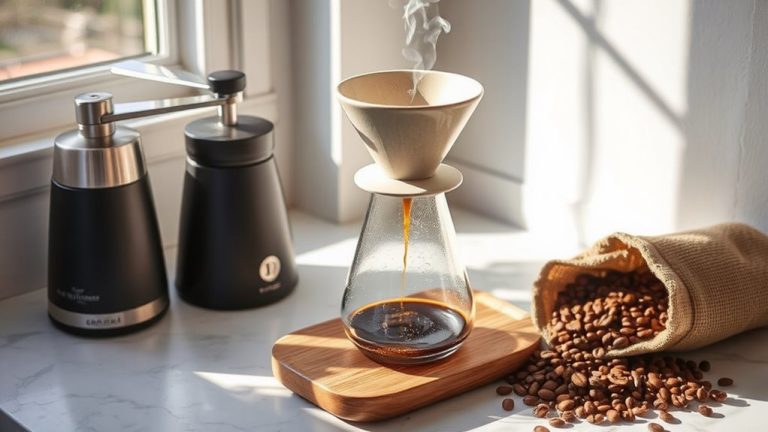
Use fresh, light-roast single-origin beans from Ethiopia or Colombia, ground to a table salt consistency. Heat filtered water to 90–94°C using a gooseneck kettle for accuracy. Rinse your paper filter to remove paper taste and preheat the brewer. Start with a 30-second bloom, then pour in slow concentric circles, keeping the water level steady. Aim for a 2.5 to 3.5 minute brew time. You’ll soon see how small adjustments refine clarity and balance.
Notable Insights
- Use light to medium roast single-origin beans from Ethiopia, Colombia, or Kenya for bright, clean flavor clarity.
- Heat filtered water to 90–94°C using a gooseneck kettle with built-in temperature control for precision.
- Rinse the paper filter thoroughly to remove paper taste and pre-warm the dripper for stable brewing temperature.
- Bloom coffee grounds with twice the water weight, wait 30 seconds, then pour in slow concentric circles.
- Grind coffee to a table salt consistency using a burr grinder for even extraction and optimal flavor balance.
Choose Beans for Delicate Japanese Pour Over
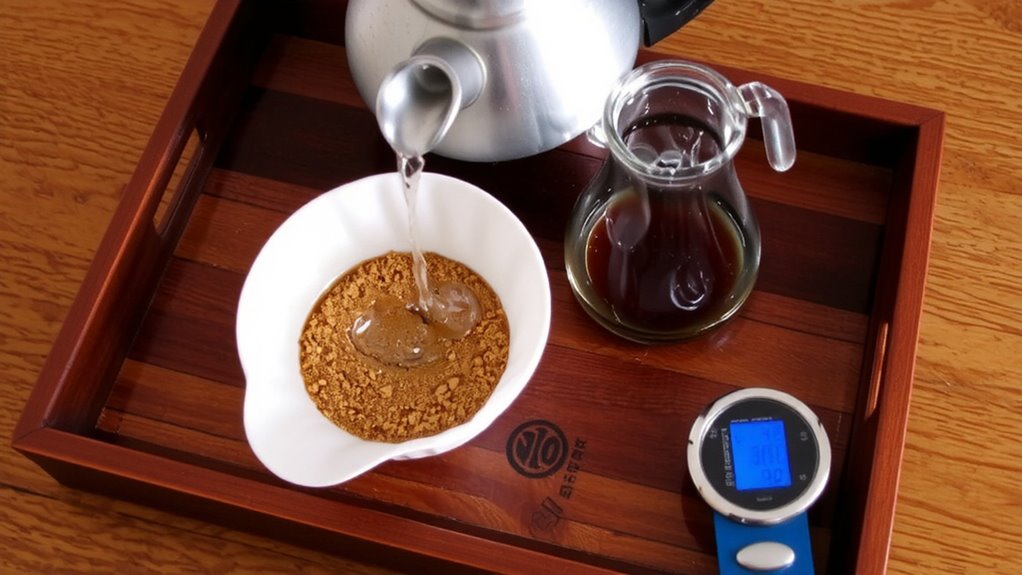
Quality beans matter most when brewing Japanese-style pour over, where clarity and balance highlight subtle flavors. You want beans with clean profiles so the brewing method can showcase nuance without bitterness or heaviness. Focus on bean origin-single origins from Ethiopia, Colombia, or Kenya often offer the bright, tea-like notes this method enhances. Avoid overly processed beans with strong fermentation; they can overpower the delicate extraction. Roast level is just as important. Aim for light to medium roast. These preserve origin character and acidity, which the pour over brings out cleanly. Dark roasts tend to mute complexity and add unnecessary char. Look for roasters like Onyx, Stumptown, or Counter Culture-they label origin and roast dates clearly. Always use beans within three weeks of roasting. Freshness guarantees you taste what the origin and roast are meant to deliver. For an authentic experience, consider sourcing from roasters featured in Japan’s Finest Coffee Experiences, which highlights Japan’s finest coffee.
Heat Water to 90–94°C With Precision
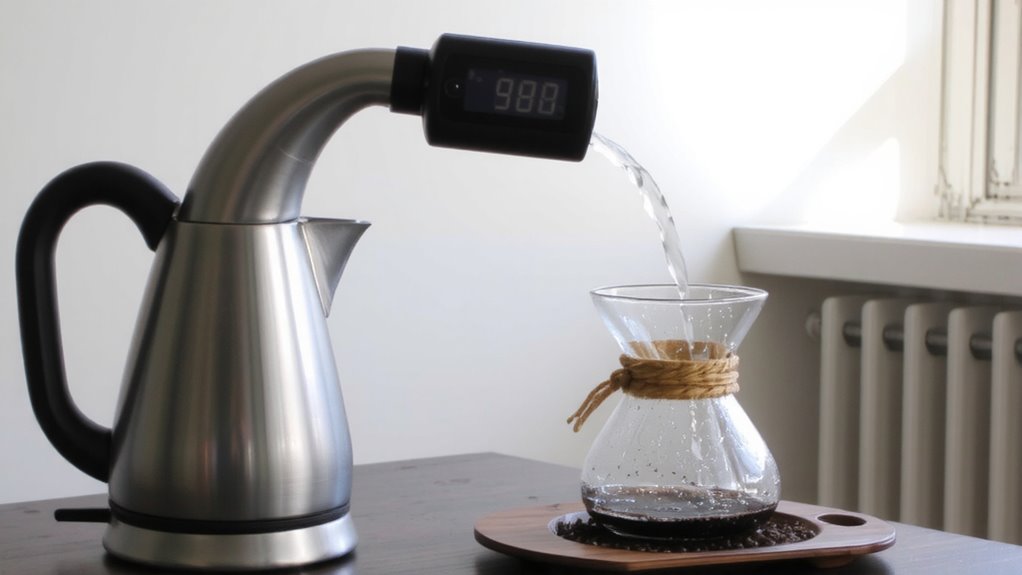
You’ll want to heat your water to between 90–94°C, as this range pulls out the best flavors from light to medium roast beans without scalding them. Your water source matters-use filtered water to avoid off-flavors and mineral imbalances. The heating method affects precision: electric kettles with temperature control are ideal, while stovetop kettles require a separate thermometer. Go for a gooseneck kettle-it gives you better pour control and pairs well with your temperature goals. For optimal results, consider an electric gooseneck kettle as it combines precision temperature control with the steady, targeted pour needed for Japanese-style pour over.
| Heating Method | Temperature Accuracy |
|---|---|
| Electric gooseneck | High (±1°C) |
| Stovetop kettle | Low (requires thermometer) |
| Microwave + cup | Poor, uneven |
| Pour-over station | High, consistent |
| Immersion heater | Medium, with monitoring |
This level of control guarantees repeatable, clean extraction every time.
Rinse the Filter and Prep Your Brewer
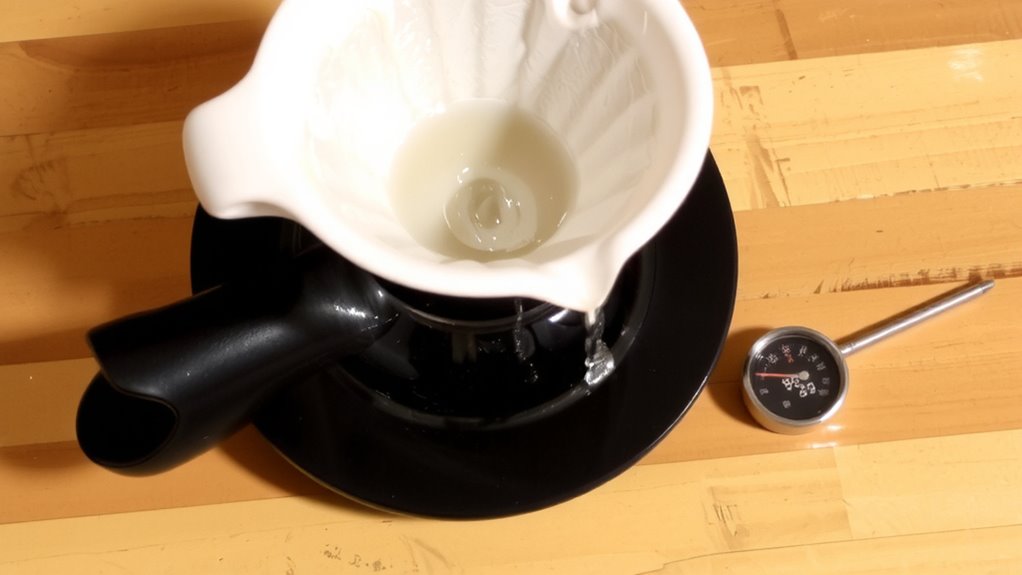
Now that your water’s heating to the right temperature, it’s time to set up your brewer. Place your filter into the dripper, making sure it fits snugly against the walls. Rinsing removes paper dust and warms the brewer, which helps maintain stable brewing temps. Pour hot water through the filter, fully saturating it, and discard the rinse water. This step also improves water purity by preventing off-flavors from transferring into your brew. Using filtered water enhances this effect, ensuring clean extraction. A high-quality filter boosts filter quality by reducing fiber shedding and supporting even flow. Cheap filters can tear or impart a papery taste. Go with trusted brands like Hario or Kalita for best results. Once rinsed, add your ground coffee immediately to begin brewing. For optimal flavor, select a dripper design that promotes even saturation, such as the best coffee drippers.
Pour Slowly in Concentric Circles
Start by pouring just enough hot water to saturate the coffee grounds, about twice their weight-a technique known as the bloom. Let it rest for 30 seconds to release trapped gases. After the bloom, resume pouring with a slow, controlled water flow, moving in a steady circular motion from the center outward. This guarantees even extraction and prevents channeling. Keep the spout of your gooseneck kettle close to the bed of water to maintain precision. A consistent circular motion helps distribute heat and water evenly across the grounds. Avoid rushing-aim for a total brew time of 2.5 to 3.5 minutes. Too fast, and your coffee will be weak; too slow, it risks over-extraction. Maintain a thin, steady stream throughout, adjusting as needed to control saturation. This method works best with brewers like the Hario V60 or Kalita Wave.
Grind Fine for Clean, Balanced Flavor
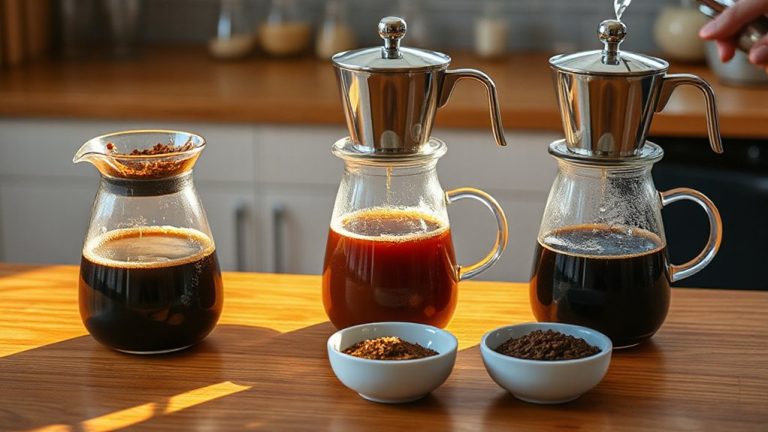
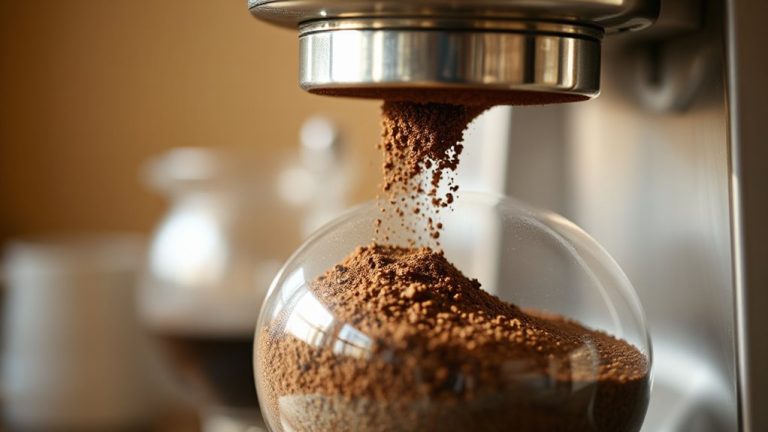
A fine grind size is essential for achieving the clean, balanced flavor typical of Japanese-style pour over coffee. You’ll want a setting similar to table salt-fine enough to boost extraction efficiency, but not so fine that it clogs the filter or causes over-extraction. Grind consistency matters just as much as size; inconsistent particles lead to uneven brewing, with some over-extracting and others under-extracting. A high-quality burr grinder, like the Baratza Encore or 1ZPresso JX-Pro, delivers the uniformity you need. This precision guarantees water extracts flavor evenly across all coffee particles, enhancing clarity and balance in your cup. Too coarse, and your brew tastes weak; too fine, and it becomes bitter. Adjust in small increments, and always grind fresh. Your grind choice directly impacts flavor development, so treat it as a key variable, not an afterthought.
On a final note
You’ve brewed a clean, nuanced cup using precise temperature and method. This approach highlights the coffee’s natural flavors, especially with light roasts. A gooseneck kettle, like the Fellow Stagg, helps control pour speed. If you lack temperature control, let boiled water sit 30 seconds. Fine grind works best, but adjust if the brew tastes bitter or weak. Practice improves consistency-repeat until the flavor matches your preference.