Determining Exact Water Volume Needed Per Gram of Coffee Across Methods
You’ll need different water volumes per gram of coffee depending on your method. For pour-over, use 13–16 grams of water per gram of coffee-lighter pours highlight bright notes, heavier ones add clarity. French press works best at 12–15, giving a full body thanks to immersion and metal filtering. Espresso uses just 2–3 grams of water per gram for a concentrated shot under high pressure. Grind size and brew time affect each, so tweak based on roast and equipment-your next step reveals how to fine-tune these variables.
Notable Insights
- Use a 1:15 ratio for drip coffee, meaning 15 grams of water per gram of coffee for balanced results.
- For espresso, apply a 1:2 to 1:3 ratio, using 2–3 grams of water per gram of coffee due to high-pressure extraction.
- French press requires 12–15 grams of water per gram of coffee, with coarse grind and 4-minute steep for full body.
- Pour-over brewing works best between 13–16 grams of water per gram of coffee, depending on bean profile and desired clarity.
- Cold brew uses a concentrated 1:8 ratio during 12–24 hour immersion, then dilutes post-brew to final strength.
Coffee-To-Water Ratios By Brew Method
You’ll want to match your coffee-to-water ratio to the brewing method you’re using, since each one extracts flavor differently. For drip machines, a 1:15 ratio works well-consistent and forgiving. Espresso, however, runs much stronger at about 1:2, using high pressure and short contact time. With French press, you’re looking at 1:12 to 1:15, where longer immersion time variables affect body and clarity. Cold brew strength depends on even longer immersion-typically 12–24 hours-so ratios go as high as 1:8, diluted later. Immersion methods like AeroPress or French press extract evenly but vary with grind and time. Pour-over and drip differ from immersion, so their ratios reflect quicker, more controlled flow. Always consider your gear; a gooseneck kettle helps precision, while standard brewers demand simpler ratios. Your taste matters, but start with these benchmarks and adjust based on extraction results.
Pour-Over Ratios: 1:13 to 1:16 (Water Per Gram)
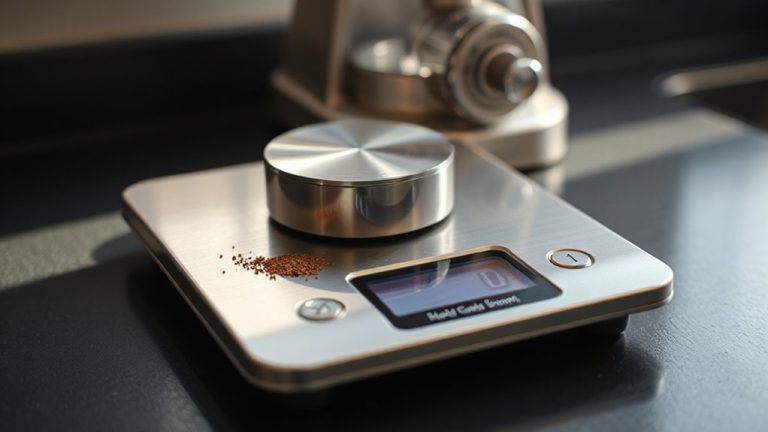
Pour-over brewing demands attention to ratio precision, as small shifts can noticeably affect strength and clarity. You’ll want to use a 1:13 to 1:16 ratio-1 gram of coffee for every 13 to 16 grams of water. Lighter ratios like 1:16 highlight acidity and floral notes, ideal for bright African beans, while 1:13 offers more body and intensity, better for balanced or chocolatey profiles. Bloom timing matters: saturate the grounds evenly and wait 30–45 seconds to let trapped gas escape, improving extraction. Pour control is critical-keep your spiral steady and even to avoid channeling. A gooseneck kettle, like the Fellow Stagg or Hario Buono, gives you the precision needed. Use a scale to measure both coffee and water accurately. Paper filters, like Hario #2, yield cleaner cups but may require finer grinds. Adjust within the range based on bean freshness and taste preference. A stable coffee pour-over stand ensures your dripper remains secure during the entire pour.
French Press: 1:12 to 1:15 for Bold, Full-Bodied Coffee
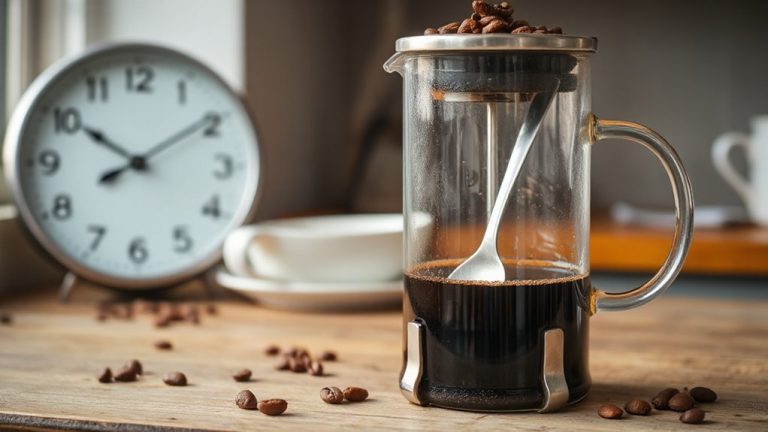
A standard French press ratio falls between 1:12 and 1:15, meaning each gram of coffee gets 12 to 15 grams of water-ideal for producing a rich, full-bodied cup. You need proper French press saturation to extract fully without overdoing bitterness. The coffee grounds must stay submerged during the full immersion time, usually 4 minutes, for even extraction.
| Coffee (g) | Water (g) | Brew Time |
|---|---|---|
| 30 | 360–450 | 4 mins |
| 40 | 480–600 | 4 mins |
| 50 | 600–750 | 4 mins |
| 60 | 720–900 | 4 mins |
| 70 | 840–1050 | 4 mins |
Use coarse grounds to limit sediment and avoid over-extraction. A metal filter gives more oils than paper, boosting body. Make sure your press is preheated and the lid is pressed down slowly. Adjust within the 1:12 to 1:15 range based on bean freshness and roast. For optimal results, use a coarse coffee grind that prevents fine particles from passing through the mesh filter.
Espresso’s 1:2 to 1:3 Ratio – Why It’s So Different
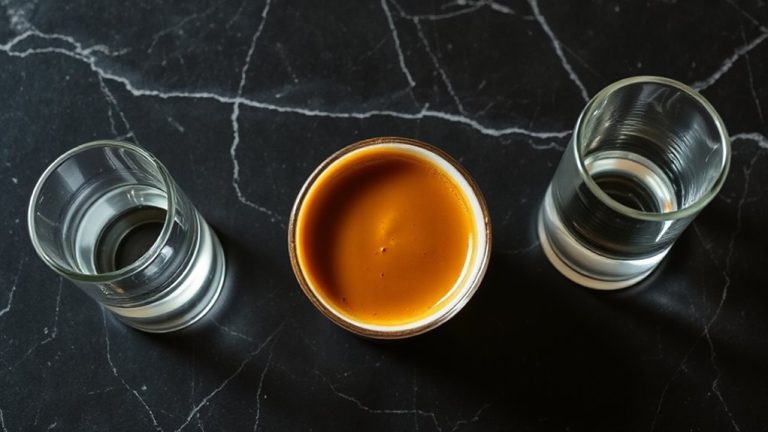
While espresso may seem like just another way to brew coffee, it operates on a completely different principle than methods like French press, using a ratio of 1:2 to 1:3-meaning 1 gram of coffee produces 2 to 3 grams of liquid espresso. That small yield comes from high pressure, not long steeping. Your machine forces hot water through finely ground coffee at around 9 bars, demanding precise pressure calibration. If pressure is too low or high, your shot under-extracts or turns bitter. Extraction timing is just as critical-most shots take 25–30 seconds. Go faster, and it’s sour; slower, it’s over-extracted. Unlike immersion methods, espresso relies on this tight balance for concentration and crema. You need a good pump-driven machine like a Gaggia or Rancilio to maintain stability. Accuracy here means repeatable, rich shots. Grind size, dose, and tamping matter, but pressure and timing make or break the shot.
How Grind Size Affects Water Needs
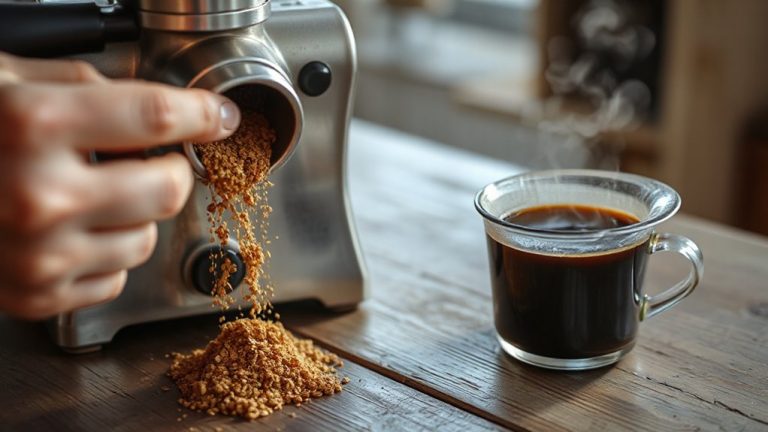
You’ve seen how pressure and timing shape an espresso shot, but now let’s look at how grind size changes the way water moves through coffee in any brew method. A finer grind increases surface exposure, letting water extract more quickly, which often means you’ll need slightly more water to avoid over-concentration. But pack those fine grounds too tightly, and grind density slows flow, risking over-extraction. With a coarse grind, like in a French press, water passes easily, but there’s less surface exposure, so you’ll usually need less total water to prevent weak, watery coffee. The key is balance-match your grind to your method. A V60 works best with medium-fine coffee; a Chemex needs medium-coarse. Adjusting grind size lets you fine-tune extraction without changing water volume first. It’s smarter than guessing. For pour-over lovers, choosing the right best coffee drippers can make a significant difference in controlling grind and water interaction.
Water Temperature’s Impact on Coffee Extraction
Since water temperature directly affects extraction speed, you’ll want to keep it in a tight range-between 195°F and 205°F-for most brewing methods. Too cold, and your coffee tastes weak with a sour flavor profile; too hot, and bitterness overwhelms, hurting balance. This sweet spot guarantees peak brew strength without scalding delicate compounds. Pour-over setups like the Hario V60 rely on precise kettles with temperature control, while cheaper drip machines often fall short, brewing below ideal temps. If your gear doesn’t heat properly, consider using an electric gooseneck. Dark roasts extract faster, so leaning toward 195°F can prevent over-extraction. Light roasts benefit from 202–205°F to develop complexity. Always calibrate based on taste-adjusting temperature slightly can fine-tune your flavor profile without changing grind or ratio. Practical testing beats theory every time.
On a final note
You’ll need different water amounts per gram of coffee depending on your brew method. Pour-over uses 13–16 grams of water per gram of coffee for clarity, while French press prefers 12–15 for a heavier body. Espresso uses just 2–3 grams of water per gram, producing a concentrated shot. Grind size and water temperature also affect extraction-finer grinds and hotter water increase it. Adjust ratios based on taste, equipment, and bean freshness.