Vietnamese Phin Grind Size Guide: Medium-Fine, 2.5-4 Min Drip
Use a medium-fine grind, like granulated sugar, for your phin brew. If coffee drips too fast (under 2½ minutes), it’s too coarse-adjust finer. If it takes over 4 minutes, it’s too fine-adjust coarser. Make small changes and test each time. A burr grinder like the Baratza Encore or 1ZPresso Q2M+ gives consistent results. Blade grinders won’t cut it. Get the grind right, and you’ll access better flavor, balance, and control every time.
Notable Insights
- Use a medium-fine grind, similar to granulated sugar, for optimal flow and extraction in a phin filter.
- Adjust grind size based on brew time: under 2½ minutes means too coarse, over 4 minutes means too fine.
- Make small, incremental changes to grinder settings to fine-tune the drip rate and extraction balance.
- Use a burr grinder for consistent particle size; avoid blade grinders due to uneven results.
- Account for bean age and density-older or dense beans may need slightly finer grind adjustments.
Why Grind Size Matters for Phin Coffee
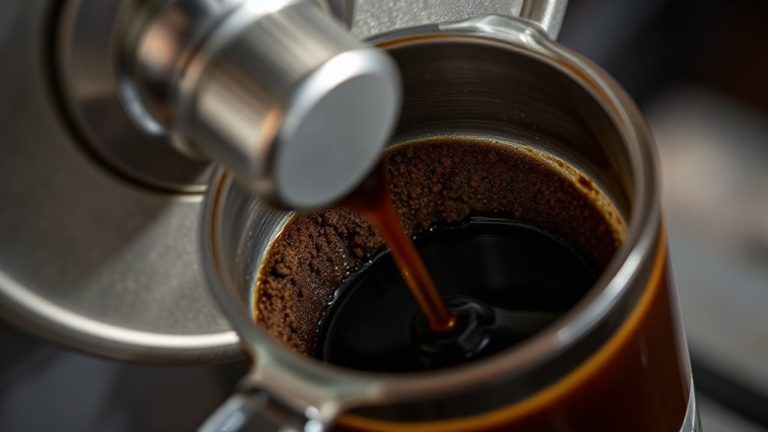
A coarse grind clogs too little and lets water rush through, while a fine grind can slow or even halt the drip-getting the grind size right matters because it directly controls extraction and brewing time in a Vietnamese phin. You rely on gravity-driven water pressure, not pumps, so grind size shapes how smoothly water moves through the coffee. Too coarse, and water flows too fast, leading to weak, under-extracted coffee-even if brew temperature is ideal. Too fine, and water stalls, risking over-extraction or overflow. The phin’s slow drip means brew temperature drops during brewing, so balanced extraction depends on timing, which grind directly affects. You need a grind that allows steady dripping-roughly one drop per second-for even saturation and consistent strength. Getting this right means adjusting based on your beans and equipment, not guessing. It’s practical, hands-on control that makes your daily brew reliable. For best results, pair your grind adjustments with one of the top-rated Best Phin Filters available to ensure optimal performance and durability.
What Is the Ideal Grind for Phin Brewing?
You need a grind that strikes the middle ground-too coarse and your brew runs fast with little flavor, too fine and it clogs or drips unevenly. For phin brewing, aim for a medium-fine grind, similar to fine sand or granulated sugar. This setting works well because it balances extraction time and flow rate under the phin’s low-pressure design. Bean density affects this-dense beans, like high-altitude Arabicas, may need a slightly finer grind, while less dense ones can use a touch coarser. Roast age matters too; older beans lose gases and extract differently, often needing a finer grind to compensate. Freshly ground is best, so adjust right before brewing. A burr grinder gives consistent results, unlike blade types. The goal is full flavor without clogging-consistency in grind size keeps each brew reliable, cup after cup. Achieving optimal coffee grinds for pour-over ensures balanced extraction even in slower brewing methods like the phin.
How to Tell If Your Grind Is Too Coarse or Too Fine
Noticing how your coffee flows through the phin can tell you a lot-when the grind’s too coarse, water races through in under two minutes, leaving you with a weak, under-extracted brew that tastes sour or flat. The flow rate is too fast, and the extraction speed doesn’t allow enough time for flavors to develop. On the flip side, if the grind’s too fine, water drips sluggishly, taking over five minutes, often resulting in over-extraction. You’ll notice bitterness or astringency. A balanced extraction speed-between 2½ to 4 minutes-is ideal. Consistent flow rate means you’ve likely hit the right grind size. Look for a medium-coarse texture, similar to fine sand. If your brew misses the mark, adjust accordingly but keep these signals in mind-your taste and timing are the best tools.
How to Adjust Your Grinder for Phin Coffee
Getting the grind right means working with your equipment to hit that 2½- to 4-minute sweet spot. Start with a medium-coarse setting-think slightly finer than sea salt-and tweak from there. Every grinder behaves differently, so you’ll need to experiment. Make small adjustments and time the drip: slower than 4 minutes means your grind’s too fine; faster than 2½ means it’s too coarse. Consistent adjustments help you dial in the perfect grind consistency, which is key for even extraction and balanced flavor. Uneven particles lead to over- and under-extracted notes in your cup. Regular grinder calibration guarantees your burrs stay aligned and deliver uniform results over time. Don’t assume your grinder’s settings are precise-numbers on dials are guides, not guarantees. Test, taste, and retest. With practice, you’ll learn how your grinder responds and how to maintain repeatable results for every phin brew. For best results, consider using a quality burr grinder designed for precision and consistency.
Best Grinders for Phin Coffee at Home
A good grinder makes all the difference when dialing in phin coffee at home. You need consistent, medium-coarse to coarse grinds that don’t clog the phin’s slow drip. Blade grinders won’t cut it-they lack precision and heat up quickly, ruining flavor. Instead, go for a burr grinder. The Baratza Encore offers reliability and solid grinder durability, with adjustable settings perfect for phin brewing. It also features decent motor cooling, so it won’t overheat during daily use. For tighter budgets, the 1ZPresso Q2M+ hand grinder gives excellent control and builds up less heat, though it takes more time. Its stainless steel burrs stay sharp, supporting long-term grinder durability. If you brew daily, electric is best-look for models with strong motor cooling to maintain grind consistency over time. Durability and heat management matter most. Pick a grinder that balances both, and your phin coffee will stay flavorful and repeatable.
Fixing Common Phin Brew Problems
Ever wonder why your phin brew drips too fast or tastes weak? It’s usually due to grind size or water temperature. If the coffee flows too quickly, your grind is likely too coarse, letting water pass through without extracting enough flavor. A finer grind slows the drip and improves strength, but don’t go too fine or it’ll clog. Also, check your water temperature-boiling water (around 200°F) is ideal. If it’s too cool, extraction suffers, leading to weak coffee. Make sure your brew vessel is clean and preheated, as residual water or cold glass can alter flavor and temperature during brewing. Avoid using thin or unsealed containers that lose heat fast. These small fixes-right grind, proper heat, and a stable brew vessel-address most common issues without needing special tools. Focus on consistency, and you’ll get reliable results every time.
Fine-Tune Brew Time and Strength Like a Pro
Why does one phin brew pack a bold punch while another tastes thin and lifeless, even when using the same beans? The difference lies in your grind size and brew time. Too coarse, and water zips through, under-extracting-weak coffee, poor flavor extraction. Too fine, and water struggles, over-extracting-bitter, clogged, inconsistent. For ideal brew consistency, aim for a grind like table salt. That usually means a setting between 5 and 7 on most burr grinders. Adjust slightly finer if weak, coarser if bitter. Test in small changes. Time your drip: 3 to 4 minutes is ideal. Shorter? Coffee’s underdeveloped. Longer? Likely over-extracted. Dial it in by tweaking the grind. Your goal isn’t perfection once-it’s repeatable, balanced flavor extraction every time. Practice beats guesswork.
On a final note
Getting the grind right for your phin filter makes a real difference in flavor and flow. Aim for a medium-coarse grind, like sand or table salt-too fine slows it down and makes coffee bitter, too coarse makes it weak. If brew time’s off, tweak your grinder in small steps. A burr grinder like the Baratza Encore or 1ZPresso Q2 gives you control. Adjusting grind helps you fix weak, sour, or bitter coffee fast.