How to Adjust Grind for a High-Tds Espresso With Clean Finish
Grind finer to boost TDS, but stay in the 1.2–1.45% range for balance. Use a high-end burr grinder for even particles-this avoids bitter fines or sour boulders. Aim for a 25–35 second shot with a 1:1.5 to 1:2 dose-to-yield ratio. If it’s sour, go finer; if bitter, coarsen slightly. Watch pump pressure-drops mean it’s too coarse, sustained high pressure means too fine. Dense beans like Ethiopians need finer settings; Brazilians, coarser. Adjust slowly, quarter-turns at a time, and let the grinder settle. Clean finishes come from even extraction, not just high TDS. Small tweaks make the difference you’re after.
Notable Insights
- Use a finer grind size to increase extraction and achieve a higher TDS within the ideal 1.2%–1.45% range.
- Ensure grind consistency with a high-quality burr grinder to avoid uneven extraction and off-flavors.
- Adjust grind in small increments, allowing time for grinder stabilization to prevent overcorrection.
- Aim for a 25–35 second extraction time to balance high TDS with a clean, non-bitter finish.
- Match grind size to bean density-finer for dense beans, coarser for softer beans-to optimize flavor and clarity.
What TDS Means for Your Espresso
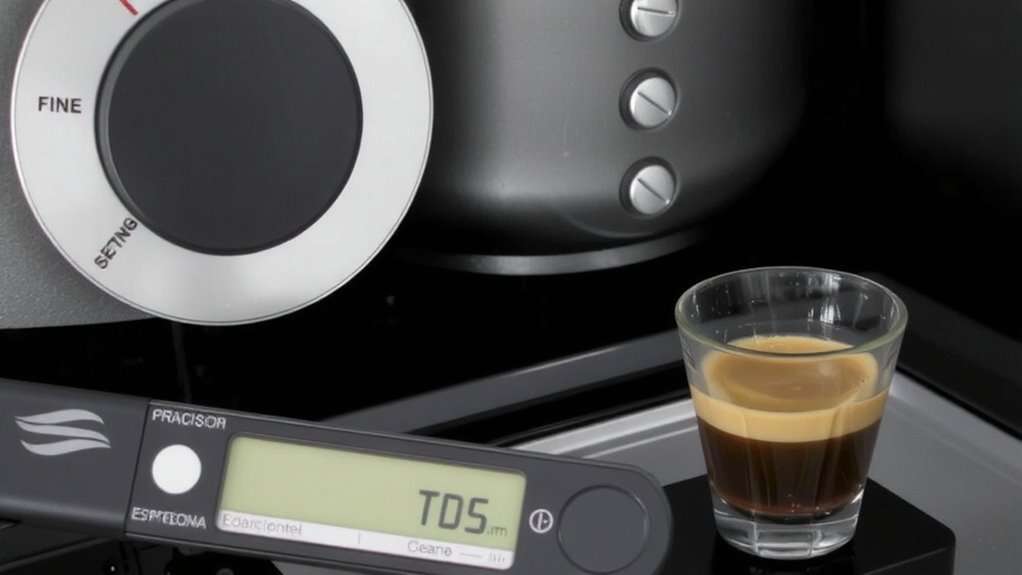
A key factor in dialing in your espresso is Total Dissolved Solids, or TDS, which measures the percentage of coffee solids dissolved in your shot. You’ll want a TDS between 1.2% and 1.45% for balanced espresso extraction. Higher TDS means more compounds are pulled from the grounds, which can boost body and sweetness-if done right. But too high and your shot may turn harsh or muddy. TDS directly affects flavor clarity; too low and your coffee tastes weak or sour, lacking richness. Devices like the VST Lab III refractometer give accurate readings, though they’re pricier than basic models. You don’t need lab precision at home, but consistent TDS helps you tweak variables with confidence. Tracking it helps isolate issues-say, whether a dull grinder or old beans is clouding flavor clarity. It’s not the whole picture, but it’s a solid, measurable anchor for improving your espresso.
Dial In Grind Size for Higher TDS
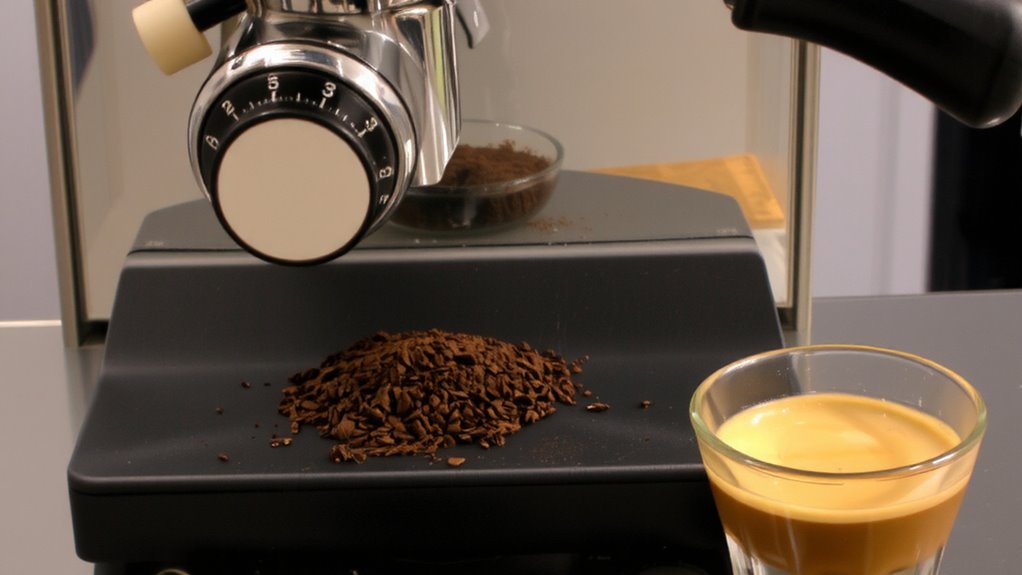
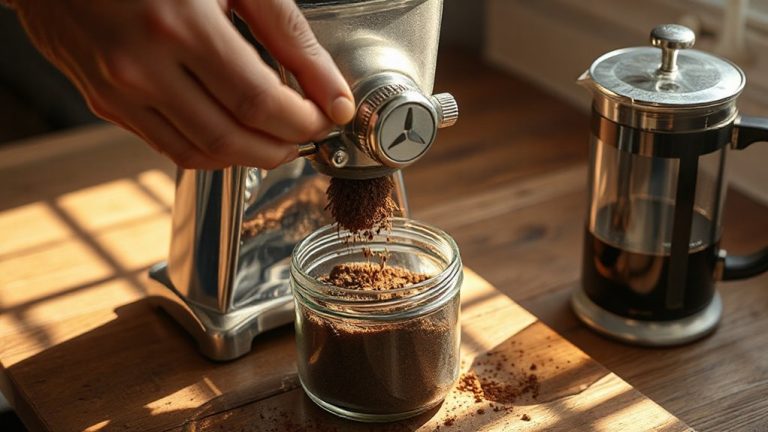
Grind size is your main lever for boosting TDS when dialing in espresso. Go finer to increase extraction and dissolve more solids, raising TDS. But don’t just adjust blindly-your grinder’s quality matters. A high-end burr grinder improves grind consistency and refines particle distribution, meaning more even extraction and a cleaner, richer shot. Inconsistent grinds lead to some particles over-extracting while others under-extract, muddying your results. If your grinder produces too many fines or boulders, even perfect settings won’t help. Machines like the Niche Zero or Eureka Olympus offer precise adjustments and superior uniformity. Start with small tweaks-quarter-turn changes on your grinder-and measure TDS after each. Wait five minutes between adjustments to let the grinder stabilize. This method gives reliable feedback and keeps variables under control. The goal is high TDS with clarity, not just strength. For optimal results, consider investing in one of the best coffee grinders for espresso to ensure consistent particle size and enhanced flavor clarity.
Fix Sour or Bitter Shots by Adjusting Grind
If your espresso tastes sour or bitter, the grind size is likely the culprit-just as it was when boosting TDS, it’s now the primary control for balancing flavor. A sour shot usually means the grind is too coarse, leading to under-extraction-fine-tune it finer to increase contact time. Bitterness often comes from a grind that’s too fine, causing over-extraction; back it off slightly. Always change one variable at a time. Recheck your grinder calibration regularly-blades wear down, and even small inconsistencies affect extraction. While water temperature plays a role, most home and café machines maintain stable heat, so focus on grind first. Poor calibration can exaggerate sour or bitter notes, even with ideal temps. Use a consistent dose and tamp pressure, then adjust grind in small increments. Let the flavor guide you, not the timer alone.
Match Dose and Yield for Cleaner High-TDS Shots
You’ll want to pair your dose and yield wisely to pull cleaner shots with higher TDS, especially when chasing that sweet spot of intensity without harshness. A balanced ratio-like 1:1.5 to 1:2-often works best, depending on your beans and equipment. Too high a yield can overextract, leading to bitterness even with a coarser grind, while too low a yield risks sourness and lower TDS. Keep extraction timing between 25–35 seconds to support proper flavor profiling without slipping into negative notes. For example, using 18g in and pulling 30g out at 28 seconds typically gives clarity and sweetness with many modern light-roast coffees. Adjusting dose slightly-say, 17g to 19g-can also shift extraction dynamics without touching the grind. Matching dose and yield gives you more control over TDS and mouthfeel, leading to cleaner, more consistent results over time. A high-quality espresso grinder ensures uniform particle size, which is critical for achieving even extraction and maximizing TDS in high-performance brewing.
Use Machine Signals to Fine-Tune Grind
What happens when your shot times are on target but the flavor still falls flat? You need to rely on machine signals to dial in your grind more precisely. Watch the pump pressure signals-if pressure drops too fast, your grind’s likely too coarse, leading to weak extraction. If it stays high too long, the grind may be too fine, risking over-extraction and clogging. Adjust in small steps and observe how the pump reacts. Proper grind bloom control matters too: a quick, even bloom means your grind size lets water distribute well. Uneven or delayed bloom? Your particle distribution might be off. Machines with real-time pressure gauges, like the Decent or Slayer, make this feedback loop clear. You’re not just chasing time-you’re reading the machine’s cues. That’s how you fine-tune for clarity and sweetness without guesswork. Rely on data, not just taste, in the grind adjustment process. For consistent results, pairing your technique with a high-quality grinder like the best espresso grinders under $1000 can make a significant difference in particle uniformity and shot repeatability.
Balance Acidity and Body in Every Shot
A well-balanced espresso delivers a harmony between brightness and richness, and getting that balance starts with your grind. If your shot tastes too sour, the flavor profile leans acidic due to under-extraction-your grind is likely too coarse or extraction time too short. If it’s overly bitter or flat, it’s over-extracted, meaning the grind’s too fine. Adjusting grind size helps you target a 25–30 second extraction time for most machines, promoting balanced sweetness, acidity, and body. Use this guide:
| Grind Size | Extraction Time | Flavor Profile |
|---|---|---|
| Too coarse | < 20 sec | Sour, weak |
| Coarse | 20–24 sec | Bright, thin |
| Medium | 25–30 sec | Balanced |
| Fine | 31–35 sec | Rich, bitter |
| Too fine | > 35 sec | Harsh, heavy |
Adapt Grind for Different Beans Consistently
Once you’ve nailed a balanced shot with the right acidity and body, it’s worth remembering that not all beans respond the same way to a given grind setting. Differences in bean density mean you’ll need to adjust your grind size even when using the same espresso recipe. Dense beans, like high-altitude Ethiopians, often require a finer grind to extract fully, while less dense beans, such as some Brasilians, may need a coarser setting to avoid over-extraction. That’s why grinder calibration is essential-consistent dosing and particle size guarantee repeatable results. Without recalibrating when switching beans, you’ll struggle with under- or over-extracted shots. Make small adjustments and track shot time, yield, and taste. A quality grinder with stable output helps, but even entry-level models can work if maintained and calibrated regularly. Treat each new bean as a fresh start-don’t assume yesterday’s setting still applies.
On a final note
You now know how to adjust your grind for a high-TDS espresso with a clean finish. Tighten the grind to boost extraction, but avoid going too far-over-extraction leads to bitterness. Match your dose and yield, and watch flow time. Machines like the Lelit Bianca or Decent ESP4 give real-time feedback, helping fine-tune results. Freshness matters: beans under 3 weeks post-roast respond best. With practice, consistency beats guesswork every time.