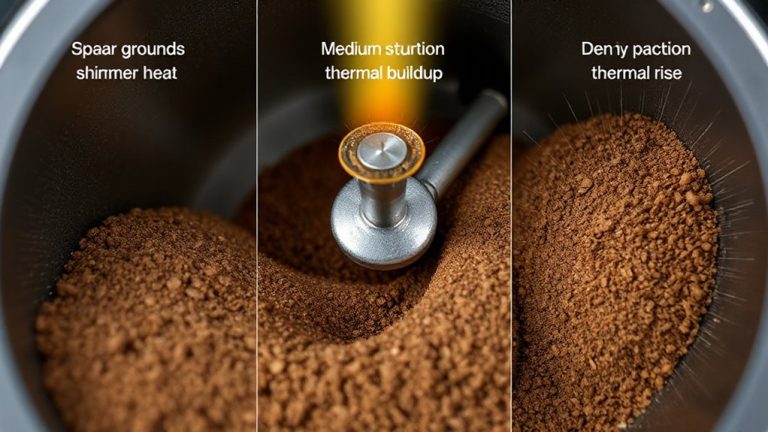
Turkish Coffee Grind Size: Powdered-Sugar Fine (Guide)
You need to grind your coffee finer than table salt-aim for a texture like powdered sugar or flour. This ultra-fine, consistent grind dissolves better and creates the rich flavor and stable foam (kaymak) Turkish coffee is known for. Use a quality burr grinder like the Comandante C40 or Kinu M47 for best results, since blade grinders create uneven particles. Grind fresh, right before brewing, to preserve aroma and prevent flat taste. If your foam’s weak or flavor’s thin, your grind’s likely too coarse or inconsistent-adjust finer and check your water and heat. You’ll get better results the more you fine-tune these details.
Notable Insights
- Turkish coffee requires an ultra-fine grind, finer than table salt, ideally resembling powdered sugar or flour.
- A consistent grind is essential for even extraction and optimal flavor development during brewing.
- Blade grinders produce inconsistent particles; burr grinders, especially with ceramic burrs, are required for uniform fineness.
- Proper grind size enables stable foam (kaymak) formation, which enhances aroma and taste complexity.
- Grind immediately before brewing, as ultra-fine coffee oxidizes quickly and loses freshness within hours.
How Fine Should Turkish Coffee Be Ground?
You’ll want your Turkish coffee ground finer than table salt-think powdered sugar or flour. That level of fineness guarantees the grounds fully dissolve during brewing, delivering the rich, syrupy body traditional to the style. For this, you need both extreme fineness and high grind consistency. Any stray coarse particles disrupt extraction, while uneven particle uniformity leads to sediment and weak spots in flavor. Blade grinders won’t cut it-use a high-end burr grinder like the Comandante C40 or 1ZPresso JX-Pro, which let you fine-tune settings close to zero. Even then, expect to experiment. Manual grinders require patience and steady hands. Electric grinders with ceramic or steel burrs, such as the Baratza Virtuoso+, offer better consistency but may still need modding for Turkish fineness. Your grinder’s build quality directly affects outcome-prioritize precision over speed. For tailored recommendations, check out the best Turkish coffee grinders guide.
Why Grind Size Is Critical for Flavor and Foam
Because the brewing method relies on simmering coffee grounds directly in water, the grind size plays a decisive role in both flavor development and foam formation. If your grind is too coarse, water temperature extracts unevenly, leading to weak, underdeveloped flavor and little to no foam. Too fine, and you risk over-extraction or even dissolving sediment, resulting in bitterness. The ideal fine grind allows even suspension in the brewing vessel, usually a cezve or ibrik, promoting stable foam-kaymak-on top. This foam traps aromatic compounds, enhancing flavor complexity. Consistent particle size guarantees predictable extraction when heat is applied gradually. Without the right grind, even high-quality beans and careful heat control won’t save your brew. You need precision because variables like material and shape of the brewing vessel interact closely with grind size to influence outcome. Get the grind right, and you’re set for authentic taste and texture.
Best Grinders for Turkish Coffee Fineness
Many home brewers find that only a few grinders on the market can reliably achieve the ultra-fine, powdery consistency needed for authentic Turkish coffee. You’ll need a grinder with precise burr type control-flat or conical ceramic burrs work best because they generate less heat and deliver a more uniform grind. Metal burrs can overheat the beans, altering flavor. Motor power matters too; a low-watt motor may struggle and inconsistency follows. Opt for models like the Comandante C40 or Kinu M47, which combine fine adjustment settings with adequate motor power for the job. Electric grinders like the Eureka Mignon Fine offer better control than most blade grinders, but check if they reach true Turkish fineness. While hand grinders give more control and reduce heat, they demand effort. Choose based on your patience and daily volume. For more detailed comparisons and top picks, consult a comprehensive buying guide for mill grinders.
Common Turkish Coffee Grind Mistakes (And Fixes)
Even with a high-quality grinder like the Comandante C40 or Eureka Mignon Fine, getting the grind right for Turkish coffee isn’t guaranteed-mistakes happen, and they directly impact your brew.
| Mistake | Fix |
|---|---|
| Grind too coarse | Adjust to a finer setting; aim for a flour-like consistency |
| Inconsistent particles | Use a burr grinder; avoid blade grinders |
If your coffee tastes weak or has sediment too quickly, your grind’s likely off. Poor water quality can exaggerate these flaws, so always use filtered water. High brew temperature is standard, but if the water’s too hot-beyond boiling-it can scald fine grounds, creating bitterness. Never boil the coffee for too long. Adjust grind fineness first, then consider water quality and maintain brew temperature stays just off rapid boiling. You’ll get a smoother, more balanced cup with clean, repeatable results. For Turkish coffee, achieving the ultra-fine consistency depends heavily on using a high-precision burr grinder.
How to Adjust Brew Time for Your Grind
How finely you grind your coffee directly affects how long it takes to brew, so getting the timing right matters just as much as the grind itself. If your grind is too fine, the coffee can over-extract in as little as 2 minutes, producing bitterness; too coarse, and it might take 4–5 minutes, yielding weak, sour results. Aim for a brew time of 2.5 to 3.5 minutes. Keep your brew temperature consistent-ideally between 160°F and 170°F-since higher heat speeds extraction. Adjusting the water ratio also influences time; using less water (like 1:8 instead of 1:10) concentrates the brew, requiring slightly shorter heating. Always monitor the foam-when it begins to rise and just starts to crest, remove it from heat. Small tweaks to grind size, paired with stable brew temperature and water ratio, give you precise control over extraction.
Does Grind Size Affect Coffee Storage?
Why does your coffee seem to lose its punch so quickly after grinding? Because once ground, coffee’s surface area skyrockets, speeding up the oxidation rate and cutting its shelf life dramatically. The finer the grind, the more exposed the beans-meaning your ultra-fine Turkish grind turns stale faster than coarse. That’s why storing pre-ground coffee, especially finely ground, is risky. Even in an airtight container, oxygen and moisture creep in, dulling flavor within hours. For best results, grind only what you need, right before brewing. If you must store it, use an opaque, vacuum-sealed container in a cool, dark place-but don’t expect it to last more than a day. Whole beans stay fresh weeks longer. Grind size directly affects how fast coffee degrades, so for maximum freshness, delay grinding as long as possible.
How Grind Freshness Impacts Turkish Coffee Quality
If you’re aiming for authentic Turkish coffee, grinding your beans just before brewing isn’t a luxury-it’s a necessity. Once ground, coffee begins to lose quality rapidly due to grind oxidation, which degrades flavor compounds and dulls the taste. Turkish coffee relies on intense, fresh aroma retention, so pre-ground beans simply won’t deliver. The ultra-fine powder needed starts staling within minutes, making a dedicated Turkish coffee grinder a practical investment. Blade grinders can work, but burr grinders designed for Turkish-like the Comandante Z40 or Mahlkönig K30-offer more consistency. If you wait too long after grinding, even the right grind size won’t save your cup. For best results, brew immediately. This isn’t just tradition-it’s chemistry. Freshness impacts body, fragrance, and balance, so treat each serving like a one-time preparation. Skip the shortcuts; your palate will notice the difference.
On a final note
You need an ultra-fine grind for Turkish coffee-think powdered sugar, not sand. The right consistency guarantees proper brewing and that rich foam (kaymak) forms. Blade grinders often work but can overheat; burr grinders like the 1ZPresso K-Max or Comandante C40 offer better control. Grind fresh every time, since fine grounds stale fast. Adjust brew time slightly if your grind varies, but consistency is key. Always store beans, not grounds.