How to Adjust Grind for a Higher-Yield Filter Brew Without Losing Body
Use a burr grinder like the Omorihique Tetsu or Forté for consistent particles. If your coffee tastes sour or thin, it’s likely under-extracted-adjust the grind slightly finer in 10–30 second increments. This boosts extraction without killing body. Pair with a gooseneck kettle and a 2:30–3:30 minute brew time for even flow. Avoid blade grinders; they create uneven grounds that hurt flavor. Stable grind size means better clarity and body. You’ll fine-tune your approach as you learn how small changes impact each cup.
Notable Insights
- Use a burr grinder to achieve uniform particle size, ensuring even extraction and preserving coffee body.
- Adjust grind finer in small increments (10–30 seconds) to increase extraction yield without causing over-extraction.
- Aim for a balanced brew time of 2:30 to 3:30 minutes to optimize both yield and mouthfeel.
- Monitor for sourness or thinness, which indicate under-extraction, and refine grind size accordingly.
- Maintain grinder stability with regular calibration to ensure consistent particle distribution and extraction performance.
How Grind Size Changes Strength and Body
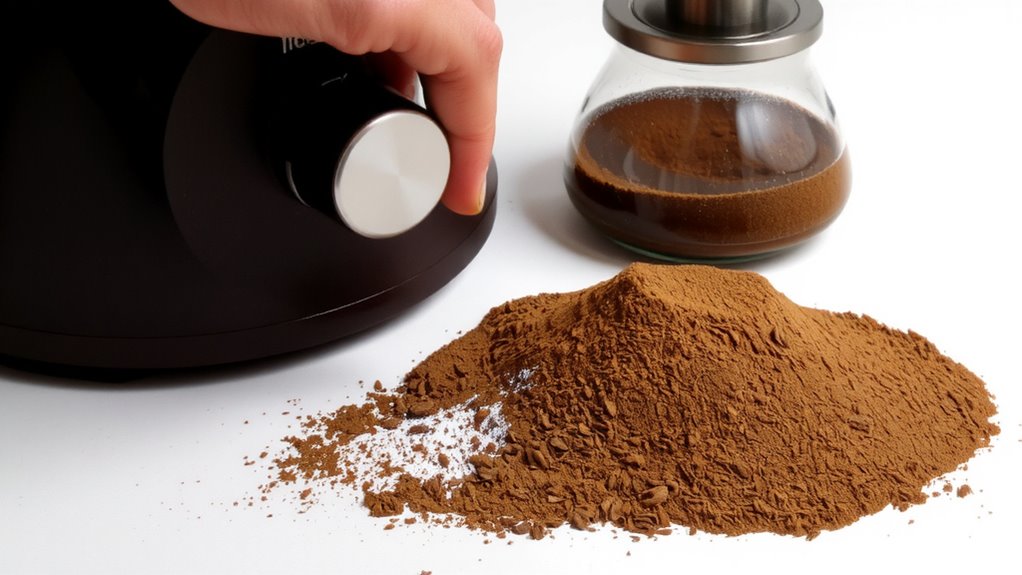
While the type of coffee and brew method matter, the grind size plays a crucial role in how strong and full-bodied your filter coffee tastes. Going finer increases surface area, which often boosts extraction and body, but only if your grinder maintains good grind consistency. Inconsistent grinds-like those from blade mills-create uneven particle distribution, leading to some fines over-extracting while larger bits under-extract. That hurts flavor clarity. For even results, use a burr grinder; models like the Baratza Encore or Fellow Ode deliver uniform particles. A consistent particle distribution helps water flow evenly, improving strength without muddiness. If the grind’s too coarse, coffee tastes thin; too fine, and it can clog filters or over-extract. Adjust in small steps. Your ideal setting depends on bean freshness, roast, and brew time. Match the grind to your gear and recipe for reliable, full-bodied results. For more precision and control, consider best mill grinders when upgrading your setup.
Spot Under-Extraction: Sour, Weak, or Flat?
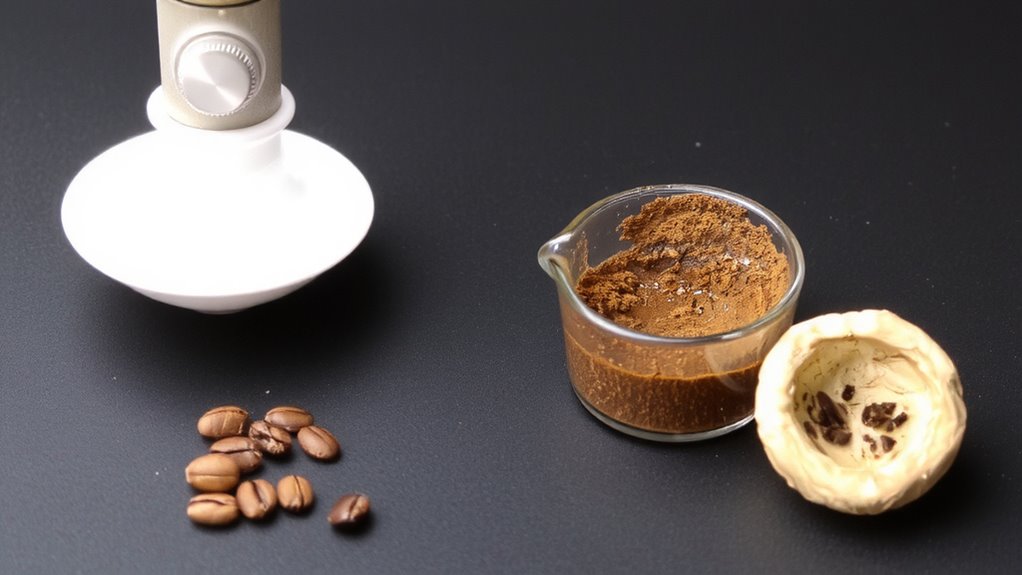
Sourness in your cup often points to under-extraction, and it’s a common issue when grind size is too coarse for your brew method. You’ll notice sharp sour notes, almost like biting into an underripe fruit-tart and unbalanced. That’s a clear signal the water passed through the grounds too quickly, pulling out acids but missing sweetness and complexity. Under-extracted coffee also tends to have a weak body, feeling thin or watery on your palate instead of rich and full. This happens because fewer dissolved solids make it into your brew. If your pour-over tastes hollow or flat, with little aftertaste, you’re likely under-extracting. Adjusting your grind finer-even slightly-can fix this by slowing down water flow and increasing extraction. Just don’t go too far, or you risk over-extraction. A consistent, medium-fine grind often hits the sweet spot for most filter setups. For pour-over mastery, using the best coffee grinds specifically tailored to your brewing setup can significantly improve both yield and body, with medium-fine grind being a key factor.
Start With a Stable Grinder: Here’s Why
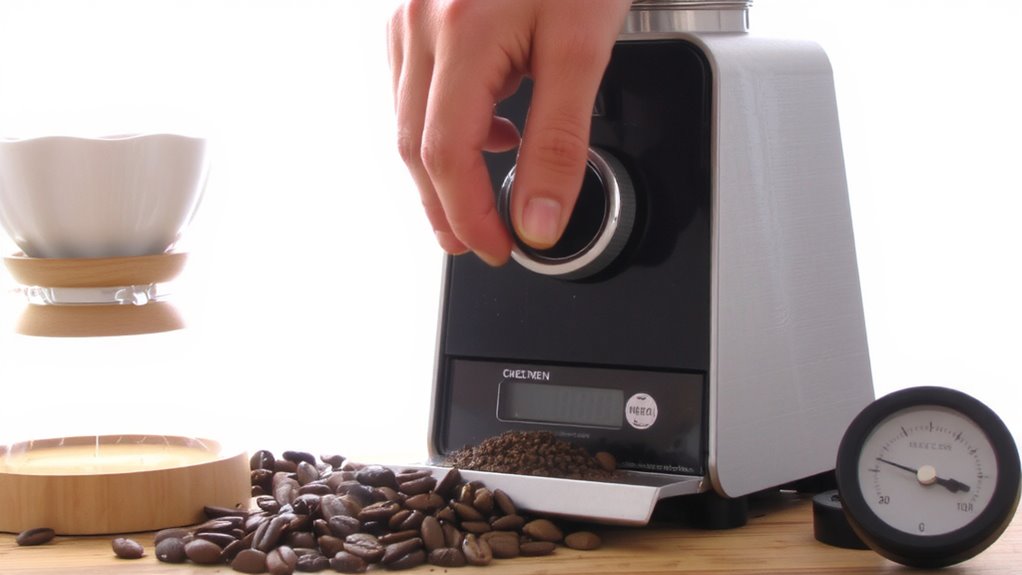
If you want to brew consistently great filter coffee, starting with a grinder that delivers uniform particle size is non-negotiable. Inconsistent grinds lead to uneven extraction-some particles over-extract while others under-extract, muddying flavor and weakening body. A stable grinder maintains precise burr alignment and consistent grinder calibration over time, ensuring each dose produces a predictable particle spread. Entry-level grinders often shift with heat or use, wrecking repeatability. Step burr grinders like the Baratza Encore help, but higher-end models such as the Omorihique Tetsu or Forté offer superior stability. Without reliable burr alignment, adjusting grind finer won’t improve yield-it’ll just increase clogging and bitterness. Check your grinder’s calibration monthly, especially if using it heavily. A stable baseline isn’t just helpful; it’s the foundation. Without it, every other tweak is guesswork. For a detailed overview of top-performing models that ensure consistency, check out the Best Coffee Grinders.
Adjust Finer in Tiny Steps (And Why 30 Seconds Matters)
A single 30-second adjustment can make or break your brew, especially when dialing in filter coffee. If you’re adjusting the grind finer to boost yield without losing body, do it in tiny steps-just 10 to 30 seconds’ worth on your grinder’s setting. Larger jumps risk over-extraction, harshness, and uneven particle distribution. Your grinder’s burrs should produce a tight grind consistency to guarantee even extraction. Inconsistent grounds-where fines mix too heavily with boulders-lead to muddy, over-extracted notes alongside weak, under-extracted ones. Entry-level grinders often struggle here, but even high-end models like the Baratza Virtuoso or 1ZPresso Q2 require careful tweaks. Small changes let you monitor flavor shifts without destabilizing the entire brew. Trust the process: fine-tune slowly, taste frequently, and prioritize uniform particle distribution above speed. That precision preserves body while increasing extraction.
Time Your Pour: Ideal Flow for Full Extraction
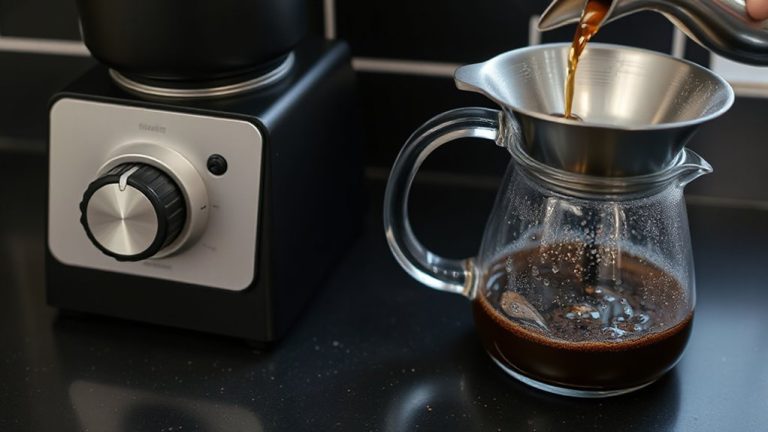
While extraction starts the moment water hits coffee, how you control the pour makes all the difference in achieving even saturation and full development. Good flow control guarantees water moves through the bed evenly, avoiding channels that cause uneven extraction. A steady, spiral pour technique from center to edge and back helps maintain stability. Pour too fast and you risk under-extraction; too slow and the brew stalls, turning bitter. Aim for a total brew time of 2:30 to 3:30 minutes for most 15–18g doses. Gooseneck kettles, like the Fellow Stagg or Hario Buono, give you precision most variable-speed kettles can’t match. Consistency matters more than speed-repeatable pour technique builds reliable results. Practice with timed pours to refine rhythm and pressure. Your grind sets the stage, but your hand controls the flow.
Fine-Tune With Temp and Stirring: Without Overcomplicating
You’ve got your grind set and your pour under control-now it’s time to make small tweaks that can sharpen your brew. Adjusting brew temperature and agitation technique doesn’t need to be complex, but it does make a difference. Lower temps (around 195°F) can reduce harshness, while 205°F extracts more sweetness. Try a full-stir with a spoon or swirl the carafe gently-your agitation technique impacts evenness. Too much agitation may over-extract fines, muddying clarity.
| Brew Temp | Effect on Extraction |
|---|---|
| 195°F | Softer, less acidic |
| 205°F | Brighter, fuller yield |
Keep changes minimal. A 5-degree shift or one extra stir can fine-tune your cup without requiring new gear or steps. Stay consistent, then adjust one variable at a time.
Taste and Tweak: Read Your Cup Like a Pro
How does your coffee taste-balanced, or leaning too sharp or flat? If it’s sour, you’re likely under-extracted-grind finer or extend brew time. Bitterness or dryness? Over-extracted-try a coarser grind or shorter contact time. Your cup preference matters, so adjust based on what you actually enjoy, not just “ideal” profiles. A well-balanced cup has clear sweetness, acidity, and body, not one dominating note. You want flavor balance, not maximum strength or clarity at the cost of mouthfeel. Taste objectively: sip at different temperatures, noting how the profile shifts. Did tweaking the grind improve body without losing yield? Great. Adjust one variable at a time-grind size first-then re-evaluate. Tools like the Kalita Wave or V60 respond quickly to changes, so use them to test adjustments. Your preferred brewer and grind setting should complement each other. Keep notes. Refine. Repeat.
On a final note
Dialing in a finer grind boosts extraction and yield without sacrificing body, but only if done gradually. Adjust in small increments and time your pour to avoid over- or under-extraction. Use a consistent grinder like the Baratza Encore for best results. Pair with stable water temp (around 200°F) and a brief stir for even extraction. Tasting tells you more than guesswork-adjust based on flavor, not theory.