Compensating for Lower Solubility in Natural Process Coffees With More Time
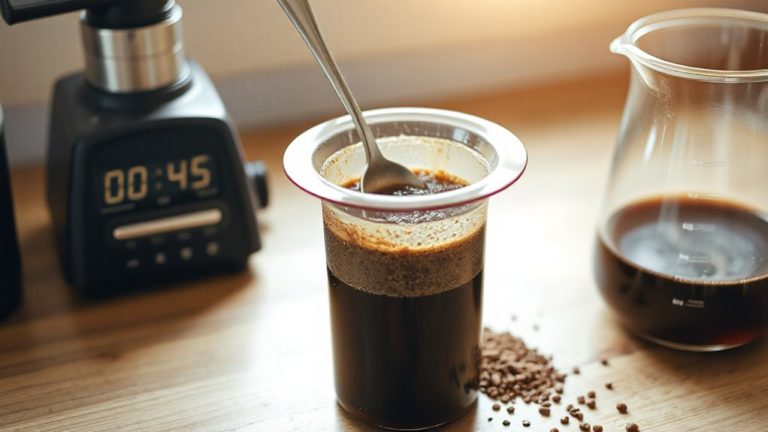
You need more brew time with natural process coffees because their dense structure and dried mucilage slow extraction. Aim for 30–45 seconds longer than washed beans, using water at 195–205°F. A gooseneck kettle helps control a slow, even pour. Try a slightly finer grind-like table salt-and consider immersion methods like French press or Clever Dripper for more consistent results. Use a burr grinder for uniform particles. You’ll get better sugar and compound extraction. There’s more to optimizing your brew based on process and equipment.
Notable Insights
- Natural process coffees have lower solubility due to dense cell structure from extended drying.
- Increase brew time by 30–45 seconds to improve extraction of locked sugars and compounds.
- Use a slightly finer grind, similar to table salt, to enhance surface area and solubility.
- Opt for immersion brewing methods to ensure even saturation and reduce channeling risks.
- Maintain water temperature between 195°F and 205°F for optimal extraction without scorching.
Why Natural Process Coffees Resist Extraction
While natural process coffees often deliver richer, fruitier flavors, they’re also more resistant to extraction due to the prolonged contact between the bean and the sugary mucilage during drying. You’ll notice this when brewing-water struggles to penetrate the bean evenly. That’s partly because of increased cell wall density from extended drying, which physically blocks water access. On top of that, fermentation impact alters internal structure, sometimes creating uneven micro-channels that lead to inconsistent extraction. You’re not imagining it-these beans really do demand more from your grinder and brewer. If your espresso shots run slow or your drip coffee tastes hollow, it’s likely due to these barriers. To counter this, you’ll need to adjust your approach-starting with grind size. A finer setting helps, but don’t rush to conclusions. Test in small batches, track changes, and remember: not all naturals behave the same.
Extend Brew Time to Improve Natural Coffee Flavor
Because natural process coffees are denser and harder to extract evenly, you’ll often need to extend your brew time to get the best flavor. A longer contact time between water and grounds helps dissolve more sugars and compounds that otherwise remain locked in the bean. Aim for a total brew time 30–45 seconds longer than you’d use for a washed coffee. Keep your water temperature steady-between 195°F and 205°F-to support consistent extraction without scalding. Too hot, and you risk bitterness; too cool, and under-extraction worsens. Pair this with careful agitation control: start with a gentle pour to minimize turbulence, then maintain a uniform flow. This reduces channeling and promotes even saturation. Devices like the Kalita Wave or Chemex respond well to this approach. You’ll notice sweeter, more balanced results-think red berries, chocolate, or stone fruit-without the harshness that comes from rushed or uneven brewing.
Optimize Pour-Overs With Slower Extraction
You’ve already seen how extending brew time improves extraction in natural coffees, and that same principle applies when fine-tuning pour-overs. Slowing your pour increases contact time, boosting extraction without raising temperature. This is key with denser natural beans that resist solubilizing. A controlled, steady pour reduces excessive water turbulence, which can channel water unevenly through the bed and hurt extraction uniformity. Instead, aim for a consistent spiral, saturating all grounds evenly. Use a gooseneck kettle-like the Fellow Stagg or Hario V60 drip-since they offer precision most standard kettles lack. If your coffee tastes flat or overly fruity, you’re likely under-extracting. Try stretching your brew time 15–30 seconds. Just don’t overdo it-too slow risks over-extraction in fines. Balance is everything. For even greater control, consider upgrading to one of the best gooseneck kettles for precision pouring.
Choose Immersion Brewing for Full-Bodied Naturals
How do you get the most out of dense, full-bodied natural coffees without over-extracting or highlighting their harsh edges? You use immersion brewing. Methods like the French press, Aeropress, or Clever Dripper let grounds steep fully in water, promoting even extraction and reducing channeling risks. This slow, consistent contact boosts body enhancement, pulling out more oils and heavier compounds that highlight a natural’s richness. Unlike pour-overs, immersion limits the aggressive extraction of bitter notes, especially in uneven grinds. You get deeper flavor immersion, capturing the coffee’s fruity, winey character without thinness. It’s ideal for lower-solubility naturals that need time, not speed. Just watch your brew time-too long and you risk over-extraction. Keep water just off boil, stir gently at start, and use a medium-coarse grind. Immersion won’t fix poor beans, but with quality naturals, it delivers bold, balanced, syrupy cups. For those looking to explore the best equipment for this method, consider starting with one of the top-rated non-pod coffee machines designed for immersion brewing.
Adjust Grind and Dose for Balanced, Smooth Results
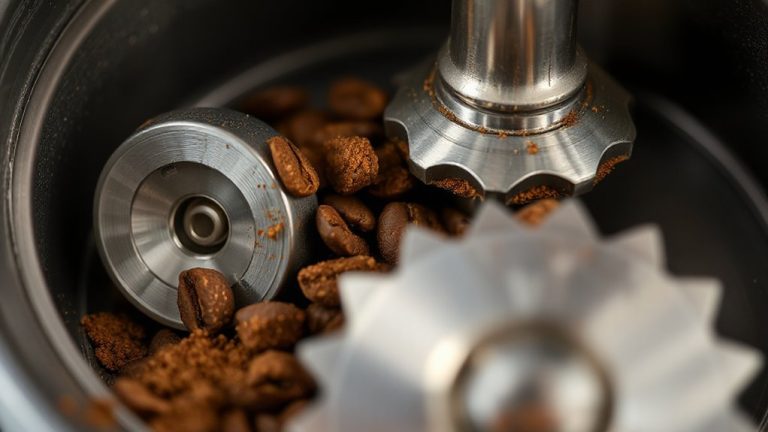
While immersion brewing sets the stage for rich extraction, getting the grind and dose right is what actually balances flavor and body. You’ll want to use a slightly finer grind than usual-think medium-fine, like table salt-to increase surface area and boost extraction despite lower solubility in naturals. But don’t go too fine; over-extraction brings unwanted bitterness. Pair this with a standard dose of 60 grams per liter. This ratio, combined with stable water temperature around 93–96°C, guarantees even saturation. Use gentle agitation control: stir once at the start, then leave it. Too much stirring disrupts even extraction and increases fines migration, muddying the cup. A gooseneck kettle helps maintain precision, while a reliable burr grinder like the Baratza Encore guarantees consistency. These small tweaks enhance sweetness and clarity without sacrificing the heavy body naturals are known for. It’s not just time-you’re fine-tuning the whole system. For filter brewing, choosing the right best grinder for filter coffee can make a significant difference in extraction consistency and flavor balance.
On a final note
You can balance natural process coffees by extending brew time, since they extract slower due to lower solubility. Try pour-overs with a finer grind and slower pours, or switch to immersion methods like a French press for fuller body. Adjust grind size and dose as needed-finer for more extraction, coarser if bitter. These tweaks help you get smoother, more balanced results without overcomplicating your setup.