How Brazilian Producers Leverage Yellow Catuai for Consistent Washed Process Coffees
You rely on Yellow Catuai because it delivers high yields and ripens evenly, letting you harvest in just one or two passes. Its compact size supports dense planting and mechanization, while solid rust resistance cuts losses and fungicide use. Uniform beans respond predictably to washed processing in stainless steel tanks, where you can control fermentation with pH checks and cooling. This gives clean, balanced cups with caramel, nut, and citrus notes-especially when roasted medium. Cold fermentation sharpens clarity, and proper grinding guarantees peak extraction. You’re already set up for consistency, but there’s still more to get right.
Notable Insights
- Yellow Catuai’s compact, high-yielding structure supports dense planting and efficient mechanized farming in Brazil.
- Its disease resistance and climate adaptability ensure stable yields across diverse Brazilian growing regions.
- Uniform ripening reduces harvest passes, lowering labor costs and improving berry consistency for processing.
- Dense, uniform beans respond predictably to controlled fermentation in stainless steel tanks for consistent quality.
- Washed processing highlights clean, balanced flavors like caramel, nuts, and citrus in the final cup.
Why Yellow Catuai Dominates Brazilian Coffee
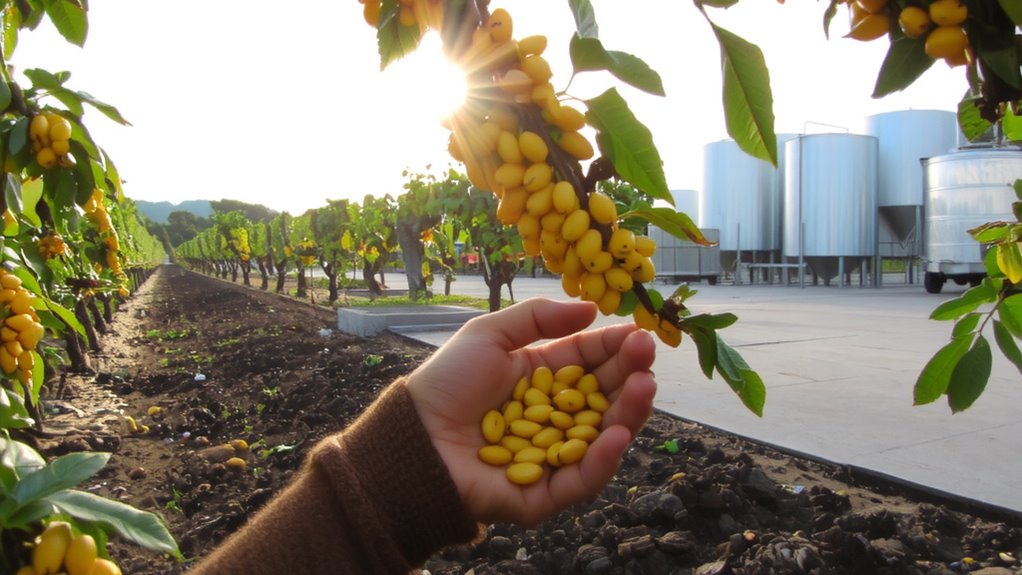
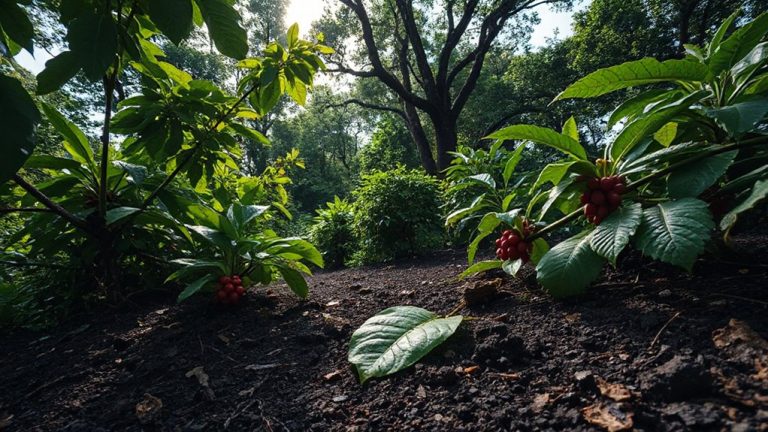
Yellow Catuai’s dominance in Brazil starts with practicality-it’s a high-yielding, compact tree that fits well in mechanized farms, which most Brazilian producers rely on. You’ll find its compact growth reduces spacing needs, letting farmers plant more trees per hectare without sacrificing access for machinery. That’s essential in large-scale operations where efficiency trumps tradition. It also offers solid disease resistance, especially against rust when managed properly, reducing crop loss and cutting down on fungicide use. While not bulletproof, this resilience gives you more predictable harvests year to year. Other varieties like Bourbon yield less and need more labor, making them less viable at scale. Catuai’s blend of compact growth, yield, and disease resistance aligns perfectly with Brazil’s focus on volume and cost-effective production. You’re not choosing it for exotic flavors-you’re choosing it because it works, consistently, under real-world conditions.
How Yellow Catuai Enables Consistent Washed Processing
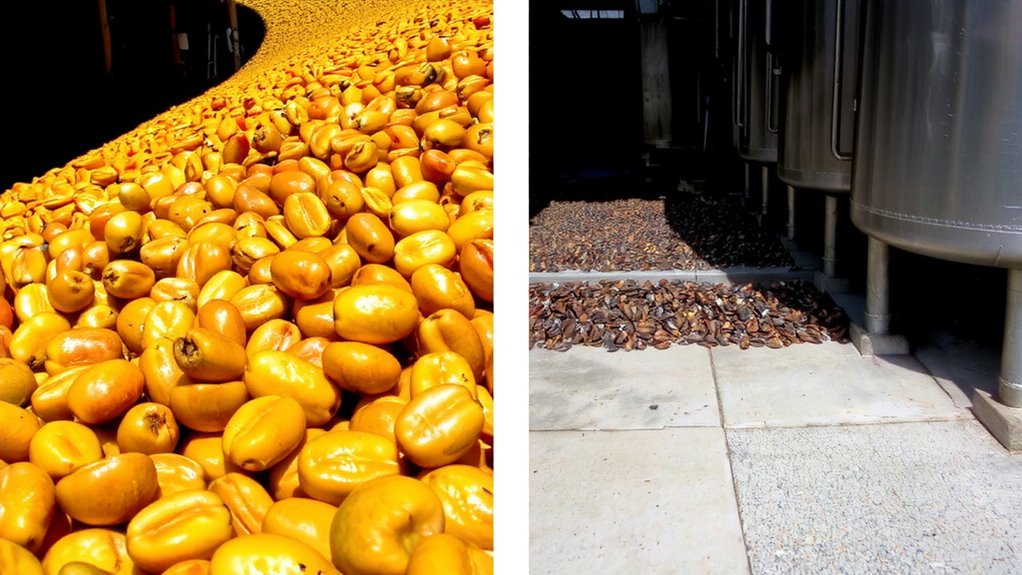
A lot of Brazilian producers stick with Yellow Catuai for washed coffees because it holds up well during processing-its dense, uniform beans respond predictably to depulping and fermentation, which helps maintain consistency across batches. You’ll find it thrives in the region’s well-drained soils, thanks to its strong soil adaptation, reducing nutrient stress that could affect bean quality. It also suits the microclimate preference of Brazil’s main growing areas, where moderate rainfall and distinct dry seasons support even fruit development. Because the plant matures reliably under these conditions, you get fewer fermentation issues during wash processing. That predictability means less batch variation and more control over the final cup profile. When you’re aiming for clean, balanced washed coffees at scale, these traits make Yellow Catuai a practical choice. Producers relying on consistent moisture and temperature ranges benefit most-its performance falters only if grown outside its preferred environment.
Uniform Ripening, Fewer Passes, Lower Costs
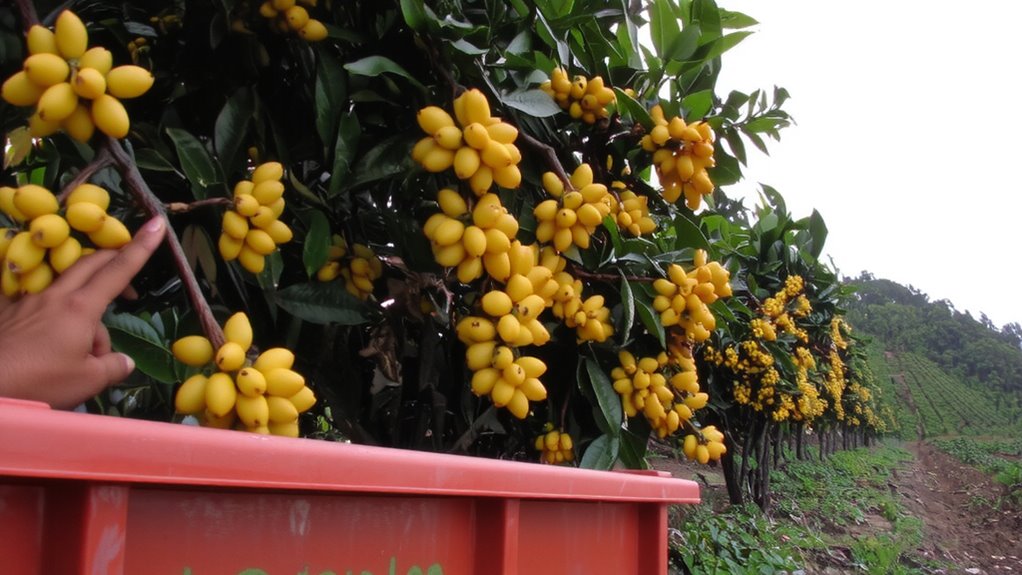
Since the Yellow Catuai variety ripens evenly across branches, you can harvest most of the crop in just one or two passes, which saves time and cuts labor costs. This uniform ripening reduces the need for multiple selective pickings, making it easier to process larger volumes consistently. You’ll find it especially effective in regions where soil composition supports balanced nutrient uptake, promoting synchronized bean development. Its strong climate adaptation also helps maintain this uniformity across varying microclimates, from higher-altitude plateaus to warmer lowlands. Because the plant responds predictably to local conditions, you’re more likely to achieve consistent harvest timing without sacrificing bean quality. Fewer passes mean less wear on equipment and lower fuel use, which streamlines operations during peak season. For producers focused on efficiency, Yellow Catuai offers a practical advantage in both labor management and operational cost, particularly when growing at scale under washed process conditions.
Controlling Fermentation for Cleaner Cups
You’ve harvested the evenly ripened Yellow Catuai in just one or two passes, which already saves time and reduces labor-but now comes the next step that directly affects cup quality: fermentation. You need to control microbial diversity to avoid off-flavors. Using pH monitoring helps you track acid development and stop fermentation at the right moment. Many producers use stainless steel tanks with lids to limit unwanted microbial exposure. Others prefer temperature-controlled rooms to maintain consistency across batches.
| Method | Benefit |
|---|---|
| Open tanks | Low cost, more microbial diversity |
| Sealed tanks | Controlled microbial activity |
| pH strips | Inexpensive, fast readings |
| Digital pH meter | Accurate, repeatable results |
| Cold fermentation | Slower process, cleaner cup |
Sweet, Balanced Flavor: Caramel, Nuts, and Citrus
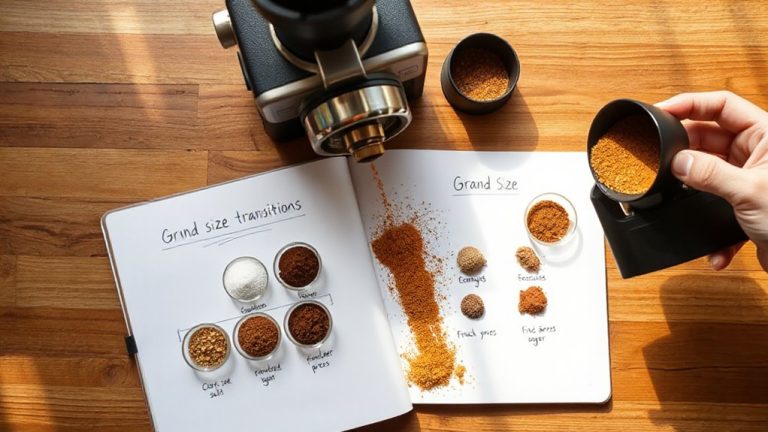
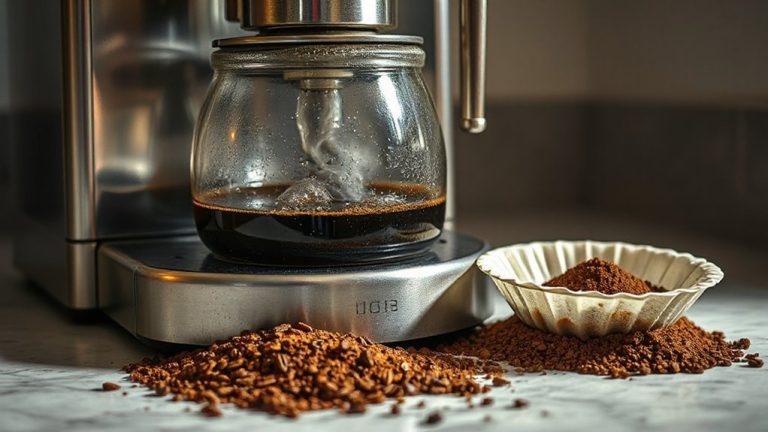
This Yellow Catuai, when processed with care, delivers a clean cup profile defined by sweet, balanced notes of caramel, roasted nuts, and a bright undercurrent of citrus. You’ll often detect hints of tropical fruit like papaya or mango, especially when brewed with a medium roast to preserve sweetness. Light roasting can enhance floral notes and citrus lift, but go too light and you risk underdeveloping the nutty depth this bean is known for. You’re aiming for balance-enough heat to caramelize sugars, but not so much that you mute the delicate layers. A reliable burr grinder guarantees even particle size, essential for extracting all flavor notes without bias. Brew it via pour-over or batch brew for clarity. The washed process sharpens these characteristics, filtering out fermentation artifacts so the bean’s inherent profile stands clean and consistent, with no distractions.
High Yield Without Sacrificing Specialty Quality
Yield matters when you’re running a farm, and Yellow Catuai delivers. You get high output per hectare without giving up the quality needed for specialty grades. Its compact growth allows dense planting, boosting efficiency. Unlike lower-yielding heirloom varieties, Yellow Catuai maintains cup quality even under high production, scoring consistently in the 84+ range when properly processed. Its climate resilience helps stabilize yields as weather patterns shift, reducing losses during dry spells or erratic rains. While it’s not as genetically diverse as some landrace varieties, pairing Yellow Catuai with other cultivars on your farm improves genetic diversity and lowers disease risk. You still need precise nutrition and pruning to avoid overburdening trees. Don’t rely on it exclusively-diversify to hedge against pests like coffee borer. When managed well, Yellow Catuai balances volume and excellence, making it a practical choice for specialty washed coffees at scale.
On a final note
You’ll find Yellow Catuai a solid choice for washed coffees, thanks to its even ripening and high yields. It reduces harvest passes, cutting costs without sacrificing quality. When processed carefully, it delivers a clean, sweet cup with notes of caramel, nuts, and a hint of citrus. While not as complex as some heirlooms, it’s more predictable than many modern hybrids-ideal for consistent, mid-to-high-tier specialty lots.