How to Match Grind Size to Basket Type and Wall Thickness for Stability
Match your grind size to your basket’s type and wall thickness for stable shots. VST or narrow baskets need a slightly finer, uniform grind to prevent channeling, while thicker-walled baskets resist warping and support even puck pressure. Use finer grinds for doubles (14–20g), slightly coarser for singles (7–9g). With bottomless portafilters, a consistent, fine-tuned grind reveals flaws fast-dial it in carefully. You’ll see how small tweaks make bigger differences than you think.
Notable Insights
- Match finer, uniform grinds to VST baskets for optimal flow control and extraction stability.
- Use slightly coarser grinds in single baskets to prevent over-restriction and maintain consistent shot times.
- Opt for more precise, finer grinds in narrow baskets to minimize channeling and improve puck integrity.
- Choose thicker-walled baskets to enhance puck stability and reduce warping under high pressure.
- Adjust grind size based on basket geometry and wall rigidity to ensure even water distribution and extraction.
How Basket Design Shapes Your Grind Needs
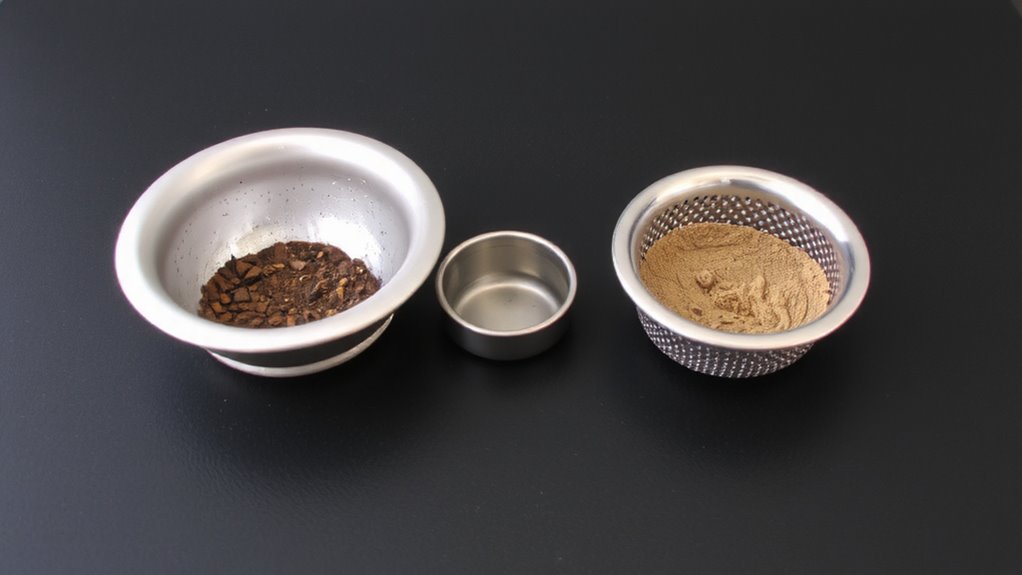
Basket design isn’t just metal and holes-it directly shapes how finely or coarsely you need to grind your coffee. Your basket’s geometry affects flow rate and extraction, meaning a VST basket with its precise basket geometry demands a finer, more uniform grind than a standard basket. If your grinder can’t deliver sufficient grind consistency, you’ll see uneven pours or clogging. Narrower baskets, like 15g twin types, work best with slightly finer settings and high consistency to avoid channeling. Wider baskets, such as 20g ones, offer more margin for minor grind inconsistencies but still depend on proper basket geometry for even distribution. You’ll get better results when your grind size matches the basket’s design specs-using a high-precision grinder helps. Always calibrate your grind based on your basket’s shape and capacity, not just dose or brew time.
Why Wall Thickness Affects Puck Stability
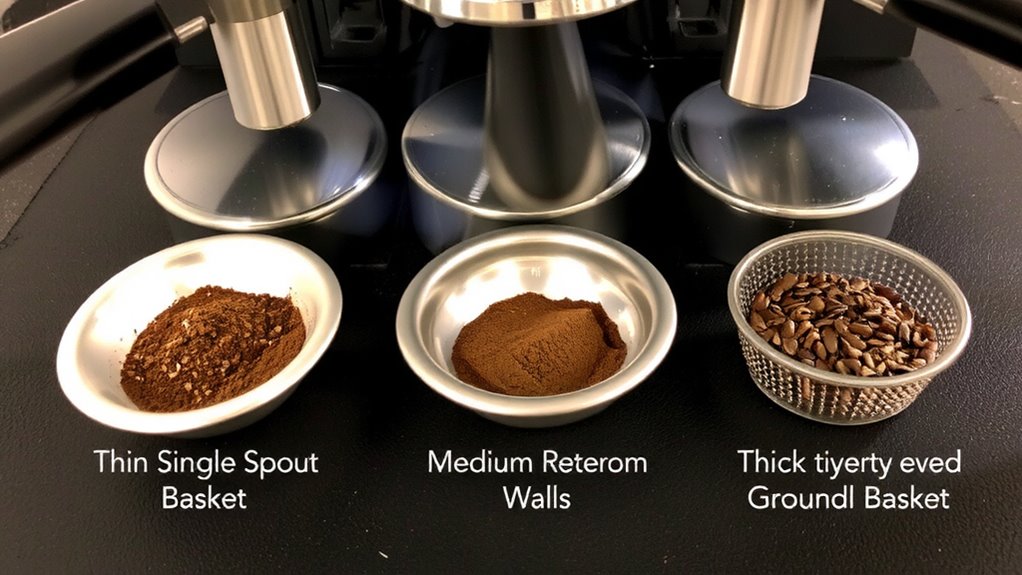
While most baristas focus on grind size and tamping pressure, the wall thickness of your portafilter basket plays a quiet but critical role in puck stability. Thicker walls offer better structural support, reducing flex during brewing and helping maintain even water distribution. Thin-walled baskets may warp over time, especially with frequent thermal stress, compromising wall integrity and increasing channeling risks. You’ll notice this as uneven extraction or inconsistent shot times. Most commercial baskets, like those from IMS or Stockfleth’s, use thicker walls for durability and reliability. After tamping, a rigid basket resists deformation, keeping your puck level and sealed against the group head. That structural support matters most under high pressure. If you’re pulling shots on a machine with strong pumps-like a Slayer or Bezzera-using a thin-walled basket can undermine even a perfect tamp. Stick with proven designs where wall integrity isn’t sacrificed for weight or cost. For reliable performance, consider upgrading to best portafilters that prioritize durability and precise engineering.
Single Vs. Double Baskets: Grind and Dose Adjustments
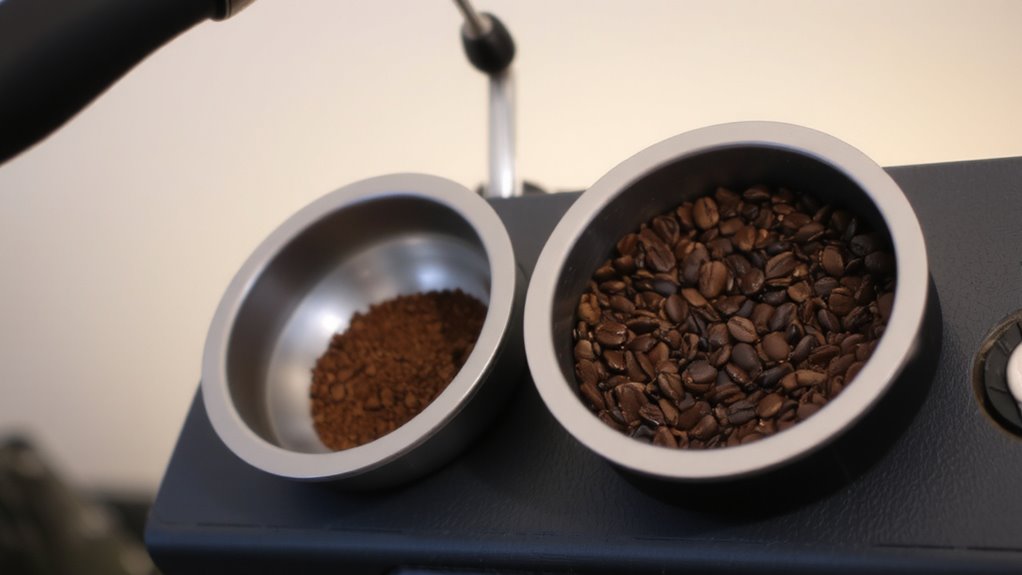
You’ve seen how a basket’s wall thickness influences puck stability under pressure, especially on high-performance machines. Now, when choosing between single and double baskets, your grind size and dose must align with the basket’s capacity. Single baskets hold less coffee-typically 7–9 grams-so you’ll need a slightly coarser grind than you might expect for the same shot timing as a double. Doubles, holding 14–20 grams, allow finer grinds without over-restricting flow. Adjusting tamping pressure matters more in singles due to lower mass, increasing the risk of uneven compaction. With doubles, consistent tamping pressure helps maintain shot timing across pulls. Using a single basket often demands tighter control over variables. If your shots run too fast in a single, don’t just grind finer-check your dose and tamping pressure first. Matching the basket type to your workflow guarantees more stable, repeatable results. Upgrading to a precision best portafilter can further enhance extraction consistency and temperature stability.
Dialing In VST Baskets for Even Extraction
Since VST baskets are designed with precision laser-cut holes and a consistent internal geometry, they tend to promote more even extraction compared to standard baskets-especially when you’re using fresh, evenly ground coffee and a good tamp. You’ll notice better extraction symmetry because the uniform holes reduce channeling and help water spread evenly. For best results, match your grind size closely to the basket’s volume and keep grind consistency tight-your grinder’s burrs should be clean and aligned. If you’re seeing uneven flow or dark streaks in the shot, check your distribution and tamp. VST baskets work well with a range of roast levels, but they really shine with medium to light roasts where clarity matters. Don’t rush the dial-in process-small grind adjustments make a real difference. With patience, you’ll maximize extraction symmetry and flavor balance.
Optimizing Grind for Bottomless Portafilter Performance
A bottomless portafilter gives you immediate feedback on your puck prep and extraction, showing exactly where water breaks through first-something you can’t see with a spouted portafilter. You need fine grind consistency to prevent weak spots, since any unevenness becomes obvious fast. A uniform grind helps achieve balanced extraction symmetry, leading to cleaner, sweeter shots. Go slightly finer than you would for a spouted basket, but avoid going too fine-choking is common with bottomless designs. Use a high-quality burr grinder; flat or conical, just guarantee particles are even. Pull shots and watch the slugs form-if they shoot out one side first, adjust your grind or technique. Bottomless portafilters demand precision, but they teach you fast. They’re ideal for learning proper tamping and grinder setup. Just remember: consistency in dose, grind, and distribution gives you the best results. For optimal performance, consider investing in one of the best espresso grinders recommended by experts.
Fix Channeling With the Right Grind-Basket Match
Some grinders and baskets simply don’t play well together, and mismatched grind size is often the culprit behind stubborn channeling. If your espresso shots run too fast or taste weak, you’re likely grinding too coarsely for your basket type. A finer grind improves grind uniformity, helping water flow evenly through the puck. With poor uniformity, water finds paths of least resistance, creating channels. Thicker basket walls, like those in triple-tier VST baskets, need slightly finer grinds to maintain stability under normal tamping pressure. Too much pressure on an uneven or coarse grind worsens channeling. Matching your grind size precisely to your basket’s design guarantees even extraction. For example, a 16g single-wall basket works best with a finer, more consistent grind than a 20g double-wall one. Get the pairing right, and you’ll see smoother flows and better-tasting shots-no guesswork needed.
Test and Refine Your Ideal Grind-Basket Pair
You’ve probably noticed how small tweaks in grind size can make or break your shot, especially when certain baskets seem to underperform no matter how well you tamp or dial in. That’s why testing and refining your ideal grind-basket pair matters. Start with a stable dose distribution-level the coffee evenly before tamping to avoid channeling. Then adjust grind size in small increments, checking for flow rate and taste. A well-matched basket improves grind consistency, leading to even extraction. Try a triple basket with a finer grind if you’re pulling short shots, or switch to a single basket with a coarser setting for sour, fast pulls. VST baskets offer precision, while IMS rings boost stability. Always log changes and results. Repeat until flavor is balanced and shot time hits 25–30 seconds. It’s methodical, but it works.
On a final note
Choose the right grind size based on your basket type and wall thickness to boost shot consistency. Thicker basket walls need a slightly coarser grind for stability, while single baskets often require less coffee and finer grinds than doubles. VST baskets demand precise matching for even extraction. Use a bottomless portafilter to spot channeling early. Always test, tweak dose and grind, and refine for your machine and beans.