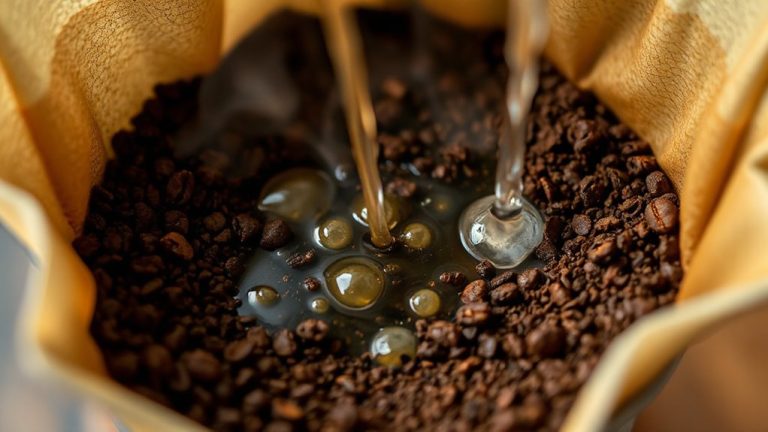
How to Visually Assess Your Coffee Grind Quality Without Special Equipment
Check your coffee’s grind size by comparing it to everyday textures-coarse like sea salt for French press, fine like table salt for espresso. Look for consistent particles; if you see boulders or dusty fines, your grinder isn’t uniform. Spread grounds on a white plate to spot inconsistencies. Feel it: gritty means coarse, powdery means fine. Uneven grinds cause bad flavors. Adjust your grinder in small steps. You’ll see how better control improves your cup.
Notable Insights
- Look for uniform particle size; consistent granules indicate even grinding, while mixed sizes suggest poor consistency.
- Compare grind texture to common references like sea salt for coarse or table salt for fine grinds.
- Spot dark chunks and fine powder together, which signal uneven grinding and potential extraction issues.
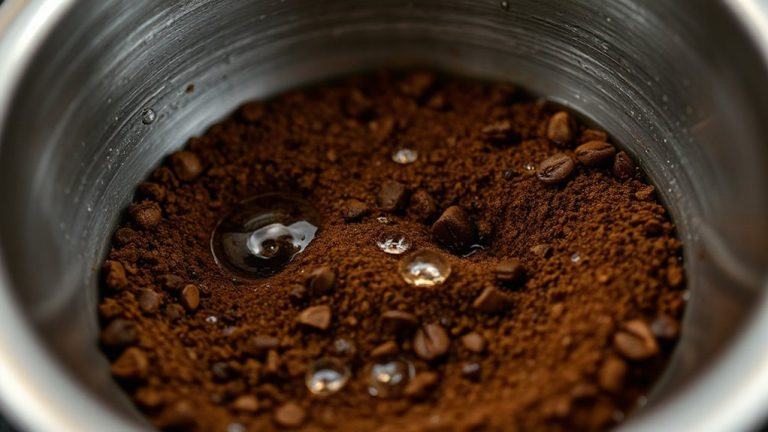
- Observe flow during brewing; if water pools or drains too fast, the grind may be too coarse or too fine.
- Check for oily residue or clumping; visible oil or stickiness may indicate roast level or moisture problems.
Choose the Right Grind Size for Your Brew Method
Most of the time, the difference between a balanced cup and a disappointing brew comes down to matching your grind size to your brewing method. If you’re using a French press, you’ll need a coarse grind-fine particles can slip through and make your coffee muddy. For pour-over, go medium-fine so water extracts evenly without stalling. Espresso? That demands a fine grind, almost like table salt, to handle high pressure. Your grinder’s quality affects grind consistency, which directly impacts brew optimization. Blades often create uneven particles, leading to over- and under-extraction. A burr grinder gives more uniform granules, improving flavor clarity. If your coffee tastes bitter or weak, check the grind first. Adjusting size and ensuring consistency isn’t fussy-it’s practical problem-solving. Small tweaks can dramatically improve your daily cup without new gear or fancy techniques. Refer to a detailed coffee grind guide to match the ideal particle size to your specific brewing device for best results.
Match Your Grind to These Everyday Textures
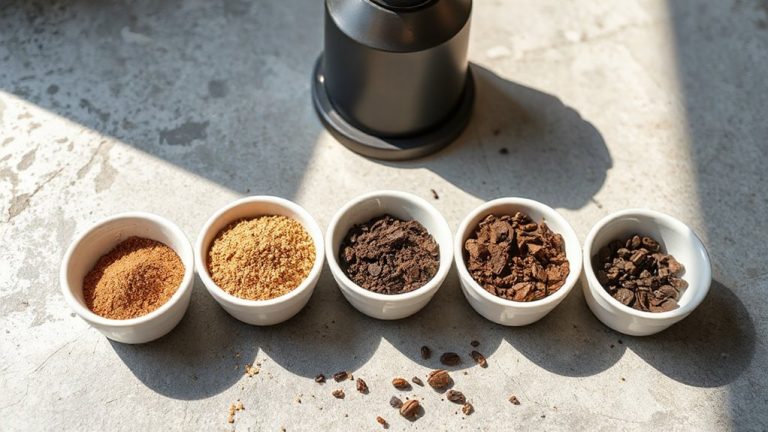
How do you know if your grind is on point? Use texture mapping to compare your coffee grounds to common household items. This grain comparison helps you spot the right coarseness without tools. Match your brew method to these everyday textures for better results.
| Brew Method | Grind Texture | Everyday Match |
|---|---|---|
| French Press | Coarse | Sea salt |
| Pour Over | Medium-coarse | Sand |
| Drip Coffee | Medium | Regular sugar |
| Aeropress | Medium-fine | Table salt |
| Espresso | Fine | Powdered sugar |
You’re aiming for consistency. If your grind looks too chunky or dusty, adjust your grinder. Texture mapping isn’t perfect, but it’s a reliable field test. Use it to fine-tune your grind size and improve extraction-no special gear needed. This grain comparison works fast and keeps your brewing practical. For even better results, consider upgrading to a quality burr grinder within your budget, as they provide consistent grind size, which is essential for balanced extraction across all brew methods.
Look for Mixed Particle Sizes: That’s Uneven Grinding
While you’re checking grind texture, keep an eye out for a mix of particle sizes-this is uneven grinding, and it hurts your brew. Poor particle distribution means some grounds extract too fast while others under-extract, leading to unbalanced flavor. You want consistent grind consistency so water flows evenly through the coffee bed. This is common with blade grinders, which chop rather than crush, creating random sizes. A burr grinder gives far better results, producing uniform particles-especially flat or conical burrs in mid-range or high-end models. If your batch looks patchy, with obvious chunks and powder together, that’s a red flag. Good distribution improves clarity and sweetness in your cup. Always check a few spoonfuls under light to assess overall uniformity. You’ll notice the difference in taste. Consistent size equals consistent extraction. For those who travel often, achieving this consistency is easier with a portable setup that includes a best portable coffee maker.
See Boulders and Fines? Your Coffee Grind Is Off
Ever pulled apart your coffee grounds and spotted large chunks mixed with a dusty powder? That’s a red flag. Those big pieces are boulders, and the tiny specks are fines-both signal poor grind consistency. Proper boulder detection starts with a quick visual check right after grinding. If you see uneven particles, your grinder’s likely chipping beans instead of cutting them evenly. Uneven boulders extract too slow, while excessive fines over-extract, leading to bitter, unbalanced coffee. A good burr grinder improves fines distribution by producing uniform particles. Blade grinders often fail here, creating chaotic sizes. Even some low-end burr models struggle with consistency. For espresso or pour-over, consistent size matters most. Adjust your grinder settings or consider upgrading if boulders and fines persist. Consistency means better flavor-every time.
Rub It Between Your Fingers: Here’s What It Tells You
A pinch of ground coffee rubbed between your fingers can reveal more than you think. If you notice oily finger residue, your beans are likely dark roasted and may clog grinders over time-common in supermarket beans. Lighter roasts usually leave little to no residue. Check for grain stickiness, too; sticky grounds suggest moisture, which harms grind consistency and speeds staling. Freshly ground dry beans shouldn’t clump or feel tacky. Uniform texture indicates a consistent grind, essential for even extraction. If it feels coarse and gritty, it’s likely suited for French press. Smooth, powdery means it’s fine, better for espresso. Avoid any dampness or clumping-signs of poor storage or old beans. This quick test helps confirm what your eyes might miss, giving you real-time feedback on freshness and grind performance without tools.
Tweak Your Grinder Settings Visually
What do you see when you look at your coffee grounds? If some particles look sandy while others are chunky, your grind lacks visual consistency. That’s a sign your grinder calibration needs adjusting. For even extraction, grounds should resemble uniform granules-like coarse sugar for French press or fine sand for espresso. Check a handful under good light. If you spot boulders (large chunks) or fines (dusty bits), tweak your grinder’s settings slightly. Blade grinders often struggle here; burr grinders give better control. Adjust in small increments, then reassess. Proper calibration means repeatable results cup after cup. Don’t guess-use visual consistency as your guide. It’s not perfect, but it’s effective when you lack lab tools. Over time, you’ll learn how tweaks affect the outcome. That’s how you dial in smarter, faster, every morning.
Fix These Common Grind Problems at a Glance
You’ve already learned how to spot inconsistencies in your grind by eye, and that visual check sets the stage for solving everyday grinding issues quickly. If your grounds look uneven, with dark chunks and fine dust, your grind lacks color consistency, which often leads to over- and under-extraction. Adjust your grinder’s burrs to reduce this variation. If the aroma intensity seems weak after grinding, it’s likely your grind size is too coarse or your beans are stale. Finer grinds expose more surface area, boosting aroma intensity. For espresso, aim for a fine, even grind with rich color consistency; for French press, a coarse, uniform grind prevents sludge and muted aroma. Grind just before brewing to preserve scent and flavor. With a quick visual scan and attention to these details, you’ll catch problems early-no tools needed.
On a final note
You now know how to check your coffee grind using just your eyes and hands. Match the texture to your brew method, watch for inconsistent particles, and feel for clues between your fingers. Adjust your grinder if you spot boulders or fines. These quick checks help you fix issues fast, without tools. Good grinding means better flavor-every time. Stay consistent, stay observant.