The Impact of Water Temperature on Tannin Release in Over-Extracted Coffee
You’re pulling out more tannins when you brew above 205°F, especially if the water stays in contact too long. High heat speeds up extraction, pulling bitter compounds from cellulose after sugars and acids are done. That’s why over-extracted coffee tastes harsh. For balanced flavor, keep water between 195–205°F-use a kettle like the Fellow Stagg EKG for precision. Pour-over and espresso need this range, but cold brew skips the bitterness entirely. The right temperature for your method makes all the difference-there’s more to how gear shapes the final cup.
Notable Insights
- High water temperature above 200°F accelerates tannin extraction, increasing bitterness in over-extracted coffee.
- Over-extraction combines prolonged brew time and high heat, releasing bound tannins from degrading coffee cellulose.
- Temperatures over 210°F promote rapid, harsh extraction, overwhelming desirable flavors with astringent tannins.
- Maintaining water between 195–205°F helps balance extraction, minimizing excess tannin release in most brewing methods.
- Cold brewing avoids thermal breakdown, significantly reducing tannin extraction and producing smoother, less bitter coffee.
Tannins and Their Role in Coffee Bitterness
You’ve probably noticed that some coffee tastes harsh or mouth-puckering, and tannins are often behind that bitterness. In coffee chemistry, tannins are polyphenolic compounds that bind with proteins and contribute to a drying sensation on your palate. While they naturally occur in coffee beans, over-extraction pulls out excessive tannins, overwhelming delicate flavor compounds like fruity acids and floral notes. This is especially common with prolonged brew times or fine grinds, even at ideal water temperatures. Light roasts tend to have more complex flavor compounds but can become unbalanced if tannins dominate. Medium roasts often strike a better balance. To minimize harshness, use fresh beans, a consistent grind, and avoid steeping too long. A gooseneck kettle helps control water flow, improving extraction precision. Ultimately, managing tannins isn’t just about temperature-it’s about the whole brewing picture.
How Heat Accelerates Tannin Extraction
When water temperature climbs above 200°F, it pulls compounds from coffee grounds faster-and that includes tannins. The boost in heat increases kinetic energy, speeding up molecular diffusion so solubles escape cells more readily. You’re not just getting more flavor-you’re getting more of everything, desirable or not. That’s why temperature control matters in gear like the Breville BES870 or Fellow Stagg EKG. Without it, you risk harshness before you even hit ideal brew time. For precise heat management, consider using a gooseneck kettle with temperature control, which allows barista-level accuracy during pour-over brewing.
| Temperature (°F) | Effect on Tannin Extraction |
|---|---|
| 195 | Moderate, balanced release |
| 200 | Noticeably faster diffusion |
| 205 | High yield, increased bitterness |
| 210 | Rapid extraction, risk of harshness |
You’ll want to stay between 195–205°F for control. Go higher, and kinetic energy overwhelms structure, releasing tannins fast.
Why Over-Extraction Releases More Tannins?
Higher water temperatures speed up extraction, but leaving grounds in contact with water too long pushes things too far-no matter the gear. You keep pulling past ideal, and that’s when over-extraction kicks in. At this stage, delicate acids and sugars are already out, so water starts attacking tougher compounds. Cellulose degradation begins, breaking down plant structure and releasing bound tannins you don’t want. Solubility shifts also play a role-compounds once hard to extract dissolve more readily under prolonged exposure. That’s why your brew turns harsh and astringent. Whether you’re using a French press or pour-over, timing matters just as much as temp. Even with perfect grind size and water quality, leaving coffee too long in contact invites bitterness. Avoid extended brews-especially with metal filters or coarse grinds that trap fines. Keep your brew within 20–30 seconds of target time to stay clean.
Optimal Temperatures for Balanced Coffee
Though brewing temperature plays a critical role in extraction, most drip coffee makers default to a range that’s often too hot for balanced flavor. You’re better off using water between 195°F and 205°F-hot enough to extract sugars and acids, but not so hot that you pull excessive tannins. If your machine runs hotter, consider upgrading to a variable-temperature brewer like the Fellow Ode or Technivorm. For low-tannin, mellow coffee, cold brewing is a solid choice. It uses room-temperature or cold water over 12–24 hours, greatly reducing tannin release while enhancing flavor preservation. Cold brewing won’t give you the same brightness as hot coffee, but it delivers smoothness and shelf stability. Keep in mind, though, it requires planning and more space. Whether hot or cold, controlling temperature is one of the easiest ways to improve balance in every cup you make.
How Brew Method Shapes Temperature Needs
Why does your pour-over need different heat than your French press? Because each method interacts with water temperature differently. Pour-over relies on gravity and no brew pressure, so water moves quickly through a medium-fine grind size. That demands hotter water-around 195–205°F-to extract evenly before dripping through. But in a French press, water soaks coarse grounds for four minutes with no pressure at all. A slightly lower range, 195–200°F, prevents over-extracting the larger particles. Espresso, though, uses high brew pressure and a very fine grind size, needing precise 200°F water to push through without scalding. Temperature must match your method’s mechanics. Mismatch it, and you’ll pull out more tannins. Adjusting heat based on grind size and brew pressure gives better control and cleaner flavor-every time. A well-designed drip coffee maker ensures consistent water temperature throughout the brewing cycle, which is critical for avoiding over-extraction and excessive tannin release.
Tips to Reduce Bitterness Through Temperature Control
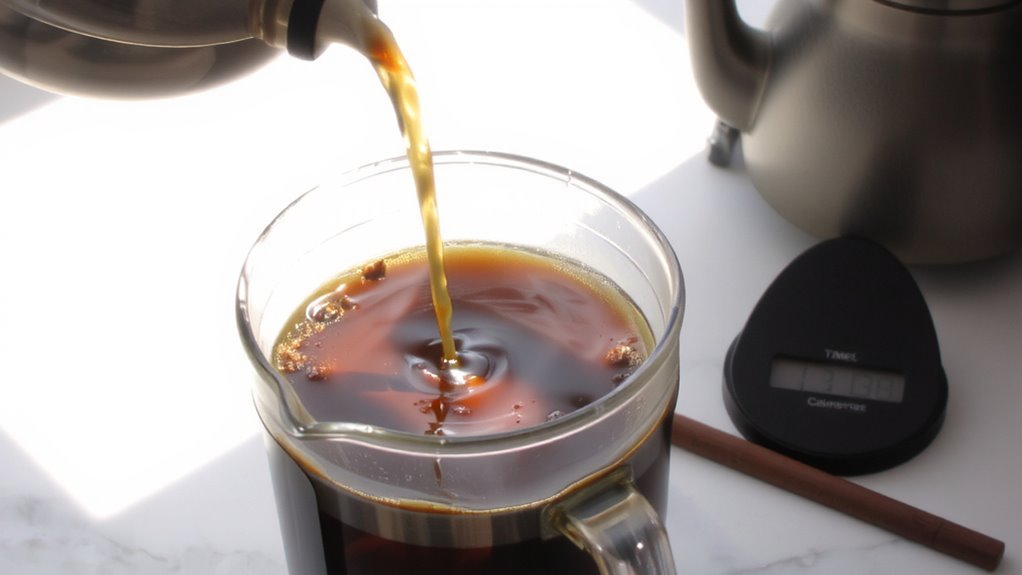
If you’re ending up with a bitter cup, your water might be too hot for the grind size and brew method you’re using. Try lowering the temperature by 5–10°F; for most pour-overs, 195–205°F works well. Too-hot water over-extracts tannins, especially with fine grinds. Water hardness matters-soft water can leach more tannins, while very hard water may mute flavors-aim for balanced mineral content. At higher brewing altitude, water boils cooler, so adjust your target temp upward if possible, or extend contact time slightly. A gooseneck kettle helps control pour rate, improving consistency. If bitterness persists, coarsen your grind before drastically changing temperature. For immersion methods like French press, steeping too long at high heat increases harshness. Use a thermometer or variable-temperature kettle for accuracy. Small tweaks in temp, combined with attention to grind and water quality, reduce bitterness without sacrificing clarity. A gooseneck kettle ensures precise pouring and even saturation, enhancing extraction control.
On a final note
You can reduce bitterness by controlling water temperature. Too hot-above 205°F-and you risk over-extracting tannins, especially in longer brews like French press. Aim for 195–202°F to balance extraction without pulling out harsh compounds. Light roasts often need the higher end, dark roasts the lower. With pour-over or drip, a gooseneck kettle helps maintain steady heat. Adjusting temp is a simple fix that beats changing grinds or brew time.