Optimizing Drip Coffee Maker Ratios for Consistent Daily Brewing
You’re more likely to get consistent, great-tasting coffee if you use a 1:16 coffee-to-water ratio by weight-about 62.5 grams per liter. Start there, then tweak: go weaker with 1:18 if it’s too strong, or stronger with 1:15 for light roasts. Always use a scale like the Hario V60 Timer or Escali Primo under $30-scoops aren’t accurate. Match your ratio to roast type and adjust grind accordingly. Get this right, and you’ll access better flavor every morning.
Notable Insights
- Start with a 1:16 coffee-to-water ratio for balanced drip brewing and adjust based on taste and roast level.
- Use a kitchen scale to measure coffee and water by weight for precise, repeatable results.
- Light roasts work best with stronger ratios like 1:15 or 1:16 to extract complex, acidic notes fully.
- Dark roasts need weaker ratios like 1:17 or 1:18 to avoid overextraction and bitter, ashy flavors.
- Always pair ratio adjustments with proper grind size to prevent under- or overextraction issues.
Why Coffee-to-Water Ratio Matters
While it might seem like just a matter of taste, getting the coffee-to-water ratio right actually has a direct impact on flavor, strength, and consistency in your drip brew. Too much coffee and your cup turns bitter; too little, and it’s weak or flat. The ratio affects extraction, which ties directly to brew time-too fast or too slow, and you’ll miss the sweet spot. Water quality matters just as much, since minerals or impurities can distort flavor and damage your machine over time. Hard water often leads to scale buildup, while overly soft water may under-extract. Use filtered water to strike a reliable balance. Together, proper ratio, clean water, and consistent brew time guarantee a stable, repeatable cup. You don’t need a scale every time, but starting with one helps build a reliable baseline. These factors work together-you can’t optimize one in isolation. For those using a best drip coffee maker, achieving this balance becomes even more effortless thanks to consistent brewing technology and temperature control.
Find Your Ideal Coffee-to-Water Ratio
You’ve seen how the coffee-to-water ratio shapes extraction, flavor, and machine performance-now it’s time to find the ratio that works best for your taste and equipment. Start with the Specialty Coffee Association’s standard: 55 grams of coffee per liter of water (1:18 ratio). This supports balanced flavor extraction and moderate brew strength. If your coffee tastes weak or sour, increase the dose to 1:16 (about 62.5 g/L)-it boosts strength and extraction by using more surface area. If it’s too bitter or over-extracted, try 1:19 or 1:20. Use a kitchen scale for accuracy-eyeballing leads to inconsistency. Consider your machine’s basket size and water dispersion; some models struggle with fine adjustments. A consistent grind size from a burr grinder also guarantees even extraction. Test one variable at a time. Small tweaks make big differences in daily brews. For reliable performance within this framework, consider models from our list of the best drip coffee makers under $200.
Match Ratio to Roast and Taste
Since lighter roasts hold onto more moisture and have denser structure, you’ll often need a slightly higher coffee-to-water ratio-like 1:15 or 1:16-to extract their full range of flavors without underdoing it. A light roast benefits from this extra strength because its bright, acidic notes and complex sugars need more contact time and density to come through clearly. If you go too weak, the cup can taste thin or grassy. With a dark roast, though, you’re dealing with more soluble material already broken down by longer roasting. That means a slightly lower ratio-closer to 1:14-can prevent bitterness and overwhelming char. You’ll get a smoother, balanced result without ashy or burnt notes dominating. Adjusting your ratio based on roast type helps match extraction to bean behavior. It’s a simple fix that makes a real difference in daily taste.
Use a Scale for Better Coffee
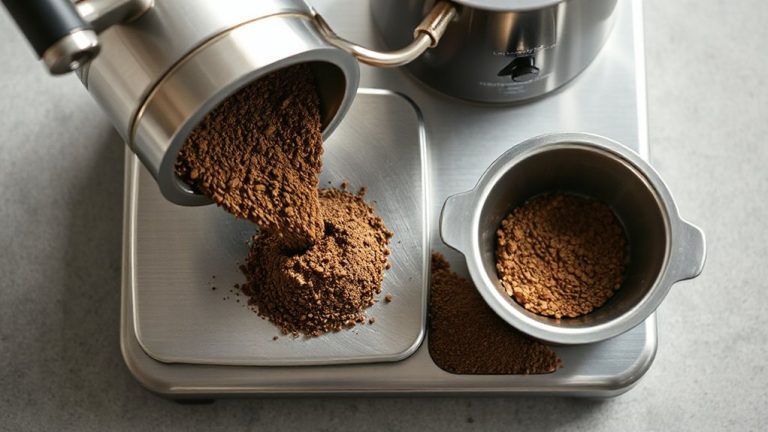
A kitchen scale is one of the most effective tools for making better drip coffee at home, and it’s not even close. Measuring coffee and water by weight-instead of scoops or cups-gives you precision that directly improves taste and consistency. Even small variations in volume can throw off your ratio, but a scale eliminates that guesswork. This accuracy supports better grind consistency, since you’re using the correct dose every time. It also helps preserve coffee freshness-by measuring precisely, you open bags less often and reduce exposure to air. A good digital scale, like the Hario V60 Timer or the Escali Primo, costs under $30 and pays for itself in better brews. Volume measures like tablespoons change with grind size and settling; weight doesn’t. If you want reliable results day to day, especially with different roasts, a scale isn’t optional-it’s essential. For 2024, consider one of the best scales for 2024 to ensure long-term durability and accuracy.
Fix Common Ratio Mistakes
Getting your coffee-to-water ratio right means more than just using a scale-it means avoiding the common errors that can ruin even the most carefully measured brew. If you use too much coffee, you’ll likely end up with overextracted coffee: bitter, harsh, and astringent due to extracting too many compounds. On the flip side, too little coffee leads to an underextracted brew-sour, weak, and flat, since not enough flavor made it into the cup. A standard 1:16 ratio (1 gram coffee to 16 grams water) works well for most drip machines. Avoid volume measurements like scoops-heaping or shallow scoops create inconsistencies. Always adjust based on taste: if it’s bitter, reduce coffee slightly; if sour, increase it. Fresh grind size also matters-too fine exacerbates overextraction, while too coarse worsens underextraction. Dial it in slowly.
On a final note
Getting your coffee-to-water ratio right means more consistent, better-tasting coffee every time. Use 1:15 to 1:17 (coffee to water) as a starting point, adjust based on roast and taste, and always weigh your beans with a scale. Scoops aren’t precise-scales are. Light roasts may need more coffee, dark roasts less. Small tweaks make a real difference. Stick to the numbers, and your brew improves without guesswork.