The Science Behind Pour Over Coffee: How Water Flow Rate Affects Flavor Extraction
Your pour over taste depends on flow rate-too fast and your coffee turns sour from under-extraction, too slow and it gets bitter from over-extraction. A steady, moderate pour with a gooseneck kettle gives you control, while a medium-fine grind guarantees even flow. Beans matter: high-density ones need a slower pour, older beans a quicker one. Devices like the Hario V60 or Kalita Wave manage flow differently. You’ll see how small tweaks improve each cup.
Notable Insights
- Water flow rate directly influences extraction: too fast causes sour, under-extracted coffee; too slow leads to bitter, over-extracted flavors.
- Controlled pouring minimizes turbulence, preventing channeling and ensuring even saturation for balanced flavor.
- High-density or fresh beans benefit from slightly slower pours to achieve full extraction without under-extracting.
- Older, low-density beans require faster pours to avoid over-extraction due to quicker water absorption.
- Gooseneck kettles and medium-fine grinds help maintain optimal flow rate and contact time for consistent results.
How Water Flow Affects Pour Over Coffee
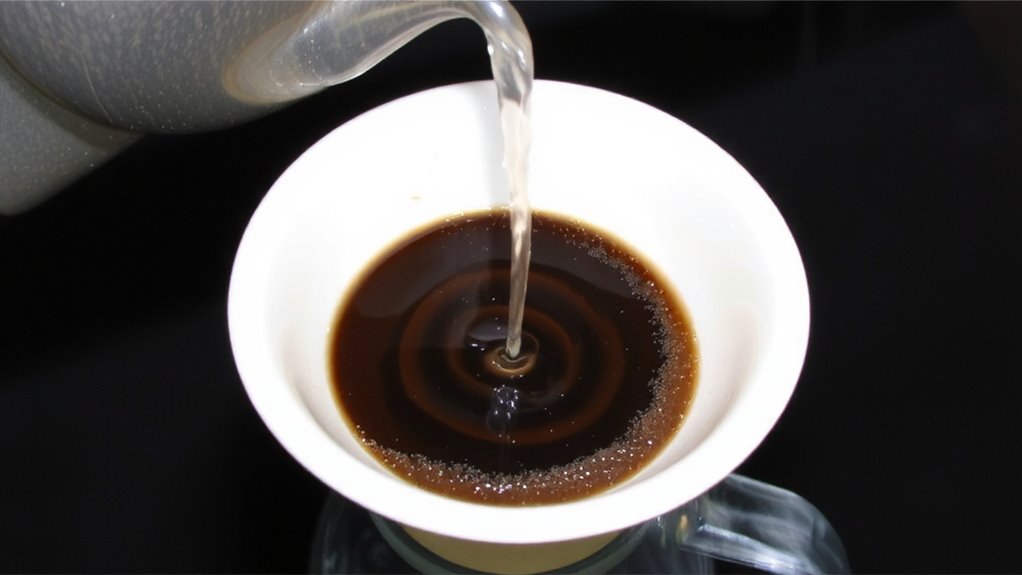
While you might not think it matters much, the way water flows through your coffee grounds during a pour over has a direct impact on flavor extraction. Water turbulence helps separate coffee particles, exposing fresh surfaces for even saturation. Too much turbulence, though, from aggressive pouring or a gooseneck kettle with poor control, can channel water unevenly, reducing effective contact time. On the other hand, gentle, steady pours create consistent flow, maximizing contact time without disrupting the bed. This balance guarantees sugars and acids extract properly without over-extracting bitter compounds. Pour-over cones like the Hario V60 rely on controlled spiral pouring to manage this, while the Kalita Wave’s flat bed reduces turbulence by design. You’ll get better results if you adjust your pour speed and technique to match your grind size and brewer. Consistency in flow means consistency in taste. A gooseneck kettle with precise temperature control and a well-designed spout enables smoother, more consistent pours, enhancing extraction-this is why many baristas recommend choosing the best gooseneck kettles for precision pouring.
Why Flow Rate Controls Sour and Bitter Flavors
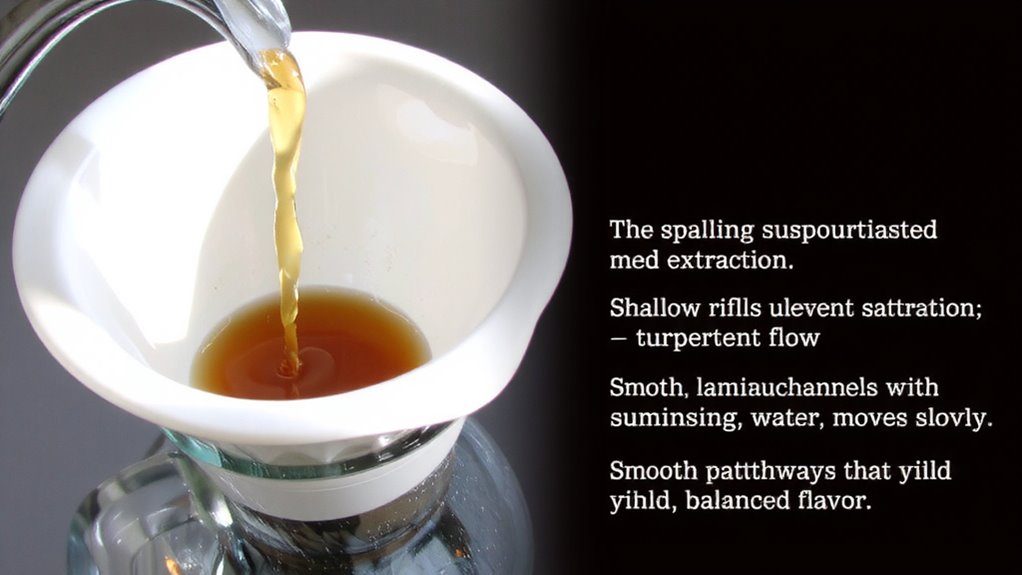
You can control how sour or bitter your pour over tastes just by adjusting how fast the water moves through the coffee. Too fast, and you’ll get sour, under-extracted flavors due to uneven saturation and the channeling effect. Too slow, and over-extraction brings out harsh bitterness. Turbulence intensity during pouring helps water interact evenly with grounds, but excessive speed ruins contact time. A balanced flow guarantees even extraction.
| Flow Rate | Risk of Sourness | Risk of Bitterness |
|---|---|---|
| Fast | High | Low |
| Moderate | Low | Low |
| Slow | Low | High |
Use a gooseneck kettle to maintain control. Avoid aggressive pours that increase turbulence intensity unnaturally. Consistency prevents channeling effect and delivers balanced flavor. Aim for even wetting and steady flow every time. The design of the best coffee drippers ensures optimal flow rate and extraction consistency.
Fast vs. Slow Flow: What Changes in Your Cup?
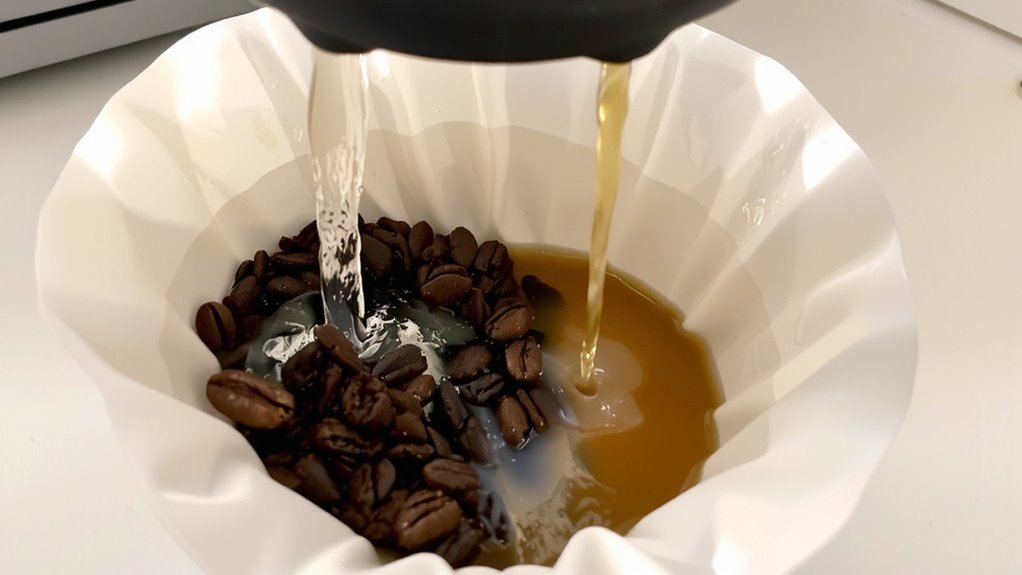
What happens when you pour too fast or too slow? If you rush the pour, water zips through the grounds too quickly, especially with dense beans or a fresh roast. That leads to weak, sour coffee because the water doesn’t have enough time to pull out the good stuff. On the flip side, pouring too slowly over older beans or low-density ones can cause over-extraction. You’ll taste bitter, flat notes since the water pulls out harsh compounds. Bean density matters-hard, high-altitude beans need a slightly slower flow to extract fully. Roast age plays a role too; older beans lose gas and absorb water faster, so a brisk pour might work better. Getting the flow right means matching your speed to these factors. Too fast or too slow changes your cup more than you think.
How to Adjust Flow Rate for Even Extraction
Since extraction depends on contact time between water and coffee, adjusting your pour speed helps balance flavor when brewing. If you pour too fast, water rushes through too quickly, shortening brew time and leaving under-extracted, weak coffee. Pouring too slow increases contact time, risking over-extraction and bitterness. You want consistent saturation control-wetting all grounds evenly early on-so they extract at the same rate. Start with a slow, steady spiral pour during the bloom, then maintain a controlled pace that keeps water level rising gradually. Aim for total brew times between 2:30 and 3:30 for a 15g dose. Adjust flow in real time: if water drains too fast, slow your pour; if it backs up, let it pull through. This fine-tunes extraction without changing grind or gear. For optimal results, use a medium-fine grind that balances flow rate and extraction efficiency.
Kettles, Grind, and Pour That Shape Flow Speed
A steady pour sets the stage, but the tools and choices you make determine how well that control holds. Your kettle material affects heat retention-stainless steel keeps water hotter longer than glass or plastic, giving more stable pours. A gooseneck spout offers precision, letting you manage flow speed with ease. Then there’s grind consistency: uneven particles extract at different rates, causing some parts to over-extract while others under-extract. A burr grinder delivers uniform size; blade grinders don’t. If your grind’s inconsistent, no amount of careful pouring fixes the imbalance. You need even particles so water flows uniformly through the bed. Pair a quality kettle with a stable grinder, and you control flow at the source. These tools aren’t flashy, but they shape speed before the first drop hits the filter.
A Step-by-Step Guide to Dialing In Flow Rate
While you can’t control every variable in pour over brewing, dialing in the flow rate is one you can master with practice and attention. Start by setting your grinder to a medium-fine setting-think table salt-and stick to a consistent water temperature around 200°F. This helps guarantee even extraction. Pour in slow, steady spirals, aiming for a total brew time of 2:30 to 3:30 minutes. If the brew time is too short, the coffee will taste weak; too long, and it risks bitterness. Adjust the grind: finer slows flow, coarser speeds it up. Use a gooseneck kettle for better control. Check each variable one at a time-don’t tweak water temperature and grind at once. Small changes make big differences. With notes and repetition, you’ll find your ideal flow rate.
On a final note
You control extraction by adjusting flow rate, and that directly shapes flavor. Too fast, and your coffee tastes sour; too slow, it risks bitterness. Use a gooseneck kettle for precision, pair it with the right grind-medium-fine for most pour overs-and pour steadily. Start with 2.5 minutes total brew time, then tweak. Faster pours need finer grinds; slower ones may need coarser. Small changes make clear differences.